
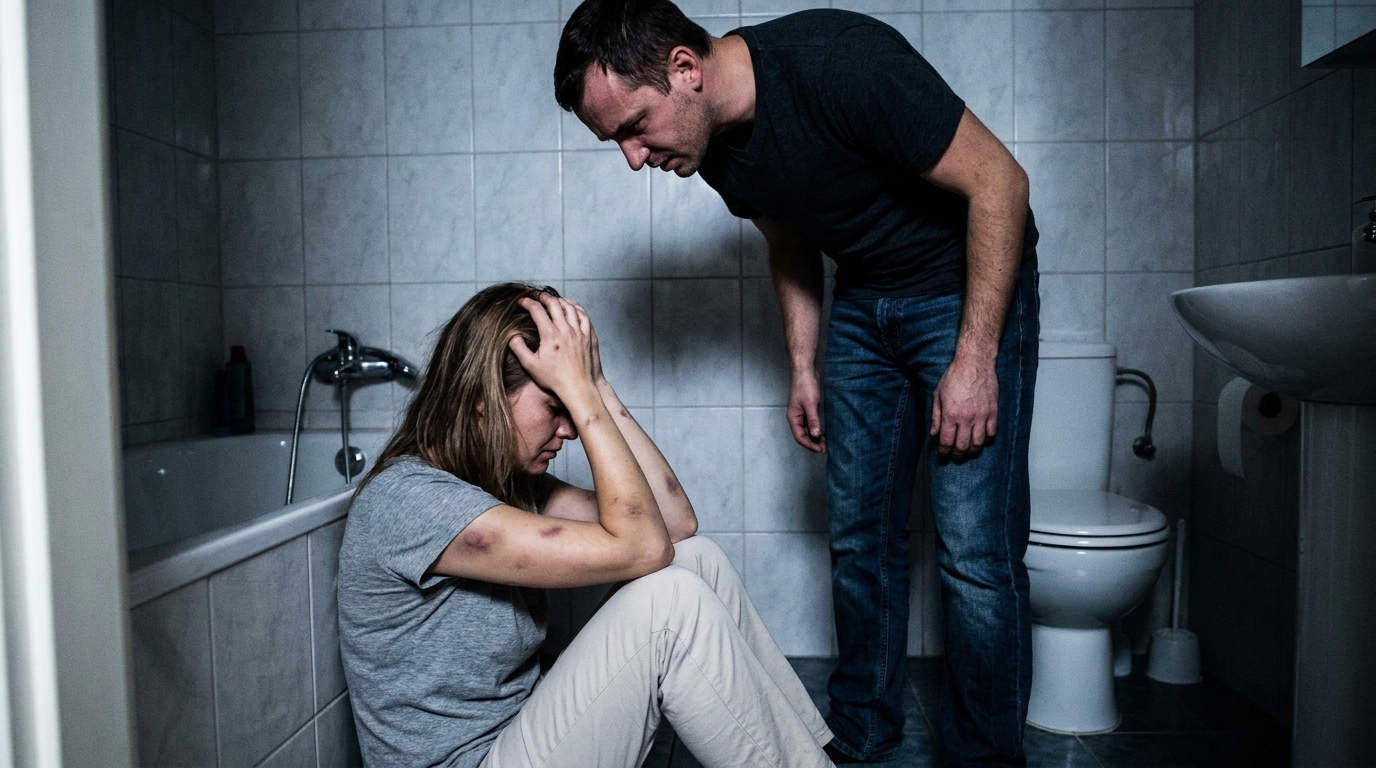
The first thing I noticed was my husband’s hand reaching through the narrow opening in the bathroom door. The second was how carefully he moved it. He was not pounding on the wood or shouting my name. His fingers curled around the edge as though he were simply trying to solve a household problem, something ordinary and mildly inconvenient. That calmness frightened me more than the shouting had.
I backed toward the bathtub with my newborn held against my bare chest. A towel was wrapped around him, tucked beneath his tiny body so it would not slip. My own towel had fallen somewhere near the sink. My feet were wet, my shoulder hurt whenever I moved it, and the smooth tile offered almost no grip. I kept one arm beneath my son and the other between him and the opening.
My phone lay on the counter beside the sink, connected to the emergency dispatcher. The baby monitor was on the floor near my knee. Its small indicator light glowed steadily. Outside the door, I could hear my mother-in-law breathing whenever the hallway became quiet. Neither of them seemed willing to leave.
Only a few hours earlier, I would have thought my husband’s quiet voice meant there was still a way to reason with him. I might have wondered whether I had misunderstood something. I might have blamed exhaustion, the sleepless nights, the strain of having a newborn in the house. I had become accustomed to questioning my own reactions whenever he insisted I was making too much of something.
But I had already heard the recording.
That was the difference now. The recording had taken the uncertainty out of what had happened. It had given me something I could hold onto when every other detail seemed to shift beneath me. His voice had been calm then, too. His mother’s voice had been calm. They had spoken as though they were arranging something they had already considered.
Before I locked myself inside the bathroom, I had been sitting on the toilet with my clothes only partly pulled up. I remember that detail because the ordinary embarrassment of the moment made what followed feel even more unreal. I had been reaching for the waistband when my husband seized my hair from behind.
There was no warning.
His hand tightened near the back of my head, and suddenly I was being pulled sideways. My shoulder struck the floor first. My hip followed. Then my cheek hit the tile hard enough that a bright flash crossed my vision. I tried to turn toward my son because he had started crying, but my husband forced me down before I could get my knees beneath me.
I remember his weight pressing me toward the floor. I remember the pain in my scalp. I remember trying to shield my face with one hand while stretching the other toward the doorway. My thoughts were not organized. They came in fragments: my baby, get up, breathe, get up, get him.
Then I heard my mother-in-law approaching the crib.
She did not ask whether I was hurt. She did not tell her son to stop. She lifted my crying baby while I was still struggling against the floor. The sight of her holding him made something inside me snap into focus. I stopped thinking about my own pain and fought harder to get free.
They had said they were going to teach me who controlled the family. At the time, the words seemed almost too ugly to belong to the people saying them. Even after everything that had happened, part of me wanted to believe they were only trying to frighten me.
Then my mother-in-law threw my son onto the mattress.
The movement was quick, careless, and completely unnecessary. My baby landed against the bedding and cried harder. I twisted free enough to get one knee underneath me. My husband’s grip loosened for a second, and I used it. I lunged toward the mattress, grabbed my son, and pulled him against my chest.
I did not stop to dress.
I ran for the bathroom.
The door slammed behind me, and my hand turned the lock before I had even fully caught my breath. I stood there with my back against the wood, my son crying into my shoulder, and listened for footsteps. My hands were shaking so badly that I could barely keep him secure.
The bathroom fan hummed above us. Water dripped from the edge of the sink. Somewhere outside, one of them moved across the hallway. Then everything went quiet.
That silence should have made me feel safer.
Instead, it made me listen harder.
I could hear my son’s uneven breathing. I could hear the faint electronic hiss from the baby monitor. I could hear my own breath catching in my throat. My cheek was already swelling, my lip had started bleeding, and a deep ache was spreading through my shoulder and thigh.
Then the monitor crackled.
At first I thought it was live sound from somewhere else in the house. I almost ignored it. But the voice that came through was unmistakable. It was my mother-in-law.
I froze.
The monitor was replaying something it had picked up earlier.
I leaned closer without realizing I was doing it. My son shifted against my chest, and I tightened my arm around him. The recording continued. My mother-in-law sounded calm, almost conversational.
“She’s exhausted. That’s the point.”
I stopped breathing for a moment.
Then my husband answered.
His voice was equally controlled.
“If she tries to leave with him, I’ll stop her at the front door.”
The words settled over me with a weight the bruises could not match.
Until that moment, I had been trying to understand the attack as something that had happened because tempers had exploded. I had been trying to find a shape for it that allowed me to believe it was an awful mistake rather than a deliberate decision.
The recording destroyed that explanation.
They had discussed my exhaustion.
They had considered what I might do.
They had talked about stopping me from leaving with my own child.
I looked down at my son. His tiny fist had caught the fabric near my collarbone. His fingers opened, closed, and opened again. His face was still damp with tears.
I realized they had been counting on my exhaustion.
They had expected me to be too tired to resist. They had expected me to become frightened enough to surrender my baby simply because surrender seemed easier than continuing to fight.
The thought made my stomach tighten.
For weeks, I had been running on broken pieces of sleep. I knew exactly how exhausted I was. They knew it too. They had seen me falling asleep sitting upright. They had watched me struggle to finish meals. They had heard the baby cry through the night.
Now I understood that my weakness had not merely been noticed.
It had been considered useful.
I reached for my phone.
My fingers slipped against the case. I tried again and managed to bring the emergency call screen up. When the dispatcher answered, I lowered my voice instinctively.
I told her I was locked in the bathroom with my newborn.
I told her my husband and mother-in-law were outside.
I told her my husband had physically hurt me and that my baby had been handled dangerously.
I did not waste time explaining every argument we had ever had. I did not try to prove that I was a good wife. I did not explain why I had been tired or why my mother-in-law and I had disagreed.
None of that mattered anymore.
The dispatcher asked me to stay on the line.
I said I would.
For several seconds, nobody outside the bathroom spoke.
Then came three soft knocks.
My husband’s voice followed.
“Open the door.”
I stared at the lock.
“No.”
There was a pause.
When he spoke again, his voice had become even gentler.
“Give Mom the baby, and we can calm down.”
I pulled my son tighter against me.
The recording hissed softly beside my knee.
And suddenly I understood that the quiet voice outside the door was not the opposite of the violence I had already experienced.
It was part of the same plan.
Click Here to continue read next: PART2: His Voice Became Gentle at the Door, but the Monitor Kept Replaying the Conversation They Thought I Would Never Hear
The Door Was Locked, but the Recording Had Already Told Me Why They Wanted It Open
Part 1 of 8

