
PART 7 — FINAL PART: THE FAMILY WE CHOSE TO PROTECT
Part Note: The ending resolves the legal and emotional conflict without forcing reconciliation. Emma decides what forgiveness and contact mean on her own terms, while Daniel rejects the old belief that preserving family unity matters more than protecting the people inside it.
Maya turned two on a Saturday.
We had twelve people in the backyard.
Not sixty.
Not the entire extended family.
Twelve.
Emma’s sister.
Two friends from college.
Our neighbors.
Dr. Patel stopped by for twenty minutes because Emma had somehow turned her into a family friend.
Paul came too.
That surprised people.
It shouldn’t have.
Of everyone at that dinner, Paul had done the hardest thing afterward.
He had not demanded forgiveness.
He had not defended himself.
He had not insisted his one weak protest made him innocent.
He simply stayed away until Emma invited him.
The invitation came eighteen months later.
Their first conversation lasted ten minutes.
He cried.
Emma didn’t.
He said, “I was scared of your mother-in-law.”
Emma answered, “So was I.”
That ended his excuses.
After that, he showed through behavior that he understood.
No pressure.
No gossip.
No passing messages.
He became someone Maya knew as Cousin Paul.
Aunt Denise eventually reentered our lives at a distance.
Rebecca did not.
Uncle Mark did not.
My grandmother died still believing the real tragedy was that younger generations had abandoned respect.
I attended the funeral.
Emma did not.
I defended neither choice.
Caleb and I remained estranged.
People often asked if that hurt.
Yes.
Of course it did.
He was my brother.
We had shared bunk beds.
Baseball cards.
A terrible first car.
We had once driven overnight to see our father before emergency surgery.
Love does not disappear just because trust does.
That was one of the hardest lessons.
I could miss who Caleb had been to me and still refuse to let him near Emma or Maya.
Both things were true.
My mother changed too.
At least according to people who still saw her.
Counseling continued.
She sold the house where the dinner happened.
Moved into a smaller place.
Stopped hosting family gatherings.
She never tried to bypass the restrictions again.
When the formal no-contact period ended, she did not appear at our door.
That mattered.
Two months later, another letter came.
This one to me.
I read it.
She said she finally understood why I had chosen Emma.
I wrote back one sentence.
I did not choose Emma over my family; Emma and Maya are my family.
I almost added more.
I didn’t.
That was enough.
Years passed.
Maya became a loud, curious child who asked questions at the worst possible times.
At four, she wanted to know why Grandma Ruth lived far away.
Emma and I had already agreed not to lie.
So we said:
“She hurt Mom and made unsafe choices, so we don’t see her right now.”
Maya accepted that.
Then asked for juice.
Children are often better with boundaries than adults.
At five, she asked again.
“Did Grandma say sorry?”
“Yes.”
“Then why can’t she come?”
Emma answered this time.
“Because sorry is important, but safety comes first.”
Maya considered that.
“So if I say sorry for hitting someone, they can still not want to play?”
“Exactly.”
“That’s not fair.”
Emma smiled sadly.
“Sometimes consequences feel unfair to the person who caused them.”
I heard my mother’s voice in the opposite of that lesson.
For generations, my family had confused forgiveness with restored access.
Apology with erasure.
Blood with entitlement.
We were not teaching Maya that.
On the third anniversary of the dinner, Emma surprised me.
“I want to see your mother.”
I put down my coffee.
“Why?”
“Because I think I’m ready.”
“You don’t owe her that.”
“I know.”
“Then why?”
Emma looked toward the backyard where Maya was chasing bubbles.
“Because I want to see if I can sit across from her without feeling small.”
I nodded.
“Where?”
“Somewhere public.”
They met at a quiet café.
I sat at another table.
Not close enough to hear.
Close enough that Emma could see me.
My mother arrived early.
She looked older.
Not dramatically.
Just human.
When Emma walked in, my mother stood.
She did not hug her.
Good.
They sat.
My mother spoke first.
Then Emma.
There were long silences.
At one point my mother cried.
Emma didn’t comfort her.
That mattered too.
After forty minutes, Emma stood.
My mother stood with her.
They said something.
Then Emma walked toward me.
“How was it?”
She exhaled.
“Fine.”
“Fine?”
“Actually fine.”
“Do you want to talk about it?”
“In the car.”
We drove home.
Halfway there she said, “She asked if I forgave her.”
“What did you say?”
“I said I’m not sure.”
“And?”
“She said that was fair.”
I looked at the road.
“That’s new.”
“Yeah.”
Emma rested her head against the seat.
“I don’t want her in our life yet.”
“Okay.”
“But maybe someday.”
“Okay.”
“You really mean that?”
“Of course.”
“She’s your mother.”
“And you decide who has access to you.”
Emma went quiet.
Then said, “That’s why I can even consider it.”
I understood.
Safety created choice.
Pressure destroyed it.
Three more years passed before my mother met Maya.
It happened in a park.
Public.
Short.
Planned.
Emma chose the date.
Maya knew exactly who she was meeting.
My mother brought no gifts.
That had been Emma’s request.
No buying affection.
No dramatic speeches.
No “Grandma has waited so long.”
She simply said, “Hi, Maya. I’m Ruth.”
Maya stared at her.
“You’re Dad’s mom.”
“Yes.”
“You hurt my mom.”
My mother’s face changed.
“Yes.”
“Why?”
There are questions adults can avoid.
Children rarely cooperate.
My mother looked at Emma.
Emma said nothing.
Ruth answered.
“Because I thought being older meant I had the right to control people. I was wrong.”
Maya nodded as if reviewing a homework answer.
“Okay.”
Then she asked if Ruth liked ducks.
My mother laughed.
“Yes.”
They walked toward the pond.
Emma stayed beside me.
“How are you?”
I asked.
“Watching.”
That was enough.
The relationship remained limited.
Always.
My mother never got a key.
Never babysat alone.
Never decided holidays.
Never had private access to Emma’s medical information or Maya’s school.
Some relatives called that cruel.
We stopped caring.
Trust was not a title.
It was a structure.
And after it collapsed, rebuilding required more than apologies.
Years later, on Maya’s tenth birthday, she asked why our dining table looked homemade.
Because by then the uneven table we built had become part of the house.
The warped corner.
The scratched finish.
The tiny burn mark from a candle.
Emma smiled.
“Your dad and I built it.”
“Why?”
I looked at Emma.
She answered.
“Because our old table had bad memories.”
Maya frowned.
“What happened?”
Emma and I had always agreed she would eventually know the truth in an age-appropriate way.
So we told her.
Not every detail.
Enough.
Grandma Ruth had hurt Mom.
Other relatives had watched.
Dad came home unexpectedly.
Doctors helped.
Police helped.
Mom and Dad made the house safe again.
Maya listened seriously.
Then touched the tabletop.
“So you made a new one.”
Emma nodded.
“Yes.”
Maya thought for a moment.
“That’s better.”
She ran outside.
I looked at Emma.
“That’s better.”
She laughed.
“She gets that from me.”
“Obviously.”
That evening, after the birthday guests left, Emma and I cleaned frosting off the uneven table.
I found a fish bone on one of the plates.
Someone had served grilled salmon.
For a second, my hand stopped.
Emma noticed.
Then she noticed the bone.
She picked it up.
Held it between two fingers.
Years earlier, that sight would have changed her face.
Now she looked annoyed.
“Who gave a ten-year-old fish without checking this?”
I laughed.
Emma dropped the bone into the trash.
That was all.
No trembling.
No silence.
No memory taking over the room.
Just a fish bone in a trash can.
I stood there staring.
“What?” she asked.
“Nothing.”
“You’re doing the face.”
“What face?”
“The emotional husband face.”
“I don’t have one.”
“You absolutely do.”
I walked over and kissed her forehead.
“You okay?”
She looked toward the trash.
Then back at me.
“Yes.”
And she was.
Not because the past vanished.
It never did.
But it no longer controlled the present.
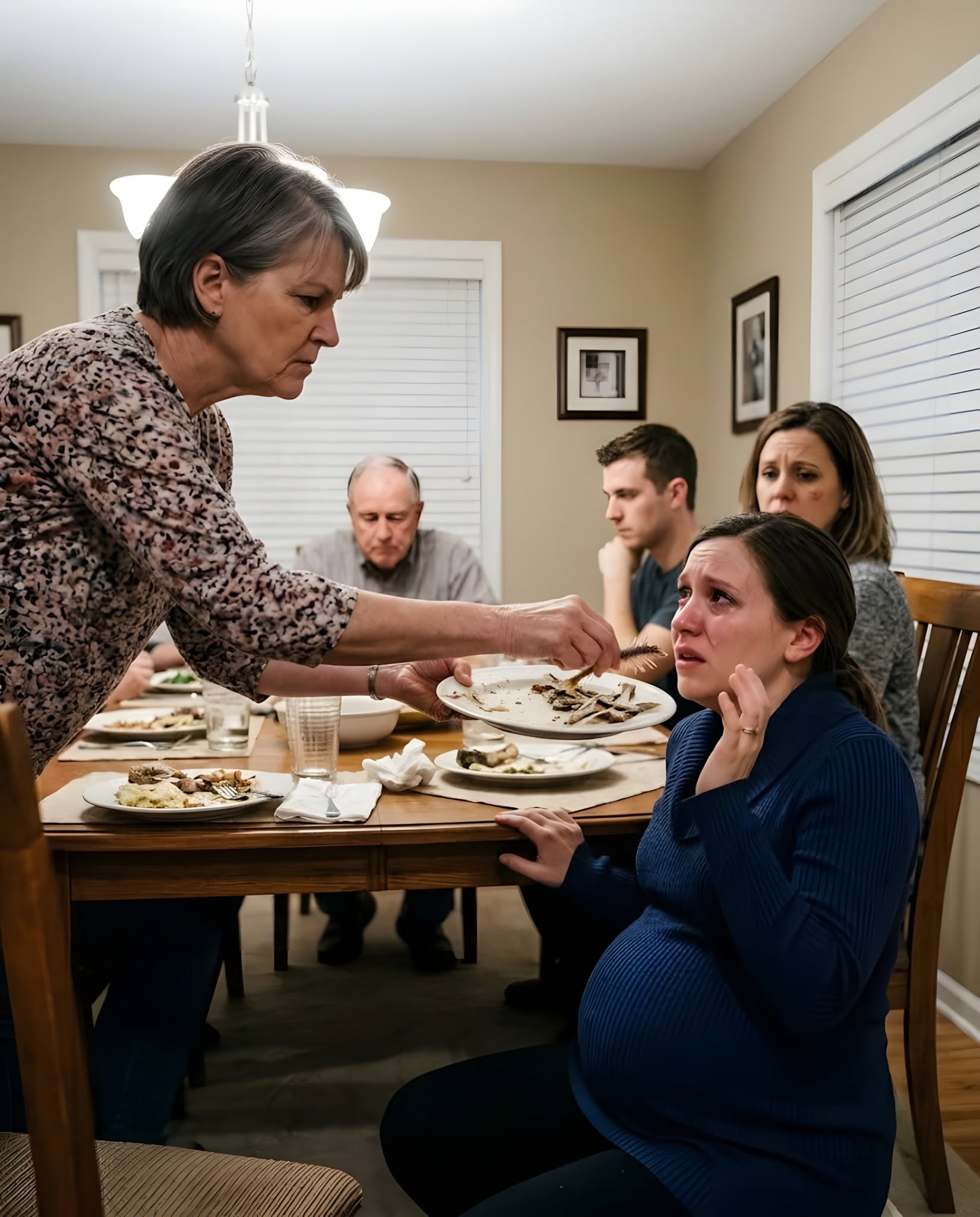
For years, I believed the worst thing I saw that night was my mother crouched beneath our dining table, holding sharp bones toward my pregnant wife.
I was wrong.
The worst part was how many people had convinced themselves it was normal enough to watch.
How many had chosen comfort over courage.
How many had treated family loyalty as permission to remain silent.
That was the lesson I carried forward.
Not that family is dangerous.
Not that people never change.
Some did.
Some didn’t.
The lesson was simpler.
Love without respect becomes possession.
Apology without accountability becomes manipulation.
And peace purchased with one person’s fear is not peace.
It is surrender.
I came home that night for a folder.
I left carrying my wife.
At the hospital, I learned she had been afraid in our own house for weeks.
I learned my mother had used a key I gave her as though access to our home meant ownership of our boundaries.
I learned my brother had helped.
I learned relatives could watch cruelty and still describe themselves as neutral.
Then I learned something else.
A family does not survive because everyone stays in the same room.
It survives when the people inside it are safe enough to tell the truth.
Emma told me the truth.
Eventually.
I believed her.
We changed the locks.
Saved the photographs.
Kept the video.
Set the boundaries.
Accepted the consequences.
And built something better.
One night, long after Maya went to bed, Emma and I sat at the table we made ourselves.
She rested her feet on the chair beside mine.
“Do you ever think about that folder?” she asked.
“All the time.”
“Do you even remember what was in it?”
I laughed.
“No.”
“Seriously?”
“I think it was an insurance contract.”
She shook her head.
“You went back for something you don’t even remember.”
“Apparently.”
“And found me.”
I looked at her.
“Yeah.”
She reached across our crooked wooden table.
Took my hand.
“I’m glad you came back.”
I squeezed her fingers.
“So am I.”
Outside, the house was quiet.
Every door was locked.
Not because Emma was afraid.
Because it was night, and people lock their doors at night.
Ordinary.
Simple.
Safe.
That was what we had fought for.
Not revenge.
Not a perfect family.
Not even forgiveness.
Just the right to live in our own home without fear.
The right to say no.
The right to leave a room.
The right to decide who came through our door.
The right to raise our daughter differently.
And the right to call that family.
END PART 7 — FINAL PART
FINAL NOTE: The story ends with no forced reconciliation and no magical erasure of trauma. Emma’s real victory is regaining control of her home, body, relationships, and choices. Daniel’s is understanding that loyalty means protecting his wife and child from harmful behavior—even when the person causing the harm is his own mother.


One Comment on “Six Relatives Watched My Mother Torment My Pregnant Wife—But the Doctor Uncovered Something Even Worse”