
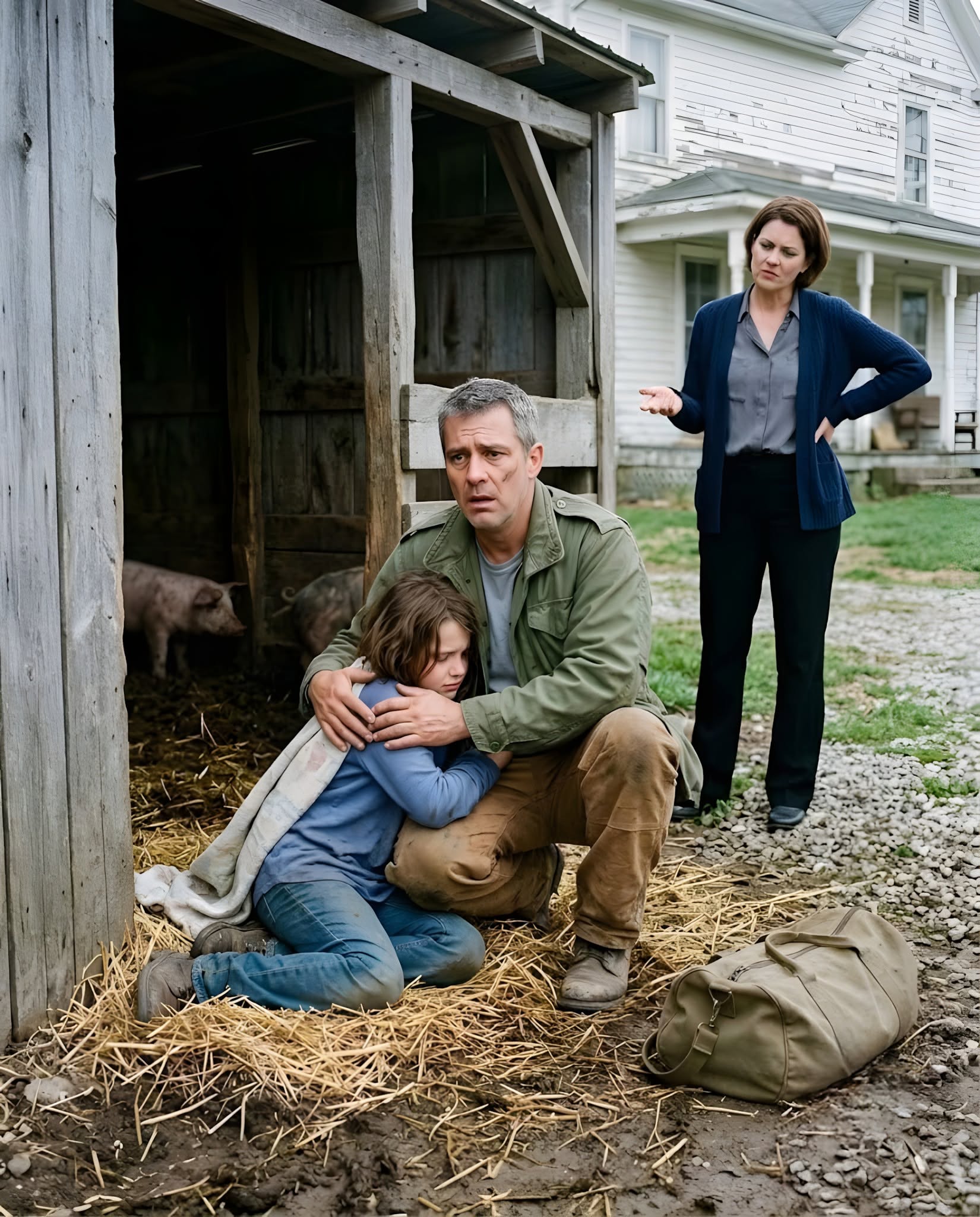
PART 7 — FINAL PART: WHAT I REALLY OWNED
Part Note: The ending resolves the property dispute, the stolen money, Sarah’s future, and most importantly Lily’s recovery. Elias learns that ownership of land means little compared with giving his daughter a secure home and a father who stays.
Six months later, Lily painted our kitchen yellow.
Technically, I painted it.
Lily painted herself, the floor, one cabinet handle and approximately four inches of the wall.
We bought a smaller house on the edge of town.
Three bedrooms.
An apple tree.
A crooked wooden fence.
No ballroom.
No swimming pool.
No pigsty.
Lily chose the bedroom facing east because sunlight reached it first.
For the first month, she slept with the lamp on.
During the second, she switched to a night-light.
By the fourth, she sometimes forgot to turn it on.
We found a good therapist.
We found a new school.
Dr. Bennett kept monitoring her health.
She gained weight.
Her wrist healed.
The cuts disappeared.
Some injuries took longer.
She still hid bread occasionally.
The first time I found two rolls beneath her pillow, I didn’t confront her.
I put a sealed container in her room.
The next morning I told her, “You can keep emergency snacks here.”
She stared at me.
“I’m not in trouble?”
“No.”
“I wasn’t stealing.”
“I know.”
“I was saving them.”
“I know that too.”
Gradually, the container stayed empty.
The legal case involving the diverted support money lasted longer.
Sarah’s attorney eventually advised her to settle.
Assets were sold.
Money was recovered.
Not all of it.
Enough.
Every recovered dollar went into a trust for Lily.
I didn’t need it.
That was another fact Sarah had never understood.
My army salary had never been the source of my security.
Years earlier, my father had transferred substantial agricultural and commercial holdings to me.
While Sarah focused on the manor, I quietly retained ownership interests in land stretching across the expanding edge of town.
Developers leased some.
Farmers worked other parcels.
A logistics company rented another.
I wasn’t the richest man in the country.
But I had never been the penniless failure Sarah imagined.
The irony was almost funny.
She had judged my worth by an old jacket while standing on land partly controlled by the man she was mocking.
I never corrected her because money had nothing to do with why I’d come home.
Lily did.
Thorne Manor sold eleven months after my return.
I refused offers from developers who wanted to turn it into luxury apartments.
Instead, a regional educational foundation purchased the main estate and converted much of the property into a residential learning center.
The farm buildings were demolished.
I attended that part.
Lily didn’t.
She didn’t need to.
When the old pigsty came down, I stood behind the safety barrier.
The excavator struck the roof.
Once.
Twice.
On the third impact, the structure collapsed.
Dust rose into the morning air.
I thought I would feel satisfaction.
Instead, I felt tired.
A building hadn’t hurt my daughter.
A person had.
Destroying wood couldn’t undo that.
So I went home.
Sarah moved two towns away.
For months, we had no contact.
Then a letter arrived.
It was addressed to Lily.
I didn’t open it.
I placed it on the kitchen table.
“Your aunt wrote you.”
Lily stared at the envelope.
“Do I have to read it?”
“No.”
“Do you want me to?”
“No.”
“What should I do?”
“Whatever makes you feel safest.”
She left it there for three days.
On the fourth, she opened it.
I didn’t ask what it said.
Later, she brought it to me.
“You can read it.”
Sarah hadn’t asked for forgiveness.
That surprised me.
She admitted what she’d done.
No excuses about discipline.
No complaints about me.
No claims that Lily had been difficult.
She wrote that she’d begun counseling and finally understood that resentment toward me had been directed at a child who had done nothing to deserve it.
At the end she wrote:
I hope one day I become someone you are not afraid to see.
Lily watched my face.
“Is she telling the truth?”
“I don’t know.”
“Do people change?”
“Sometimes.”
“Did she?”
“I don’t know yet.”
Lily folded the letter.
“I don’t want to see her.”
“Then you won’t.”
“Maybe when I’m bigger.”
“Maybe.”
“Will you be mad if I forgive her?”
That question hurt in a different way.
I knelt beside her.
“Never.”
“What if I don’t forgive her?”
“I won’t be mad about that either.”
She studied me.
“So I choose?”
“You choose.”
She nodded.
Then she ran outside because she’d spotted a butterfly.
Children can move between enormous questions and butterflies with astonishing ease.
I stayed in the yellow kitchen holding Sarah’s letter.
I didn’t forgive my sister that day.
Maybe part of me never completely would.
But I stopped building my life around anger toward her.
That was different.
A year after I came home, Lily and I visited my parents’ graves.
She placed daisies beside her grandmother’s stone.
Then she sat beside my father’s.
“Grandpa owned our old house?”
“Partly.”
“And you owned it too?”
“Yes.”
“Why didn’t Aunt Sarah know?”
“She knew some of it. She misunderstood the rest.”
Lily pulled grass between her fingers.
“Why didn’t you tell her?”
I considered the question.
“Because I never thought I needed to.”
“But when she said you were poor?”
“I didn’t care.”
Lily frowned.
“I would care.”
I smiled.
“You probably have more sense than I do.”
She leaned against me.
After a minute, she asked, “Daddy?”
“Yeah?”
“Are you going away again?”
That was the question beneath all her other questions.
I had already made my decision months earlier.
My active military career was over.
There were administrative matters, reserve obligations and paperwork, but the years of disappearing across oceans were finished.
“No.”
She looked up.
“Never?”
“I can’t promise I’ll never have to travel.”
Her expression changed.
“But I’m not leaving you behind again.”
“Promise?”
“Promise.”
She held out her little finger.
I hooked mine around it.
The most serious contract I’d ever signed required no lawyer.
That autumn, Lily entered the school talent show.
She didn’t sing.
Didn’t dance.
Didn’t play an instrument.
She displayed a model house she’d built from cardboard.
The walls were yellow.
There were blue curtains.
A tiny apple tree stood outside.
Her teacher had asked every child to write a sentence describing what “home” meant.
Most wrote about family dinners, pets or bedrooms.
Lily wrote:
Home is where nobody makes you earn the right to stay.
I had to walk into the hallway after reading it.
Not because I was ashamed to cry.
I simply didn’t want my tears to make her think she’d written something sad.
She hadn’t.
She’d written something true.
Two years passed.
Sarah continued writing occasionally.
Lily eventually answered one letter.
Then another.
Their relationship did not magically repair itself.
There was no tearful reunion on the manor steps.
No single apology erased what happened.
When Lily was eleven, she agreed to meet Sarah in a public park.
I sat twenty yards away.
Sarah arrived early.
She looked different.
Simpler.
Older.
Nervous.
When Lily approached, Sarah didn’t touch her.
She waited.
They talked for twenty minutes.
Then Lily came back to me.
“Ready?” I asked.
“Yes.”
We walked toward the car.
Behind us, Sarah remained on the bench.
She was crying.
Lily looked back once.
“Should I hug her?”
“Only if you want to.”
She thought about it.
Then she ran back.
Sarah stood in surprise.
Lily hugged her briefly.
Three seconds, perhaps four.
Then she returned.
I didn’t ask why.
It belonged to her.
Not me.
Years later, people in town still told the story incorrectly.
They said I returned from war and discovered my sister abusing my daughter.
They said I revealed I secretly owned half the town.
They said I destroyed Sarah financially with one signature.
They said I threw her out of Thorne Manor and watched her cry.
Some versions made me sound like a hero.
Others made me sound ruthless.
Neither version was right.
I had made mistakes too.
The largest was trusting promises more than evidence.
I should have found better ways to communicate with Lily.
I should have verified where the money went.
I should have questioned why her letters became shorter and eventually stopped.
Distance explained some of it.
War explained some.
Neither erased my responsibility.
I couldn’t rewrite those years.
I could only be present for the years ahead.
On Lily’s thirteenth birthday, we sat beneath the apple tree.
She was taller now.
Healthy.
Sharp-witted.
She wanted to become a veterinarian, though she insisted she would work with horses and dogs rather than pigs.
I didn’t blame her.
She handed me a small wrapped box.
“It’s your birthday,” I said.
“I know.”
“Traditionally, you’re supposed to receive presents.”
“Open it.”
Inside was my old satellite phone.
I stared at it.
I’d forgotten she knew where I kept it.
Attached to it was a handwritten note.
This is the phone Daddy used when he came back for me.
My throat tightened.
“Lily—”
“I know you couldn’t fix everything that day.”
She was looking toward the apple tree rather than at me.
“But you came.”
I put the phone down.
Then I hugged her.
For years I’d believed that my father’s land was the inheritance that mattered.
The deeds.
The leases.
The fields.
Thorne Manor.
All those boundaries drawn in ink across official maps.
I had been wrong.
The real inheritance was what we decided to pass forward.
Sarah had inherited a beautiful house and nearly destroyed herself trying to prove it made her important.
Lily had inherited pain she never deserved.
My responsibility was to make sure she didn’t have to carry it forever.
The old manor eventually became filled with children.
The rose garden survived.
My mother’s favorite oak survived.
The porch survived too.
Once a year, Lily and I attended the foundation’s open day.
The first time we went, she stood where Sarah had once mocked my faded uniform.
“You really owned all this?”
“Enough of it.”
“And Aunt Sarah really thought you were broke?”
“Completely.”
Lily laughed.
“That’s kind of funny.”
“A little.”
She pointed across the property.
“And all those fields?”
“Some of them.”
“How many?”
“Enough.”
She rolled her eyes.
“You never answer questions about money.”
“Good habit.”
We continued walking.
Near the place where the pigsty once stood was a children’s garden.
Sunflowers grew there now.
Bright yellow heads turned toward the afternoon light.
Lily stopped.
She knew exactly where we were.
I waited.
Finally, she reached for my hand.
“I don’t hate this place anymore.”
“No?”
She shook her head.
“It’s just a garden.”
That was when I understood we had finally won.
Not when Sarah surrendered the key.
Not when I signed the papers.
Not when Thorne Manor was sold.
Not when the stolen money was recovered.
This.
My daughter could stand on the ground where she’d once been treated as less than human and see flowers instead of a prison.
We walked back toward the porch.
At the gate, Lily ran ahead to talk to some children from the foundation.
I watched her disappear into the crowd.
Healthy.
Laughing.
Unashamed.
Free.
Ten years in the army had taught me how to defend ground.
Coming home taught me something harder.
Land isn’t valuable because your name appears on a deed.
A house isn’t a home because you possess its keys.
And power means very little if you only use it after the people you love have already been hurt.
Sarah once told me a poor, washed-up soldier had no right to speak.
I could have answered her that day.
I could have shown her the deeds.
The accounts.
The leases.
The signatures proving that the ground beneath her expensive heels wasn’t nearly as much hers as she believed.
But none of that would have changed what mattered.
So I let her walk away believing she’d humiliated me.
Then I picked up my daughter.
I called the people I trusted.
I documented the truth.
I signed the papers.
And seven days later, Sarah stood crying outside a house that was no longer hers.
I didn’t celebrate.
I simply took Lily’s hand and left.
Because in the end, I hadn’t come home to reclaim Thorne Manor.
I had come home to reclaim my daughter.
And this time, I stayed.
END PART 7 — FINAL PART
FINAL NOTE: Elias’s victory is deliberately not the eviction itself. The deeper resolution is Lily recovering her ability to choose, trust, sleep safely, accept kindness, and eventually decide for herself whether Sarah deserves any place in her future. The property twist delivers justice, but Lily’s recovery completes the story.


One Comment on “**My Sister Forced My Daughter to Sleep in a Pigsty—She Had No Idea the “Washed-Up Soldier” Owned Her Home**”