
PART 2: 👇👇🙏❤️
Here’s Part 2, continuing directly from the hospital and Grandma Augusta’s trust.
I said, “Send it.”
Miss Castellano was quiet for half a second.
Not because she had not heard me. Because she had.
For most of my adult life, people in my family had learned that silence was the easiest way to defeat me. Give me enough time after an insult and I would soften it for them. Leave me alone after a cruel remark and I would invent an explanation. Let a few hours pass and I would start wondering whether I had overreacted.
Miss Castellano knew that version of me.
Grandma Augusta had known her too.
“Are you certain?” she asked.
I looked through the glass panel beside Juny’s hospital room door. My daughter lay beneath a thin white blanket, her face drained of its usual color. A plastic line disappeared beneath the tape on her hand. Every few seconds, the monitor beside her bed made a small electronic sound.
Fourteen years old.
She had spent an entire day apologizing for appendicitis.
“Yes,” I said. “Send everything.”
“All right.”
“And Miss Castellano?”
“Yes?”
“I don’t want them warned first.”
Another pause.
“They won’t be.”
I ended the call and went back into Juny’s room.
She woke sometime after two in the morning.
Her eyes opened slowly, unfocused at first, and then found me in the chair beside her.
“Mom?”
“I’m here.”
Her fingers moved weakly over the blanket. I took her hand.
She swallowed.
“Did I ruin the trip?”
There are questions a mother never forgets.
That became one of mine.
I leaned forward until my forehead almost touched hers.
“No.”
“But Grandma Eleanor—”
“No.”
My voice came out sharper than I intended, and Juny blinked.
So I softened it.
“You did not ruin anything. You were sick. You needed surgery.”
She stared at me.
“Was it really my appendix?”
“Yes.”
“How bad?”
“The doctor said we got here in time.”
Her eyes filled.
Not because she was frightened.
Because somebody had finally confirmed that the pain had been real.
“I knew it hurt,” she whispered.
“I know.”
“They kept saying—”
“I know.”
She turned her face toward the pillow.
For several seconds, neither of us spoke.
Then she asked, “Did they come?”
I could have lied.
I had lied for my family before. Not enormous lies. The smaller kind that rot things slowly.
Grandma didn’t mean it that way.
Aunt Davina is just joking.
Grandpa has a hard time showing affection.
They love you in their own way.
Every one of those sentences had taught Juny to distrust what she could see with her own eyes.
So this time I told her the truth.
“No.”
Her fingers tightened around mine.
“Oh.”
“They went back to the house.”
Another silence.
Then Juny gave a tiny nod.
She was trying to make herself okay with it.
I recognized the gesture because I had been making it since childhood.
I squeezed her hand.
“You don’t have to pretend that doesn’t hurt.”
Her mouth trembled.
That was all it took.
She cried without making a sound.
I moved onto the edge of the bed and held her as carefully as I could around the surgical site. She pressed her face against my shoulder, and I felt something in me breaking apart—not my love for my family.
The excuses.
By sunrise, Miss Castellano had already started the process.
My relatives knew nothing.
That was the strange part.
Their vacation continued.
Davina posted a photograph of Holt standing on the dock holding a coffee mug. My father took the boat out with the grandchildren. My mother uploaded a picture of pancakes and berries on Grandma Augusta’s old blue dishes.
I stared at that photograph longer than I should have.
Those dishes had been in Augusta’s kitchen when I was a child.
I remembered sitting beside her while she rolled pie dough. I remembered flour on her hands and the way she never asked children questions she already knew the answers to.
Once, when I was twelve, she had found me crying behind the shed after my mother accused me of ruining Davina’s birthday because I had gotten carsick on the drive.
Augusta sat beside me without saying anything.
After a while, she asked, “Who taught you that being inconvenient is the same as being bad?”
I had never forgotten it.
I simply had not understood it until now.
Juny was discharged the following afternoon.
The surgeon wanted her resting, walking short distances, drinking plenty of fluids and returning immediately if she developed a fever or worsening pain.
I expected my mother to call eventually.
She did.
Not to ask about Juny.
To complain.
“You disappeared with the rental car.”
I stood outside the pharmacy while Juny waited inside with a nurse helping us arrange a wheelchair.
“She had emergency surgery, Mom.”
“I know. You sent that dramatic message.”
“Appendicitis isn’t dramatic.”
“You know what I mean.”
For the first time, I realized that I actually did.
In my mother’s language, “dramatic” meant anything that required attention she did not feel like giving.
“She could have died.”
“Oh, stop.”
Three words.
That was all.
Oh, stop.
Something about hearing them after watching my child being wheeled into an operating room erased the final obligation I felt to protect my mother’s feelings.
“We’re not coming back to the house tonight,” I said.
“Well, obviously. Everyone agrees Juny needs somewhere quiet to recover.”
Everyone agrees.
As though they had held a family meeting about the inconvenience of my daughter’s illness.
“We’re going home.”
There was a pause.
“What?”
“Juny and I are leaving.”
“You cannot make everything into a family crisis because your daughter had her appendix removed. Thousands of children have that surgery.”
I almost laughed.
Instead, I said, “Enjoy the lake.”
Then I hung up.
My hand shook afterward.
That surprised me.
I had imagined standing up to my mother would feel powerful.
It did not.
It felt terrifying.
But fear and regret, I discovered, were not the same thing.
We stayed one night at a hotel near the hospital because Juny was too sore for the long drive. I ordered soup and toast from room service. She ate three spoonfuls before falling asleep.
At 8:17 the following morning, according to the delivery confirmation Miss Castellano later forwarded to me, a courier drove up the gravel road to Augusta’s lake house.
My family was having breakfast.
I know exactly how the next part happened because Davina told practically everyone afterward.
My father was outside.
Holt was making coffee.
The kids were arguing over who got the last cinnamon roll.
My mother was sitting at the kitchen table wearing Augusta’s old linen robe.
The courier knocked.
Davina answered.
He asked for Eleanor.
My mother signed for a thick cream envelope.
According to Davina, she opened it while standing beside the kitchen island.
Then she stopped talking.
My sister thought she had received bad news.
In a way, she had.
“What is it?” Davina asked.
My mother read the first page twice.
Then she said my name.
Not affectionately.
The envelope contained formal notice from the trustee.
The property they had treated as their private family vacation home did not belong to my mother.
It did not belong to my father.
It did not belong to Davina.
It belonged to the Augusta Castellano Family Trust, and the sole beneficial interest in the lake property had been designated for Juniper—Juny—effective under the terms Augusta had established before her death.
Because Juny was a minor, the property was administered on her behalf.
And I was her legal guardian.
There was more.
Augusta had anticipated conflict.
Of course she had.
She knew her daughter.
The trust allowed family members temporary use of the property only with authorization from Juny’s guardian and only while such use remained consistent with Juny’s interests.
Authorization could be withdrawn.
Mine had just been withdrawn.
The letter gave them forty-eight hours to remove their personal belongings.
My phone rang nine minutes after delivery confirmation.
Mom.
I watched it vibrate.
Then stop.
Again.
Stop.
Again.
Twenty-three missed calls accumulated before lunch.
Davina sent seventeen messages.
The first was:
WHAT DID YOU DO?
The second:
CALL MOM NOW.
Then:
You cannot throw your own parents out.
Then:
Juny is FOURTEEN.
Then came the sentence that made me sit very still.
This house is for the FAMILY.
I showed it to Juny.
She was curled carefully on the hotel bed watching an old cooking show.
“Do you want to know what Grandma Augusta left you?” I asked.
Juny looked confused.
“What?”
“The lake house.”
She stared at me.
“No, she didn’t.”
“She did.”
“All of it?”
“Yes.”
Her face changed.
Not excitement.
Fear.
“Does Grandma Eleanor know?”
“She knows now.”
Juny looked down at her hands.
Then she said something that told me exactly how much damage I had allowed my family to do.
“Can we give it back?”
I sat beside her.
“Why?”
“So they won’t hate me.”
My throat tightened.
“Juny, look at me.”
She did.
“You do not buy love by giving people things that belong to you.”
“But Grandma’s going to say—”
“I know what Grandma will say.”
“She’ll blame me.”
“No.”
“She always does.”
“Then she can blame me.”
Juny studied my face.
I think she was waiting for the familiar qualification.
But she loves you.
But she’s family.
But try to understand.
I gave her none.
“Grandma Augusta made this decision,” I said. “Not you. You didn’t take anything from anybody.”
My phone started vibrating again.
This time it was Dad.
I answered.
He skipped hello.
“You need to fix this.”
“Fix what?”
“You know exactly what.”
“Grandma Augusta’s trust?”
“Don’t play games.”
“I’m not.”
“Your mother is beside herself.”
I looked at Juny.
“She seemed fine when her granddaughter was in emergency surgery.”
“That’s unfair.”
“Is it?”
“We didn’t understand how serious it was.”
“I told you.”
“We thought you were exaggerating.”
“Why?”
He had no immediate answer.
So I asked again.
“Why did all of you assume I was exaggerating when a fourteen-year-old collapsed?”
“Because Juny can be sensitive.”
There it was.
Not an apology.
A defense.
“She had appendicitis.”
“We know that now.”
“You knew she was sick before dinner.”
“We were on vacation.”
I closed my eyes.
My own father had somehow offered that sentence as an explanation.
“Dad, you have forty-eight hours.”
His voice changed.
“You wouldn’t.”
“The notice already went out.”
“That house has been in this family for decades.”
“And Augusta decided what happened to it.”
“She wasn’t thinking clearly.”
“She had an attorney and a trust.”
“Davina’s children have spent every summer there.”
“So has Juny.”
“This will destroy the family.”
“No.”
I surprised myself with how calm I sounded.
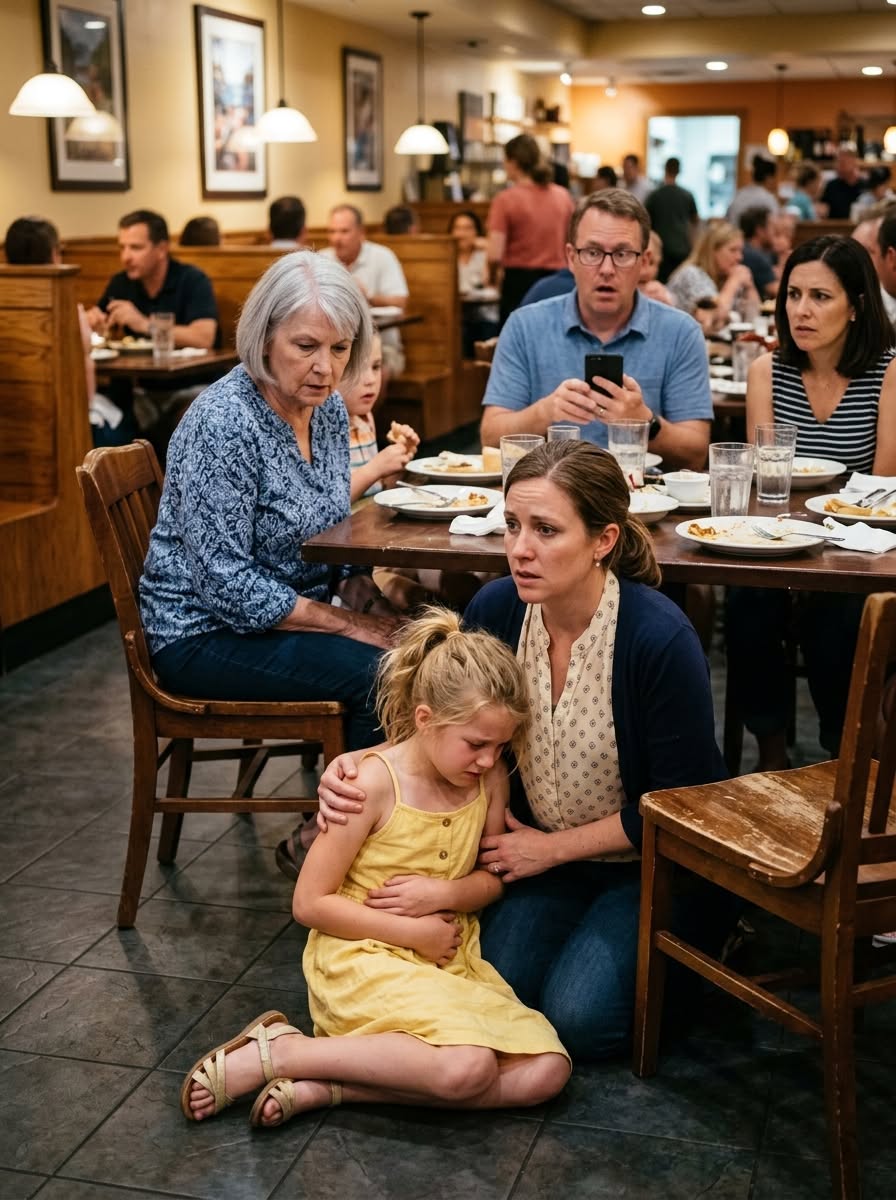
“Leaving my daughter on a restaurant floor while you mocked her did that.”
I ended the call.
For several minutes, Juny said nothing.
Then she whispered, “Mom?”
“Yes?”
“You hung up on Grandpa.”
“I did.”
A smile appeared.
Tiny.
Gone almost immediately.
But I saw it.
We drove home the next morning.
I expected the messages to stop eventually.
Instead, the family machinery started moving.
Cousins I had not spoken to in years suddenly texted me.
An uncle called to say my mother was “heartbroken.”
Davina posted a vague message online about greedy people exploiting elderly relatives.
Someone commented that inheritance revealed people’s true character.
I did not respond.
Miss Castellano had told me not to.
“People become very creative when property is involved,” she said. “Save everything.”
So I did.
Every message.
Every post.
Every voicemail.
Especially the one from my mother.
It arrived the evening before their deadline.
Her voice was controlled.
That was when she was most dangerous.
“You’ve made your point. We’re willing to forgive the hospital situation, and I think you should be mature enough to do the same. Tell the attorney this was a misunderstanding. Your father and I will continue maintaining the property, and naturally Juny can use it whenever she wants.”
I listened twice.
We’re willing to forgive.
Them.
Forgive us.
For my daughter’s emergency.
I forwarded the voicemail to Miss Castellano.
Her reply came a minute later.
Keep that.
At noon the following day, the caretaker Augusta had appointed years ago met my parents at the property.
They had packed.
Mostly.
My mother apparently argued over a set of antique lamps.
The lamps were listed as trust property.
She argued over Augusta’s quilts.
Trust property.
She tried to take the framed photograph hanging beside the fireplace—the one showing Augusta and Juny on the dock when Juny was nine.
Trust property.
The caretaker removed it from my mother’s hands.
At 12:46 p.m., the family drove away.
At 1:00, the locks were changed.
I thought that would be the end.
I was wrong.
Three days later, someone knocked on our front door.
Juny was asleep upstairs.
I opened it.
Davina stood on the porch.
No Holt.
No children.
No sunglasses.
She looked exhausted.
“You have five minutes,” I said.
She stared at me as though I had spoken in another language.
“You’re serious.”
“Four minutes fifty-five.”
“God, you’ve become unbearable.”
I started closing the door.
Her hand shot out.
“Wait.”
I stopped.
Davina looked toward the street.
Then back at me.
“Mom wants to challenge the trust.”
“I know.”
“She says Augusta wasn’t competent.”
“She was.”
“I know.”
That caught me.
Davina swallowed.
“There’s something else.”
“What?”
She lowered her voice.
“I found a box while we were packing.”
I waited.
“It was behind the false panel in Grandma’s writing desk.”
My pulse changed.
“What was in it?”
“Letters.”
“What letters?”
“Grandma’s.”
“To whom?”
Davina looked at me for a long moment.
“To Miss Castellano. To you.”
She paused.
“And one to Juny.”
I held out my hand.
Davina didn’t move.
“Where are they?”
“Mom has them.”
Of course she did.
“She found me reading them.”
“What do they say?”
Davina’s eyes shifted toward the upstairs window.
When she spoke again, there was no sarcasm in her voice.
“For starters, Grandma knew exactly how Mom treated Juny.”
I felt cold again.
“And?”
Davina rubbed her palms together.
“And the lake house isn’t the biggest thing Augusta left her.”
For a second, neither of us moved.
Then a floorboard creaked upstairs.
Juny was awake.
Davina looked toward the sound and whispered, “If Mom destroys those letters, you may never find out what Grandma was trying to protect Juny from.”
This time, when I looked at my sister, I understood something worse than the inheritance fight.
Grandma Augusta hadn’t simply left my daughter a house.
She had left evidence.
And my mother had gotten to it first.
I can continue with Part 3, beginning with the hidden letters and what Augusta knew about Eleanor.
Click Here to continuous Read Full Ending Story PART3 : 👉My fourteen-year-old daughter hit the restaurant floor while my family kept calling her a drama queen.


One Comment on “My fourteen-year-old daughter hit the restaurant floor while my family kept calling her a drama queen.”