
Three weeks after Mia returned to her apartment, a letter arrived.
It was not addressed to her.
It was addressed to Daniel.
The envelope had been forwarded from an old address connected to his family.
Daniel called her that evening.
“Are you busy?”
Mia smiled.
“That's never a good opening.”
He laughed quietly.
“Something arrived today.”
“What?”
“A letter.”
“From who?”
“My father's cousin.”
Mia became silent.
“What does he want?”
“I don't know yet.”
“Have you opened it?”
“No.”
“Why are you calling me?”
Daniel hesitated.
“Because it mentions something from before.”
Mia sat down.
“Before what?”
“Before you were born.”
The question immediately pulled her attention toward the past.
She had spent years learning to live without constantly investigating what had happened in Daniel's childhood. She knew enough to understand the pattern. She knew his father had been frightening. She knew there had been a warning. She knew Daniel had carried that history into adulthood.
But now there was another piece.
“What does it say?”
“I don't want to read it without asking you.”
Mia frowned.
“Why me?”
“Because some of the letter concerns the family. And I don't want to drag you into something you don't want.”
Mia appreciated that.
“Read it yourself first.”
“Are you sure?”
“Yes.”
The following day, Daniel called again.
His voice was different.
“What happened?”
“My father's cousin says my father tried to get help.”
Mia was quiet.
“Before you were born?”
“Yes.”
“What kind of help?”
“He went to someone in the family. He admitted he was afraid he would repeat what his own father had done.”
Mia looked out her window.
“Did he?”
“Eventually.”
“What happened to the help?”
Daniel sighed.
“Nobody took it seriously.”
Mia closed her eyes.
“That doesn't excuse anything.”
“No.”
“But it explains another part.”
“Yes.”
The information unsettled Mia.
She had always believed the old letter represented a final warning.
Now she understood that it had been part of a longer struggle.
Daniel's father had recognized something dangerous in himself.
He had apparently tried, in his own limited way, to stop it.
He had failed.
Daniel had recognized the same danger.
He had failed too.
But the difference was what came afterward.
Mia called her mother.
“Did you know Grandpa had tried to get help?”
Sarah answered honestly.
“No.”
“Dad told you?”
“Not until now.”
Mia told her what Daniel had said.
Sarah listened.
When Mia finished, Sarah remained quiet.
“What do you think?”
Sarah sighed.
“I think it is useful to understand.”
“Does it change anything?”
“No.”
Mia knew exactly what she meant.
The past could become clearer without becoming less serious.
A few days later, the family met at the house.
Daniel placed the letter on the table.
“I don't want this to become another object that controls the story.”
Mia looked at him.
“Then what do we do with it?”
“Read it once.”
Sarah opened the envelope.
The letter was several pages long.
It described Daniel's father's childhood.
It described the fear he had experienced.
It described his attempts to become different.
It also described moments when he failed.
There were no excuses.
Only a painful record of a man who understood the damage he had inherited but had never fully learned how to stop carrying it.
Ethan read silently.
When they finished, nobody spoke for a while.
Finally, Ethan said, “It sounds like everyone was scared.”
Daniel nodded.
“Yes.”
Mia looked at the letter.
“But someone always got hurt.”
“Yes.”
“That's the part that matters.”
Sarah nodded.
“It does.”
Daniel folded the pages.
“I don't want our children to inherit this.”
Mia looked at him.
“Then they won't.”
Daniel smiled sadly.
“I hope you're right.”
Mia shook her head.
“Hope isn't enough.”
Daniel smiled.
“You sound like your mother.”
Sarah laughed.
“That's not an insult.”
“No.”
Mia pointed toward the notebook.
“You have tools now.”
Daniel nodded.
“We do.”
That evening, they discussed what they wanted the family legacy to be.
Ethan suggested kindness.
Sarah said honesty.
Daniel said accountability.
Mia said boundaries.
They wrote the words on a piece of paper.
Then Ethan added another.
Listening.
Mia smiled.
“That one too.”
They placed the paper on the refrigerator.
It was not a family constitution.
It was a reminder.
The next month brought another difficult moment.
Daniel and Sarah had a serious disagreement about money.
Their voices became sharper.
Mia happened to be visiting.
She heard them from the hallway.
For a few seconds, the old fear rose automatically.
Her heart accelerated.
Her body became alert.
She almost went into the kitchen.
Then she stopped.
She listened.
Daniel said, “I need a minute.”
Sarah answered, “Okay.”
A door closed.
No crash.
No threat.
No one followed anyone.
Mia remained in the hallway.
After ten minutes, Daniel came back.
He and Sarah continued speaking.
Their voices were calmer.
Mia realized she was holding her breath.
She exhaled.
Sarah noticed.
“Are you okay?”
Mia nodded.
“I heard you arguing.”
“We were.”
“I got scared.”
Sarah's face softened.
“I'm sorry.”
“You didn't do anything wrong.”
“I know.”
Daniel stepped closer but stopped at a respectful distance.
“Do you want us to explain?”
Mia thought.
“Yes.”
Sarah explained the disagreement.
Daniel explained his side.
They disagreed.
But neither demanded that Mia choose.
When they finished, Mia smiled.
“That was strange.”
“What was?” Daniel asked.
“You argued and then solved it.”
Sarah laughed.
“We're practicing.”
Mia laughed too.
The next day, Daniel told his counselor about the incident.
“She heard us arguing and got scared.”
“How did you respond?”
“We explained.”
“Did you feel guilty?”
“Yes.”
“Did you make her responsible for comforting you?”
“No.”
The counselor smiled.
“That is progress.”
Daniel nodded.
“I know.”
The new family pattern was not that anger disappeared.
It was that anger became survivable.
That distinction became important to Mia.
She had spent years thinking safety meant no one would ever raise their voice.
Now she understood that safety meant knowing what happened next.
Someone could be frustrated.
Someone could disagree.
Someone could need space.
And none of those things automatically meant danger.
Later that year, Mia began working on a series of paintings about family memory.
She painted four kitchens.
The first was dark and crowded.
The second was empty.
The third contained a single open window.
The fourth showed four people eating breakfast.
She titled the collection “Rooms We Leave Behind.”
When Daniel saw it, he became quiet.
“You like it?”
“I love it.”
“Why?”
“Because it doesn't pretend.”
Mia nodded.
“That's what I wanted.”
The exhibition attracted attention.
People asked Mia what inspired the work.
She did not tell everyone the details.
Some stories belonged to her.
But when a close friend asked, she explained that the paintings were about how places can hold memories without owning the people who lived through them.
The friend understood.
Mia returned home that night.
Daniel was sitting in the kitchen.
“Your exhibition was beautiful.”
“Thanks.”
“I saw the final painting.”
“The breakfast one?”
“Yes.”
“What do you think?”
Daniel smiled.
“I think it looks peaceful.”
“It is.”
He nodded.
Then he looked at her.
“Thank you for allowing me to be part of it.”
Mia shook her head.
“You're not the whole painting.”
Daniel smiled.
“I know.”
“And neither am I.”
“I know.”
She sat beside him.
The letter from his father's cousin was still in the drawer.
They had decided not to destroy it.
Not because the family needed another relic.
Because they had learned that history could be acknowledged without becoming a command.
Mia looked toward the drawer.
“Maybe someday I'll write something too.”
“What?”
“About what we learned.”
Daniel smiled.
“Will you make me look bad?”
Mia laughed.
“I won't have to.”
He laughed.
For the first time, the old story could be discussed without swallowing the present.
The family had not escaped history.
They had learned how to place it where it belonged.
Behind them.
Visible.
Remembered.
But no longer in charge.
Click Here to continue read next: PART15: When Ethan Faced a Crisis of His Own, the Family Discovered Whether the Lessons They Had Learned Could Protect the Next Generation
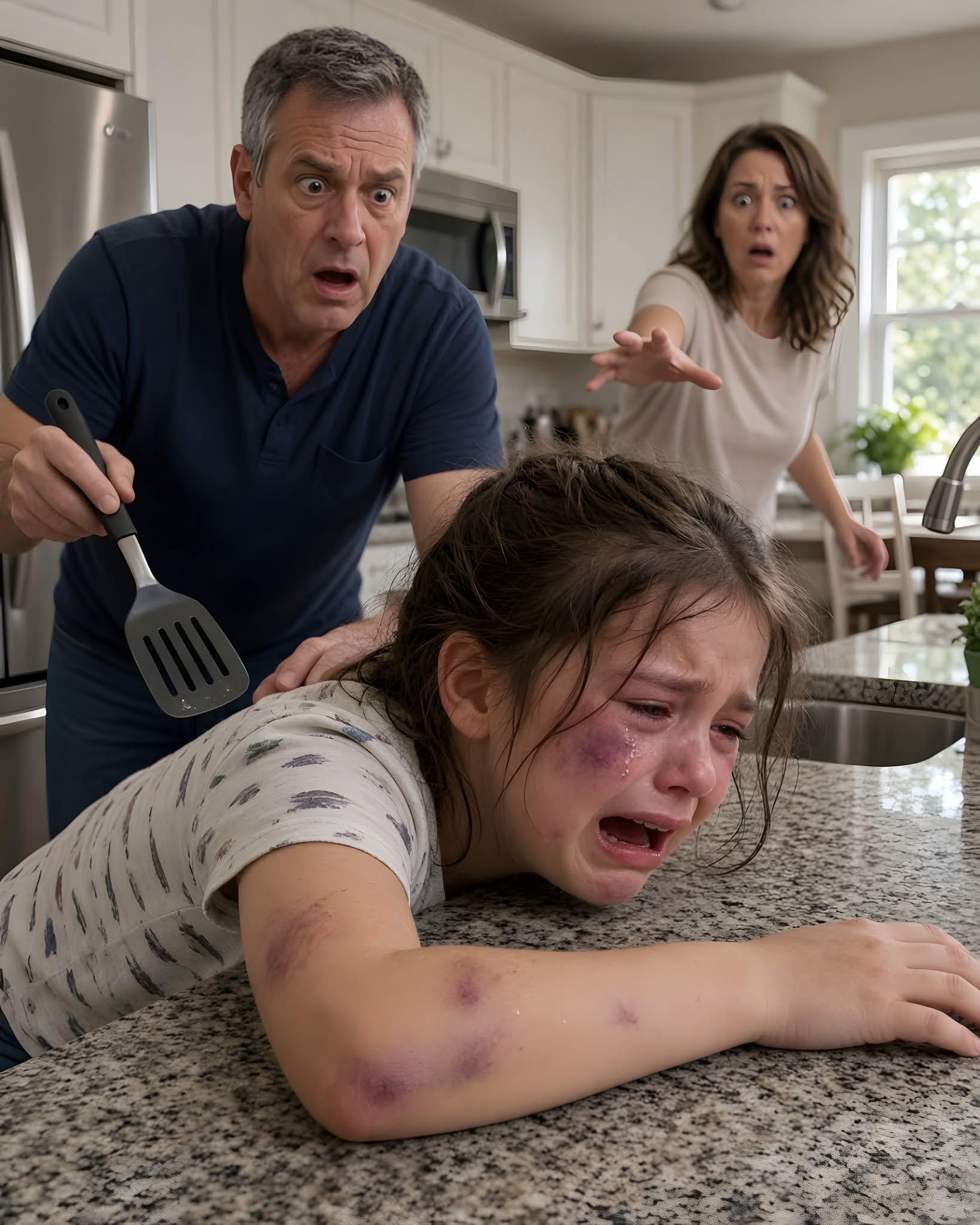
She Heard the Spatula Hit the Counter and Knew Something Had Changed Before Anyone Spoke
Part 14 of 16

