
Sarah placed the envelope on the dining table.
She did not open it immediately.
Mia stood several feet away.
“What does it say?”
“I don't know yet.”
“Are you scared?”
“Yes.”
Mia gave a small nod.
They had stopped pretending fear was something adults were supposed to hide.
Sarah opened the envelope.
Inside was a single handwritten letter.
She read the first lines silently.
Then she stopped.
Mia noticed.
“What?”
Sarah continued.
The letter had been written by Daniel's father when Daniel was twelve.
It described a boy who had become increasingly frightened of his father's temper. The handwriting was uneven, as though every sentence had been written after long hesitation.
Sarah read it twice.
Then she put it down.
“What does it say?”
Sarah looked at Mia.
“It says Dad was hurt when he was young.”
Mia's face changed.
“By his dad?”
“Yes.”
The information did not make the morning easier.
It made it more complicated.
Daniel's brother had told Sarah that their father had been an angry man. But Sarah had never understood how deeply that history had shaped Daniel.
She called Daniel.
He answered after one ring.
“Sarah?”
“Your brother brought me a letter.”
Silence.
“Did you read it?”
“Yes.”
“I didn't know it was still around.”
“You knew about it?”
“I remembered it.”
“What does it say?”
Daniel took a breath.
“It says I promised I would never become him.”
Sarah closed her eyes.
“You did become him.”
“I know.”
“That doesn't erase what happened to Mia.”
“I know.”
“Why didn't you tell me?”
“I was ashamed.”
Sarah's voice softened, but only slightly.
“Shame isn't the same thing as accountability.”
“I understand.”
“Do you?”
“I’m trying.”
That was the first time Sarah heard something different in his voice.
Not an excuse.
Not anger.
Fear.
But she still refused to confuse fear with change.
“Daniel, you need professional help.”
“I've already arranged it.”
“When?”
“Tomorrow.”
Sarah nodded.
“Good.”
He hesitated.
“Can I talk to Mia?”
Sarah looked at her daughter.
Mia shook her head.
“Not yet.”
“I understand.”
The call ended.
Mia sat down.
“Did he really get hurt too?”
“Yes.”
“Does that mean he can't help being angry?”
“No.”
Mia looked at her.
“Then why did he do it?”
Sarah thought carefully.
“Because something can explain a person's behavior without excusing it.”
Mia absorbed the words.
“I don't want to hate him.”
“You don't have to.”
“I don't want to forgive him either.”
“You don't have to do that today.”
Mia nodded.
That afternoon, Sarah and the children went to stay with her sister, Rachel.
Rachel opened the door before Sarah could knock twice.
She saw Mia's face.
Then she saw Sarah's expression.
She did not ask unnecessary questions.
She simply stepped aside.
“Come in.”
The house smelled like coffee and laundry detergent.
For the first time in days, Mia relaxed enough to sleep.
Ethan played quietly in the living room.
Sarah sat at the kitchen table with Rachel.
“I should have known,” Sarah said.
Rachel shook her head.
“You knew something was wrong.”
“I knew he was angry.”
“You didn't know this.”
“I saw bruises.”
Rachel was silent.
Sarah looked down.
“I kept believing the explanations.”
“Why?”
“Because the other possibility scared me.”
Rachel reached across the table.
“You can't change what you didn't understand then.”
Sarah looked at her.
“But I can change what I do now.”
“Yes.”
That was what Sarah needed to hear.
Not absolution.
A direction.
Meanwhile, Daniel sat in his brother's spare room.
He had attended his first counseling appointment.
The counselor had asked him a question he had avoided for years.
“What did you feel immediately before you hurt your daughter?”
Daniel had answered, “Anger.”
The counselor shook her head.
“Anger is what you did. What did you feel before it?”
Daniel had been silent.
Eventually he said, “Powerless.”
The word frightened him.
He had always thought of himself as a man who needed control.
When Mia questioned him, he felt challenged.
When she failed to obey immediately, he felt disrespected.
When his work became difficult, he carried that frustration home.
He had built a chain of excuses and called it discipline.
The counselor told him that understanding the chain would be necessary if he wanted to break it.
“Do you expect your family to trust you again?”
“No.”
“Do you want them to?”
“Yes.”
“Then you have to accept that wanting trust doesn't entitle you to receive it.”
Daniel looked down.
For the first time, he began writing things down.
Not promises.
Facts.
What he had done.
What he had said.
What Mia had tried to tell him.
What he had ignored.
At Rachel's house, Mia woke from a nightmare.
Sarah found her sitting upright.
“Dad was angry again.”
“It was a dream.”
“I know.”
Sarah sat beside her.
“Do you want the light on?”
Mia nodded.
Sarah left it on.
The next morning, a social worker visited.
They spoke privately with both children.
When Mia came out, she looked tired but relieved.
“What happened?”
“They listened.”
Sarah smiled.
“Good.”
Mia looked at her mother.
“They asked if I wanted to live with you.”
Sarah's expression changed.
“What did you say?”
“I said yes.”
Sarah pulled her close.
“I'll make sure you have that.”
Weeks passed slowly.
Daniel continued counseling.
Sarah began attending sessions with Mia.
Ethan started talking more.
The family learned new routines.
Doors stayed locked at night.
Nobody raised voices around the children.
When anger appeared, adults named it instead of disguising it.
The changes were small.
They did not repair everything.
But they gave the children something they had not had before.
Predictability.
One afternoon, Daniel sent Mia a letter.
Sarah gave it to her without opening it.
“You don't have to read it.”
Mia stared at the envelope.
“Did he write what he wants me to do?”
“I don't know.”
She opened it.
The letter was short.
Daniel did not ask forgiveness.
He did not say he had lost control.
He wrote that what happened was his responsibility.
He wrote that Mia had done nothing to cause it.
He wrote that she never needed to protect him from consequences.
And he wrote one sentence that made Mia stop.
You are allowed to be angry with me.
She read the letter twice.
Then she folded it.
“What do you think?”
Sarah asked.
“I think he finally understands one thing.”
“What?”
“That I'm not responsible for making him feel better.”
Sarah nodded.
“That is important.”
Mia placed the letter in a drawer.
She did not tear it up.
She did not keep it beside her bed.
She simply put it away.
Months later, there was a supervised meeting.
Daniel sat across from Mia in a quiet room.
His hands rested on his knees.
Mia looked smaller than he remembered.
Not because she had changed.
Because he had finally stopped looking at her through the lens of authority.
“I’m sorry,” he said.
Mia stared at him.
“I know.”
“I hurt you.”
“Yes.”
“I was wrong.”
“Yes.”
He swallowed.
“I want to earn back your trust.”
Mia looked at him for several seconds.
“You can't ask me when.”
“I won't.”
“And you can't get angry if I don't want to hug you.”
Daniel nodded.
“I won't.”
“And you can't say you did it because you were angry.”
“I won't.”
“Because Dad was angry too.”
Daniel's eyes filled.
Mia continued.
“You chose what you did.”
Daniel lowered his head.
“You're right.”
It was not a dramatic reconciliation.
There was no embrace.
No sudden forgiveness.
When the meeting ended, Mia walked out beside Sarah.
Daniel remained seated.
He watched the door close.
The counselor entered.
“How did that feel?”
“Painful.”
“Anything else?”
Daniel looked at the empty chair.
“Necessary.”
That night, Sarah found Mia drawing again.
“What are you making?”
“A kitchen.”
Sarah sat beside her.
Mia drew the counter.
The refrigerator.
The window.
The sink.
Then she erased something.
“What was there?”
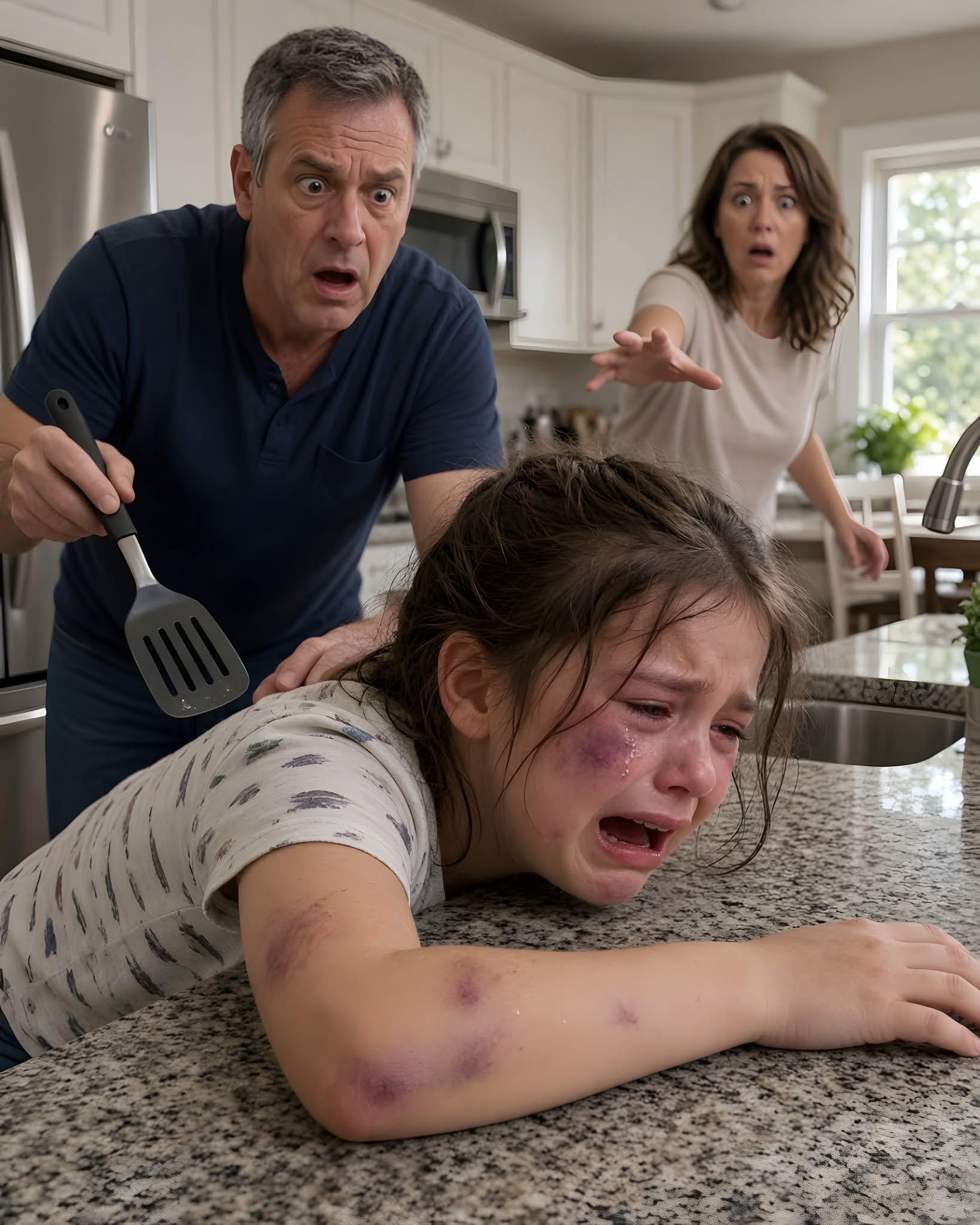
“The spatula.”
She drew the kitchen again.
This time, nobody was on the floor.
Nobody was shouting.
The room was ordinary.
Sarah watched her daughter work.
Then Mia stopped.
“Mom?”
“Yes?”
“Do you think someday I won't remember his hands when I see the kitchen?”
Sarah did not promise.
“I think the memory may change.”
“How?”
“It may become something that happened to you instead of something that controls you.”
Mia looked at the picture.
“I'd like that.”
That night, Sarah placed the old letter beside Daniel's first counseling record.
She understood now that the past had reached into the present.
But she also understood something more important.
History could explain a wound.
It could never give someone permission to pass that wound to a child.
And somewhere across town, Daniel sat alone with the same truth.
For years, he had believed the hardest thing would be admitting he had become like his father.
He was beginning to realize that admitting it was only the beginning.
The harder part would be proving, one ordinary decision at a time, that the pattern ended with him.
Click Here to continue read next: PART4: The Family Returned to the Kitchen Slowly, Carrying New Rules, Old Memories, and One Question Nobody Could Answer Yet
She Heard the Spatula Hit the Counter and Knew Something Had Changed Before Anyone Spoke
Part 3 of 16

