
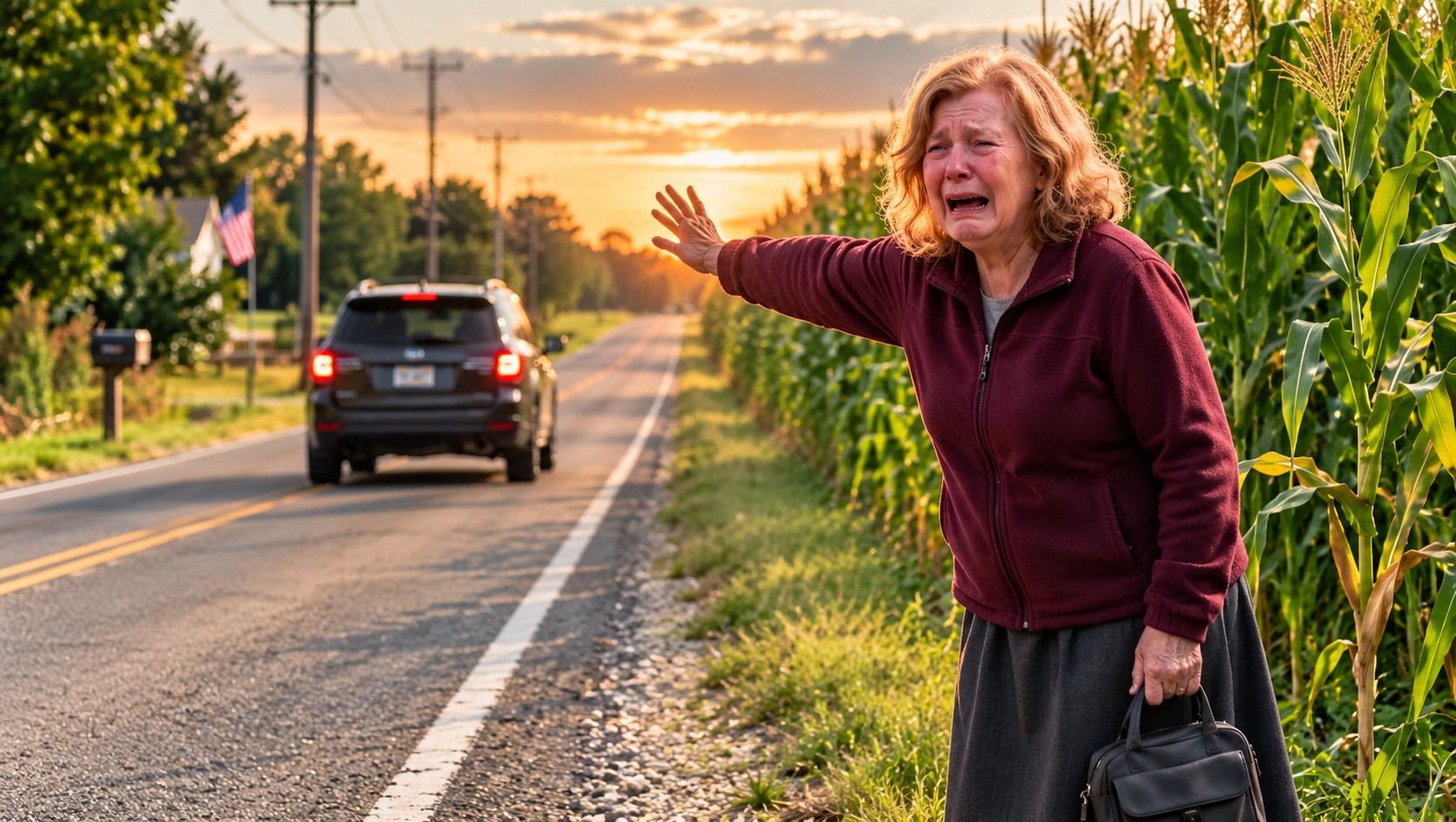
Vincent arrived before my coffee had gone cold.
I recognized the battered leather briefcase in his hand before I saw his face. He had carried that case for years, through meetings with Nicholas, tax appointments, insurance discussions, and the complicated paperwork that came with running a farm and a business.
He slid into the booth across from me.
For several seconds, neither of us spoke.
Then he placed the briefcase on the table.
“Tell me exactly what happened.”
I did.
This time, I left nothing out.
When I finished, Vincent asked about the document.
I described it as carefully as I could.
He listened with his hands folded.
“You're certain Nicholas didn't sign it?”
“I am certain it wasn't his handwriting.”
Vincent nodded.
“That matters.”
He opened the briefcase.
“More than your children realize.”
He removed several folders.
The first contained copies of documents I recognized.
The second did not.
He laid a deed on the table.
I stared at the name printed near the top.
Naomi Marie Blackwood.
My maiden name.
For a moment, the diner seemed to become strangely quiet.
“You remember this?”
“Yes.”
“When did you last see it?”
“Years ago.”
Vincent tapped the page.
“This is the original ownership record for the twenty acres.”
I looked at him.
“Nicholas and I built the farmhouse there.”
“I know.”
“We planted the orchard together.”
“I know that too.”
“But the original land purchase was yours.”
He let that sentence sit between us.
I had not thought about it in years.
Before Nicholas and I married, before the orchard had become a business, before our children were born, I had bought the land.
Nicholas helped build our life on it.
We planted the first rows together.
We worked through bad harvests.
We repaired irrigation lines.
We borrowed money when we needed equipment and paid it back.
We raised Brandon and Melissa there.
Over the years, the distinction between what belonged to me and what belonged to us had become almost meaningless.
But legally, Vincent explained, it mattered.
The land had never been transferred into Nicholas's sole ownership.
And Nicholas had never converted it into something our children could simply claim when he died.
Vincent placed another document beside the deed.
“Our operating agreement.”
I read the first page.
My name appeared there too.
“Surviving principal,” Vincent said.
I looked up.
“What does that mean?”
“It means the business does not automatically pass to Brandon or Melissa because Nicholas died.”
I leaned back.
Vincent watched me carefully.
“They have been acting as though the funeral was the opening bell of an auction.”
The words were blunt.
They were also accurate.
“What about the document they showed me?”
“We'll deal with that.”
He pulled out another folder.
“First, I want you to understand something. Your children may have convinced themselves that they were entitled to make decisions. That does not make those decisions legal.”
I thought of Brandon at the dining table.
Next steps.
Practical.
Manageable.
Words designed to sound harmless.
“What were they planning?”
Vincent looked at me.
“Did either of them mention a developer?”
I hesitated.
“Brandon talked about someone interested in the property.”
Vincent nodded.
“I suspected that.”
He told me that Melissa had already been communicating with a developer about the orchard.
The plan had been simple.
Get control of the property.
Convince me to leave.
Sell the land.
Use the money to solve their financial problems.
The simplicity of it hurt more than the complexity would have.
I had spent forty years thinking of my children as people who might disappoint me, argue with me, or make foolish decisions.
I had never imagined they could look at my home and calculate its value while I was still grieving their father.
Vincent opened the final folder.
Inside was a letter.
The handwriting stopped me.
Nicholas.
I knew every curve of it.
Every uneven line.
Every place where his pen pressed harder than necessary.
“When did he write this?”
“Six months before he died.”
I unfolded it.
The letter was short.
Nicholas had apparently understood that his health was worsening.
He had also understood something I had refused to see.
He had written that the children might come looking for a way to sell the orchard. He had specifically instructed Vincent not to allow his death to become a means of taking control from me.
The orchard was to remain with me.
I read the letter once.
Then again.
My eyes blurred.
Vincent waited.
I pressed the page flat with my palm.
“Nicholas knew.”
“Yes.”
“He knew they might do this.”
“I believe he was afraid they would.”
I looked out the window.
Cars passed on Route 30.
People were buying groceries, going to work, carrying on with ordinary lives.
Mine had split open three days after my husband's funeral.
“What do I do now?”
Vincent closed the folder.
“We move quickly.”
He contacted the developer that afternoon.
A formal notice went out.
The land was disputed.
I remained the legal owner.
The supposed authorization bearing Nicholas's questionable signature would be challenged.
No sale could proceed without me.
The first sign that the message had reached Brandon came that evening.
The farmhouse phone rang.
I was still at the diner.
Vincent answered it first.
Then he looked at me.
“It's Brandon.”
I took the receiver.
“Hello.”
There was silence.
Then his voice.
“Mom, what are you doing?”
The question almost made me laugh.
“What am I doing?”
“You know what I mean.”
“You left me on a road.”
“That isn't what happened.”
“It is exactly what happened.”
He exhaled.
“We were trying to make things easier.”
“For whom?”
He said nothing.
I waited.
Eventually, his polished tone returned.
“There are costs. Taxes. Repairs. The orchard can't just keep operating the way it always has.”
“You didn't mention any of that when you left me beside a road.”
“Because you weren't listening.”
“No, Brandon. I was listening very carefully.”
I heard another voice in the background.
Melissa.
He covered the phone, but not quickly enough.
“She knows.”
My son returned.
“Mom, we need to talk.”
“You should have thought of that before you drove away.”
“We can fix this.”
“You can't fix what you refuse to admit.”
His voice hardened.
“You don't understand the pressure we're under.”
“Then tell me.”
Silence.
Finally, Brandon said, “My condo is costing more than I can handle.”
I closed my eyes.
“And Melissa has debts.”
Another silence.
“So you needed my land.”
“We needed a solution.”
“You decided I was the solution.”
“No.”
“You decided my home was.”
He had no answer.
The call ended without either of us saying goodbye.
The next morning, Vincent brought me back to the farmhouse.
I sat in the passenger seat as we approached the property.
The orchard came into view.
Rows of trees stretched toward the farmhouse, their branches moving gently in the wind.
I had seen that view every day for decades.
But this time, I saw it differently.
Not as something that could simply be taken for granted.
Not as something my children could divide among themselves while I was still alive.
As mine.
Brandon and Melissa were waiting inside.
They looked smaller than they had before.
The confidence had gone.
Brandon stood beside the kitchen table.
Melissa sat with her hands clasped tightly.
Vincent placed the deed in front of them.
“This is the original title.”
Brandon stared.
“But Dad owned the property.”
“Not solely,” Vincent said.
“He ran the business.”
“Together with Naomi.”
Brandon looked at me.
“You knew about this?”
“I knew I had purchased the land.”
“But you never told us.”
I shook my head.
“I didn't think I needed to explain my own name to my children.”
Melissa began crying quietly.
Brandon remained rigid.
Then Vincent placed the operating agreement beside the deed.
“The orchard business is also not what you assumed it was.”
Brandon's face changed.
He finally understood.
The sale they had been preparing was not merely uncertain.
It was impossible without me.
Then Vincent placed Nicholas's letter on the table.
Neither child spoke.
Brandon read it.
His eyes stopped halfway down the page.
He read the sentence again.
Then he looked up.
“Dad wrote this?”
“Yes.”
His voice had lost its certainty.
Melissa covered her mouth.
I watched them both.
They had believed Nicholas's death opened a door.
Instead, he had left behind a lock.
And I was the person holding the key.
Click Here to continue read next: PART3: When My Children Finally Admitted Why They Needed the Orchard Sold, I Realized Their Desperation Had Never Included Me
My Son Said He Was Taking Me Somewhere Safe, But the Road Ahead Told Me Exactly What He Had Already Decided
Part 2 of 4

