
The first consequence did not come from the court.
It came from Michael's bank.
Helen learned this from Victoria, who arrived early the following morning with two attorneys and a file thick enough to barely close.
Michael's creditors had begun demanding repayment.
Several loans he had treated as manageable were suddenly due under provisions he had apparently never expected to be enforced.
Helen did not understand how Robert could possibly be connected.
Victoria explained.
“Your husband guaranteed certain obligations.”
Helen stared at her.
“For Michael?”
“For businesses and loans connected to him.”
“Why would Robert guarantee his debts?”
“Because he wanted to know exactly where the money went.”
Helen looked confused.
Victoria opened another document.
“The guarantees contained conditions. If Michael attempted to obtain control of your estate through deception or coercion, those guarantees could be withdrawn.”
Helen slowly understood.
Robert had not created a weapon out of anger.
He had created consequences that would remain dormant unless Michael crossed certain lines.
“He knew,” Helen whispered.
“He prepared.”
Within days Michael's financial world began to contract.
A lender refused to extend his credit.
A business partner backed away from a proposed investment.
Another creditor demanded immediate payment.
The expensive life Michael had built depended on borrowed money moving smoothly from one place to another.
Now the flow had stopped.
Helen did not celebrate.
She felt no pleasure imagining her son frightened.
But neither did she feel responsible for saving him.
For the first time, she could distinguish compassion from surrender.
The guardianship hearing was scheduled for the following week.
Michael's attorney argued that Helen's physical limitations made her vulnerable.
Victoria responded with medical evaluations, financial records, property documents, and evidence showing that Helen understood her affairs clearly.
Then came the documents Robert had prepared.
They showed that Helen had access to professional financial management, legal counsel, medical support, and substantial resources.
The claim that she was helpless became increasingly difficult to defend.
Helen spoke for herself.
“I use a wheelchair,” she told the judge. “That does not mean I don't know what I own, who I trust, or what I want.”
Michael sat across the room.
He looked exhausted.
Helen almost felt sorry for him.
Almost.
Then the judge asked Michael why he believed he should become his mother's guardian.
Michael hesitated.
“My mother needs someone close to her.”
Helen watched him.
Not once did he say, “I love her.”
Not once did he say, “I want her safe.”
He spoke about management.
Property.
Bills.
Responsibility.
Words that sounded respectable until you listened carefully.
The petition was denied.
Victoria later told Helen that it was only the beginning.
Michael's financial problems were becoming impossible to hide.
Ashley began calling Helen directly.
At first she was apologetic.
Then frightened.
Then pleading.
Helen did not answer.
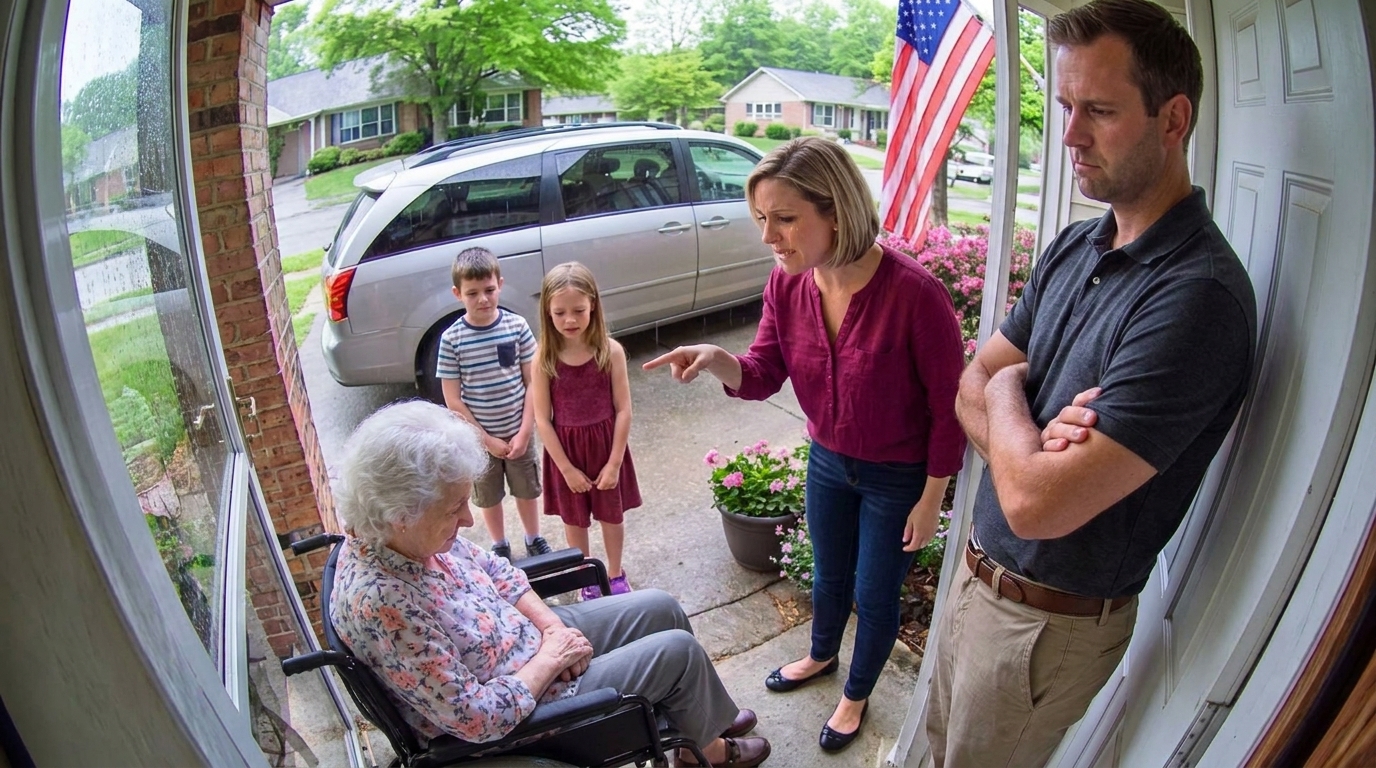
Three days later, Michael appeared at her house.
He stood outside the door with his shoulders slumped.
Ashley was beside him.
Helen opened the door but did not invite them inside immediately.
Michael looked older than he had two weeks earlier.
“Mom.”
Helen waited.
“We made a mistake.”
Ashley nodded quickly.
“We didn't understand what was happening.”
Helen looked from one to the other.
“You understood enough to file for guardianship.”
Michael flinched.
“That wasn't supposed to hurt you.”
“What was it supposed to do?”
He had no answer.
Finally he said, “I was scared.”
“Of what?”
“My debts.”
There it was.
The truth without decoration.
Helen opened the door.
“Come in.”
They sat in the living room.
Michael kept his hands clasped between his knees.
Ashley stared at the floor.
“We're in serious trouble,” Michael said.
Helen said nothing.
“I owe people money. The bank won't work with me. The business is collapsing.”
Helen looked at him.
“And you came here because?”
Michael's voice became smaller.
“Because you're my mother.”
Helen felt something inside her settle.
She had spent years wondering whether she mattered to him.
Now she knew the answer was more complicated than yes or no.
She mattered when he needed something.
That was not the same thing.
“Can you help us?” he asked.
Helen did not answer.
Instead, she reached toward the folder Victoria had left on the side table.
She opened it.
Inside was the statement from Robert's account.
She handed it to Michael.
He looked down.
His eyes moved across the page.
Then stopped.
$47,362,891.42
For several seconds he did not breathe.
Ashley leaned closer.
“What is that?”
Michael looked up at his mother.
“You knew?”
Helen shook her head.
“I didn't know until after you shut the door.”
His face lost what little color remained.
“All this time?”
“I didn't know.”
“You inherited it?”
“Yes.”
Michael looked at the document again.
The silence became unbearable.
“Why didn't Dad tell me?”
Helen thought of Robert's letter.
She thought of the warnings.
She thought of the old Honda and the clipped coupons and all the evenings she had believed they were simply getting by.
Then she looked at her son.
“Maybe he wanted to see what you would do when you thought there was nothing to gain.”
Michael's eyes filled.
“Mom, I was wrong.”
“I know.”
“I can fix it.”
“You can't fix what already happened.”
“I can change.”
Helen believed people could change.
But she also believed change had to exist before desperation demanded it.
Michael leaned forward.
“Please. Just help us get through this.”
Helen closed the folder.
“I will help you in one way.”
His expression lifted.
“I'll make sure you know where you can receive legitimate financial counseling and legal advice.”
He stared.
“That's it?”
“That is what I can offer without betraying myself.”
Michael's shoulders fell.
Ashley began crying quietly.
Helen did not shout.
She did not insult them.
She simply refused.
After they left, Helen sat beside the window until the streetlights came on.
Victoria arrived later that evening.
“You did what Robert hoped you would do,” she said.
Helen looked at her.
“He wanted me to reject my son?”
“No.”
“Then what?”
Victoria sat beside her.
“He wanted you to have the freedom to decide without fear.”
Helen looked at Robert's photograph.
That was the part she finally understood.
The money was not the real gift.
The companies were not the real gift.
Even the legal protections were not the real gift.
Robert had spent years building something that would outlast him: a life in which Helen could choose kindness without being forced into sacrifice.
In the months that followed, Helen took control of the Carter Foundation.
She visited the medical clinics Robert had quietly supported. She met families who could not afford treatment. She learned about the restaurants carrying her name and discovered that Robert had required them to provide meals to local shelters.
For the first time, Helen saw the shape of the life her husband had built while she thought he was simply balancing household bills.
She expanded the foundation's work.
She funded accessible housing.
She supported rehabilitation programs for people recovering from serious injuries.
She helped widows who suddenly found themselves alone.
And she kept one photograph of Robert on her desk.
Michael did not disappear completely.
Months later, he sent a letter.
There was no request for money.
No mention of debt.
No legal language.
Just an apology.
Helen read it several times.
She did not immediately answer.
Forgiveness, she realized, did not require reopening every door.
Some doors could remain closed without hatred.
She eventually wrote back.
Not as the frightened woman who had waited outside his house in a wheelchair.
Not as the widow who had believed she was nearly helpless.
As Helen.
His mother.
A woman who had finally learned that being loved did not mean being available for exploitation.
When she finished the letter, she placed it beside Robert's photograph.
Outside, evening settled over the garden.
The house was quiet.
For once, the quiet did not feel empty.
It felt like peace.
Click Here to continue read next: PART5: Helen Began Rebuilding Robert’s Quiet Legacy, Until One Unanswered Question Sent Her Back Into His Old Office
When the Door Closed, Helen Realized Her Son Had Become Someone She Could No Longer Reach
Part 4 of 8

