
The responder read the message again.
The father watched their face.
“Who did you call?” he asked his girlfriend.
She didn't answer.
“Who?”
“I didn't call anyone.”
“You just said you did.”
“I said I sent a message.”
“To whom?”
She looked toward Grandma.
“I asked my sister to come.”
The father took a step forward.
The responder immediately raised a hand.
“Stay where you are.”
He stopped.
“When did you send it?” the responder asked.
She gave the time.
The responder compared it with the activity on the phone.
The witness watched the father realize that the timeline was becoming clearer without him.
His girlfriend had been planning to leave before the argument escalated.
Grandma had entered the room afterward.
The baby had been involved.
The jar had come later.
And the father had known enough about what he had done to ask whether anyone had seen him.
“Why didn't you tell us about this before?” the responder asked her.
“Because I was scared.”
“Of him?”
She looked at the father.
“Yes.”
The father shut his eyes.
The answer seemed to hurt him, but he did not challenge it.
Grandma did not look at him either.
She looked at the baby.
The responder asked, “Did you tell your sister what was happening?”
“Yes.”
“What did you say?”
“That I needed help.”
“Did you tell her why?”
“I said we were arguing.”
“Did you mention the baby?”
She nodded.
“I said I was afraid he would take him.”
The father whispered, “I wasn't going to take him.”
“You tried.”
“I wanted to hold him.”
“You were angry.”
“Yes.”
“You wouldn't let me leave.”
He had no answer.
Grandma finally looked at him.
“That is the part you keep trying to make smaller.”
He stared at her.
“What part?”
“The part where you decided your fear mattered more than everyone else's.”
He sat down.
The chair creaked beneath him.
For the first time since the responders arrived, he looked exhausted rather than defensive.
“I thought if she left, I would lose everything.”
His girlfriend answered quietly.
“You were already losing it.”
He looked at her.
“Because I was angry?”
“Because you wouldn't listen.”
The responder asked, “Were there previous arguments about the baby?”
The father hesitated.
“Yes.”
“How many?”
“I don't know.”
“Recently?”
“Yes.”
Grandma looked at him.
“You told me you were going to change.”
He nodded.
“I meant it.”
“You always mean it afterward.”
The father looked down.
The witness realized that this was not a sudden family crisis created by one unfortunate movement. The jar had been the visible moment. The pressure behind it had been building quietly for longer.
The responder asked, “Had anyone been hurt before today?”
The father looked up.
“No.”
His girlfriend hesitated.
He saw her.
“Don't.”
The responder turned toward her.
“You can answer.”
She wiped her eyes.
“Not physically.”
Grandma's face tightened.
“What does that mean?”
She looked at the father.
“He would stand in front of doors.”
The father shook his head.
“Not always.”
“He would take my phone.”
“I was worried.”
“He would read my messages.”
“I thought you were leaving me.”
“You would tell me I couldn't take the baby.”
“I was afraid.”
The responder listened without interruption.
The father eventually whispered, “I know how it sounds.”
Grandma answered.
“It sounds like you were controlling her.”
He didn't respond.
The baby began fussing.
Grandma carried him toward the quieter end of the room.
She whispered to him until his crying softened.
The father watched them.
The responder asked, “Why was the baby with Grandma when you raised the jar?”
“I don't know.”
“You said you wanted to hold him.”
“Yes.”
“Did you believe Grandma was preventing you from seeing him?”
“No.”
“Then why did you move toward her?”
“I was angry.”
Again, the same answer.
Anger.
As though naming it could somehow explain what followed.
The responder shook their head.
“Anger explains a feeling. It does not explain a choice.”
The father looked away.
His girlfriend stood near the wall.
“I want to leave,” she said.
The father looked at her.
The responder nodded.
“You can.”
He immediately stood.
“I need to talk to her.”
“No,” she said.
He stopped.
“I don't want to talk right now.”
He looked wounded.
“I just want to explain.”
“I've heard your explanations.”
The sentence was quiet but final.
Grandma looked at her.
“You don't have to stay.”
She nodded.
The responder helped establish what could safely happen next. The father did not object. He seemed to understand that the decision was no longer his to make.
Then the witness remembered something.
“The back door.”
Everyone looked over.
“What about it?” the responder asked.
“It was open when I came in.”
The father looked toward the door.
“I left it open.”
“Why?”
“I don't know.”
His girlfriend answered.
“You opened it when you checked whether my sister had arrived.”
The father turned toward her.
“I thought I heard a car.”
“Did you?”
“No.”
“Then why did you check?”
He didn't answer.
The responder asked, “Was someone expected?”
“My sister.”
“When?”
“She said she was coming.”
The responder looked at the timestamp of the message.
“How long after you sent the message did you hear the car?”
“I didn't.”
“So you opened the door before she arrived.”
“Yes.”
The witness remembered the dirt near the threshold.
The father had not been standing there accidentally.
He had been waiting.
Then another detail surfaced.
“I remember something else.”
The responder turned.
“What?”
“When I came toward the dining room, I heard him say, ‘Don't let her come in.’”
The father looked up sharply.
“I didn't say that.”
The witness continued.
“I couldn't see who he was talking to.”
His girlfriend closed her eyes.
“You said it to me.”
The father stared at her.
“Why?”
“Because I didn't want your sister involved.”
“Because you knew I had asked her for help.”
He said nothing.
The responder looked at the phone.
The earlier message.
The later message.
The timeline was beginning to make sense.
The father had discovered that his girlfriend had asked for help. He had confronted her. He had tried to stop her from leaving with the baby. Grandma had intervened. The argument had spilled into the dining room. The jar had been raised. Grandma had fallen. The father had left the scene, then returned and constructed a simpler story.
It was not a mystery anymore.
It was a sequence.
But one question remained.
The responder looked at Grandma.
“Why did you come into the room?”
Grandma's face softened.
“She called me.”
The father looked at his girlfriend.
“You called my mother?”
“Yes.”
“When?”
“Before I sent the message to my sister.”
The father sat very still.
Grandma continued.
“She told me she was frightened.”
He looked at her.
“Why didn't you tell me?”
“Because I knew you would be angry.”
The father lowered his head.
That answer seemed to break something in him.
Not dramatically.
There was no sudden confession.
Only a long silence.
Then he whispered, “I didn't know I had become that person.”
Grandma answered, “You knew enough to hide it.”
He looked at her.
She continued.
“That is why we are here.”
The responders prepared to leave with the necessary information, but before the room settled, the father asked a question.
“Is the baby okay?”
Grandma looked down.
“He's frightened.”
“Is he hurt?”
“No.”
The father exhaled.
His eyes filled.
“Thank God.”
Grandma looked at him.
“Don't use gratitude to avoid responsibility.”
He nodded.
“I won't.”
His girlfriend moved toward the door.
The father watched her go.
He did not follow.
That was the first boundary he had respected all afternoon.
Outside, a vehicle stopped.
A woman stepped out and hurried toward the house.
The girlfriend recognized her.
“My sister.”
She wiped her face.
Grandma handed the baby carefully toward her, but the sister stopped.
“No. Keep him.”
Grandma nodded.
The father looked at the woman approaching the door.
For a moment, fear returned to his face.
Then he looked at his mother.
“I'm sorry.”
She did not answer.
He looked at his girlfriend.
“I'm sorry.”
She looked away.
The responder stood beside him.
“There will be consequences.”
“I know.”
“No. You don't know yet.”
The father swallowed.
“You're right.”
The responder gestured toward the door.
“Then start by accepting what you cannot control.”
The father nodded.
He stepped aside.
His girlfriend walked past him.
He did not block her.
The sister entered.
Grandma moved away from the doorway with the baby.
The father remained alone near the table.
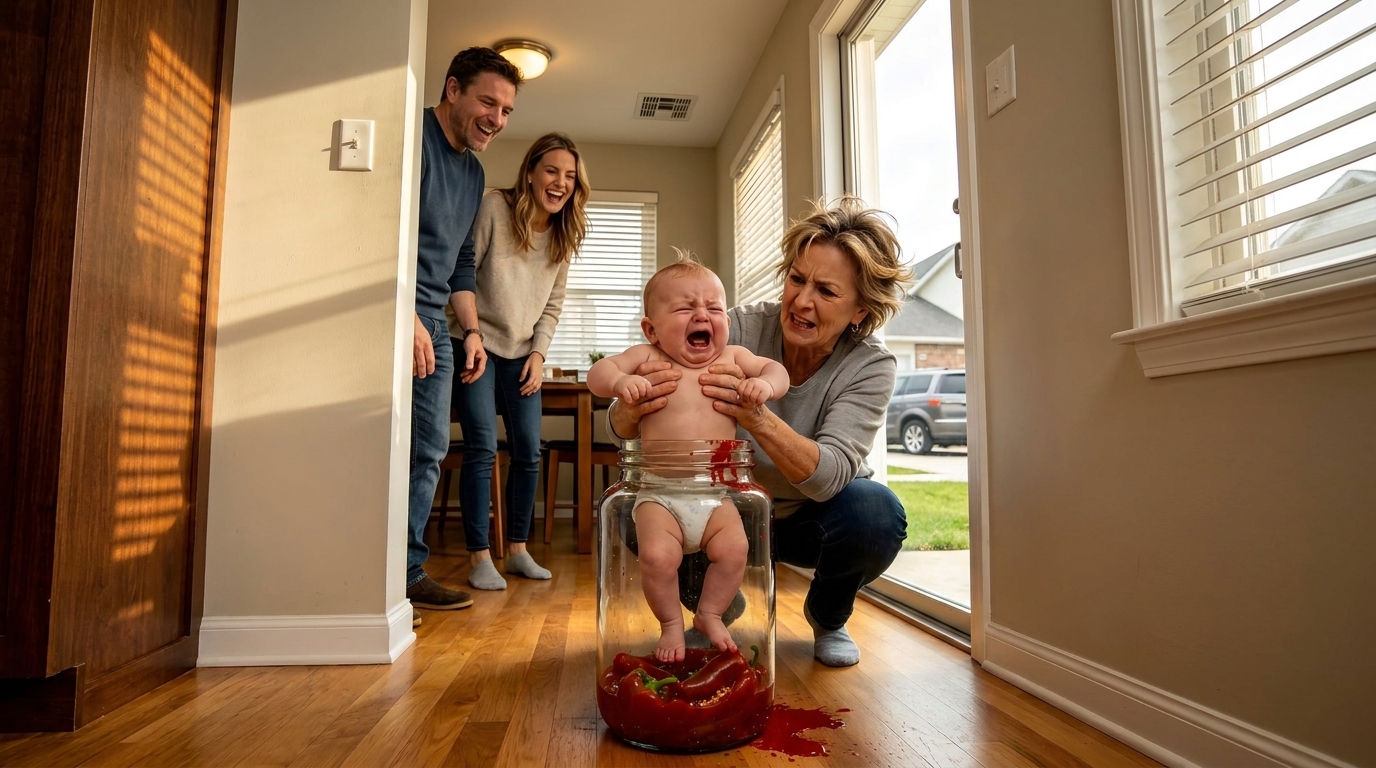
The jar was still there.
He stared at it.
Then he noticed something on the floor beneath the table.
A tiny piece of paper.
He bent down and picked it up.
It was part of the label from the jar, torn loose when the glass struck the table.
On the back, written in his own handwriting, was a short note he had made earlier that day.
He read it once.
Then again.
His face changed.
Because the note proved something he had denied from the beginning.
He had not forgotten why he was angry.
He had written it down.
Click Here to continue read next: PART7: The Note in His Own Hand Forced Him to Face the Motive He Had Tried to Forget, While Grandma Made a Decision That Could Not Be Reversed
The Jar Was Still on the Table When the Father Gave an Explanation That Made Everyone Stop Listening
Part 6 of 8

