
Stella was conscious when we reached the hospital.
She looked smaller than I remembered.
Rachel was already there.
Sophia was with a neighbor.
Tom arrived shortly afterward.
The doctor told us Stella had suffered a serious medical episode but was stable.
She would need further testing.
We waited.
Rachel sat beside me.
Neither of us spoke for several minutes.
Then she reached for my hand.
I let her take it.
“I was so afraid,” she whispered.
“So was I.”
“I kept thinking about everything.”
“Me too.”
She looked toward the hospital room.
“I almost lost my mother.”
I squeezed her hand.
“You didn't.”
“She might not be here forever.”
“No one is.”
Rachel looked at me.
“I used to think family meant holding on to people.”
I smiled faintly.
“Sometimes it means letting them change.”
She nodded.
The doctor came out.
“She is stable,” he said.
We all exhaled.
“She'll need observation tonight.”
“Can we see her?” Julian asked.
“In a few minutes.”
When we entered, Stella looked at each of us.
Her eyes stopped on me.
“Betty.”
“I'm here.”
She began to cry.
“I thought I'd die alone.”
I moved closer.
“You aren't alone.”
She reached for my hand.
I took it.
For years, I had imagined forgiveness as something dramatic.
A moment when the past suddenly stopped hurting.
That was not what happened.
The past remained.
The barbecue remained.
The containers remained.
The insults remained.
The weeks when Julian would not speak to me remained.
Forgiveness did not erase them.
It simply meant they no longer controlled what happened next.
Stella squeezed my hand.
“I was wrong.”
“I know.”
“I hurt you.”
“Yes.”
“I hurt Rachel.”
“Yes.”
“I hurt myself.”
I nodded.
“But you changed.”
She looked at me.
“Did I?”
“Yes.”
A faint smile appeared.
“I tried.”
“I know.”
The next morning, Stella was moved to a regular room.
Her condition improved.
Sophia visited later that afternoon.
She carried a handmade card.
She climbed onto the edge of the hospital bed.
“I made this for you.”
Stella smiled.
“What does it say?”
Sophia pointed.
“It says get better.”
Stella laughed weakly.
“I will.”
Sophia leaned over and kissed her cheek.
I watched.
The sight filled me with something I could not name.
Years earlier, I had been afraid that Rachel would keep my son away from me.
Later, I feared Stella's influence would affect Sophia.
But here they were.
A grandmother and granddaughter.
Connected despite everything that had happened.
The family had not returned to what it had been.
It had become something more honest.
After Stella came home, she moved more slowly.
She accepted help.
She did not pretend she could do everything herself.
Rachel visited.
Julian checked on her.
Sophia drew pictures.
I brought meals.
But I did not take over her life.
If she said she did not need something, I respected that.
If she asked for help, I gave it.
The distinction mattered.
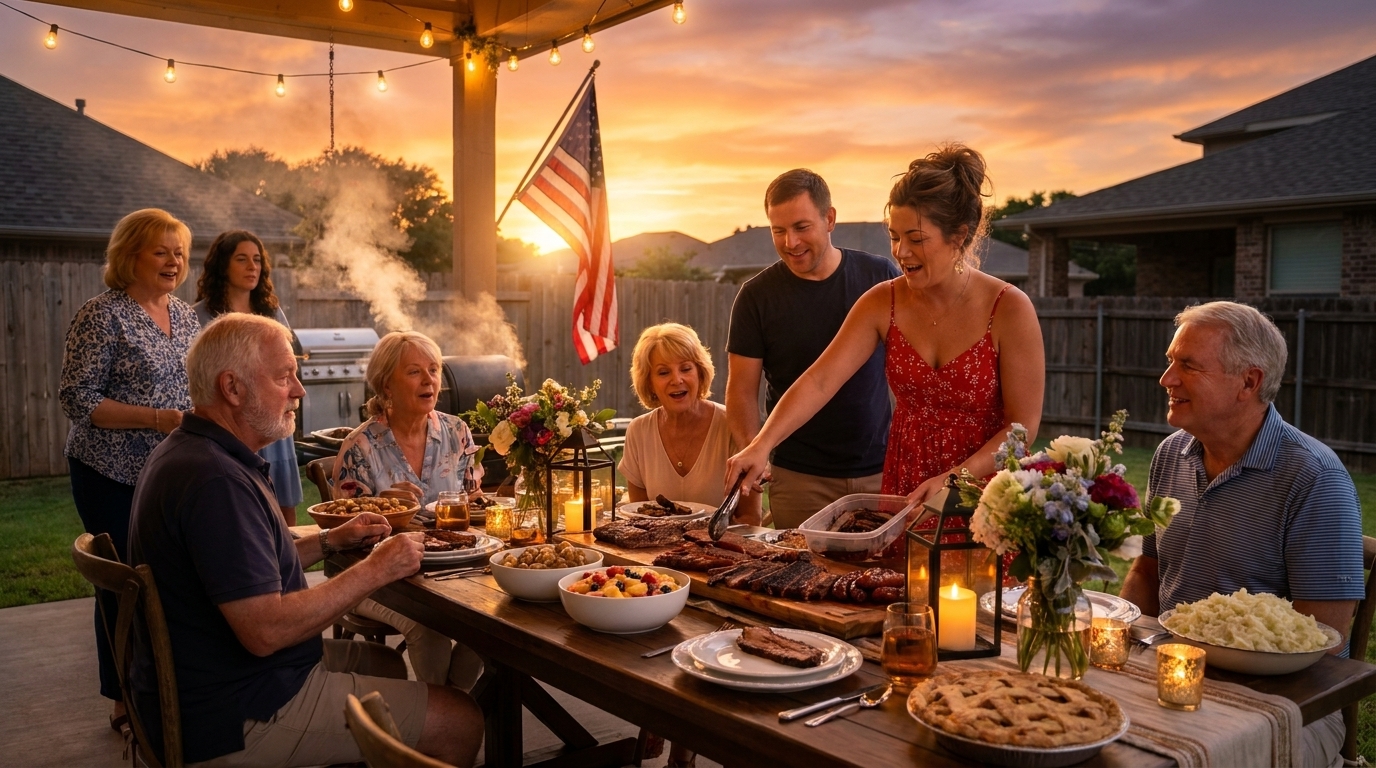
Months later, we held another barbecue.
The weather was mild.
The pecan tree cast a broad shadow across the yard.
Tom stood at the grill.
Julian prepared the drinks.
Rachel brought vegetables.
Stella brought bread.
Isabella arrived with pie.
Erica and Louisa came with their families.
Sophia ran through the yard.
I stood in the kitchen looking at the food.
There were no empty containers waiting on the counter.
Not one.
I smiled.
Then Sophia came running inside.
“Grandma!”
“Yes?”
“Can I help?”
“You can put the napkins on the table.”
She grabbed the stack.
“Okay.”
She carried them outside.
I followed.
Everyone was laughing.
Tom called from the grill.
“Betty, we're almost ready.”
“I'll bring the salad.”
Rachel appeared beside me.
“I'll carry it.”
I handed her the bowl.
She took it.
“Thank you.”
“You're welcome.”
That exchange was ordinary.
That was why I loved it.
Nothing needed to be dramatic anymore.
We had already learned the lessons drama had failed to teach us.
At dinner, Stella looked around the table.
“There are a lot of people.”
Tom smiled.
“Betty's behaving herself.”
Everyone laughed.
I shook my head.
“I bought enough this time.”
Sophia raised her hand.
“How much?”
“Eleven pounds.”
She looked impressed.
“That is a lot.”
“It is.”
Julian laughed.
“She's learned.”
I looked at my son.
“So have you.”
He nodded.
After dinner, nobody rushed to leave.
People talked.
Children played.
The adults cleared plates.
Stella packed nothing.
Rachel packed nothing.
Julian packed nothing.
When the evening ended, I offered leftovers.
I chose what each person would take.
Nobody reached for anything.
Nobody assumed.
And somehow, that simple act felt like the ending of a very long story.
Later, after everyone had gone, Tom and I sat beneath the string lights.
The backyard was quiet again.
“You know,” he said, “I never thought a few containers would change all of this.”
I smiled.
“They didn't.”
He looked at me.
“What did?”
“The decision to say no.”
He nodded.
I looked toward the table.
“I used to think saying no would make people leave.”
“And?”
“Sometimes it did.”
Tom waited.
“But the people who were meant to stay learned how to knock.”
He smiled.
I leaned back.
“That's the part I didn't understand.”
“What?”
“I thought boundaries were walls.”
Tom took my hand.
“They can be doors.”
I looked at him.
“You decide who comes through.”
He nodded.
For a while, we sat without speaking.
Then my phone buzzed.
A photograph from Julian.
Sophia was asleep in the back seat.
Under the picture, he had written:
“Thanks, Mom.”
I smiled.
I typed back:
“Always.”
Then I stopped.
I deleted it.
I wrote something else.
“Love you. Drive safely.”
It was a small difference.
But it represented everything I had learned.
I could love him without rescuing him.
I could support him without controlling him.
I could feed people without allowing them to take advantage of me.
I could forgive without forgetting.
I could open my door without giving away the house.
The barbecue that had once seemed like the worst day of my life had become something else.
Not a happy memory.
I would never call it that.
But it became a turning point.
It showed me where my kindness had become a habit of surrender.
It showed Julian that loyalty did not mean obedience.
It showed Rachel that love could not be secured through control.
It showed Stella that helping someone did not give her authority over them.
And most importantly, it taught us that families do not survive because nobody makes mistakes.
They survive because people are willing to face the mistakes, tell the truth, change their behavior, and accept that forgiveness must be accompanied by responsibility.
Years later, Sophia would sometimes ask me to tell her about the old barbecue.
I never told her every detail.
She was too young to carry all of it.
Instead, I told her there had once been a day when grown-ups forgot how to ask.
She always frowned.
“Ask what?”
“Ask before taking.”
She nodded seriously.
“And you said no?”
“Yes.”
“Were you scared?”
I smiled.
“Yes.”
“Did you cry?”
“Probably.”
“What happened?”
I looked at her.
“Some people left.”
She thought about that.
“Did they come back?”
“Some did.”
“Why?”
“Because they learned how to come back differently.”
She smiled.
“Like when I say sorry?”
“Exactly.”
Then she would hug me.
Every time.
And every time, I remembered that the real gift of that terrible afternoon had not been the meat, the argument, or even the apology.
It was clarity.
I finally understood that love does not require a person to disappear inside everyone else's needs.
A family is not a table where one person provides everything while everyone else reaches across it.
A family is a table where people bring something.
Time.
Respect.
Honesty.
Patience.
Accountability.
Sometimes food.
Sometimes forgiveness.
And sometimes, when necessary, the courage to say, “Please stop.”
I still cook Sunday dinner.
I still make too much occasionally.
Tom still teases me about it.
The roses still struggle in the Texas heat.
The old tablecloth still has a faint stain near one corner that I have never managed to remove.
And sometimes, after everyone has eaten, I send people home with leftovers.
But now I choose what leaves my house.
That difference may sound small.
To me, it changed everything.
Because the woman standing in that kitchen years ago was afraid that saying no would cost her family.
She was right.
For a while, it did.
But she was wrong about what came next.
Some people left.
Some people returned.
Some people changed.
And some relationships became stronger precisely because they were finally built on something more solid than guilt, fear, obligation, or silence.
My son came back.
Not because I begged him.
Not because I apologized for a boundary I had every right to set.
He came back because he finally understood what I had been trying to teach him without ever having the words for it.
Love is not permission to hurt someone.
Marriage is not permission to erase a parent.
Generosity is not surrender.
And forgiveness is not forgetting.
It is choosing what happens next.
That Sunday barbecue began with thirty-three pounds of meat and a row of empty containers.
It ended with a family that finally understood the value of asking.
And if I had to live through that painful day again, I would still stop my son's hand before he reached for the meat.
Not because the food mattered more than my family.
Because, for the first time, I understood that protecting the family sometimes begins with protecting the person who has spent years feeding it.
The End
Read more original stories on Feel Every Story.
The Barbecue Was Meant to Bring My Family Together, But the Containers in My Daughter-in-Law’s Bag Made Me Question Why They Had Come
Part 8 of 8

