My mother’s message came on a Sunday morning, when sunlight was spreading across the kitchen floor and Pickles was trying to convince me that breakfast should happen earlier than usual. I had just finished washing my coffee mug when my phone vibrated. The message was longer than her recent ones. She wrote that she knew I was keeping my distance and that she had been thinking about the reasons. She said she wanted to understand what I would need from her if we were ever going to have a relationship again.
I read it carefully, trying not to decide too quickly whether it represented a genuine change. There was no demand that I attend a family dinner, no accusation that I was being cruel, and no suggestion that the estate agreement should have settled everything. She had asked a question instead of telling me what I ought to do. That was different from the conversations we had been having, and I wanted to acknowledge the difference without assuming it meant the hard work was finished.
I did not answer immediately. I made breakfast, fed Pickles, and sat down with my notebook. I wrote out what I would need in a relationship with my mother: honesty about the past, respect for my financial boundaries, and the ability to disagree without turning the disagreement into a test of loyalty. I wanted her to stop using family obligations as a reason to pressure me. I wanted her to recognize that I could love her without agreeing to every request. Most of all, I needed her to accept that the legal resolution had not automatically repaired the emotional damage.
When I was ready, I replied that I appreciated her asking. I explained that I did not expect her to change everything overnight, but I needed her to stop treating my boundaries as punishment. If she wanted to talk about the past, I needed her to be willing to acknowledge what she had known about Grandma’s estate and why she had told me there was nothing left. I also needed her to understand that I would not return to the old financial arrangements. I was open to honest conversation, but I was not ready to resume family gatherings or pretend that trust had been restored.
Her response came later that afternoon. She said she had been afraid that admitting what she knew would mean losing her marriage and destroying the family. She had convinced herself that staying quiet would prevent a crisis. She now understood that her silence had not prevented the damage; it had allowed me to continue believing something that was not true. She did not explain every detail, and she did not provide a complete account of the past, but she acknowledged that she had chosen avoidance over honesty.
I read the message twice. It was the closest she had come to recognizing her own role without immediately shifting the conversation toward Dad’s decisions or the family’s financial pressure. I wanted to believe that she meant it. At the same time, I knew that a message was not the same as a lasting change in behavior. I could appreciate what she had said and still wait to see whether she would act differently the next time she felt afraid or uncomfortable.
We agreed to have a phone conversation the following weekend. I told her I could speak for about half an hour, and she accepted the limit without arguing. Before the call, I reminded myself that I was not responsible for making the conversation pleasant at any cost. I could listen without agreeing. I could ask questions without apologizing for asking them. If the discussion became accusatory, I could end it rather than remain on the phone until she felt satisfied.
When the call began, we talked about ordinary things for several minutes. She asked about my new role at work, and I told her I was enjoying the additional responsibility. She said she was proud of me. The words were simple, and I felt the ache of wanting to hear them from her without a shadow of expectation attached. I thanked her, then allowed the conversation to continue without trying to turn the moment into proof that everything was different.
Eventually, she returned to the estate. She said she knew the agreement had resolved the legal claims it covered, but she understood that the relationship between us remained damaged. She admitted that she had wanted me to accept the family’s explanation because challenging it would have forced her to face things she did not want to confront. She said she had been afraid of Dad’s reaction and afraid of what would happen if the family’s finances became unstable.
I listened, then asked her a question I had avoided for years. “When you told me Grandma’s money was gone, did you ever stop to think about what that meant for me?”
There was a long silence. When she finally answered, she said she had thought about the immediate consequences for the household, but she had not allowed herself to consider what it meant for my future. She had assumed I would manage, because I had always managed. She recognized that she had treated my ability to cope as a reason not to worry about what I was losing.
The answer hurt, but it was honest in a way her earlier explanations had not been. She was not claiming she had protected me or that she had known what was best. She was acknowledging that she had prioritized the immediate comfort of the household over my right to know the truth. I could not make that choice harmless by understanding her fear. But I could hear the difference between an explanation that shifted responsibility and one that admitted it.
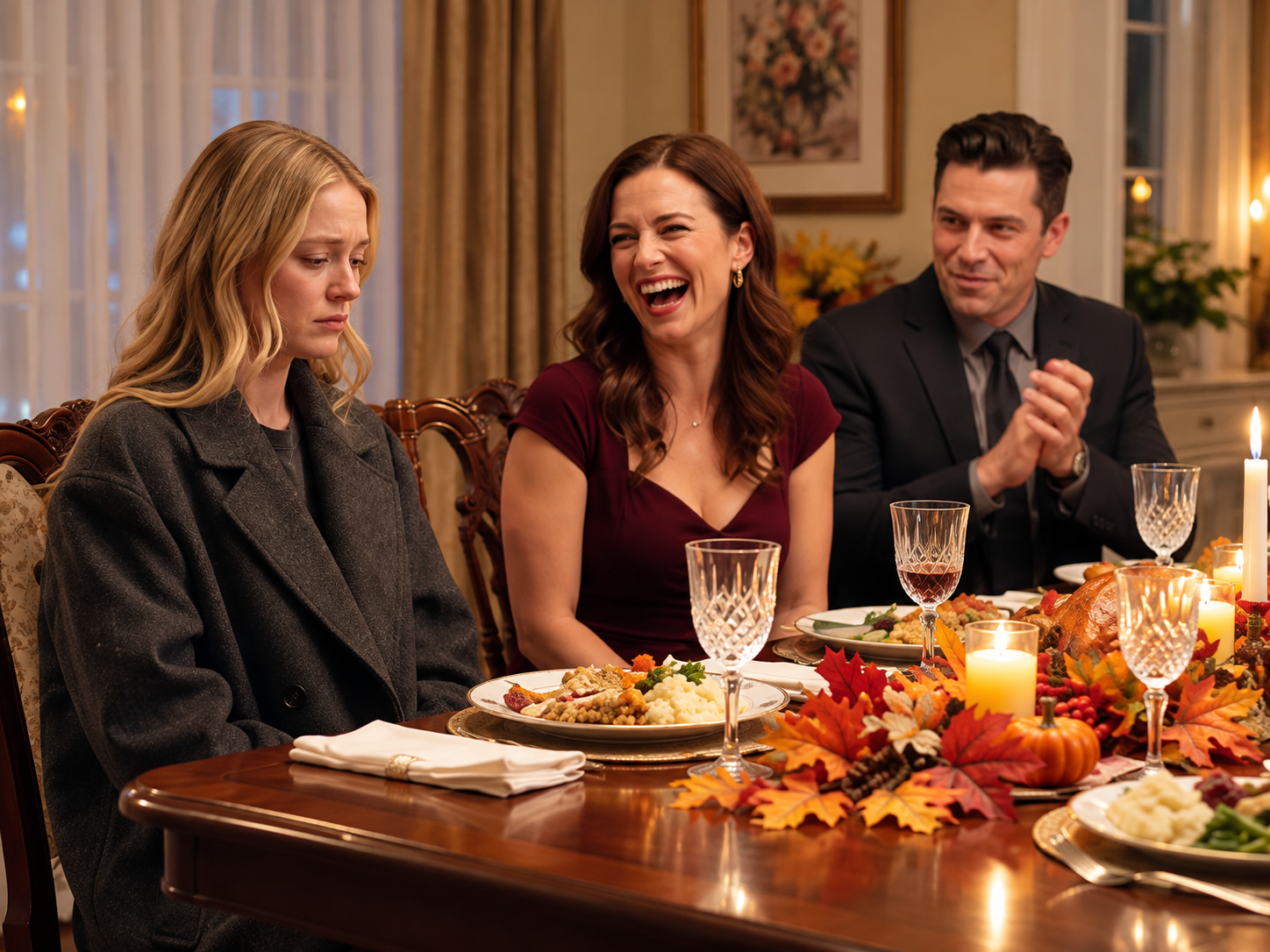
I told her that the hardest part had not been only the money. It had been learning that my questions were treated as betrayal while my financial support was treated as something the family could expect. It had been sitting at Thanksgiving while Dad said no one needed me, watching Travis clap sarcastically, and hearing her say I had no real family. Those words had stayed with me because they seemed to reveal what she believed about my place among them.
Mom cried quietly. She said she regretted what she had said that evening and that she had been angry, frightened, and unwilling to face the conflict growing around the family. She apologized for humiliating me. I had imagined hearing those words many times, but when they finally came, they did not erase the memory. They gave the memory a different context. I no longer had to wonder whether she understood that the words had hurt me. She had finally said that she regretted them.
I told her I appreciated the apology. I also explained that forgiveness, if it came, would not mean returning to the old relationship. I could accept that she was sorry and still need distance. I could hope that she continued to change without promising that we would become close again. The apology mattered, but it was the beginning of a process, not a conclusion that either of us could declare complete.
She asked whether there was any chance we could have lunch sometime. I told her I would consider it after we had more conversations like this one. I was not ready to meet in person yet, and I did not want her to interpret a future meeting as a promise of reconciliation. She said she understood. We ended the call a few minutes before the half-hour limit, and I sat quietly afterward, noticing that I felt tired but not overwhelmed.
I had spent years believing that the only way to preserve a relationship was to make the other person feel better as quickly as possible. During that call, I had allowed my mother to feel sad without rushing to comfort her. I had allowed silence to exist without filling it with excuses. I had accepted an apology without promising to forget. Those were small changes, but they showed me that I could take part in a difficult conversation without surrendering my own experience.
Over the next several weeks, Mom’s messages remained more respectful. She asked about my work and accepted brief answers. She did not ask me to pay bills or pass messages to Dad. When she mentioned a family memory, she did not use it to insist that we should all return to the old routine. I noticed the change, but I did not immediately expand the amount of contact. I wanted to see whether the new pattern could last when the conversation became uncomfortable again.
Dad remained distant, and I did not chase him for an apology. I had already told him what I needed through the legal process and in my own boundaries. If he ever chose to acknowledge his decisions, I would consider what that meant when it happened. I was no longer going to spend my evenings imagining the conversation and preparing answers to arguments he had not actually made. I had other things to do with my life.
Britney’s letters continued to reflect her work on accountability. She wrote that she was learning to distinguish a request from an expectation, and that she understood why I had refused to promise housing after her release. She did not ask me to change my answer. I was encouraged by that, although I kept my expectations realistic. It would take more than a few letters for me to know whether she could maintain those lessons in everyday life.
At work, I completed another review cycle in my new role and received positive feedback. My manager noted that I had become more confident in making decisions and explaining the evidence behind them. I thought about how much time I had once spent doubting my judgment whenever my family disagreed with me. I had allowed their certainty to outweigh my own observations. Now I was learning to trust the careful process I had developed: gather the facts, ask questions, consider the options, and make a decision I could explain.
One evening, I took a walk through the neighborhood after dinner. The air was mild, and people were sitting on porches or walking dogs along the sidewalk. I thought about the different relationships in my life and realized that I no longer wanted a single definition of closeness to determine them all. My mother might earn more trust over time. Britney might continue to change. Dad might never offer the apology I wanted. Each relationship would have to be evaluated on its own behavior, rather than on the family title attached to it.
When I returned home, I opened the cedar chest to put away a photograph I had been looking at. Grandma’s quilts were neatly folded inside, and the brass key rested in its familiar place. I remembered that she had not left me only a house and a trust. She had also given me an example of care that did not require humiliation. She had listened to me, encouraged me to think for myself, and reminded me that I was allowed to protect what mattered.
I could not recreate that relationship with my mother simply because she had begun to understand some of the harm she had caused. But I could allow the possibility of a different future without making it a promise. If she continued to be honest, respected my limits, and took responsibility when she made mistakes, trust might grow. If she returned to guilt and pressure, I would recognize that, too. I did not have to decide the rest of our lives in one phone call.
The most important change was that I no longer needed my mother to agree with every boundary before I could keep it. Her apology had given me something I had wanted, but my peace could not depend on whether she offered more. I could be grateful for the progress and remain careful. I could love her and still say no. I could leave room for repair without stepping back into the role that had nearly cost me my future.
That night, I put my phone on the nightstand and turned off the light. I felt sadness for the years we had lost and cautious hope for the conversations that might come. Neither feeling required me to change my decision. I had finally learned that repairing a relationship did not mean returning to the person I had been before the truth came out. It meant discovering whether two people could build something more honest from what remained.
Click here to continue reading: PART 20: On the Anniversary of That Thanksgiving, I Finally Understood That I Had Not Lost My Family in One Night—I Had Stopped Losing Myself to Keep It
My Father Raised His Glass to Insult Me at Thanksgiving, Unaware That the Daughter He Mocked Had Been Paying for Nearly Everything He Owned
Part 19 of 20