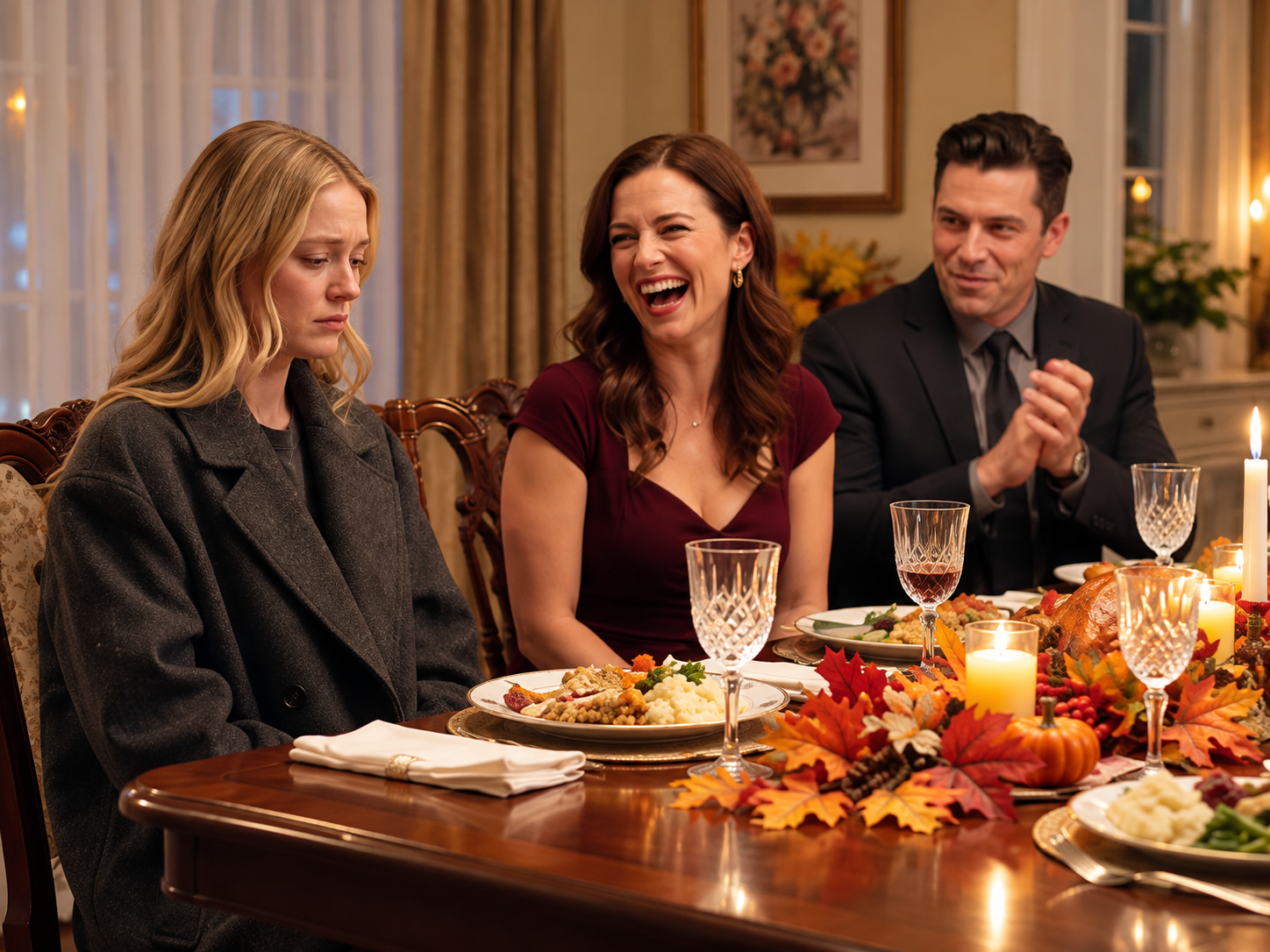
The anniversary of that Thanksgiving arrived on a cool morning in Columbus, and I noticed the date only because it appeared on my calendar while I was planning the week. For a moment, I considered deleting the reminder and treating the day like any other. Then I decided not to hide from it. The dinner had marked the moment when I finally stopped pretending that my family’s treatment of me could be fixed by giving more. I did not need to celebrate the memory, but I no longer wanted to fear it.
I made coffee, opened the curtains, and watched the neighborhood wake up. Pickles sat beside the window, his orange fur bright in the morning light. The condo looked much as it had during the previous months: the quilt on the sofa, the framed photograph of Grandma Dot on the bookshelf, and the small dish near the door where I kept my keys. Ordinary things had become precious because I had chosen them for a home that was mine. I had built a place where I could rest without waiting for the next family demand.
At work, the day passed with its usual responsibilities. I reviewed reports, answered questions, and helped a colleague work through a complicated file. My new position was challenging, but I enjoyed having responsibilities that were clearly defined and decisions that could be supported by evidence. I could ask for help without being made to feel weak, and I could disagree with someone without the disagreement becoming a test of loyalty. The contrast with my family was not something I thought about every hour, but it was always there in the background.
During lunch, I remembered the person I had been one year earlier. I had believed that if I kept helping, my family would eventually recognize my value. I had treated every request as an opportunity to prove that I was dependable, and every refusal as a possible threat to the relationship. I had postponed buying a home, delayed plans for myself, and accepted explanations that did not make sense because I feared what might happen if I kept asking questions.
I had not been foolish for wanting to help. I had been trying to care for people I loved, using the habits I had learned over a lifetime. But I had also allowed my fear of being rejected to shape decisions that should have been made with more care. I could acknowledge that without blaming myself for the choices my family had made. Their actions belonged to them. My responsibility now was to learn from my own choices and protect the life I was building.
When I returned home that evening, I decided to cook a proper dinner instead of eating whatever was easiest. I made Grandma’s apple cake for dessert, following the recipe card I had preserved. As the apples softened and the cinnamon filled the kitchen, I thought about the Thanksgiving meal that had started everything. The memory still hurt, but it no longer controlled the room around me. I could remember the cruelty without letting it dictate what the day meant.
I set the table for one, then paused. For years, eating alone had felt like evidence that I had failed to keep my family close. Now the table did not look like a punishment. It looked like a place where I could enjoy a meal without listening for a criticism or wondering whether someone would ask me to pay for something before dessert. I poured a glass of water, sat down, and ate slowly.
After dinner, I opened the drawer where I kept the letters from Britney. I had not read them all in several weeks. I took out the most recent one and reviewed it, noticing the difference between the earlier letters that focused on her fear and the newer ones that acknowledged the decisions she had made. She was beginning to describe the account as an act of betrayal rather than a financial mistake that had grown out of control. That change mattered, even though it did not erase the harm.
I did not know what would happen when Britney eventually left prison. She would have to find work, build a stable routine, and learn to live with the consequences of her choices. She might continue making progress, or she might struggle when the structure around her changed. I hoped she would choose well. I also knew that I could not guarantee her success by promising to catch her whenever she fell. If we developed a relationship again, it would have to be one in which she respected my boundaries and took responsibility for her own life.
I placed the letters back in the drawer. I did not feel compelled to write to her simply because I was thinking about her. The relationship could develop at a pace that respected both of us. I could acknowledge her efforts without turning every moment of hope into a commitment. I could be her sister without becoming her financial plan.
My mother called the following weekend. We had spoken a few times since our earlier conversation, and she had generally respected the limits I set. This time, she asked whether I would consider meeting for lunch. She said she wanted to keep working on our relationship and understood that one apology would not make everything right. I listened carefully, then told her I was willing to meet in a public place for a short lunch, as long as we both understood that it was an opportunity to talk rather than a promise that everything was repaired.
She agreed without arguing. We chose a small restaurant and arranged a time. Before the meeting, I thought about what I wanted to say and what I did not need to explain again. I did not prepare a list of accusations. I wanted to hear whether she could talk honestly about the past and respect the boundaries I had already communicated. I also wanted to leave if the conversation returned to guilt, pressure, or demands that I forget what had happened.
When I arrived, Mom was waiting at a table near the window. She looked nervous, and I felt nervous, too. We greeted each other and ordered lunch. At first, we talked about ordinary things, including my new position and the condo. She asked about Pickles and laughed when I described his habit of sitting directly on whatever document I was trying to read. For a little while, we were simply a mother and daughter sharing a meal.
Eventually, she said she had been thinking about the years when I paid so many of the family’s expenses. She admitted that she had grown accustomed to my help and had not considered how much it delayed my own plans. She said she had treated my ability to manage money as if it meant I had more than enough to spare. She acknowledged that she should have asked whether I could afford to help rather than assuming I would say yes.
I appreciated the acknowledgment. It was not a complete accounting of everything that had happened, and it did not answer every question about the estate. Those matters had been handled through the legal process to the extent covered by the agreement. But her willingness to name the pattern without immediately asking me to resume it was a meaningful change. I told her that the financial help had often come from love, but it had also become something I felt unable to refuse. I needed any future relationship to leave room for me to make choices without fear.
She said she understood that more clearly now. Then she asked whether I thought we could eventually have family holidays together again. I told her I could not answer that yet. I would not rule out future gatherings, but I would not attend one simply to prove that I had forgiven everyone. If we reached that point, it would be because the relationships had become safer and more honest, not because enough time had passed for people to become impatient with the consequences.
Mom nodded. She looked disappointed, but she did not argue. That was important. For once, her disappointment did not become a reason for me to change my answer. We finished lunch, spoke briefly about the week ahead, and said goodbye. I walked to my car feeling neither triumphant nor defeated. It had been a small step, and I could let it remain small.
Dad did not contact me on the anniversary of Thanksgiving. I had not expected him to, but I noticed the absence. Part of me still wished he would call and acknowledge the humiliation, the financial dependence, and the way he had used his authority in the family to discourage questions. I wanted to hear him say that I had deserved better. Yet I had stopped treating that apology as something I needed before I could move forward. His silence could be painful without becoming a command to wait.
The estate matter was no longer the center of my daily life. The agreement had resolved the claims it covered, and I kept the final records with the earlier documents. I did not claim that the outcome had restored everything Grandma had intended or made every financial consequence disappear. The resolution was a legal outcome with defined terms, not a magical repair of the past. I could be grateful that the process had reached an endpoint while recognizing that grief and disappointment would remain.
My credit protection had also become routine. I maintained the freeze, kept the identity-theft records, and checked my reports periodically. I was careful about sharing personal information, even with people I knew. The fraudulent Visa account had taught me that familiarity was not the same as permission and that someone knowing my details did not give them the right to use them. I no longer felt that every financial document was a threat, but I treated my information with the care it deserved.
The $63,418.72 spreadsheet remained in my archive. I did not need to look at it often, but I kept it as a reminder of how easily separate acts of help could become a pattern that drained my own resources. I had once used the total as proof that I had been a good daughter and sister. Now I understood that the number could tell me how much I had given, but it could not determine whether I was worthy of love. I did not have to keep paying to demonstrate that I cared.
My new position gave me more confidence and a clearer sense of direction. I began setting professional goals for the next year, including additional training and a plan for continuing to grow in my field. I also continued saving for home repairs and future expenses. I did not assume that my life would always be easy, but I had learned to prepare for uncertainty without making myself responsible for every other adult’s choices. My future no longer depended on my family becoming stable first.
I made plans with friends more often. Sometimes we went out for dinner; sometimes we met for coffee or spent an afternoon walking. I began to appreciate relationships that did not require me to prove my value through money or constant availability. I could offer help when I had the capacity, and I could accept help without feeling that I had to repay it immediately. Those experiences reminded me that mutual care was possible. It did not need to be earned through exhaustion.
One evening, I took Grandma’s quilt from the sofa and folded it carefully. I placed it over the back of the chair near the bookshelf, where I could see it from the dining table. The brass key remained in its dish near the door. I thought about the old house, the will, and the warning Grandma had given me. I had spent so long focusing on what my family had done with her estate that I sometimes forgot the most important part: she had wanted me to have a future of my own.
I could not ask Grandma what she would think of the decisions I had made. But I knew that I had taken her words seriously. I had sought legal advice instead of surrendering to pressure. I had preserved the records and followed the process. I had refused to let the family’s discomfort determine whether I could ask for the truth. And I had begun to understand that protecting what she left me meant more than protecting money or property. It meant protecting the person I was becoming.
On the night of the anniversary, I sat beside the window with a cup of tea and watched the lights appear in the neighboring apartments. I thought about the girl I had been, the woman who had supported her family for years, and the person I was now. I felt compassion for the earlier version of myself who believed that saying yes was the safest way to remain loved. She had been trying to keep people close with the tools she understood. She deserved understanding, not contempt.
I also felt sadness for the family relationship I had hoped to have. There might never be a holiday when everyone gathered around a table and spoke honestly about what had happened. There might never be a complete apology from Dad or a moment when Britney’s choices no longer hurt to remember. I could grieve those possibilities without allowing them to dictate my future. The life I had was not the life I had imagined, but it was a life I could shape.
Before bed, I checked the front door, turned off the lights, and placed my phone on the nightstand. Pickles settled beside me, purring softly. The condo was quiet, and the quiet no longer felt like proof that I had been abandoned. It felt like space—space to rest, to think, to work toward something meaningful, and to decide what kind of relationships I would allow into my life.
I had not become indifferent to my family. I still cared about Mom’s growth, hoped Britney would continue taking responsibility, and wished Dad would one day face the truth without turning it into an accusation against me. But I no longer believed that caring meant sacrificing my peace until they were ready to change. Their choices belonged to them. My future belonged to me.
That Thanksgiving had not destroyed a perfect family. It had exposed the cost of trying to keep one together through silence and money. The years of payments, the fraudulent account, the disputed inheritance, and the humiliation at the dinner table had all forced me to confront a truth I had avoided: I could not make people treat me well by becoming endlessly useful to them.
I had lost the illusion that my family would always protect me simply because we shared a name. I had lost the hope that generosity alone could create mutual respect. But I had gained something more durable than approval. I had learned to trust my judgment, protect my identity, pursue the truth through the proper channels, and build a home where my worth was not measured by what I could pay for someone else.
As I closed my eyes, I thought of Grandma’s words one last time. She had told me not to let my father talk me out of what she had left me. I had honored that warning, but I had also learned to hear its wider meaning. I would not let anyone talk me out of my future, my boundaries, or my right to choose a life that belonged to me.
I still had Pickles, my work, the truth, and the home I had built. I had memories worth keeping and lessons I would carry forward. I did not know whether my family would ever become what I had hoped it could be. I no longer needed that answer before I could be happy.
For the first time, I was not waiting for my family to decide that I deserved a place in my own life. I had already made one.
The End
Read more original stories on Feel Every Story.
My Father Raised His Glass to Insult Me at Thanksgiving, Unaware That the Daughter He Mocked Had Been Paying for Nearly Everything He Owned
Part 20 of 20