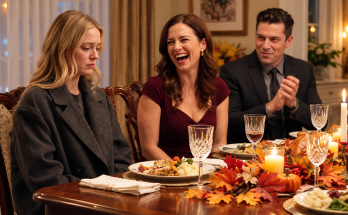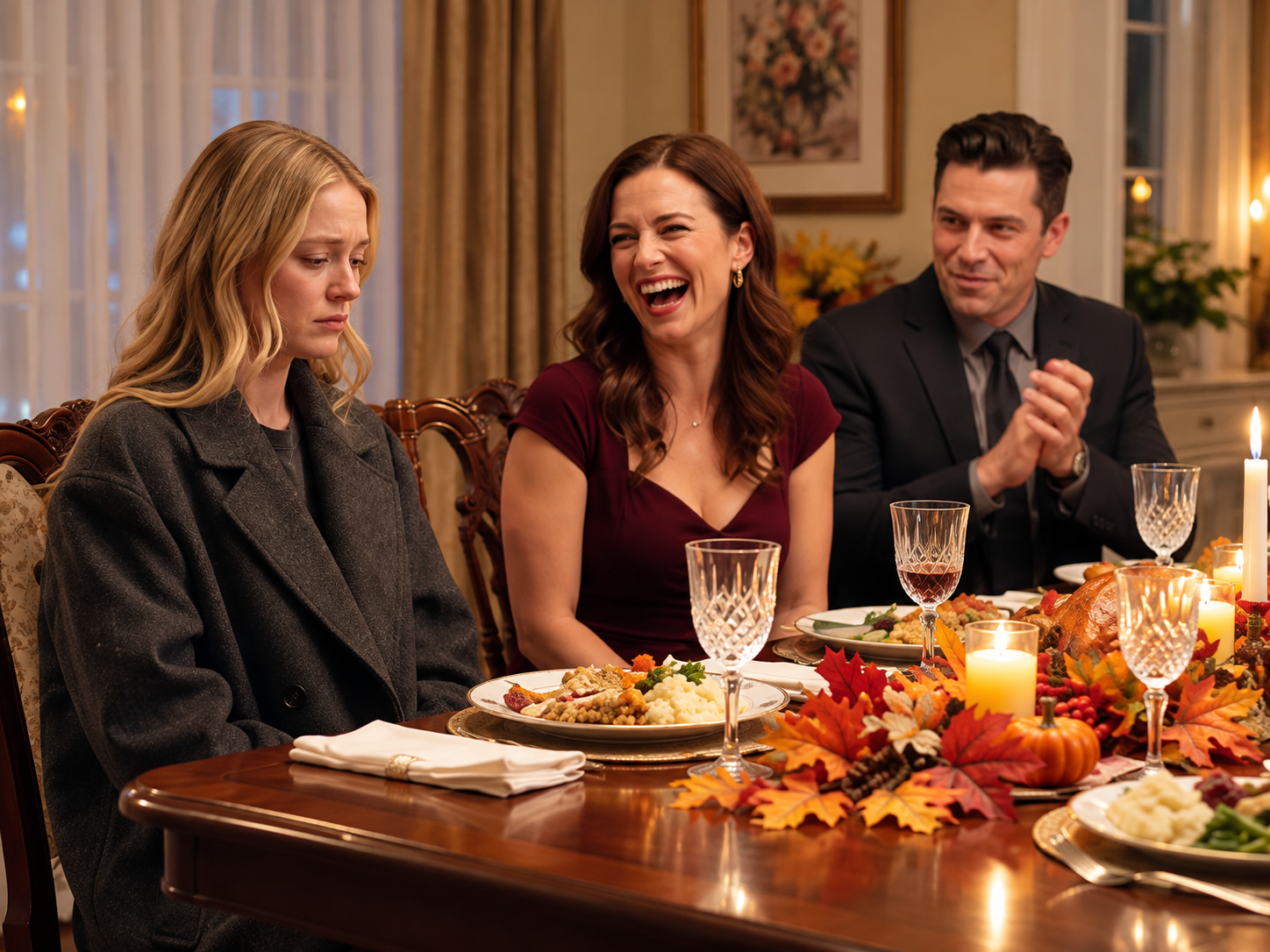
“Your money isn’t wanted here, and neither are you.”
My father delivered the words with a glass of red wine raised above the Thanksgiving table, his attention fixed on the framed photograph of my sister’s wedding rather than on me. The photograph stood on the mantel behind him, its silver frame catching the warm light from the chandelier. Britney looked radiant in her white dress, her husband, Travis, grinning beside her as if the entire world had been arranged for his convenience.
I knew the photograph well. I had helped choose it, paid for the frame, and quietly covered the photographer’s five-thousand-dollar invoice when Britney admitted she could not afford it. She had cried over the phone that afternoon, insisting that canceling the photographer would ruin her wedding memories forever. I had transferred the money before dinner that night. She had thanked me with a heart emoji and never mentioned it again.
Now she lifted her wineglass and laughed at our father’s announcement.
“About time someone said it,” she remarked.
Travis leaned back in his chair. He looked directly at me, then applauded six times, slowly enough that every person at the table could hear each clap. His expression carried the smug satisfaction of a man who believed he had finally found an audience for his contempt.
My mother continued slicing the ham. She did not even lift her eyes toward me.
“Please don’t start crying, Hannah,” she said. “You have a habit of turning every family gathering into a performance. Besides, you don’t have a real family to worry about.”
Travis glanced toward the kitchen doorway. “She has a cat. Maybe that counts.”
The laughter came immediately. My father chuckled into his wine, Britney covered her mouth with one hand, and my mother shook her head as if my mere presence had become an exhausting inconvenience. Somewhere near the end of the table, one of the children giggled without quite understanding the joke.
I stared at my untouched plate. The turkey had gone lukewarm, a small pool of gravy spreading across the mashed potatoes. I could smell roasted onions and sage, the familiar scents that had always made Thanksgiving feel comforting when I was younger. Tonight, they seemed to belong to a house where I was merely an unwelcome guest.
My name is Hannah. I was thirty-two years old, living alone in Columbus, Ohio, and earning eighty-one thousand dollars a year as a senior claims analyst. My job involved investigating questionable insurance claims, reviewing financial records, comparing statements against documented events, and identifying inconsistencies other people hoped would escape notice.
I was good at it. My supervisors trusted my conclusions because I did not make accusations based on feelings, appearances, or personal grudges. I followed the money, verified the documents, and separated what I could prove from what I merely suspected.
Yet when it came to my own family, I had spent years ignoring the very evidence I would have considered suspicious in anyone else’s case.
The financial help had started innocently enough. Britney and Travis were facing eviction after Travis lost a job and Britney said her childcare expenses had become impossible to manage. She called me one evening, crying so hard I could barely understand her.
“We just need a little breathing room,” she told me. “Three months, Hannah. Just until Travis gets back on his feet.”
I transferred the first rent payment that night. Four hundred and fifty dollars came from my savings, and the remaining thousand came from the money I had set aside for a down payment on a condominium. I told myself it was temporary. Families helped one another through difficult periods.
Three months became six. Six became a year. Eventually, I was sending Britney and Travis fourteen hundred and fifty dollars every month, covering the rent directly so they could not fall behind. Whenever I asked when they might begin contributing again, Britney reminded me that the children needed stability.
I loved my niece and nephew. I did not want them growing up frightened that they would lose their home. That fear made it easy for Britney to turn every discussion about money into a discussion about the children.
Dad had his own emergencies. His truck payment was six hundred and twelve dollars, and he called me three separate times when he fell behind. Each time, he insisted that the problem was temporary and that he would repay me as soon as his next payment arrived. I covered it three times. I never received a dollar back.
Mom’s credit had deteriorated after years of missed payments, so I added her to my phone plan. I paid the monthly bill, replaced a damaged phone, and covered the cost when she claimed she could not afford the activation fee for a new device. The explanation changed depending on the occasion, but the request was always the same: I had a steady job, and I could manage it.
There were the children’s dance lessons, school clothes, birthday gifts, grocery deliveries, and utility bills. Sometimes Britney asked for money directly. Other times, she sent a photograph of a shutoff notice or a message about how embarrassed she felt asking anyone for help.
I would feel guilty, send the money, and tell myself that next month would be different.
Meanwhile, I postponed replacing my aging laptop, delayed dental work, and cooked cheap meals at home. I had stopped taking weekend trips because even a modest hotel stay seemed irresponsible while my family needed help. Every time I moved money into my condominium savings account, someone called with another emergency.
Last week, when I mentioned that I had a mortgage pre-approval appointment scheduled for December ninth, Britney immediately tried to discourage me.
“A mortgage could wreck your credit,” she had warned. “You should wait until the economy settles down. Besides, you never know when the family might need you.”
At the time, I had interpreted her advice as concern. Sitting at the Thanksgiving table while her husband mocked me, I began to wonder whether she was more worried about my financial independence than my financial security.
My mother reached across the table for the serving dish. Her sleeve brushed the edge of my plate, and she gave me an irritated look when I moved it out of her way.
“You should be grateful we invited you,” she said. “Some people would love to have parents who still make an effort.”
I looked at her, waiting for some sign that she recognized what she was saying. There was none.
At the end of the table stood an empty chair with a plate arranged neatly in front of it. Grandma Dot had been dead for six years, but my mother continued setting a place for her every Thanksgiving. She said it honored Grandma’s memory.
I had always found the gesture comforting. Grandma had been the one person in the family who noticed when I was struggling, who asked about my work, and who remembered the small things I liked. She taught me to bake, kept a jar of coins for neighborhood children, and believed that being generous did not mean allowing people to take advantage of you.
During her final hospital stay, she had gripped my wrist with surprising strength. Her fingers were thin, her skin almost translucent beneath the fluorescent lights. She pulled me closer and spoke so quietly that I had to lean over the bed to hear her.
“I made sure it would be yours,” she had whispered. “All of it. Don't let your father persuade you otherwise.”
I had asked what she meant, but the nurse came in before Grandma could explain. Later that week, she was gone.
After the funeral, Dad handed me a brass key and told me it belonged to an old cedar chest containing Grandma’s quilts. Mom said the house had been sold to cover medical debts and that whatever money Grandma had left had disappeared into hospital bills.
I believed them. I was grieving, inexperienced with probate matters, and unwilling to imagine that my own parents might lie to me about an inheritance. I placed the key in a drawer and eventually stopped thinking about it.
Now, staring at the empty chair, I remembered the weight of Grandma’s hand around my wrist and the unusual urgency in her voice.
Britney kicked my foot beneath the table.
“Hello? Are you even listening?”
I looked at her. Her hair was freshly styled, her nails professionally manicured, and the diamond on her left hand glittered whenever she moved her wineglass. Travis wore a new watch that I suspected had been purchased shortly after I covered his rent for another month. Their children had new clothes, and the framed wedding photograph behind Dad had cost me five thousand dollars.
“Say something,” Britney demanded. “Or are you going to make that sad face again?”
For a moment, I wanted to remind them of every transfer, every bill, every night I had spent worrying that they might lose their home. I wanted to ask why my generosity had made me the family joke rather than the person they were grateful to have.
Instead, I folded my napkin and placed it beside my plate.
“I understand,” I said.
Dad gave a dismissive wave with his fork. “Good. Then stop making everything so dramatic.”
I stood, buttoned my gray wool coat, and walked toward the front door. Nobody followed me. Nobody asked me to stay. Behind me, I heard Travis make another remark that sent the table into laughter.
The cold air struck my face when I stepped outside. I sat in my car for several seconds with both hands resting on the steering wheel, watching the warm rectangles of light behind the house windows. I had spent years trying to earn a place at that table by paying for the things everyone else wanted. Apparently, the payments had purchased no respect at all.
I drove back to my apartment in silence. Pickles, my orange tabby, met me near the door with his tail raised, complaining about the delay in his evening meal. I fed him, changed into comfortable clothes, and sat at my kitchen table with my laptop.
For years, I had treated my family’s financial problems as separate emergencies. A rent payment here, a truck installment there, a phone bill, a school expense. Each request had arrived with its own explanation, making it easy to forget the cumulative cost.
I opened a spreadsheet and named it Family Payments.
Then I began working backward through six years of bank statements, Venmo transactions, Zelle records, and credit card payments. I sorted the entries by recipient and date. When a payment description was vague, I opened the corresponding statement and checked the amount. I separated gifts from loans, recurring bills from emergency transfers, and payments I could verify from amounts I merely remembered.
At first, the process felt mechanical. Dates, dollar amounts, and transaction references were easier to handle than the humiliation still burning in my chest.
By midnight, I had documented the rent transfers. Shortly afterward, I finished the truck payments and the phone bills. I added the children’s expenses, the wedding photographer, and the other payments I had almost forgotten.
At 3:52 in the morning, I entered the final verified amount into the spreadsheet.
$63,418.72.
I stared at the figure until the digits began to blur. More than sixty-three thousand dollars. Enough to cover a substantial portion of a condominium down payment, build an emergency fund, and give me choices I had spent years postponing.
I had been eating inexpensive meals and putting off my own plans while the people who benefited from my sacrifices laughed at me over Thanksgiving dinner.
Pickles jumped onto the chair beside me. I stroked his head, then returned to the spreadsheet. My professional instincts were beginning to take over. I had records. I had dates. I had a pattern.
If I was going to understand what my family had done with my money, I needed to stop assuming that their explanations were true.
I opened my credit reports from the three major bureaus.
The first report showed my student loans, my auto lease, and the ordinary accounts I expected to find. The second looked much the same. I was preparing to close the third when a credit card entry caught my attention.
Visa Platinum.
I had never opened a Visa Platinum account.
I clicked into the details. The account had been opened in March 2023, carried a twelve-thousand-dollar credit limit, and showed an outstanding balance of $11,046.18. The billing address was not my apartment.
It was my parents’ house at 2217 Hawthorne Drive.
My fingers went cold against the keyboard.
March 2023. The exact month Britney had called me in a panic about Lily’s daycare. She had claimed the daycare needed an additional emergency contact for its licensing paperwork and asked for my full legal name, date of birth, and Social Security number.
I had given her the information without hesitation. She was my sister. Lily was my niece. I had assumed the request was harmless.
Now I stared at an account I had never authorized, carrying a balance I had never spent, with statements delivered to the home where my parents lived.
I opened a blank document and typed the account details at the top. Then I saved the credit report, printed the relevant pages, and wrote down the date I had discovered the account.
The family spreadsheet had started as a record of money I had willingly given away.
This was something else entirely.
Click here to continue reading: PART 2: A Credit Card I Had Never Opened Led Me Back to My Sister’s Request for Personal Information and a Secret My Parents Had Hidden for Years
My Father Raised His Glass to Insult Me at Thanksgiving, Unaware That the Daughter He Mocked Had Been Paying for Nearly Everything He Owned
Part 1 of 20