The first holiday season in my condominium arrived without the familiar stream of requests for money. I bought a small tree, decorated it with inexpensive lights, and placed it beside the living-room window. Pickles investigated the lower branches and knocked off one ornament before deciding the entire arrangement was beneath his interest. I laughed harder than the incident deserved, grateful for an evening in which the biggest problem was a cat determined to rearrange my decorations.
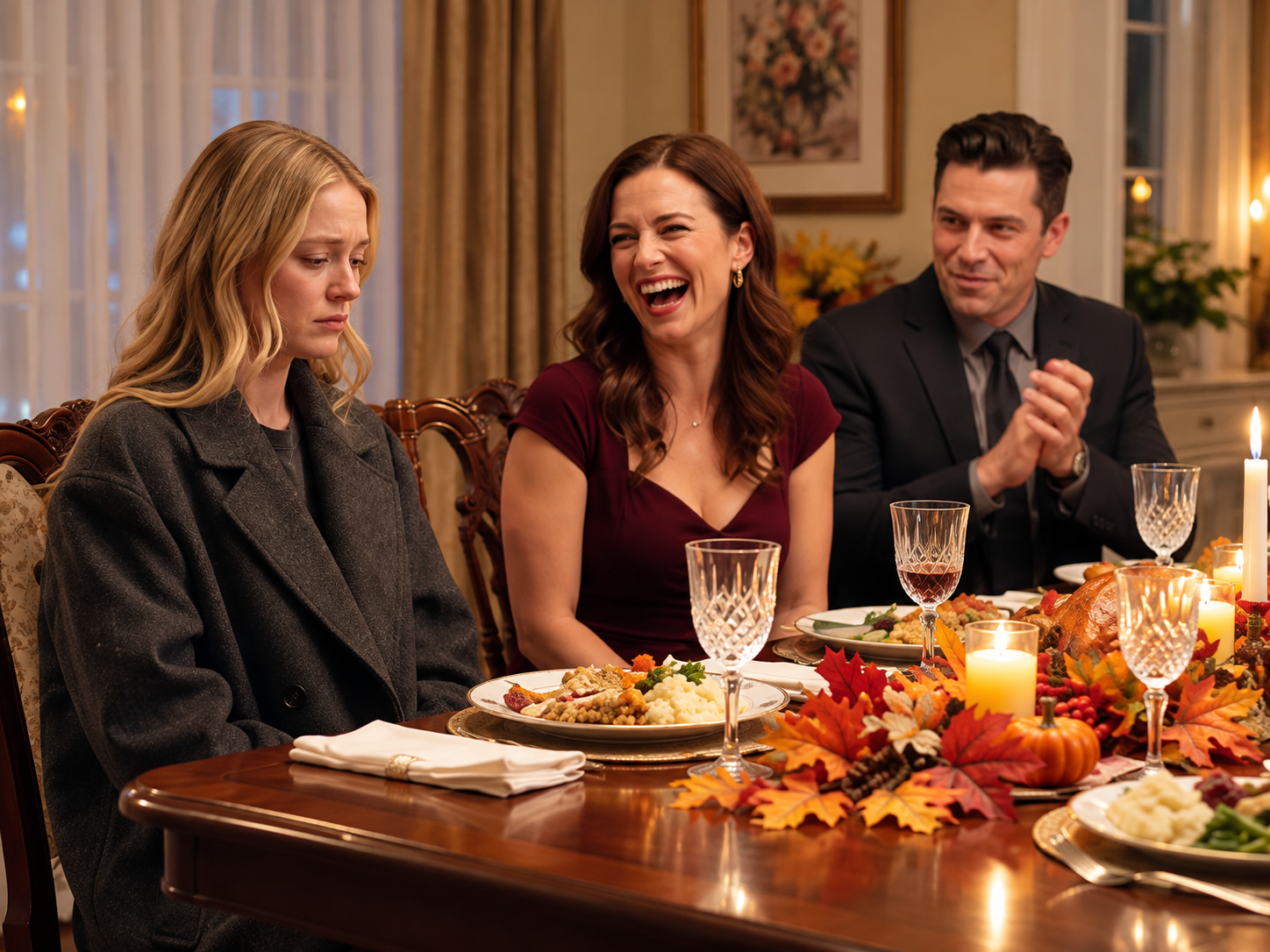
Thanksgiving was approaching again, and I knew my family would notice that I was not coming to their house. I had not received an invitation, but I doubted that silence meant they had forgotten the date. For years, I had been expected to attend, bring something expensive, and remain available to pay for whatever emergency surfaced before dessert. This time, I made plans for myself.
I bought groceries for a meal I actually wanted, including the apple cake Grandma had taught me to bake. I followed her handwritten recipe, checking the measurements twice and adjusting the baking time because my oven ran slightly hot. The familiar smell filled the kitchen, and for a moment I could almost hear her reminding me not to open the oven door too early.
When the cake cooled, I cut a small slice and sat by the window. I was not celebrating what had happened to Britney or pretending that the legal disputes had been painless. I was marking a different kind of milestone: I had reached a holiday without agreeing to sacrifice my finances, time, or dignity just to maintain the appearance of a happy family.
The civil case concerning Grandma’s estate remained active. My attorney continued pursuing the claims supported by the will, the property records, and the questionable power-of-attorney document. There were further discussions about the funds associated with the property sale and the trust. The legal process had to account for what could be traced and what remedies were available, and I understood that the outcome would depend on the evidence and the applicable law.
I had stopped expecting each new document to deliver a dramatic revelation. Instead, I looked for specific answers to specific questions. Did the record show a transfer? Did it identify the account involved? Did the signature match a verified document? Did the timeline support the explanation being offered? Those questions were less emotionally satisfying than imagining a single moment when everyone admitted everything, but they were more useful.
The criminal case involving Britney had already produced a serious consequence. She had been sentenced to prison for the identity theft established through the proceedings. Her letters continued occasionally, though I did not answer every one. I read them when I felt able, preserved them, and gave myself permission to stop if the contents became overwhelming.
In one letter, Britney wrote that she had begun to understand how much she had relied on my willingness to rescue her. She acknowledged that she had treated my help as something she could demand and that she had assumed I would always protect her from the consequences of her decisions. She wrote that she was sorry for the account, the lies, and the humiliation at Thanksgiving.
I believed that she might genuinely regret what she had done. But I also knew that regret could coexist with a desire to escape punishment, and I could not determine her motives from a few pages. I did not have to decide whether her remorse was complete before deciding what boundaries I needed.
I wrote a reply that was honest but limited. I acknowledged receiving the letter and told her that I hoped she would use her time to take responsibility for her actions. I did not promise to restore our relationship, pay her expenses, or intervene in the consequences of the case. I told her that trust could not be rebuilt by demanding that I return to the role I had played before.
I sent the letter through the appropriate channel and did not wait beside the mailbox for a response. It was the first time I had communicated with Britney without trying to manage her feelings about my words. I had told her what I believed and left the next step to her.
My parents’ communications were less direct. Dad’s representatives continued to dispute aspects of the estate claim, while Mom’s letters focused on the strain the family had experienced since the investigation began. I read the legal correspondence carefully and forwarded it to my attorney. I did not respond to personal accusations that were unrelated to the issues before the court.
The distinction helped me preserve my energy. I could address a legal question without participating in an argument about whether I was a good daughter. I could provide a document without defending my decision to stop paying the rent. I could acknowledge that my parents were facing serious consequences without accepting their claim that those consequences were my fault.
At work, I began mentoring a newer analyst who was struggling with a complicated claim. She was bright and diligent, but she had become attached to one explanation before all the records were available. I encouraged her to create a timeline, separate verified facts from assumptions, and identify what additional information would help resolve the discrepancies.
“You don’t have to know the answer before you start,” I told her. “You have to know what the evidence can actually support.”
As I said the words, I recognized how much I had needed to hear them myself. For years, I had decided that my family’s explanations must be true because the alternative was too painful to consider. I had treated trust as a reason not to investigate. Now I understood that genuine trust did not require blindness, and asking for evidence did not automatically make me disloyal.
My supervisor later commended the quality of my work and asked whether I would be interested in taking on additional responsibility in the coming months. The opportunity was not a promotion yet, but it represented a possible next step in my career. I reviewed the requirements and decided to pursue it. I no longer felt guilty about investing time in my own professional future while my family dealt with problems they had created.
The condominium slowly began to feel like home. I bought a secondhand bookshelf, hung a few photographs, and placed Grandma’s recipe card in a frame beside the cedar chest. I kept the living room simple, not because I could not afford more decorations, but because I liked having space to breathe. The mortgage payment remained a serious responsibility, yet it was one I had chosen with a clear understanding of the cost.
The credit account continued to be handled through the appropriate dispute process. The criminal proceedings had established Britney’s responsibility, but I still needed the financial records and credit reporting to reflect the outcome accurately. I followed up with the issuer and the credit bureaus as advised, keeping copies of every response. I did not assume that a criminal sentence automatically corrected every financial record associated with the account.
When the corrected information began to appear, I reviewed it carefully. The process was slower than I would have preferred, but I had learned to keep following through until each issue was actually resolved. I did not confuse one successful legal outcome with the completion of every practical step.
The estate case also required patience. My attorney continued working to establish the extent of the funds involved and pursue the remedies available. The records supported the conclusion that Grandma’s intentions had not been honored as I had been told, but recovering assets was a separate question from proving that the estate had been mishandled. I did not assume that every dollar would return to me, and I did not allow that uncertainty to stop the case from moving forward.
I sometimes wondered what Grandma would have said if she could see the family now. I imagined her sitting at the kitchen table, hands wrapped around a cup of tea, listening while I explained the will, the credit account, and the Thanksgiving dinner that had finally forced me to examine everything. I could not know how she would have responded to every detail. I did know that she had tried to protect my future, and that she had warned me not to let Dad talk me out of what she had left.
That memory no longer made me feel guilty for pursuing the inheritance. It reminded me that accepting a gift was not greed, and protecting a legal right was not betrayal. Grandma had made a decision about her estate. My parents did not have the right to erase that decision simply because they preferred a different outcome.
One evening, I took the brass key from the dish beside her photograph and placed it inside the cedar chest. The quilts lay folded beneath it. I closed the lid gently, not because I wanted to hide the key, but because I no longer needed to keep it in sight as a warning. I knew what it represented, and I knew where the documents were.
I had begun this entire process by adding up the money I had given my family. The final total had shocked me because it revealed how much of my future I had postponed. But the money was only part of the loss. I had also given away time, peace, and the freedom to make ordinary decisions without fear that someone would accuse me of selfishness.
I could not recover every hour or undo every choice. What I could do was stop the pattern from continuing. I could keep my finances separate, insist on clear agreements, and offer help only when I chose to do so. I could love people without making myself responsible for every consequence of their lives.
On the anniversary of that Thanksgiving, I did not drive to Hawthorne Drive. I stayed home, prepared dinner, and called a friend who had supported me during the legal proceedings. We ate at my small table and talked about work, travel, and the books she had been reading. She asked whether I ever wished things had turned out differently.
“Sometimes,” I answered. “But I don’t wish I had kept paying them just to avoid finding out the truth.”
She nodded, and we returned to our conversation. No one demanded money. No one mocked me for living alone. No one treated my home as a resource that belonged to everyone else.
Later, after my friend had left, I washed the dishes and turned off the kitchen light. Pickles followed me into the living room and curled beside the couch. I looked at the framed photograph of Grandma and thought about the promises I had made to myself since the day I discovered the unauthorized account.
I had promised to protect my identity, pursue the estate claim, and stop funding the people who had humiliated me. I had kept those promises. I had also learned that freedom did not require me to remain angry every hour of every day. I could move forward without pretending that the past had been harmless.
Britney’s imprisonment remained a serious consequence of the identity theft, and the civil case concerning the estate continued through the proper process. My parents still had to answer the questions raised by the records. I did not know whether any of them would ever fully understand the damage they had caused. I no longer needed their understanding to make my next decision.
My life was not defined by the Thanksgiving dinner, the credit account, or the house that had been sold. Those events had changed me, but they did not own the rest of my story. I was a claims analyst who valued evidence, a homeowner learning how to maintain a place of my own, and a woman who could finally plan beyond the next emergency.
I still had Grandma’s recipes. I still had Pickles. I still had work I was good at and goals I could pursue. I had learned that generosity could be a strength without becoming an obligation, and that refusing exploitation did not make me cruel.
For years, I had believed that keeping the family together was my responsibility. Now I understood that a family could not be made healthy by asking one person to carry everyone else’s costs, conceal every problem, and accept every insult without protest.
I had stopped paying for that illusion.
The future would still contain bills, disappointments, and difficult choices. But the decisions would be mine to make, based on my own needs and the facts in front of me. I would not need to prove my love by giving away the life I had worked to build.
On the windowsill, Pickles stretched in his sleep as the lights of Columbus glowed beyond the glass. I stood for a moment in the quiet room, then turned toward the kitchen to put away the last plate.
My family had once treated my paycheck as if it belonged to them. They had mistaken my patience for weakness and my love for permission. They had laughed when I said nothing, confident that I would keep paying because I always had.
They had been wrong.
I could not rewrite the years that had passed, but I could decide what the years ahead would look like. I would keep the truth, protect my future, and offer my kindness where it was welcomed rather than demanded.
For the first time, my life was no longer a rescue operation.
It was my own.
Click here to continue reading: PART 9: The First Money Recovered From Grandma’s Estate Came With a Warning That Justice Would Not Restore the Years I Had Lost
My Father Raised His Glass to Insult Me at Thanksgiving, Unaware That the Daughter He Mocked Had Been Paying for Nearly Everything He Owned
Part 8 of 20