
I spent the following morning calling St. Catherine's Medical Center.
The first person I reached transferred me to medical records. The second explained that older birth records were protected and could not be discussed over the phone. When I tried to explain that I was the child's biological mother, the woman on the line asked for identifying information and advised me to submit a formal request.
I gave her my full name, the date of the birth, and the reference number printed on the papers in front of me.
There was a long pause while she checked the information.
“Ms. Bennett, because this involves adoption-related documentation and a minor, some records may be held by a separate office. I can tell you how to submit the request, but I can't confirm anything else at this stage.”
I thanked her and wrote down the instructions.
It was frustrating, but it was also a reminder that Noah was not simply a piece of my past waiting to be reclaimed. He was a child with a life of his own, and any investigation into his identity had to protect his privacy and safety.
After the call, I contacted Elena Ruiz. I told her I had documents that might help establish Noah's identity, but I did not ask her to disclose anything he had shared privately. She explained that we could arrange a meeting with Noah's agreement, and that an independent child advocate could be present if he wanted one.
I accepted those conditions without hesitation.
Two days later, Elena called to say that Noah had agreed to meet me at the family-support office. He had asked whether Sophie would be there.
I told Elena that Sophie would stay with my sister for the afternoon, unless Noah specifically wanted to see her. He had not asked for that, so I would come alone.
When I arrived, I carried a folder containing the hospital documents and a small envelope with a photograph I had taken shortly after Noah's birth. I had kept the photograph hidden for years, unable to destroy it and unwilling to look at it for long.
Elena met me at the entrance and explained the plan. Noah would be given time to ask questions, and he could end the meeting whenever he wanted. She would not permit me to pressure him into accepting a relationship, a promise, or a particular version of events.
“I don't want that,” I said. “I want him to have the truth.”
“Then we need to establish what the records actually show,” she replied. “And we need to be honest about anything we still don't know.”
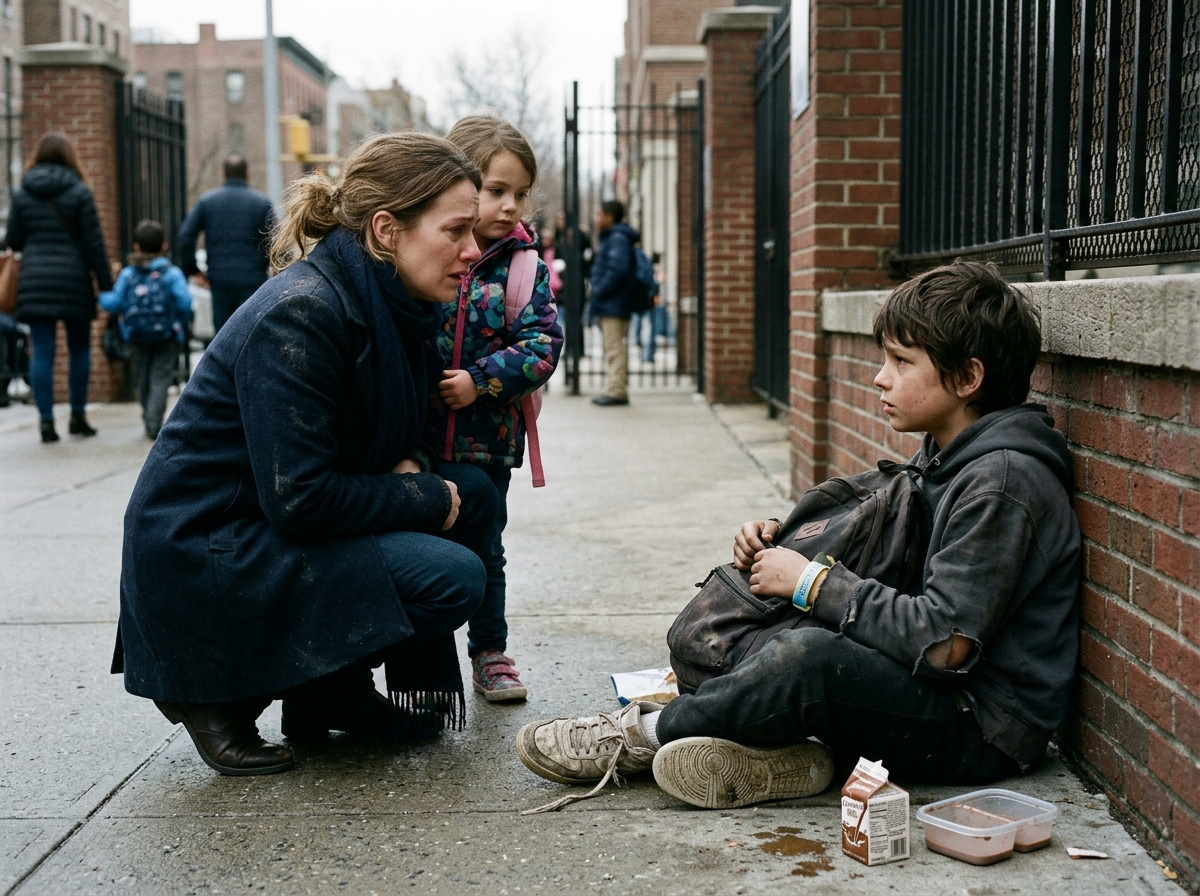
Noah was waiting in a small room with a window overlooking a courtyard. His hoodie had been replaced with a clean sweatshirt, and his hair had been washed. He still looked wary, but he was no longer trying to disappear into the furniture.
The blue bracelet remained on his wrist.
He looked at me when I entered.
“You came back.”
“Yes.”
“Why?”
I sat in the chair opposite him, leaving enough space between us that he would not feel trapped.
“Because I believe I may be connected to your birth. I don't want to make you believe something that isn't true, so I brought documents that might help us understand what happened.”
He glanced at the folder.
“Are you going to take me somewhere?”
“No. Nobody is going to move you simply because I say something. Elena and the other people helping you will explain every step, and you can ask questions.”
He looked toward Elena, who nodded.
“Do you know who my parents are?” he asked.
I felt the question like a hand closing around my heart.
“I believe I know who your mother is,” I said. “And I think that person may be me.”
Noah did not move.
For several seconds, he stared at me with an expression too complicated for a child his age. I saw disbelief, anger, and something that looked dangerously close to hope.
“Then why did you leave me?”
I had rehearsed answers during the sleepless nights since our first meeting. None of them seemed adequate now that the child himself was asking.
“I was frightened,” I said. “There were circumstances around your birth that I didn't know how to handle. I believed that leaving you in the care of other people would give you a safer life. I signed papers because I was told that was the best way to protect you.”
“Did you want me?”
“Yes.”
The word came out immediately.
Noah's eyes narrowed.
“Then why didn't you come back?”
I lowered my gaze for a moment, not to escape his question but to make certain I answered it honestly.
“I was told the arrangement had been settled. I was afraid that trying to change it would hurt you. I also felt ashamed of the choice I had made. Instead of facing that shame and finding out the truth, I stayed away. That was my responsibility. You were a baby. None of it was your fault.”
He looked down at the bracelet.
“People said my mother didn't want me.”
My throat tightened.
“I'm sorry you were made to believe that. I wanted you, Noah. I was too frightened to make the choices you deserved from me, but I never believed you were unworthy of love.”
He gave a bitter little laugh.
“That's easy to say now.”
“Yes,” I replied. “It is. I know that words can't undo what happened.”
He looked surprised that I hadn't argued.
I opened the folder and showed him the birth record. Elena remained beside us, helping him understand the information without overwhelming him with legal terminology. The hospital's name matched the bracelet. The date matched his age. My full name appeared in the space for the birth mother.
Noah stared at the page.
“That's your name.”
“Yes.”
“And this is my birthday?”
“Yes.”
He traced the printed date with one finger.
“Why didn't anyone tell me?”
“I don't know exactly what you were told or by whom. I don't want to guess. We need to examine the records and find out what happened.”
I then placed the photograph on the table, turning it toward him.
It showed a newborn wrapped in a white blanket, his face scrunched as though he had just been interrupted in the middle of an important dream. My hand rested beside his cheek. The hospital bracelet was visible around his tiny wrist.
Noah looked from the photograph to the bracelet he wore now.
For the first time, he leaned forward.
“That's me?”
“I believe it is.”
He picked up the photograph carefully. His thumb stopped near the edge where the bracelet appeared.
“Did you take this?”
“A nurse took it for me.”
“Why did you keep it?”
I could not hide the tears in my eyes.
“Because I couldn't bear to throw it away. Even when I couldn't bear to look at it, I kept it.”
He set the photograph down.
“You kept a picture. I kept this.”
He touched the old bracelet.
The comparison left me speechless. I had preserved a photograph in a locked drawer, protected from dust and daylight. He had carried a fragile strip of plastic through whatever places he had slept, keeping it close even when he had almost nothing else.
I wanted to reach for his hand. I did not.
“May I ask how you got it?” I said.
Noah rubbed the worn edge of the band.
“I've always had it. When I was little, a woman told me it was from the hospital where I was born. She said it was important, but she didn't explain much. Later, when I asked questions, people got angry or said I should stop asking.”
“Do you remember the woman's name?”
He shook his head. “I was small.”
Elena noted the answer without pressing him further. She explained that the bracelet was useful evidence, but the documents needed independent verification before anyone could draw final conclusions.
Noah looked at me again.
“If you're my mother, do I have to live with you?”
“No.”
The answer surprised him.
I continued carefully. “You deserve a safe place to live, and you deserve to know your family history. But you don't have to decide anything about living with me today. We need to make sure you're safe first, and then you should have a say in what happens next.”
He seemed uncertain what to do with that answer.
“What if I don't want to call you Mom?”
“Then you don't have to.”
“What if I don't forgive you?”
I felt the words settle between us.
“I will be sorry for what happened whether you forgive me or not. You don't owe me forgiveness.”
Noah turned toward the window. His shoulders had risen, and he was gripping the photograph so tightly that I feared he might bend it. Elena gently reminded him that he could take a break whenever he wanted.
He shook his head but remained silent.
I let the silence stand.
After several minutes, he asked whether I had another child.
“Yes. Sophie is seven.”
“Does she know about me?”
“Not yet. I haven't told her because I wanted to understand the truth first and respect your privacy. I won't tell her more than you are comfortable sharing without talking with you about it.”
He looked back at me.
“Would she hate me?”
“No,” I said. “But I can't decide how she will feel about something she doesn't understand yet. I can promise to help her understand that none of this is your fault.”
Noah studied the photograph again.
The meeting ended when he said he was tired. I did not ask him to stay. Before he left, I asked whether he wanted the photograph.
He hesitated.
“Can I keep it for now?”
“Of course.”
He slipped it carefully into the front pocket of his backpack, separate from the broken zipper.
I watched him go with Elena, carrying the first tangible proof of his earliest days that he had ever been given.
For the first time since I had seen him outside the school, I had a reason to believe the truth could be established. But I also understood that proving I had given birth to Noah would not erase the years he had spent without me.
That evening, I returned to the documents I had signed nine years earlier. The language was still difficult, but now I read every line with a lawyer's help rather than relying on the explanation I had received when I was frightened and exhausted.
The lawyer, Ms. Morgan, listened as I described the bracelet, the records, and the meeting with Noah. She cautioned me not to assume that the old paperwork explained his entire childhood. The documents might show what I had agreed to at the hospital, but they could not establish every event that followed.
Then she reached a section I had barely understood at the time.
Her expression changed.
“Claire,” she said, “this document does not establish what you thought it established.”
I leaned forward.
“What does it mean?”
She turned the page toward me and pointed to the relevant paragraph.
“This is a temporary placement authorization. It is not, by itself, proof of a completed adoption or a permanent transfer of parental rights. We need to obtain the full case file and determine what happened afterward.”
I stared at the words.
For nine years, I had believed my son had been permanently placed beyond my reach. I had believed that the decision was irreversible, that I had no right to disturb whatever life he had been given.
But the paperwork in front of me did not say what I remembered being told.
“What are you saying?” I whispered.
“I'm saying we don't yet know the legal history. We need the complete records.”
I looked at the photograph on my phone, taken from the copy I had kept in the folder. The newborn's tiny face stared back at me.
I had not simply lost a child in the past. I might have misunderstood the very decision that separated us.
And if that was true, the question was no longer only why I had left him.
It was what had happened to him after I did.
Click here to continue reading: PART 4: The Truth About His Birth Forced Me to Face the Choice I Had Made and the Life He Deserved Now
The Blue Hospital Bracelet That Made a Mother Stop in the Middle of the Street
Part 3 of 28

One Comment on “PART 3 – The Records Behind His Bracelet Exposed the Difference Between Giving Him Away and Losing Him”