The complete file arrived several days later, after the hospital and the relevant child-welfare office verified my identity and authorized the release of records I was entitled to receive. Ms. Morgan reviewed the documents with me in her office. I had barely slept the night before, and my hands were cold despite the heating.
She began with the facts.
I had given birth to Noah at St. Catherine's Medical Center nine years earlier. The bracelet matched the hospital's record. The date, temporary name, and identifying details were consistent. A review of the archived records confirmed that the child in the photograph was the boy now receiving support through Elena Ruiz's team.
There was no longer a reasonable basis to doubt that Noah was my biological son.
But the records also showed that the arrangements made after his birth had not followed the path I had believed they had.
The temporary placement had been arranged through a private intermediary recommended to my family. I had been told that Noah would enter a stable, permanent home and that the paperwork I signed completed the process. The file contained evidence of an initial placement, but it did not contain the final legal order I had assumed existed.
A later note showed that the original placement had broken down. The child had been moved again. Subsequent records were incomplete, and some information had been transferred between agencies without a clear explanation of who was responsible for maintaining contact with the birth family.
I read the pages twice, trying to reconcile them with the assurances I had received nine years earlier.
“What happened to him after the placement failed?” I asked.
Ms. Morgan folded her hands.
“We can't determine every detail from this file. Some of the records are missing, and others require further verification. We know he experienced multiple changes in care. We also know the permanent legal arrangement you believed had been completed was never established in the way you were told.”
I felt sick.
For years, I had imagined Noah growing up in a secure home, perhaps asking about his birth mother one day but otherwise surrounded by people who loved him. That belief had been the only thing allowing me to endure the separation.
Now I understood that my silence had been built partly on information that was false or incomplete.
“I should have checked,” I said.
“Yes,” Ms. Morgan replied. “You should have sought independent advice before accepting those assurances. But we need to distinguish your decision from the actions of the people responsible for his care afterward. You made a choice under pressure. Other adults and institutions also had responsibilities.”
I wanted someone to blame, but anger could not restore Noah's childhood. I had to face the part that belonged to me without pretending that I had caused every misfortune that followed.
I had left my newborn son in the belief that I was giving him a chance at stability. When uncertainty arose, I chose not to investigate. I let shame and fear persuade me that the story was finished.
It had not been finished for Noah.
He had been the one living with the consequences.
The next step was not a dramatic reunion or an immediate decision about where he would live. Elena explained that Noah needed consistent care, a safe place to stay, medical attention if required, and support from professionals trained to work with children who had experienced unstable living arrangements. Any longer-term plan would need to consider his wishes, his circumstances, and the legal findings.
I agreed to cooperate fully.
I also agreed not to approach him unexpectedly, contact anyone from his past without guidance, or promise him a future I could not guarantee. If he wanted to see me, I would be there. If he needed distance, I would respect it.
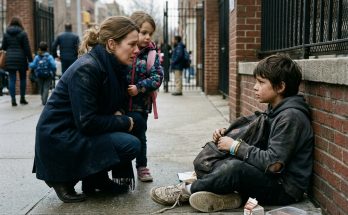
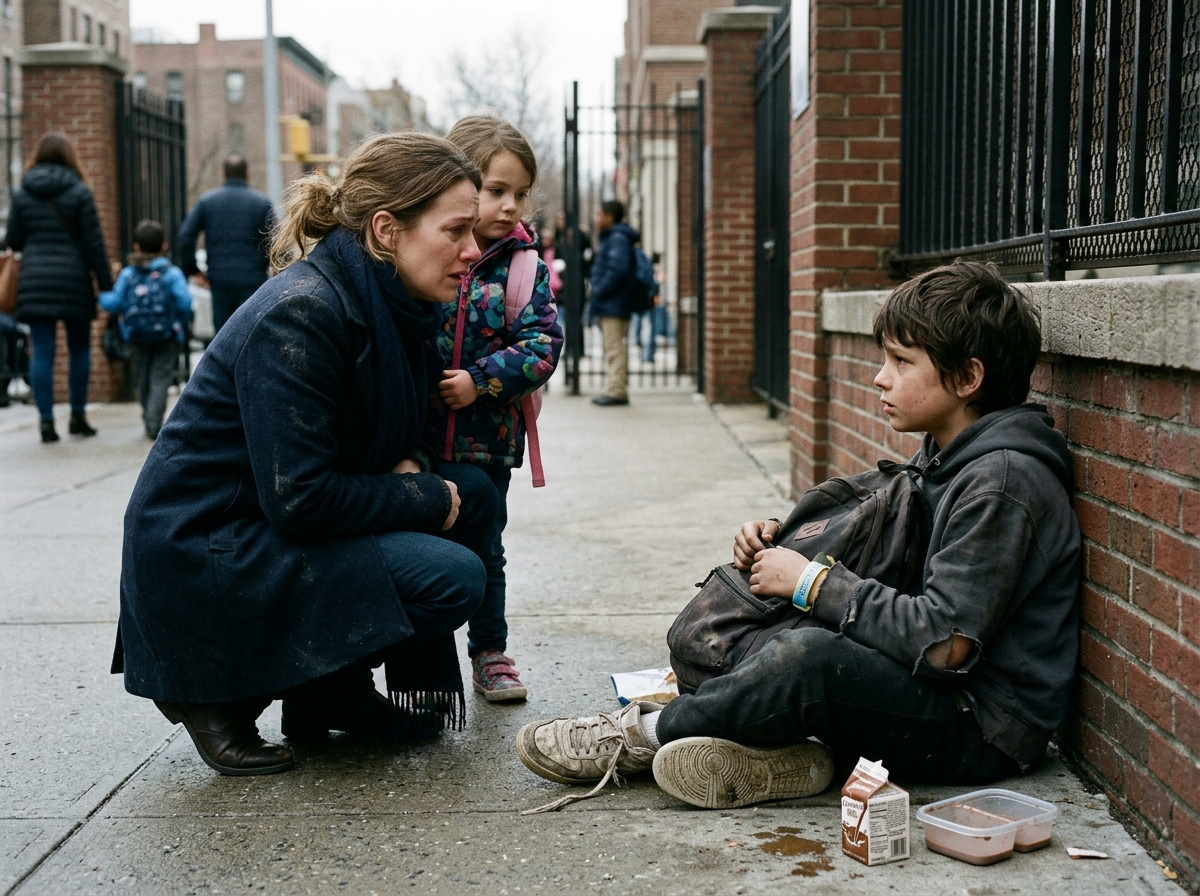
When Elena arranged our next meeting, Noah arrived carrying the same backpack. The photograph was now tucked into a plastic sleeve, protected from moisture. The blue bracelet remained on his wrist.
I noticed that he had washed his sweatshirt, though the cuffs were beginning to fray.
“Did you find out?” he asked.
“Yes.”
He sat down across from me.
“Am I really your son?”
I felt the answer rise from somewhere deeper than speech.
“Yes, Noah. You are.”
He stared at the table. His expression did not soften into relief. Instead, he looked as though someone had handed him a new problem he had not asked to solve.
“What happened to me?”
I told him what the verified records showed. I explained that I had given birth to him, that I had signed temporary placement documents, and that I had been told the arrangement was permanent when it had not been completed as I believed. I explained that the records showed he had moved between placements, but that we did not yet know every detail of his life afterward.
I did not tell him that everything had happened because of a single villain. The file did not support such a simple explanation. There had been mistakes, failures of communication, and adults who had not fulfilled their responsibilities. I had also made a choice that I should have questioned more carefully.
“I thought you were safe,” I told him. “I believed you were growing up with people who could give you a stable home. When I was told the arrangement was finished, I was afraid to challenge it. I should have asked for independent advice and made sure the truth was clear.”
Noah's eyes remained fixed on the table.
“Did you forget about me?”
“No. Not one day.”
“Then why didn't you look for me?”
I had no answer that could make the years disappear.
“I was afraid,” I said. “And I let that fear control me. I told myself that staying away was kinder than disturbing your life. I was wrong to make that decision without knowing what your life was really like.”
He pressed his lips together.
“I used to think maybe my mother was dead.”
I closed my eyes briefly.
“I'm sorry.”
“Sometimes I thought she was rich and didn't want a poor kid. Sometimes I thought she had another family and was happy without me.”
“I can understand why you thought those things. I can't ask you to stop feeling hurt just because you know more now.”
He looked at me then, and I saw the anger I had feared.
“You had a house. You had a daughter. You had food. I was sleeping wherever I could.”
I did not defend myself.
“Yes.”
“You could have looked for me.”
“Yes,” I said again, tears slipping down my face. “I should have done more.”
For a moment, the only sound in the room was the hum of the heating system.
Noah pulled his sleeve over the bracelet.
“I don't know if I want you to be my mother.”
The words hurt, but I had no right to ask him to protect me from the consequences of my own decisions.
“You don't have to decide that today,” I replied. “You don't have to call me anything you aren't ready to call me. I want to earn your trust, but I understand that I cannot demand it.”
He studied me for a long time.
“Are you going to leave again?”
I leaned forward slightly, keeping my hands on my own knees rather than reaching for him.
“I won't disappear without telling you. If something changes, I will explain it honestly. I can't promise that every decision will be easy, and I can't promise that you'll never be disappointed in me. But I can promise to tell you the truth and to keep showing up in the ways you're comfortable with.”
He said nothing.
Elena reminded us that Noah could take a break. He shook his head and remained in the chair, though his shoulders were tense.
After a while, he asked about Sophie.
“Does she know now?”
“I told her that I met a boy who may be part of our family, and that we were trying to understand the truth. I didn't give her details about your life. I wanted to speak with you first.”
“Does she want to see me?”
“She asked whether you were safe. She said she hoped you were getting help. If you decide you'd like to meet her, we can arrange it slowly, with support. There is no hurry.”
Noah looked down at his shoes.
“Maybe.”
“Maybe is enough.”
Over the following weeks, we began with short, supported meetings. Noah chose where he wanted to sit and how long he wanted to stay. Sometimes he asked questions about his birth. Sometimes he wanted to talk about school, food, or the places he had slept. At other times, he barely spoke.
I learned not to treat every silence as a problem I needed to solve.
The support team helped arrange a stable temporary home while the longer-term plan was assessed. Noah received clean clothes, regular meals, and help returning to education. He was offered counseling, but no one forced him to describe experiences before he was ready. His bracelet remained his possession, and the photograph stayed in the plastic sleeve inside his backpack.
When he first visited my house, he stood at the entrance for nearly a minute.
Sophie waited in the living room, wearing a yellow sweater and holding a drawing she had made. I had explained that Noah was her brother, but I had also told her that he might not want hugs, questions, or immediate friendship.
She had listened carefully.
When Noah finally stepped inside, Sophie stayed where she was.
“Hi,” she said. “I'm Sophie.”
“I know.”
She glanced at the drawing in her hands. “I made a picture of the garden. You don't have to look at it if you don't want to.”
Noah stared at her, then accepted the paper.
It showed a house, three people, and a sun in the corner. The figures were drawn with uneven arms and enormous heads. Sophie had written their names beneath them, but she had left the third name blank.
“Who's that?” Noah asked, pointing to the empty space.
“I didn't know what you wanted me to call you in the picture,” she answered. “You can write your name if you want.”
Noah held the pencil for a long time. Then, slowly, he wrote Noah beneath the third figure.
Sophie smiled but did not try to hug him.
That first visit lasted less than an hour. Noah ate a sandwich at the kitchen table, looked around the garden, and asked whether he could take the drawing with him. I said yes. When it was time to leave, he thanked me for the food and followed Elena to the door.
I wanted to ask him to stay longer.
I let him go.
The visits continued, gradually becoming more comfortable. Sometimes Noah came for lunch. Sometimes he wanted to look at old photographs. Once he spent nearly twenty minutes examining a shelf of children's books before selecting one about an adventurous fox. He did not immediately become affectionate, and I stopped measuring our progress by how often he smiled.
Trust was not a prize he owed me for trying.
One afternoon, several months after I first saw him outside the school, Noah sat across from me at the kitchen table. His blue bracelet was still on his wrist, though the cracked plastic had begun to separate along one edge. The care team had offered to help preserve it, but he had not decided whether he wanted that.
“Claire,” he said.
I looked up.
It was the first time he had used my name without calling me “lady” or avoiding any form of address.
“Yes?”
“Can I ask you something?”
“Anything.”
“Why did you call me Noah?”
I sat back, surprised by the question.
“Because when I was pregnant, I kept thinking about the name. I wanted something simple, something that sounded gentle. I wrote it down before you were born.”
“Did you like it?”
“I loved it.”
He looked at the bracelet. “Then I want to keep it.”
“The name?”
“The bracelet. And the name.”
I nodded, unable to speak for a moment.
“Then we'll keep both.”
He did not call me Mom that day. He did not promise to forgive me, and he did not suddenly forget the years he had spent without a stable home. Those wounds would take time, and some might always remain part of his story.
But he stayed for dinner.
Sophie showed him how to make a paper airplane, and the two of them argued over whose plane had flown farther. Noah laughed when hers landed inside a fruit bowl. Later, he asked whether he could come back the following Saturday.
I told him he could, provided the plan worked with his support team and he wanted to come.
“I do,” he said.
That night, after he had left with Elena, I stood by the kitchen window and watched the streetlights come on. I thought about the woman I had been nine years earlier, frightened and convinced that silence was the only way to protect her child. I could not return to that hospital room and make a different decision. I could not give Noah back the years he had lost.
But I could stop allowing fear to make decisions for him now.
The truth about his birth had answered the question raised by the bracelet. The boy outside the school was the newborn I had held and left behind. The records had revealed how incomplete my understanding of that decision had been, and the years that followed had shown the terrible cost of trusting assurances instead of seeking the truth.
What came next could not be determined by guilt alone. Noah needed safety, consistency, and the freedom to decide what kind of relationship he wanted with me. He needed adults who would not ask him to comfort them for the pain they had caused. He needed time to discover whether the woman who had returned to his life could become someone he trusted.
I was willing to begin there.
The following morning, Sophie placed the drawing of the three people on the refrigerator. Noah had not taken it home after all; he had left it on the kitchen table, saying he might want to add something to it next time.
The third figure now had a name.
I stood looking at the picture for a long moment. Then I took down the old hospital photograph from the folder and placed it in a frame beside it, not as a demand that Noah embrace his past, but as a reminder of the truth we had finally stopped hiding.
The blue bracelet had brought me face-to-face with the child I had lost. It had not repaired what happened, and it had not made forgiveness inevitable. It had simply opened a door that I should never have allowed fear to close.
For the first time in nine years, I was no longer asking myself how to live without knowing what had become of my son.
I was learning how to show up for the boy who had survived without me.
Click here to continue reading: PART 5: My Son Returned to the House He Had Never Known, but Trust Was Not Something I Could Buy
The Blue Hospital Bracelet That Made a Mother Stop in the Middle of the Street
Part 4 of 28