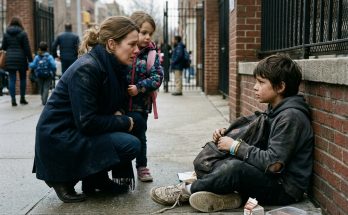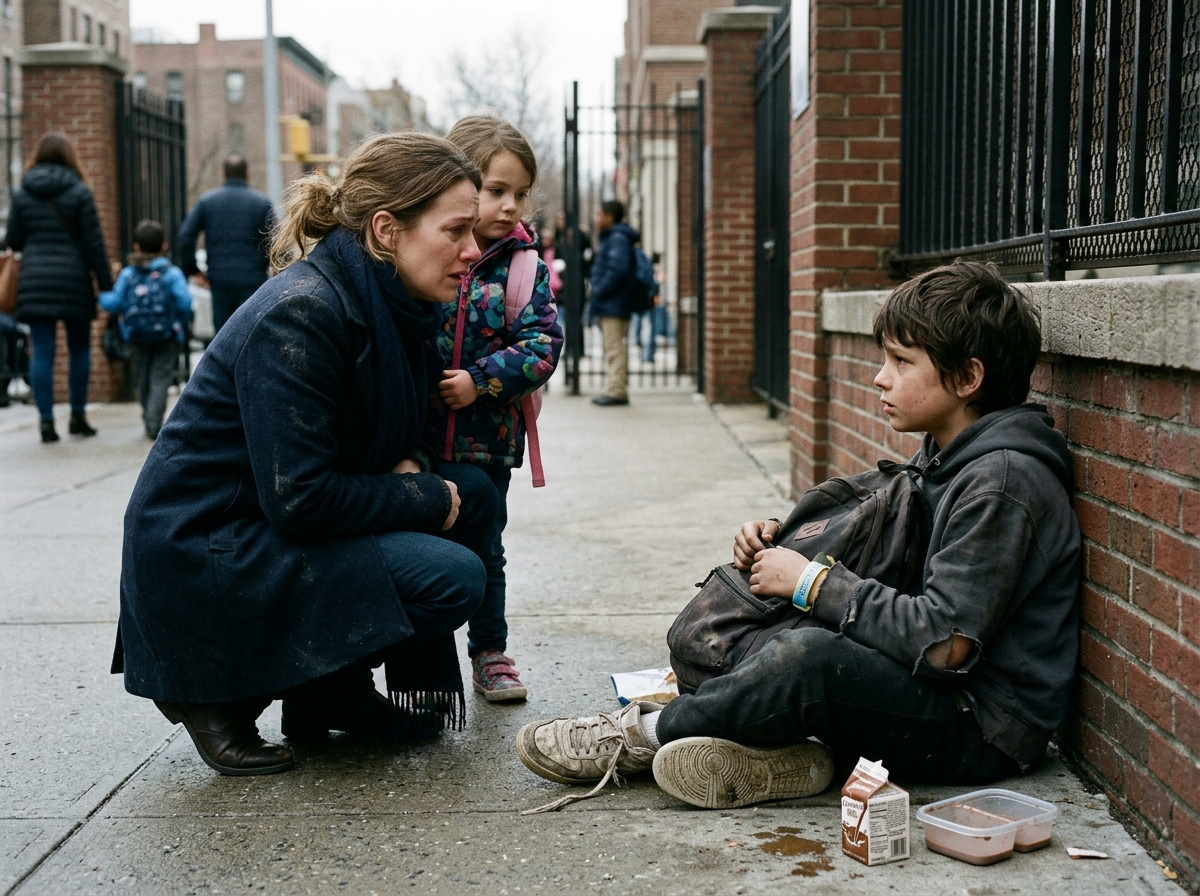
Noah did not come closer. He stood near the curb with his battered backpack hanging from one shoulder, watching me as though he were deciding whether to run.
I couldn't blame him. A stranger had intervened in a humiliating scene, offered him food, and then begun crying at the sight of a hospital bracelet he clearly considered private. From his perspective, my behavior was frighteningly unpredictable.
I took a slow breath and made myself lower my voice.
“I'm sorry. I didn't mean to scare you.”
“You said you knew something about my bracelet.”
“I recognized the hospital's name.”
His expression tightened. “So?”
“So I was there nine years ago.”
He looked unconvinced. “Lots of people go to hospitals.”
“Yes. You're right.”
I wanted to tell him everything. I wanted to explain the night I had given birth, the impossible choice that followed, and the years in which I had convinced myself that staying away was the least harmful thing I could do. But I had no proof yet, and he had every reason to distrust an adult who approached him with a story that might change his life.
I needed to slow down.
“Would you let me look at the bracelet from a little closer?” I asked. “You can say no.”
He covered it with his other hand.
“No.”
“All right.”
My answer seemed to surprise him. He had probably expected an argument.
I continued, “I won't force you. But I am worried about you being out here without somewhere safe to go. You don't have to trust me. We can ask the school counselor or a child-support worker to help you find somewhere safe tonight.”
His eyes moved toward the school gates. “They'll make me leave.”
“Who will?”
“The people who say they're helping.”
I understood that I was hearing only fragments of a much larger story. I also knew that a child who had been sleeping in different places might have learned to distrust every promise an adult made.
“I can't promise exactly what they'll do,” I said. “But I can stay with you while we find someone qualified to help.”
He looked at me for several seconds.
“Why would you stay?”
Because I might be your mother.
The answer burned in my throat, but I swallowed it.
“Because you shouldn't have to deal with this alone.”
Noah glanced at Sophie. She had been unusually quiet, watching him with the solemn concern children sometimes show when they sense that adults are struggling with something they cannot explain.
“Is she your daughter?” he asked.
“Yes.”
“You look like her.”
The remark struck me unexpectedly.
Sophie had my eyes, the same dark eyebrows, and the small dimple that appeared in her left cheek when she smiled. Noah's resemblance to me was more pronounced, but there was something in the way he studied my face that reminded me of Sophie when she was trying to understand an unfamiliar situation.
“She's seven,” I said.
Noah nodded. “I'm nine.”
“I know.”
He frowned. “How?”
I froze.
“I mean, you look about nine,” I corrected. “You told me earlier.”
He had. I was grateful for that small fact, although it did nothing to calm the storm inside me.
The school staff member who had approached earlier returned with a woman wearing an identification badge. She introduced herself as Ms. Patel, one of the school's safeguarding coordinators. She asked Noah whether he wanted to speak somewhere quieter and made it clear that he did not have to enter the building if he felt uncomfortable.
Noah immediately backed away.
“I'm not going inside.”
“That's fine,” Ms. Patel said. “We can talk out here, or we can find another place that feels comfortable.”
He studied her badge but did not answer.
I watched his face. Every offer seemed to force him into a calculation: what would it cost to accept, what might he lose, and whether the person offering help would change their mind once he became inconvenient.
Ms. Patel asked whether he had eaten that day. He admitted that he had only eaten the crackers Sophie gave him. She then asked whether he had somewhere to sleep that night.
Noah looked at the pavement.
“I'll find somewhere.”
“That isn't the same as having somewhere safe,” she replied gently.
“I can manage.”
“I believe you're doing your best. You shouldn't have to do everything by yourself.”
For a moment, I thought he might agree. Then his gaze fell on my face, and his expression hardened again.
“I don't want her asking me questions.”
Ms. Patel followed his glance toward me.
“That's okay,” she said. “Claire doesn't have to be involved in our conversation if you don't want her to be.”
“No,” I said quickly, then stopped myself. I had no right to insist on being present. “I'm happy to give him space.”
Noah seemed to relax a fraction.
Ms. Patel arranged for a trained outreach worker to meet them at a nearby family-support office. She explained that the worker could discuss Noah's immediate needs and help determine the safest next steps. Nothing would be decided by a stranger on the pavement, she assured him, and he could ask questions about what was happening.
Noah agreed to walk with her only after she promised he would not be taken anywhere without an explanation.
Before leaving, he turned to me.
“Are you going to tell people about me?”
I shook my head. “I'm not going to share your story with other people. The professionals helping you may need information to keep you safe, but you deserve to know what is being shared and why.”
He studied me again, then tugged his sleeve farther down over the bracelet.
“Fine.”
I watched him walk beside Ms. Patel toward the corner. He kept his head lowered, but his pace was steady. Sophie stood beside me, holding my hand so tightly that my fingers began to ache.
“Mommy,” she said, “you looked like you knew him.”
I stared after Noah.
“I don't know yet.”
It was the truth, though not the whole truth.
At home that afternoon, I sat at the kitchen table while Sophie colored a picture beside me. I had barely touched the lunch I prepared. Every time I closed my eyes, I saw the blue bracelet and the small hand that had once rested in mine.
Nine years earlier, I had been twenty-six, unmarried, and terrified. The pregnancy had begun with a relationship I believed would become a family. When the child's father learned I was pregnant, he disappeared from my life. My parents, who had built their reputation around respectability and control, told me that a baby born outside marriage would destroy the future they had planned for me.
I resisted them at first.
I attended prenatal appointments alone. I bought tiny clothes with money saved from my first job. I spoke to the baby when I was certain nobody could hear me. In the quiet of my rented room, I imagined a little boy growing up with my stubbornness and perhaps his father's smile.
Then, near the end of the pregnancy, I discovered something that changed the circumstances surrounding the birth. The details were more complicated than a family argument, and they were the reason I had never told anyone the whole story. For nine years, I had carried those details like a sealed envelope I was afraid to open.
I gave birth at St. Catherine's Medical Center on a rainy night in October.
I remembered the white ceiling, the sharp smell of antiseptic, the nurse's calm voice, and the weight of the newborn placed against my chest. His hair was dark and damp. His tiny mouth opened in a silent yawn before he began crying.
Someone had written his temporary name on the blue hospital bracelet. I remembered the handwriting because I had watched the nurse print each letter while I held him.
Noah.
I had called him Noah before anyone else had the chance to suggest a different name.
When I held him, the world narrowed to the warmth of his body and the small movements of his fingers. I promised him that I would keep him safe. I promised that he would never wonder whether he was wanted.
Then the adults around me began explaining why I could not keep him.
The choice I made afterward had never stopped hurting. I had told myself that I was giving him a better chance, that I was too young and too frightened to protect him from the conflict surrounding his birth. I had signed documents I barely understood, believing the arrangement would provide him with a stable home.
I did not know what his life would become.
For years, I received no direct information. When I asked questions, I was told that the matter had been handled and that reopening it would only cause distress. Eventually, shame became another reason for silence. I built a life around my daughter, my work, and the secret that had never stopped following me.
Now the child I had left behind was sleeping somewhere unsafe, wearing the bracelet that connected him to the night I had tried to bury.
My phone rang.
The number was unfamiliar. I answered immediately.
“Ms. Bennett?” a woman asked. “My name is Elena Ruiz. I'm the outreach worker who met Noah this afternoon. He agreed that I could contact you because you were present when he was being bullied.”
I gripped the edge of the table.
“Is he all right?”
“He's physically safe at the moment. We've arranged temporary support while we assess his circumstances. He has been reluctant to provide much information about his family, and we don't want to pressure him.”
“Did he tell you anything about where he got the bracelet?”
There was a pause.
“He said it has belonged to him for as long as he can remember. He believes it came from the hospital where he was born. He becomes distressed when people suggest taking it away.”
I closed my eyes.
“Did he give you the hospital's name?”
“Yes. St. Catherine's Medical Center.”
The room seemed to lose its air.
Elena continued, “He also mentioned that the bracelet is the only thing he has from his earliest days. We are trying to understand whether there are records or relatives who can help us establish his identity and history.”
I pressed a hand over my mouth.
“Can I see him?”
“That depends on what Noah wants. He was unsettled by the attention he received today, and we need to respect his boundaries. If he agrees to another meeting, we can arrange it in a supported setting.”
“I understand.”
I did understand, at least in principle. If Noah was my son, I had already made one life-changing decision on his behalf without giving him a voice. I could not begin this second chance by repeating that mistake.
Before ending the call, I asked Elena whether there was a way to verify the bracelet without removing it from Noah's possession.
“We can explore that with him,” she said. “But any search should be handled carefully. A bracelet can provide a lead, not a complete answer.”
After the call, I remained at the table long after the screen went dark.
Sophie came over and leaned against me.
“Is the boy okay?”
“He has someone helping him tonight.”
“Will we see him again?”
I looked at my daughter, who knew nothing about the brother she might have had for nine years.
“I don't know, sweetheart.”
She studied my face. “You're still sad.”
“Yes.”
“Is it because of the bracelet?”
I drew her into my arms. “Yes.”
She rested her head against my shoulder, accepting that answer without demanding more.
That night, I retrieved the old folder I had kept in a locked drawer. The hospital paperwork was still there, along with the documents I had signed before leaving the medical center. Some pages were folded at the corners; others bore marks from years of being handled and put away again.
I spread them across the dining table.
There was the date of birth. There was the hospital's name. There was my signature.
And there was a document that made my hands begin to shake.
It referred to an arrangement I had believed would protect my newborn son, but it did not say what I had spent nine years telling myself it said. The language was careful, full of legal phrases and conditions. I had been exhausted, frightened, and surrounded by people insisting that I had no better choice.
I read it once, then again.
My memory of that night began to fracture under the weight of the words on the page.
I had thought I understood what happened to my son after I left the hospital.
Perhaps I had never understood it at all.
Click here to continue reading: PART 3: The Records Behind His Bracelet Exposed the Difference Between Giving Him Away and Losing Him
The Blue Hospital Bracelet That Made a Mother Stop in the Middle of the Street
Part 2 of 28