“Get away from our school! Nobody wants you here!”
The boy barely had time to lift his head before a carton of chocolate milk struck the pavement beside his shoes. Brown liquid splashed across his torn jeans. A second boy laughed, raised his phone, and began recording while two other students scattered the remains of their lunches around the sidewalk.
I stopped walking.
My seven-year-old daughter, Sophie, tightened her fingers around mine. We had been on our way to the car after her morning appointment at school, and I had been thinking about an email I needed to answer before noon. A moment earlier, the world had been ordinary: traffic crawling along the street, parents hurrying toward their vehicles, the smell of warm bread escaping from a bakery across the road.
Now I could hear the boy's laughter from the students surrounding him, and something in that sound made me turn completely around.
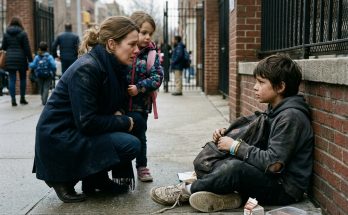
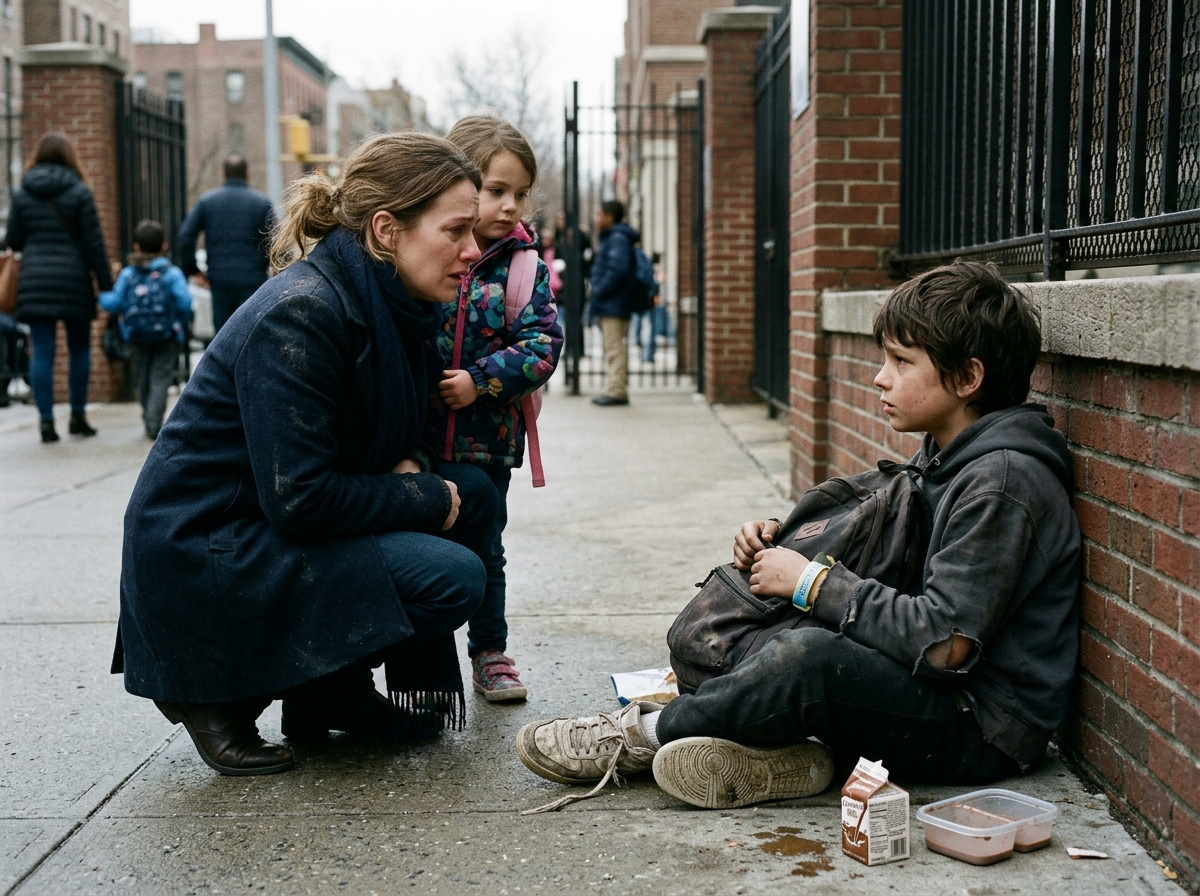
The child on the ground looked about nine. His hoodie had once been dark gray, but the fabric was faded and stained, with a hole near one elbow. His sneakers were too large for his feet, and the laces on one shoe had been replaced with a strip of fraying cord. A battered backpack lay beside him, its zipper broken and one shoulder strap hanging by a few threads.
He wasn't crying.
That was what unsettled me most.
He was gathering the pieces of his lunch from the pavement, moving carefully, as though he had learned that any sudden gesture might give someone another reason to hurt him. When a student kicked a plastic container toward the road, the boy reached after it instinctively.
“Leave it,” the student said. “It's garbage anyway.”
The boy withdrew his hand.
I felt Sophie staring at me, waiting to see what I would do. She had always been sensitive to other people's distress. At home, she cried when she saw an injured bird, and once she had insisted we take an umbrella to a delivery driver standing in the rain. Yet she had never witnessed anything quite like this.
“Mommy,” she whispered, “why are they being mean to him?”
I had no answer that could make the scene acceptable.
“Stay beside me,” I told her.
Then I crossed the remaining distance.
“That's enough.”
My voice was sharper than I intended. The students turned. One of them, a tall boy wearing an expensive blue jacket, lowered his phone a few inches but continued recording.
“We're only joking,” he said.
“Does he look as though he's enjoying the joke?”
The boy glanced at his friends. They seemed suddenly less certain of themselves without an audience willing to laugh.
“He shouldn't be hanging around here,” another student muttered. “He doesn't even go to this school.”
“That doesn't give you permission to throw food at him.”
I took out my phone. “I'm going to speak to the school administration about what happened. If you've recorded anything, you can explain why.”
The boy in the blue jacket stopped smiling.
“You can't tell us what to do.”
“No,” I said, keeping my voice level. “But I can make sure the adults responsible for this school know exactly what you did.”
For a moment, nobody moved. Then one of the students muttered something under his breath, and the group began retreating toward the school entrance. The boy with the phone was the last to leave. He looked back at me with an expression that suggested he was angry about being interrupted rather than ashamed of what he had done.
I waited until they were gone before turning to the child on the pavement.
“Are you hurt?”
He shook his head.
“Did anyone hit you?”
Another shake.
I crouched so we would be at the same height. The concrete was cold beneath my knees, and the smell of spilled milk mixed unpleasantly with the sour scent of wet clothing. Up close, the boy looked even younger. His cheeks were hollow, his lips chapped, and there was a small scab near his chin.
“What's your name?” I asked.
He looked at my face, then at Sophie, who had moved behind my shoulder.
“Does it matter?”
The question caught me off guard.
“Yes,” I replied. “It matters to me.”
He seemed to search my expression for a trick. After a moment, he said, “Noah.”
The name struck me with a strange, inexplicable force. I had heard it thousands of times in my life, yet hearing it from this child made my chest tighten.
“Noah what?”
“Collins.”
A passing car sounded its horn. Somewhere behind us, a school bell rang, and a teacher called for students to hurry inside. I barely noticed any of it.
Collins.
I repeated the surname silently, searching for a reason it should mean something. There were thousands of Collins families. The name alone proved nothing. Still, the boy's face held my attention in a way I could not explain.
His eyes were a deep brown, almost black around the pupils. His nose had a slight curve at the bridge. When he looked down, a small crease appeared between his eyebrows.
I knew that crease.
No. I couldn't know it. I was looking at a stranger, a hungry child who needed help. My mind was reaching for patterns because I was upset by what I had witnessed.
I forced myself to concentrate on the immediate problem.
“Have you eaten today, Noah?”
He hesitated.
“I had something yesterday.”
Sophie stepped around me. “We have crackers in my backpack.”
I reached for her shoulder. “Let's ask him first, sweetheart.”
She looked at the boy. “Would you like some?”
Noah's gaze moved to the small pink backpack hanging from her shoulders. For a moment, his face changed. The guarded expression loosened, revealing the hunger he had been trying so hard to hide.
“If you don't mind,” he said.
Sophie unzipped her bag and took out a sealed packet of crackers. Noah accepted it with both hands. He thanked her quietly, then glanced around before opening it, as though he expected someone to take it away.
He ate slowly at first. After the first few crackers, however, his movements became quicker. He tried to disguise his hunger by looking away from us between bites, but I could see his fingers trembling.
“Would you like something more substantial?” I asked. “There's a café across the street. We can get you breakfast.”
His expression closed again.
“I don't need charity.”
“I didn't ask whether you needed charity. I asked whether you were hungry.”
He stared at me.
Sophie tugged my sleeve. “Mommy, we can buy him a sandwich.”
Noah's jaw tightened. “I can take care of myself.”
The words came out too quickly, with a desperation that seemed far beyond his years.
I recognized that tone, though I could not have explained why. It was the voice of someone who had discovered that accepting help could be dangerous, embarrassing, or costly.
“All right,” I said. “You don't have to decide now. But I'd like to know whether you're safe.”
He gave a short, humorless laugh.
“Safe where?”
The question silenced me.
I looked at the school gates, the line of parked cars, and the people passing us without slowing down. The boy had been sitting in plain sight, surrounded by children whose families might have owned more than he had ever possessed, and nobody had stopped until I did.
“Where are you staying?” I asked gently.
Noah looked at his shoes.
“Different places.”
“Do you have an adult you can call?”
He shook his head.
“Anyone who looks after you?”
His silence answered before he did.
“No.”
I felt a cold pressure building beneath my ribs. I knew I could not solve his entire situation on a pavement, and I didn't want to frighten him by asking questions too quickly. But a nine-year-old child with no reliable place to stay needed more than a sandwich.
“We can contact someone who helps children,” I said. “You don't have to tell me everything at once. I just want to make sure you're not left out here alone.”
His eyes sharpened.
“Don't call the police.”
“Why not?”
He hugged the battered backpack against his chest. “They'll take me away.”
“Take you where?”
“I don't know.” His voice dropped. “They always say they'll take me somewhere safe. Then I don't see the people I know anymore.”
The words were delivered without drama. That made them harder to hear.
I glanced toward the school entrance. A staff member had noticed the disturbance and was approaching, but Noah stiffened when he saw her. I raised one hand to signal that everything was under control and asked her to give us a moment.
Then I turned back to him.
“My name is Claire Bennett. This is my daughter, Sophie. We're not going to force you to tell us anything you aren't ready to tell us.”
Noah studied me.
“Why are you helping me?”
“Because those students were hurting you, and that was wrong.”
“People usually keep walking.”
I had no defense against that observation.
Sophie knelt beside me and placed her remaining crackers on the pavement between them.
“You can have the rest,” she said. “I already ate breakfast.”
Noah looked at her for a long moment. Then he took another cracker, breaking it in half before eating it. He offered the other half to Sophie, who shook her head.
“Keep it,” she told him.
For the first time, something resembling a smile touched his face.
It vanished when he reached for his backpack.
The broken zipper had caught in the fabric, and he tugged at it impatiently. As he lifted the bag, the sleeve of his hoodie slid up his forearm.
I saw the bracelet.
It was blue, faded almost to gray, with a narrow white strip across the center. The plastic had yellowed with age, and one edge had cracked. A few letters remained visible despite the worn surface.
My breath stopped.
I knew the hospital's name. I knew the year printed beneath it. Most of all, I knew the small, slanted handwriting on the band, the kind nurses used when there was barely enough room to write a newborn's details.
Nine years earlier, I had held a baby boy wearing a bracelet exactly like that one.
My fingers went numb.
The street seemed to tilt, and for a moment I couldn't hear anything except the pounding of my heart. I stared at the blue band, trying to persuade myself that there must be another explanation. Hospitals used thousands of bracelets. Families kept old things. Children found objects in secondhand clothing.
But I recognized the hospital.
I recognized the year.
And I remembered the night I had walked out of that hospital carrying an empty bag, leaving behind a child whose tiny fingers had curled around mine.
Noah noticed my expression.
“Lady?” he asked. “What's wrong?”
I forced my eyes away from his wrist and looked at his face.
The resemblance was no longer something I could dismiss as an anxious imagination. The shape of his eyes, the crease between his brows, even the way his mouth tightened when he was uncertain—all of it seemed painfully familiar.
He looked like me.
Not vaguely. Not in the ordinary way that strangers sometimes resemble one another.
He looked like the child I had spent nine years trying not to imagine.
“Claire?” Sophie whispered. “Mommy, are you okay?”
I couldn't answer her.
Noah pulled his sleeve down, hiding the bracelet. He shifted backward, alarmed by the tears gathering in my eyes.
“Did I do something wrong?”
“No,” I managed. “No, sweetheart. You haven't done anything wrong.”
I wanted to reach for him. I wanted to touch his cheek and search for proof that the truth I feared was real. But he was a frightened child, and I was a stranger whose sudden tears made no sense to him.
So I stayed where I was.
“Can I ask you something about that bracelet?” I said.
His hand went immediately to his wrist.
“No.”
“I won't take it from you.”
“People always want to take my things.”
“I understand.”
“No, you don't.”
He stood abruptly, slinging the backpack over one shoulder. His face had gone pale beneath the dirt.
“I have to go.”
“Please, Noah. Just wait a moment.”
He turned toward the street.
I rose too quickly and nearly lost my balance. Sophie caught my hand, her small fingers wrapping around mine.
“Mommy, why are you crying?”
I looked at Noah's retreating figure, at the thin shoulders beneath his torn hoodie, and at the arm he kept pressed against his body to protect the bracelet.
Nine years ago, I had left a hospital believing I was making the only choice available to me.
Now the child I had left behind was standing ten feet away, hungry and frightened, asking why a stranger was looking at him as though her heart had broken.
I could have let him disappear into the crowd. I could have told myself I was mistaken and returned to the safe, orderly life I had built around a secret no one knew.
Instead, I stepped forward.
“Noah,” I called, my voice shaking. “I think I may know something about that hospital bracelet.”
He stopped.
Slowly, he turned around.
“Who are you?” he asked.
I opened my mouth, but the words I had carried for nine years would not come.
Click here to continue reading: PART 2: The Secret I Buried Nine Years Ago Was Standing Before Me, Asking Why I Cared
The Blue Hospital Bracelet That Made a Mother Stop in the Middle of the Street
Part 1 of 28