
By the time Oliver reached the end of his next school year, the family notebook had grown thick enough that its cover no longer closed properly. Pages contained drawings of the garden, the lake, the restaurant, and the community room. There were silly songs, notes about birthday cakes, and stories about people who had helped them. Grace's photograph appeared more than once, sometimes beside a serious memory and sometimes beside a drawing of the crowned tomato.
Oliver had started writing short captions without asking Daniel to check every word. His spelling was not always correct, but the meaning was clear. He was learning that a memory did not need perfect language to be worth keeping.
One afternoon, he carried the notebook into the kitchen and placed it beside Daniel's cup of tea.
“I want to make a last page,” he announced.
“Why the last page?”
“Because this book is nearly full. I want it to have an ending.”
Daniel closed his laptop. “What would you like the ending to say?”
Oliver considered the question. He looked at the notebook, then toward the photograph of Grace on the shelf.
“I'm not sure yet.”
“That's all right. We can think about it.”
They spent the afternoon reviewing the pages. Oliver laughed at the pancake drawings, paused at the picture of the cemetery, and asked Daniel to retell the story of the day Grace had nearly lost their picnic to the wind. Daniel told it with the same details he remembered, including the part where Grace had blamed him for bringing the wrong napkins.
“You always say she blamed you,” Oliver observed.
“She did. Frequently.”
“Maybe you were doing things wrong.”
Daniel put a hand to his chest in mock offense. Oliver laughed, and they returned to the notebook.
As they reached the later pages, Oliver stopped at the drawing of the family beneath the yellow sun. It had been one of his earliest attempts to show how he understood his family after Grace's death. The figures were uneven, and the house leaned to one side, but the picture had survived every rearrangement of the notebook.
“I want to draw this again,” Oliver said.
Daniel brought him fresh paper. Oliver began with the house, then added the yellow flowers, the music box, and a small table with two chairs. He drew himself beside Daniel, and he placed a photograph of Grace inside the house.
This time, the drawing was more detailed. The figures had hands and faces, and the windows showed the yellow light of a sunny morning. Oliver added a little book on the table, with a music note floating above it.
When he finished, he studied the picture carefully.
“It's different from the first one,” he said.
“Yes.”
“But it's still our family.”
Daniel felt a quiet warmth spread through him. “Yes, it is.”
Oliver wrote beneath the picture: Our family changes, but love stays with us.
They placed the drawing on the final page of the notebook. Oliver asked Daniel to help him write one more sentence, but after a moment he shook his head.
“I think that's enough.”
Daniel agreed. The book did not need to explain everything. It was a record of moments, not a complete answer to the experience of loss.
A few weeks later, the community center held a small gathering to thank its volunteers. Daniel and Oliver attended, and Mara helped arrange the chairs. Families who had used the drawing room brought photographs, notebooks, and small objects that reminded them of the people they missed. No one was required to speak, and no one was asked to explain the meaning of an object unless they wanted to.
Oliver brought his family notebook. He had decided that he wanted to show the final drawing to Helen and Mara, but he did not want to read the earlier letters aloud. Daniel supported his decision, and they placed the notebook on a table where people could look at the pictures if Oliver invited them.
During the gathering, a father approached Daniel and thanked him for helping make the room available. His daughter had used the drawing table several times, and the quiet space had helped her feel comfortable enough to attend the family meetings.
Daniel accepted the thanks but did not pretend that the room had solved the family's grief. “I'm glad it helped,” he said. “I hope it continues to be useful.”
The father nodded. “It has. Sometimes she draws. Sometimes she just sits.”
Daniel smiled. “Both are welcome.”
Across the room, Oliver was showing Mara the new drawing. She looked at the picture for a long time before asking whether he had decided what to write beneath it.
“He wrote that our family changes, but love stays with us,” Daniel said.
Mara turned toward Oliver. “That's a thoughtful ending.”
Oliver considered the word. “It's the ending of the book, not the ending of our family.”
Mara smiled. “You're right.”
The distinction mattered. Oliver did not believe that life had reached a final, perfect conclusion. He knew that he would grow older, that he would have new experiences, and that some questions about his mother would remain unanswered. The book had an ending because its pages were full, not because the family's story had stopped.
Later, Helen invited anyone who wished to share a few words about the community room to speak. Daniel remained seated, content to listen. Several volunteers described the activities they had helped organize, while a young woman thanked the group for giving her a place to write letters to her brother.
Mara spoke briefly about her mother's belief that kindness should be offered without demanding a particular response. She did not tell the entire story of the lullaby or claim that one song could change every life. She simply said that small acts of care often mattered most when people were given the freedom to receive them in their own way.
When the gathering ended, Oliver helped return the pencils to their box. He placed the unused paper in a neat stack and checked the floor for dropped markers. Daniel watched him work, remembering how the boy had once been too overwhelmed to notice anything beyond his grief.
Now Oliver could still be sad, but he could also help, laugh, and move between different parts of his life without feeling that one emotion had to erase another. Daniel knew that this would not always be easy. Growing up would bring new questions and new losses, and the meaning of Grace's absence would change as Oliver understood more about the world.
But his son had learned that he did not have to face those changes alone.
On the way home, Oliver asked whether they could visit the restaurant the following weekend. He wanted to thank Mara again for teaching him the lullaby and show her the completed notebook.
Daniel agreed. They arranged to visit after Mara's shift, when the restaurant would be quieter.
That Saturday, they arrived in the late afternoon. The familiar tables stood near the windows, and the soft clatter of dishes came from the kitchen. Mara greeted them with a smile and led them to a small table away from the busiest part of the room.
Oliver placed the notebook on the table and opened it to the final drawing.
“I finished it,” he said.
Mara studied the picture. “You've made something very special.”
“It's not just about Mommy,” Oliver explained. “It's about the people who helped us too.”
Mara turned through a few pages, admiring the drawings of the garden, the music box, and the community room. She did not ask to read the private letter or examine every page. When Oliver closed the notebook, she thanked him for showing her what he had chosen to share.
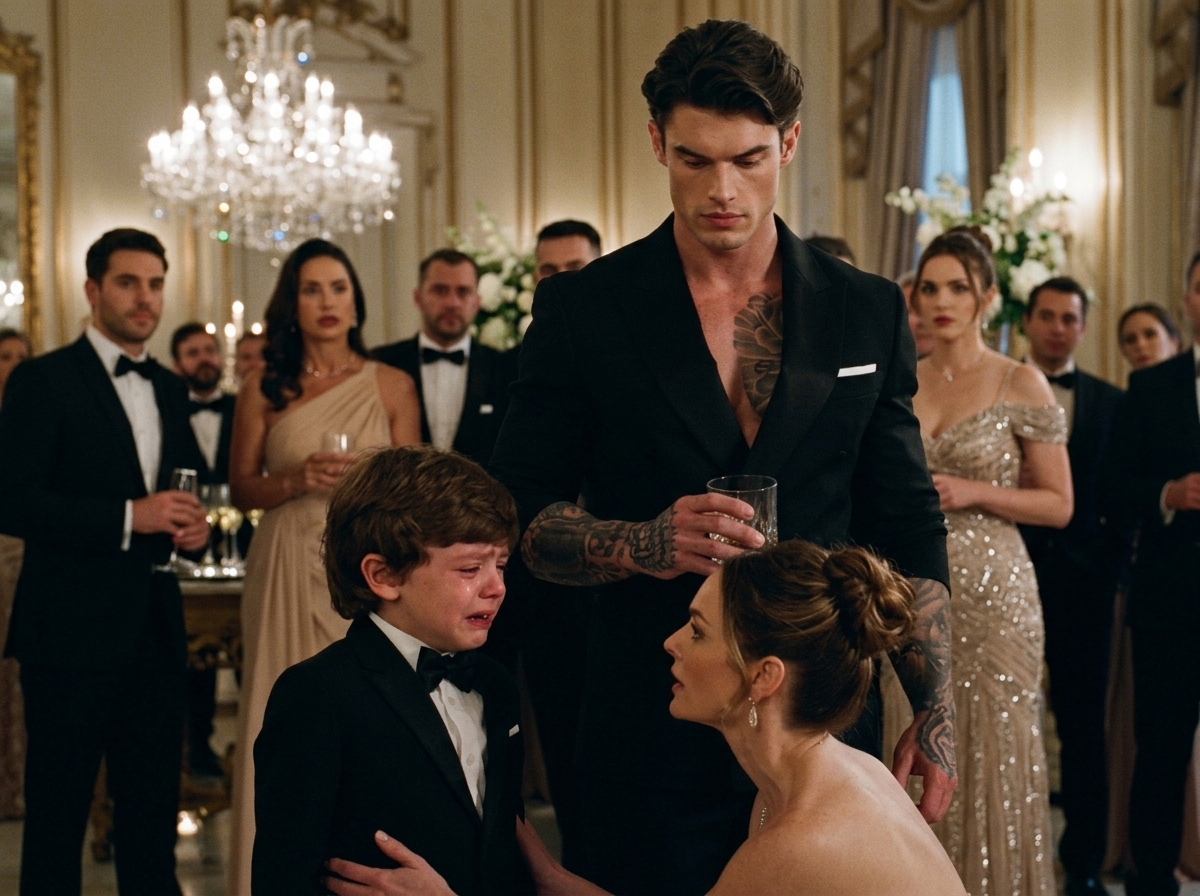
Daniel looked around the restaurant. He could still remember the evening when he had stood in the middle of the room, desperate to stop his son's crying. The memory was clear, but it no longer filled him with the same helplessness. He could see how frightened he had been, how badly he had wanted to make the pain disappear, and how little he had understood about what Oliver needed.
Mara had not solved their grief. She had sung a lullaby. She had offered a moment of comfort without knowing what would follow, and she had respected their choices as their lives continued to unfold.
“Would you like to sing it?” Mara asked Oliver.
He considered the invitation. “Yes. But just for us.”
Mara nodded. Daniel moved his chair closer, and Oliver began the song. His voice was steady, and he sang the words without looking at the notebook. Mara joined him softly, and Daniel followed as best he could.
The restaurant continued around them. A server carried plates past their table, someone laughed near the counter, and a family by the window helped a small child cut a piece of bread. The lullaby did not stop the world. It became part of the ordinary sounds of life, just as it had become part of their home.
When they finished, Oliver smiled and closed the notebook.
“Thank you,” he told Mara.
“You're welcome.”
Daniel wanted to thank her too, but he had learned that gratitude did not need to become a long speech. He met her eyes and said simply, “I'm glad you were there that night.”
Mara smiled. “So am I.”
They stayed for a little while, talking about the notebook and the plans for the next school term. Then Daniel and Oliver said goodbye and walked toward the car. The evening air was cool, and the streetlights had begun to glow.
Oliver held the notebook against his chest.
“Dad, do you think I'll sing the song when I'm grown up?”
“If you want to.”
“What if I forget some of the words?”
“We'll keep the notebook. And if we ever forget a line, we can ask Mara or look at the copy she helped us make.”
Oliver nodded. “Good.”
He was quiet for a moment, then added, “I think I understand why Mommy's song is special now.”
Daniel glanced at him. “Why?”
“Because it doesn't have to make everything better. It reminds me that someone loves me when things are hard.”
Daniel felt tears rise, but he smiled. “I think you've understood it beautifully.”
They drove home through the evening traffic. When they arrived, Oliver placed the notebook beside Grace's photograph, where it had rested for much of the year. The three stones from the lake remained nearby, along with the small music box Mara had once brought to the house.
At bedtime, Oliver asked Daniel to sing the lullaby one final time that week. Daniel sat beside him and began the familiar melody. Oliver joined him, and together they sang the words that had carried them through their hardest days.
When the song ended, Oliver closed his eyes.
“Dad?”
“Yes?”
“I'm glad I have the song.”
Daniel brushed his son's hair away from his forehead. “Me too.”
“And I'm glad I have you.”
Daniel leaned down and kissed him. “I'm glad I have you too.”
Oliver fell asleep, and Daniel remained beside the bed until the room grew still. He thought about the years that had passed since Grace's death, about the fear that had once made him believe he needed to control every feeling his son experienced. He understood now that he could not prevent every tear, and that trying to do so would have kept them both from discovering how much comfort could be found in simply staying together.
Grace's lullaby had traveled farther than any of them could have imagined. It had survived through the memory of a nurse, the care of her daughter, and the voice of a waitress who recognized a child in need. It had become part of Oliver's childhood, part of Daniel's understanding of fatherhood, and part of the quiet kindness they tried to offer other people.
The song had not brought Grace back. It had done something different. It had helped the people who loved her find a way to carry her memory without asking their lives to remain frozen around the day she died.
Daniel stood and switched off the lamp, leaving the hallway light glowing as he always did. He paused at the doorway and looked back at his sleeping son. Oliver was growing, and his understanding of love would continue to change. There would be days when the memories made him cry, days when he laughed at stories about his mother, and days when he barely thought about grief at all.
All of those days belonged to the life ahead of him.
Downstairs, the family notebook rested beside Grace's photograph. Its final page showed a house filled with yellow light, two figures standing together, and a photograph of the woman whose love had shaped them both. The drawing was imperfect, but it held the truth Oliver had learned: their family had changed, yet love had remained part of it.
Daniel looked at the photograph one last time before turning off the living-room light. He would keep telling Oliver stories about Grace, keep answering his questions honestly, and keep making room for the future without asking his son to leave the past behind.
He could not promise that every night would be peaceful or that the lullaby would always be enough. He could promise to listen, to stay, and to remind Oliver that sadness was not something he needed to hide.
And in the quiet house, where Grace's photograph stood beside the words she had once sung, that love continued to reach their son.
Click here to continue reading: PART 21: The Question Oliver Saved for the Day He Was Ready to Ask
A Wealthy Father Challenged an Entire Restaurant to Calm His Grieving Son, Until a Quiet Waitress Sang Words That Made the Boy Stop Crying
Part 20 of 28

