
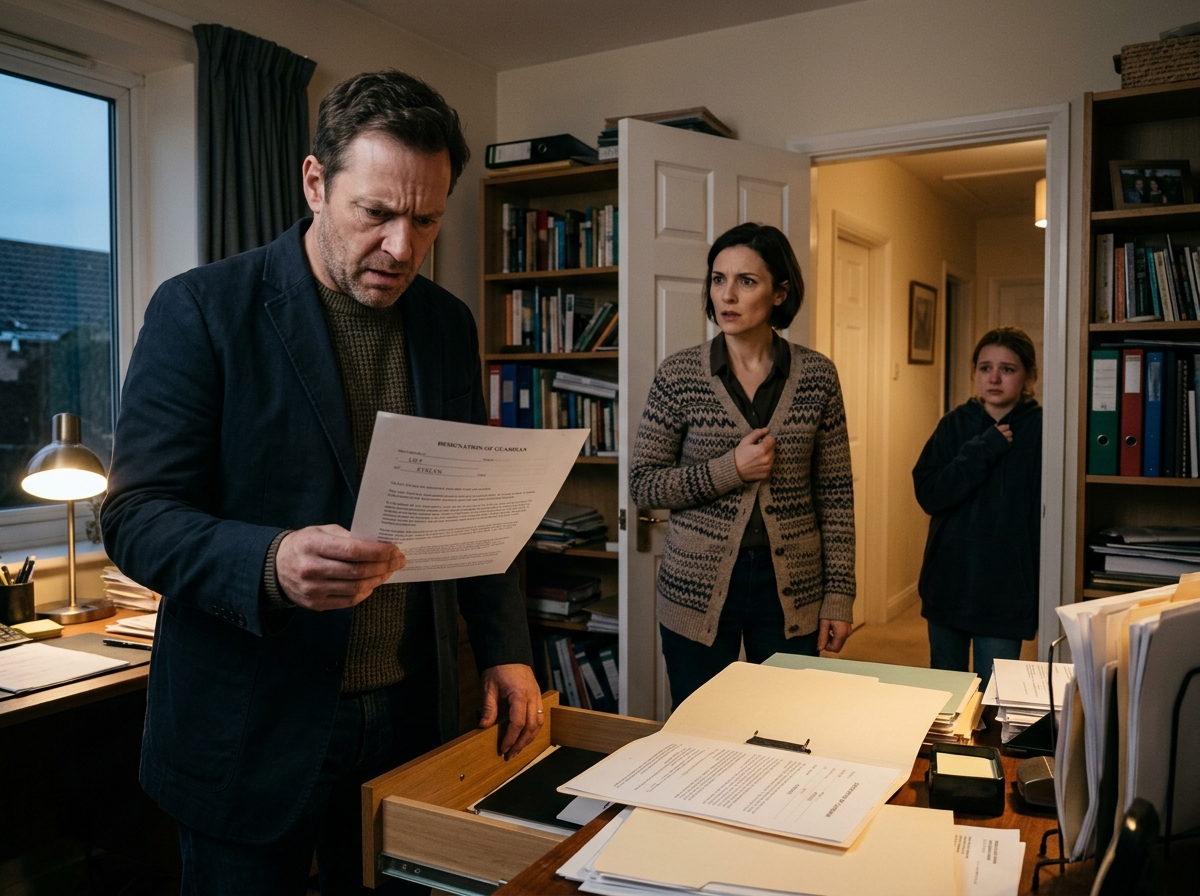
By the beginning of winter, Richard had stopped waiting for a single moment to tell him what to do. He had gathered legal advice, spoken with his counselor, watched Lily settle into a steadier routine, and observed Vanessa's behavior from a distance. The separation had become less like an emergency arrangement and more like the life they were actually living. It was time to decide whether the marriage had a future he could responsibly pursue.
He did not reach that decision because Vanessa failed one final test. There was no new incident, no sudden message exposing another secret, and no dramatic confrontation that made the answer obvious. The hardest part was that Vanessa had begun to respect the boundaries he set. She was attending therapy, acknowledging her choices, and no longer insisting that Lily should forgive her. Richard could see the effort. He could also see that his trust had changed in ways he could not simply reverse.
During his next appointment with his counselor, he said aloud what he had been reluctant to admit: he did not want to rebuild the marriage enough to accept the uncertainty it would bring into Lily's life. He still cared about Vanessa. He hoped she would continue becoming more honest and more aware of her behavior. But he did not want Lily to grow up believing that an adult's remorse was a reason to take another risk with her sense of safety.
His counselor asked whether the decision came from anger or fear. Richard considered the question carefully. Anger was still there, though it no longer arrived with the same force. Fear was there too, especially the fear of making a choice he would later regret. But beneath both was a quieter recognition: he could not promise Vanessa a shared future simply because she was trying to change, and he could not ask Lily to live with that uncertainty while he waited to see whether his feelings returned.
When Richard met Mr. Lawson, he said he wanted to begin the formal process of ending the marriage. The attorney explained the steps and the decisions that would need to be addressed, including property, finances, and any necessary arrangements related to the separation. Richard listened, asked questions, and made notes. The process was not an act of revenge. It was a practical decision to give each person a clear path forward.
He informed Vanessa in a scheduled meeting at the attorney's office. She arrived with her notebook, but she did not open it. Richard told her that he had decided to proceed with divorce. He explained that he was not making the decision because he believed her therapy was meaningless or because he wanted to punish her. He was making it because he could not rebuild the trust required for a marriage without compromising the stability he needed to protect for Lily.
Vanessa's face went pale. For a moment, Richard thought she might argue, point to her progress, or remind him of the years they had shared. Instead, she looked down at her hands and breathed slowly, as if trying to remain present through something she could not control.
“I hoped you'd eventually feel differently,” she said.
“I know.”
“I wanted to prove that I could change.”
“I believe you are trying to change,” Richard answered. “But I can't make that the reason we stay married. Your work has to matter even if I don't come back.”
She nodded, and tears gathered in her eyes. Richard felt the old urge to comfort her, to offer some reassurance that would soften the finality of what he had said. He did not want to be cruel, but he understood that comfort could become confusing if it sounded like a promise.
“I'm sorry,” he said. “I know this isn't what you wanted.”
Vanessa wiped her face. “I wanted you to forgive me. I wanted Lily to forgive me. I thought if I did everything right for long enough, we could be a family again.”
“That's what you hoped for,” Richard said. “But Lily isn't responsible for that, and neither of us can guarantee it.”
“I know that now.” She paused. “I don't want her to feel that my life has fallen apart because of her.”
“Then don't tell her that. Don't ask her to help you through this. If she ever wants to talk, it needs to be because she wants to, not because she thinks she owes you something.”
Vanessa agreed. She asked Mr. Lawson to explain the next steps and began discussing the practical matters without turning the meeting into a plea for another chance. It was painful to watch her accept the decision, but Richard knew that her ability to endure disappointment without making someone else responsible for it was part of the change she needed to sustain.
After the meeting, Richard sat in his car for several minutes before starting the engine. He felt grief, relief, and an unexpected emptiness. The decision was clear, but clarity did not make it painless. He had once imagined that marriage meant remaining beside someone through every difficulty. Now he understood that commitment could not require him to ignore the harm done to his daughter or pretend that love alone made a home safe.
When he returned home, Lily was at the dining table working on a drawing. She looked up as he came in and immediately noticed that something had changed.
“Did you decide?” she asked.
Richard set his keys down. He sat across from her, giving himself a moment to choose words that were honest without making her carry the weight of them.
“Yes,” he said. “Vanessa and I are going to divorce.”
Lily's pencil stopped moving. She did not look happy or sad at first. She seemed to be checking his face for a sign that he might take the words back.
“Are you sure?”
“I've thought about it carefully. It's my decision, and I'm responsible for it.”
“Because of me?”
“No.” Richard answered firmly, but without raising his voice. “What happened to you mattered. It had to matter. But you did not cause the marriage to end. The choices Vanessa made were hers, and the decision I'm making now is mine. You do not have to carry responsibility for either one.”
Lily looked down at her drawing. “I thought maybe if I got better, or if I wasn't so scared, you could all be together again.”
Richard felt the pain behind her words, and he moved his chair a little closer. “You don't have to get better for me. You don't have to stop being scared on a schedule. And you never had to behave perfectly to deserve a safe home. We are not separating because you failed to do something. We are making an adult decision because of what happened and what we need now.”
She was quiet for a while. Then she asked whether Vanessa would ever come back to live with them.
“No,” he said. “Not as part of this household. We are going to establish separate lives.”
Lily absorbed the answer. Richard did not tell her that she should feel relieved, nor did he ask whether she was glad. After a few moments, she picked up her pencil again.
“Can I finish my drawing?”
“Of course.”
He let her return to it. The conversation had been important, but it did not need to become the only thing they did that evening. He made dinner, and Lily told him about a funny incident at school. Later, they watched a familiar program together. The future had changed, but the ordinary parts of their life were still there.
Over the following weeks, Richard and Vanessa worked through the divorce process with Mr. Lawson's guidance. They discussed the practical division of their shared responsibilities and arranged for Vanessa to collect her remaining belongings. Richard made sure Lily would not be present during the collection, and he explained the arrangement to her beforehand. Vanessa respected it, arriving at the agreed time and leaving without attempting to contact Lily.
Before she left, Vanessa gave Mr. Lawson a final envelope containing copies of the correspondence and her written acknowledgment that the guardianship proposal had never transferred authority. The attorney confirmed that Richard's existing legal arrangements remained in place. There was no new filing from Evelyn, no court order naming her as a guardian, and no reason to treat the old document as anything more than evidence of a plan that had never acquired legal force.
Richard kept the records secure, then put the folder away. He did not need to keep opening it to remind himself what had happened. The documents were preserved in case they ever mattered again, but they no longer governed the rhythm of his day.
Vanessa continued therapy after the separation became formal. She had moments of regret so intense that she wanted to contact Richard and ask whether he believed she was becoming a better person. She learned to take those questions to her therapist instead. Richard was no longer the person responsible for reassuring her, and Lily was never going to be responsible for proving that Vanessa had changed.
In one session, Vanessa admitted that part of her still wanted Evelyn to acknowledge what she had done in the past. She wanted an apology that would confirm Vanessa had not imagined the harm she experienced as a child. Her therapist helped her consider that Evelyn might never offer the kind of acknowledgment she wanted. Vanessa could not control whether her mother changed, apologized, or remained distant. She could control whether she continued repeating the behavior she had once suffered.
That work did not make Vanessa's past less painful, and it did not undo the harm she had caused Lily. It did, however, give her a responsibility she could act on without demanding anything from the people she had hurt. She continued to respect the boundary around Lily and did not attempt to approach her.
Richard did not tell Lily about every development in Vanessa's therapy. He gave her only the information she asked for and what she needed to know. When she asked whether Vanessa had moved her belongings out, he answered yes. When she asked whether Evelyn could take her away, he explained again that Evelyn had no authority over her and that the legal arrangements were secure. He answered the question without mocking her fear or suggesting she should already have stopped worrying.
Lily's counselor continued helping her distinguish memories from present circumstances. Some days, Lily felt confident and made plans with friends. Other days, a raised voice in a classroom or an unexpected change in schedule could bring back the feeling that she had done something wrong. Richard learned to respond without treating every setback as a crisis. He asked what she needed, offered reassurance, and let her return to her day when she was ready.
As spring approached, Lily began attending an after-school activity she had once been reluctant to try. She liked the teacher and had made friends with two girls in her group. One afternoon, she came home talking so quickly that Richard could barely follow the story. She described a mistake she had made during practice, then laughed at how everyone had tried to fix it together.
Richard smiled as he listened. The moment did not erase what had happened, and he did not tell himself that her laughter proved she was completely recovered. It simply showed that her life was becoming larger than the fear she had carried.
On a warm evening near the end of the school year, Lily asked whether they could plant flowers in the small garden beside the house. Richard found a pair of gloves for her, and they spent an hour loosening the soil and arranging the seedlings. Lily chose bright flowers and insisted that the tallest ones should go near the fence.
“Why there?” he asked.
“So they have room to grow.”
Richard looked at her, then at the small plants standing in the fresh earth. “That makes sense.”
They watered the garden together. Lily got soil on her sleeve and complained about it, and Richard handed her a towel. Nothing about the moment was grand or symbolic to her. It was simply a pleasant evening with her father, a small project they could return to tomorrow.
Later, after Lily had gone upstairs, Richard stood by the kitchen window and watched the garden settle into the dusk. He thought of Anna, whose absence had shaped the family long before Vanessa entered their lives. He thought of the future he had hoped to build with Vanessa and the painful truth that affection could not repair what trust no longer supported. He also thought of Lily, who had been frightened into believing that her place in the family could be taken away.
That belief was no longer allowed to govern their home. Lily had her phone, her trusted adults, her routines, and the freedom to say no. She did not owe Vanessa a meeting, Evelyn a relationship, or Richard an easy recovery. She could grow at her own pace, with the assurance that the adults around her were responsible for their own choices.
Richard knew there would still be difficult days. Divorce would bring practical complications, and Lily might continue to struggle with memories she could not yet fully explain. He would sometimes wonder whether he had missed something else, or whether he could have recognized the danger earlier. When those thoughts returned, he would have to remind himself that regret was useful only when it guided him toward better decisions in the present.
He could not rewrite the months when Lily had been afraid. He could not give Vanessa a childhood she had never received, or force Evelyn to acknowledge the past. He could not make everyone whole through one act of forgiveness. What he could do was keep his word, listen when Lily spoke, respect her boundaries, and refuse to confuse a person's pain with permission to hurt someone else.
The following morning, Lily came downstairs with her phone in one hand and her schoolbag over her shoulder. She told him she had forgotten to finish a small assignment and asked whether he could help her review it after dinner. Richard said yes and wrote the reminder on the calendar.
She glanced at the calendar, then at him. “You'll remember?”
“I've written it down,” he said. “And if something changes, I'll tell you.”
“Okay.”
She left for school without asking him to promise anything more. Richard watched her walk toward the waiting car, then returned to the kitchen. Her trust was not a gift he could demand or a reward she owed him. It was something he would continue to earn through the life they built together.
The family Richard had imagined was gone, and the marriage he had once hoped to save was ending. Yet the home he was building with Lily was no longer held together by silence, secrecy, or fear of upsetting an adult. It was held together by honesty, routine, and the understanding that love did not give anyone the right to control another person.
Richard could not promise Lily that no one would ever disappoint her again. He could promise that she would not have to face it alone, that her voice would matter, and that she would never be required to surrender her safety to protect someone else's feelings.
For the first time since he had returned home early and heard his daughter begging for her phone, he no longer felt that the family's future depended on discovering one more hidden truth. The truth that mattered most was already in the open: Lily had been harmed, the adults responsible had to face their choices, and her safety came before the appearance of a perfect family.
He turned off the kitchen light and followed the sound of Lily laughing upstairs. Their future was not the one he had planned, but it was honest, and it was theirs to build.
Click here to continue reading: PART 13: A Letter From Vanessa Arrived After the Divorce, and Richard Had to Decide Whether Its Quiet Honesty Belonged in the Past or Deserved to Be Acknowledged
Richard Returned Home Before Sunset and Heard His Daughter Begging for Her Phone, but Vanessa’s Explanation Made Him Question Everything
Part 12 of 20

