
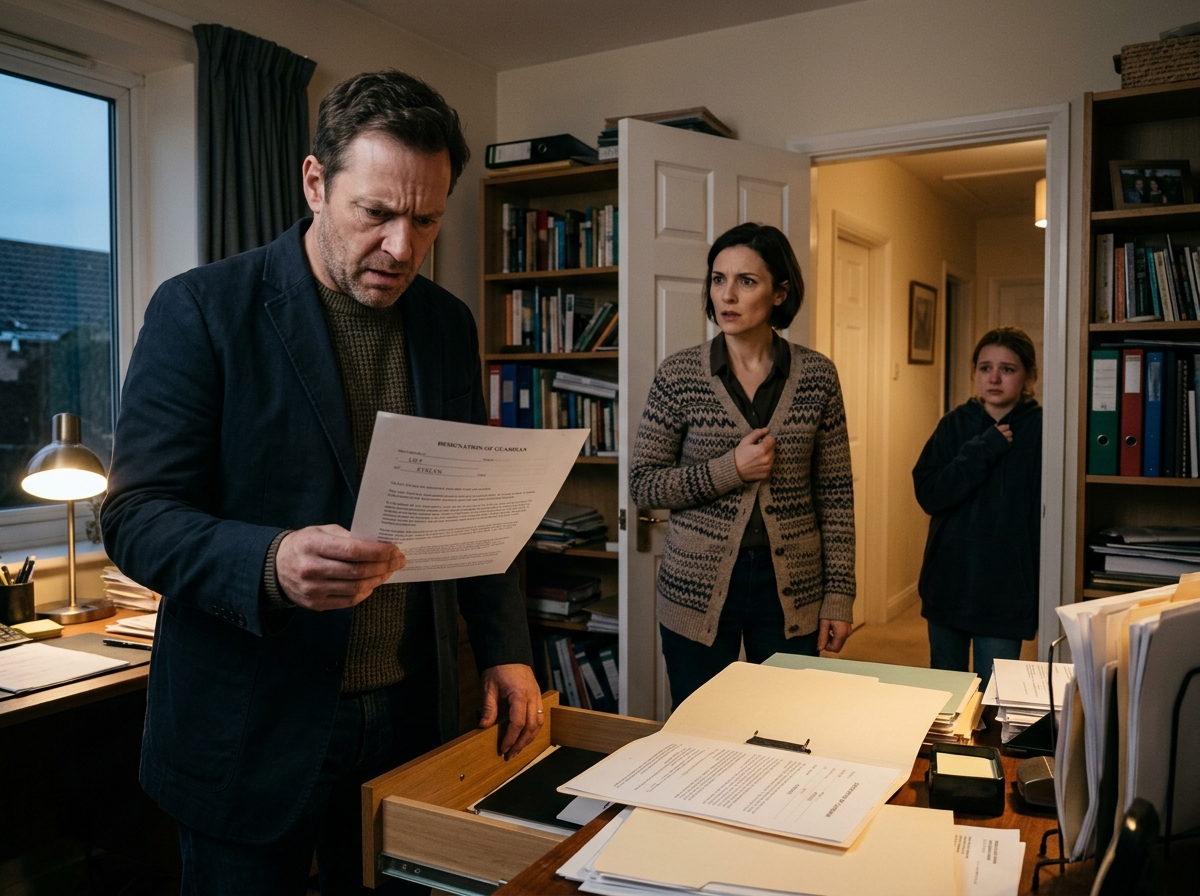
The letter arrived on a Tuesday afternoon, several weeks after Richard and Vanessa had completed the final arrangements for their divorce. It was addressed to Richard, written in Vanessa's familiar handwriting, and delivered in a plain envelope without a return message or request for a reply. He found it among the ordinary mail when he returned from work, beside a school notice for Lily and a bill he had been meaning to pay.
For several minutes, he left the envelope on the kitchen counter. He had no reason to expect another hidden arrangement or legal document, yet the sight of Vanessa's handwriting brought back the uneasy feeling of discovering the first papers in the study. He reminded himself that the situation had changed. They were no longer married, the guardianship issue had been settled, and he was not required to respond to every feeling the past stirred in him.
He waited until Lily was upstairs doing her homework before opening it. Vanessa's letter was three pages long, written carefully in paragraphs that appeared to have been revised. She did not describe their marriage as a tragedy, blame Evelyn for her actions, or ask Richard to reconsider the divorce. Instead, she wrote about the things she had finally begun to understand after losing the home and relationship she had once believed she could control.
She admitted that she had treated Richard's long working hours as evidence that she was entitled to manage Lily without question. She had interpreted Lily's closeness to her father as rejection, then used her position in the household to make the child feel insecure. When Lily wanted her phone, Vanessa had not simply been enforcing a rule. She had been preventing Lily from reaching someone who might challenge the story Vanessa was telling her.
The letter also acknowledged the legal document. Vanessa wrote that she had helped prepare a proposed guardianship arrangement naming Evelyn because she wanted a solution that made her feel less powerless. She had convinced herself that having a backup plan gave her control over an uncertain future. She had ignored the fact that the plan concerned Lily's life, not Vanessa's comfort, and that Richard had neither approved nor signed it.
Richard read the letter a second time. He noticed what was missing: there was no request to tell Lily that Vanessa was sorry, no suggestion that the child had misunderstood, and no claim that the abuse Vanessa had suffered from Evelyn explained away the abuse she had inflicted on Lily. Vanessa had written, plainly, that she had made choices that hurt a child who depended on the adults around her.
At the end, she wrote that she still regretted losing the family, but she no longer believed that regret gave her a claim on its members. She hoped Richard and Lily would have a peaceful life. She would continue therapy, maintain the boundaries they had established, and accept that she might never be welcomed back into their lives. She did not ask him to answer.
Richard folded the letter and put it in a drawer with the other important papers. He did not feel relieved, and he did not feel the sudden forgiveness he might once have hoped to experience after hearing a convincing apology. What he felt was a cautious recognition that Vanessa had described her actions without trying to bargain her way out of their consequences.
He wondered whether she had finally understood the harm she had caused or whether she had simply learned how to describe it. The distinction mattered. Yet he also understood that he could not measure the rest of Vanessa's life from one letter, nor was he responsible for supervising her recovery. Her choices from that point onward would belong to her.
That evening, Lily came downstairs carrying a notebook and asked whether he could help her with a paragraph for school. Richard put the letter aside and listened as she explained the assignment. She wanted to write about a person who had influenced her, but she had not decided whom to choose.
“You could write about someone you know well,” he suggested.
“I know lots of people well.”
“Then you've got plenty of choices.”
She frowned at the notebook. “What if someone did something good and something bad? Can you still write about the good thing?”
Richard considered his answer. “Yes. You can remember something good a person did without pretending the bad thing never happened. You don't have to make the whole person one thing.”
Lily nodded slowly. “And you don't have to forgive them?”
“No. Remembering something and deciding what relationship you want with someone are different questions.”
She returned to her paragraph. Richard did not ask whether she had been thinking about Vanessa. It was possible she had, but it was equally possible she was considering a teacher, a classmate, or someone from a story she had read. He had learned not to turn every question into an invitation to discuss the past.
A few days later, Richard received a message from Mr. Lawson asking whether he wanted Vanessa's letter retained with the other separation records. Richard confirmed that it could be kept with the relevant correspondence. He did not see a need to share it with Lily or make it part of any future discussion about contact. The letter had been written to him, and he could acknowledge its contents without passing its emotional weight to his daughter.
Meanwhile, Lily's life continued to expand in small ways. She had begun spending time with a group of classmates after school and was talking about a project they hoped to complete together. She sometimes complained that the other girls could not agree on anything, then admitted that she liked having people to argue with about ordinary matters.
One Friday, she asked if she could keep her phone in her pocket during an after-school activity rather than leave it in her bag. Richard asked why, and she explained that she liked knowing she could call him if she needed to. He said that was reasonable and reminded her that she could also speak to the teacher if something happened.
She looked at him, waiting for a qualification. When none came, she put the phone away and returned to her plans. Richard realized that the question had not been a test of his rules so much as a small attempt to learn whether she could make an ordinary decision without losing the freedom she had regained.
The following week, Lily's counselor suggested that Richard continue to give her opportunities to make age-appropriate choices. The goal was not to remove every limit but to make sure limits were predictable, explained, and unrelated to an adult's need for control. Richard appreciated the distinction. He could still tell Lily when she needed to be home or when homework had to be finished. He simply had to make sure discipline never became a way of frightening her into silence.
At the next session, Lily spoke about the possibility that Vanessa might someday contact her. She said she did not want to meet her, but she sometimes wondered what Vanessa was doing and whether she felt sorry. The counselor helped her understand that curiosity did not mean she wanted contact and that feeling sorry for someone did not make her responsible for helping them.
Lily later mentioned the conversation to Richard. “I don't want to see her,” she said. “But sometimes I wonder if she thinks about me.”
Richard did not pretend he knew the answer. “I expect she does. But I can't tell you exactly what she thinks, and you don't have to do anything about it.”
“What if she sends another letter?”
“We'll decide what to do based on what you want and what is best for you. You won't have to answer.”
Lily accepted that answer and changed the subject to a science assignment. Richard let the conversation end. He was learning that a boundary could remain firm even when the feelings surrounding it were complicated.
Vanessa, for her part, did not send another letter. She continued attending therapy and began working on relationships outside the family without expecting them to repair her loneliness. She spoke with a trusted friend about the divorce, acknowledging that she had harmed Lily rather than describing herself only as a woman who had lost her marriage. When the friend asked whether Richard might eventually reconsider, Vanessa said she did not know and could not build her life around waiting for that possibility.
Her therapist encouraged her to identify what accountability would look like when no one was watching. Vanessa began paying attention to moments when she wanted to control a conversation or force reassurance from someone. She practiced asking directly for what she needed, accepting a refusal, and managing the discomfort that followed without punishing the person who had said no.
The work was not dramatic. Sometimes she managed a difficult conversation well; sometimes she noticed her old reactions only after the moment had passed. She brought those failures to therapy without using them as proof that she was incapable of change. She had spent years believing that admitting weakness meant losing control. Now she was learning that honest self-examination required her to tolerate being wrong without turning the mistake into someone else's responsibility.
Richard did not receive reports about these efforts, and he did not seek them out. The divorce had ended his role as Vanessa's partner. He could hope she would become healthier without monitoring her progress. He could wish her well from a distance and still know that he had made the right decision for himself and Lily.
One evening, as Richard and Lily were clearing the dinner table, she asked whether he ever missed being married.
“Yes,” he said.
She glanced at him. “Even after everything?”
“I miss some parts of it. I miss having the life I thought we were going to have. That doesn't mean I want to go back to the way things were.”
“Can you miss something and know it wasn't good for you?”
“Yes,” Richard replied. “People can feel more than one thing at the same time.”
Lily thought about that while stacking the plates. Then she said she sometimes missed the way things had been before she became afraid at home. She missed the evenings when she had believed everyone was happy and the holidays when she had not worried about what might happen if she said the wrong thing.
Richard felt the familiar ache of knowing that he could not restore those memories to their original meaning. “I wish you hadn't had to go through it,” he said. “But you don't have to pretend the past was perfect to remember the parts you liked.”
Lily nodded. They carried the plates to the sink together. Neither of them needed to decide that evening whether the good memories outweighed the bad ones. Their relationship with the past could remain unfinished without making their present unsafe.
Before bed, Richard checked the calendar for the coming week. He had a meeting on Wednesday and a school event on Thursday. He wrote both down, made sure Lily knew the arrangements, and set a reminder to pick up supplies for her project. The routine seemed almost trivial after everything that had happened, but he had come to value the reliability of ordinary life.
The letter remained in the drawer. It was not a key that unlocked the family Richard had lost, nor was it proof that Vanessa had become someone entirely different. It was evidence that she had begun to name her choices honestly. That mattered, but it did not change what Lily needed from him.
Richard turned off the light and went upstairs. From Lily's room came the quiet sound of a page turning. He paused outside her door long enough to hear her settle, then continued to his own room, grateful for the simple knowledge that she could read in peace without wondering whether someone would take her phone or threaten her place in the family.
Click here to continue reading: PART 14: When Lily Began Asking About Her Mother, Richard Realized That Protecting Her Future Also Meant Helping Her Understand the Family History She Had Never Been Told
Richard Returned Home Before Sunset and Heard His Daughter Begging for Her Phone, but Vanessa’s Explanation Made Him Question Everything
Part 13 of 20

