
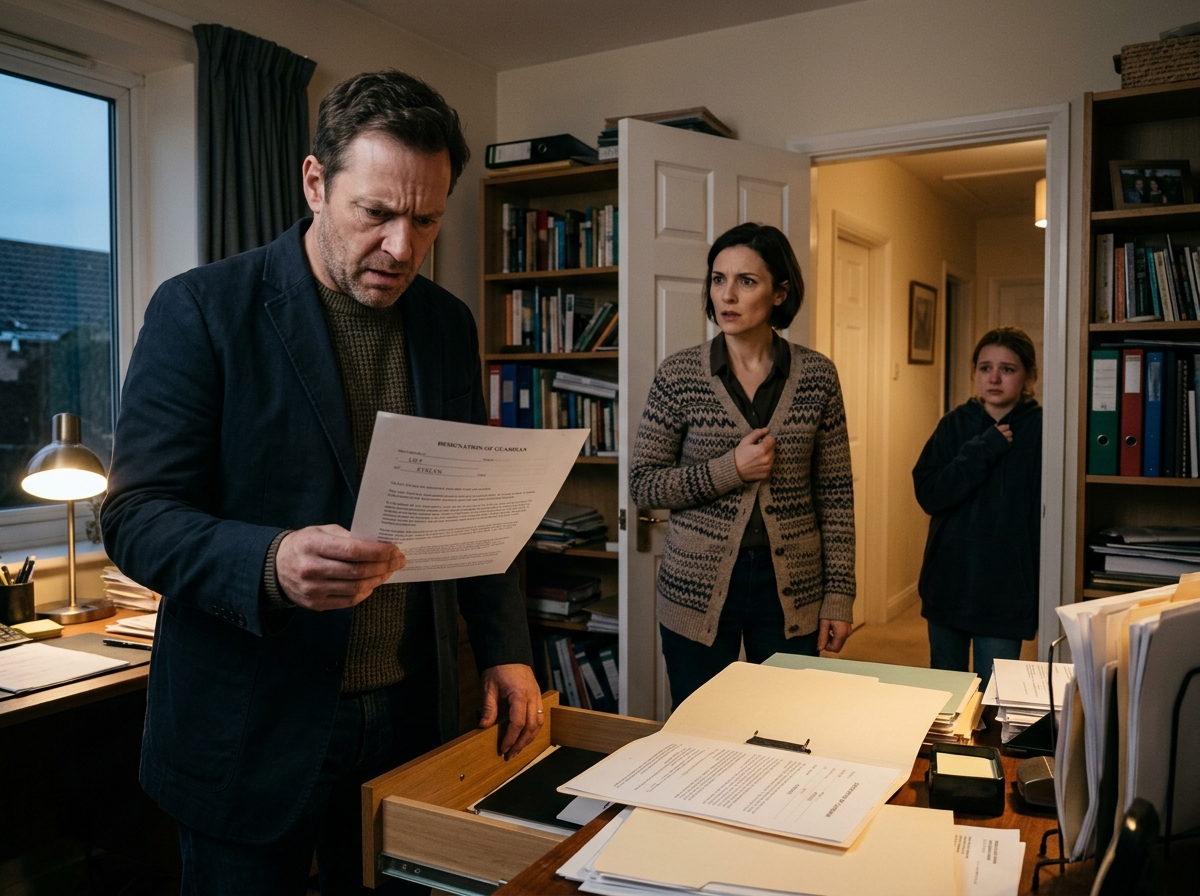
The decision did not arrive during a dramatic argument or a sudden revelation. It began with a quiet question Richard wrote in the margin of his notebook after another meeting with Mr. Lawson: if Lily never wanted Vanessa back in her life, would he still want to rebuild the marriage?
He stared at the sentence for a long time. He loved the woman he had married, or at least the memories of the woman he believed he knew. He remembered her bringing soup when he was ill, sitting beside him during the first anniversary of Anna's death, and helping Lily prepare for school events. Those memories were real. So was the fear Vanessa had created. One truth could not erase the other.
He tried to imagine reconciliation without pretending the past had been a misunderstanding. It would require complete honesty about Evelyn's involvement, continued therapeutic work, and clear boundaries around Lily. It would also require him to accept that Vanessa's remorse could be sincere without making her safe to live with again. Even if she never repeated the behavior, the damage to trust would remain part of their history.
Divorce presented a different kind of grief. It would end the marriage formally and force them to establish a new permanent arrangement. Richard knew he would miss the good parts of their life together. He also knew that missing someone was not proof that keeping them close was wise. He could not make the decision solely to avoid loneliness, nor could he make it as punishment for Vanessa. The question was what kind of future he could responsibly build.
He spoke to his own counselor, who helped him separate the decision from the pressure to produce a quick, clean ending. Richard admitted that he still hoped Vanessa might become the person he had believed she was. His counselor asked whether that hope depended on Vanessa changing or on Richard needing the pain of the past to have been temporary.
The question unsettled him because the answer was both. He wanted to believe that people could change, but he also wanted to recover the life he had lost. Those were different desires. Vanessa's work could address her behavior, but it could not guarantee that the marriage would return to what he had imagined.
When Richard next met Vanessa at Mr. Lawson's office, he told her he was still considering divorce. He explained that he would not make a final decision until he had reviewed the practical consequences and considered the stability Lily needed. He did not give Vanessa a deadline designed to frighten her, and he did not offer a promise that continued therapy would lead to reconciliation.
Vanessa listened without interrupting. Her hands were folded on the table, and the notebook she usually brought to therapy remained closed in front of her.
“I used to think that if I could explain why I did something, you would understand and forgive me,” she said. “Now I see that understanding why I did it doesn't mean you have to accept it.”
Richard nodded. “I can understand your history and still hold you responsible for what you did to Lily.”
“I know.”
“Do you?” he asked, more quietly than he intended. “Because I don't want you to agree with me here and then go home believing that if you work hard enough, I owe you another chance.”
Vanessa's face tightened, but she did not turn away. “I don't want to believe that. I still hope we can find a way forward, but I know I can't demand it.”
It was the first time Richard had heard her acknowledge the difference between hope and entitlement without immediately adding a reason he should reconsider. He allowed himself to notice that. He also reminded himself that one good conversation was only one good conversation.
They reviewed the practical arrangements. Vanessa would continue living separately. Any future contact with Lily would be considered only if Lily expressed a genuine willingness and the counselor believed it appropriate. Vanessa would not contact Evelyn about Lily or attempt to establish any relationship through relatives, school staff, or other intermediaries. The existing guardianship arrangements would remain unchanged unless Richard initiated a lawful review for Lily's welfare. Any questions about documents would go through Mr. Lawson.
Vanessa agreed to each condition. She did not ask for a special exception on the grounds that she was Lily's stepmother or that she had been part of the family for three years. Richard recognized that the boundaries were necessary regardless of what happened to the marriage.
Later that week, Vanessa's therapist asked her to write two letters. One was addressed to Lily but was not intended to be sent; it was an exercise in acknowledging harm without asking for anything in return. The other was addressed to herself as the child she had once been, the girl who had learned that love could be withdrawn whenever she failed to please Evelyn.
Vanessa struggled with the second letter. She wanted to tell that child that none of the abuse had been her fault, but she also wanted to insist that the child had survived by becoming strong and strict. Her therapist challenged the idea that strength required control over others. Vanessa began to understand that surviving a harmful home had not made her responsible for Evelyn's actions, but it did leave her responsible for how she treated people as an adult.
The letter to Lily was harder in a different way. Vanessa wrote that she had taken Lily's phone, threatened to send her away, and used Richard's absence to make Lily doubt her place in the family. She acknowledged that she had made the house frightening and that Lily had not caused it. She did not ask Lily to forgive her, promise to meet her, or recognize Vanessa's progress.
When she finished, Vanessa asked her therapist whether the letter should be sent. The therapist reminded her that the question was not whether Vanessa needed relief from guilt. It was whether receiving the letter would help Lily, and that decision belonged to the adults responsible for Lily's care, informed by Lily's wishes.
Vanessa did not send it directly. She gave it to Mr. Lawson, who forwarded it to Richard with a note that he could decide whether to discuss it with Lily's counselor. Richard read the letter in private. It was more direct than Vanessa's earlier apology, but he knew Lily had already received one letter and chosen not to reply. Another apology could easily become another burden if it arrived too soon.
He spoke to Lily's counselor before mentioning it to his daughter. The counselor agreed that there was no reason to introduce the letter immediately. Lily had been making progress, and she had not asked for further contact. They decided the letter would remain with the adults unless Lily raised the subject herself.
Richard told Vanessa that he had received it and would not share it with Lily at this time. Vanessa's reply came several hours later: “I understand. Please don't give it to her just because I wrote it. She should only see it if you and her counselor believe it is right for her.”
Richard read that sentence more than once. He did not mistake it for a guarantee of change, but it showed that Vanessa was beginning to tolerate a limit without trying to negotiate it away.
At home, Lily was preparing for an upcoming school presentation. She asked Richard to listen to her practice and then insisted that he tell her which parts were confusing. He gave her honest feedback, and she rolled her eyes when he suggested shortening a sentence.
“You sound like my teacher,” she complained.
“I'll take that as a compliment.”
“It wasn't one.”
They laughed, and the moment passed without either of them needing to explain why it mattered. Richard was learning that protecting Lily also meant allowing her to be annoyed, playful, impatient, and entirely ordinary. A child could not recover if every emotion was treated as a sign of danger.
A few days later, Richard received a short message from Evelyn. It did not mention Lily directly. Evelyn wrote that she understood Richard had made his position clear and that she would not seek contact with the child. She said she hoped Vanessa was receiving help and that she would not interfere further.
Richard forwarded the message to Mr. Lawson and did not reply. There was no need to invite a discussion about Evelyn's intentions. The boundaries were already clear, and the message did not change the facts. She had no authority over Lily, and Richard had no reason to establish a relationship between them.
He wondered briefly whether Evelyn's promise was sincere. Then he recognized that he did not need to settle that question in order to protect his daughter. If Evelyn respected the boundary, there would be no reason for further action. If she did not, Richard had records, legal advice, and a clear plan for responding.
That distinction brought him a measure of peace. He could be prepared without living in anticipation of a new threat. He could take a boundary seriously without allowing Evelyn to occupy his thoughts every day.
As the weeks passed, Vanessa continued therapy and maintained the separation. Richard noticed that her messages were practical and infrequent. She did not ask Lily's counselor for information, and she did not send gifts or letters in an attempt to reopen contact. None of this erased the past. It simply meant that, for now, she was not adding new pressure to Lily's life.
Richard still had moments when he wanted to call Vanessa and talk about the small things that used to fill their evenings. He missed having someone beside him when the house was quiet. He missed the ease of assuming that they were working toward the same future. But he had begun to distinguish loneliness from evidence that the marriage should continue.
One night, he opened the drawer where he kept the photograph of Lily and Vanessa from the birthday party. He looked at it for a moment, then placed it back without tearing it or displaying it. The picture belonged to a complicated history. It did not tell him whether Vanessa could change, whether he could trust her again, or whether Lily would ever want contact. Those answers would come, if they came, through time and choices rather than through an image.
He closed the drawer and went to check whether Lily had finished her homework. She had, and she was reading in bed with her phone charging on the nightstand. She asked if he could leave the hallway light on.
“Of course,” he said.
She thanked him and returned to her book. Richard left the light on, not because he believed she would never be afraid again, but because comfort did not need to be justified by fear. It could simply be part of home.
Click here to continue reading: PART 12: The Final Decision Did Not Restore the Family Richard Had Imagined, but It Gave Lily Something More Important Than an Apology or a Promise That Everything Would Be Different
Richard Returned Home Before Sunset and Heard His Daughter Begging for Her Phone, but Vanessa’s Explanation Made Him Question Everything
Part 11 of 20


One Comment on “PART 11 – Richard Finally Examined What Reconciliation Would Demand, and Vanessa Had to Decide Whether She Could Accept a Future That Might Never Include the Family She Wanted”