
The first night we slept in our new home, I woke before dawn.
For a few seconds, I did not know where I was.
The room was dark.
The baby monitor glowed softly from the dresser.
My son slept in his crib.
I listened.
No footsteps.
No voices.
No hand on the door.
I waited for the old fear to arrive.
It did.
But it was different now.
It no longer told me someone was coming.
It reminded me that I had survived someone who had.
I got out of bed and checked on my son.
He was sleeping on his back, one hand beside his cheek.
I stood there for a while.
Then I smiled.
It was the first morning in a long time when the silence felt safe.
The legal process had taken months.
There had been statements.
Documents.
Hearings.
Questions that forced me to revisit moments I wanted to forget.
My husband had tried to explain himself.
He said he had been overwhelmed.
He said his mother had influenced him.
He said he had not intended the situation to become violent.
But intention could not erase action.
And influence did not remove responsibility.
He had made choices.
His mother had made choices.
I had made one too.
I had refused to open the door.
The final arrangements concerning my son were strict.
My husband was not allowed to take him without supervision and authorization.
His mother had no independent authority to remove him from my care.
The agreement they had tried to create in secret was rejected.
The documents they had prepared were examined alongside the recording and the messages.
What they had hoped would appear voluntary instead showed pressure.
The distinction mattered.
I kept copies of everything.
Not because I wanted to live in the past.
Because I had learned what happened when other people controlled the story.
I wanted the truth preserved.
One afternoon, I received a letter from my husband.
I read it alone.
He wrote that he missed our family.
He wrote that he regretted what happened.
He said he wished he could go back to that morning.
I believed that he might genuinely regret it.
But regret was not the same as repair.
He asked whether I could forgive him.
I folded the letter.
I did not answer.
Forgiveness, if it ever came, would not mean returning.
It would not mean trusting him with the life I had rebuilt.
It would not mean pretending that the bathroom had been an argument between equals.
It had not.
There had been a plan.
There had been violence.
There had been an attempt to use my exhaustion and my child against me.
Those facts remained.
My mother visited often.
She helped with the baby when I needed sleep.
She never told me what I should feel.
That was one of the things I appreciated most.
She simply sat with me.
Sometimes we talked.
Sometimes we did not.
One evening, while my son slept, she asked whether I still had the monitor.
I nodded.
“It still works.”
She smiled faintly.
“You kept it?”
“Yes.”
I had kept it.
The same device.
The same small speaker.
The same harmless-looking machine that had captured the conversation.
I turned it on.
Static filled the room.
I almost turned it off again.
Then I stopped.
I realized I did not need to hear the recording anymore.
I had heard enough.
I knew what it contained.
I knew what it had changed.
So I switched it off.
The silence afterward was complete.
And that silence did not frighten me.
Months passed.
My son grew.
He learned to sit.
Then crawl.
Then pull himself upright using the edge of the sofa.
His laugh began filling the apartment.
Sometimes I caught myself watching him with tears in my eyes.
Not because I was sad.
Because there were moments when I remembered how close I had come to believing that I had no choices.
I had choices.
I still did.
My husband eventually stopped sending letters.
The formal arrangements continued.
He saw our son under the conditions set by the court.
I never attended those meetings alone.
The distance between us became permanent.
There were people who asked whether I regretted leaving.
I always gave the same answer.
“No.”
I did not hate him.
Hating him would have kept him too close to my thoughts.
I simply refused to return to the life we had.
There was a time when I thought the end of a marriage had to feel like failure.
Now I understood that sometimes leaving was not the failure.
Sometimes staying was the thing that would have cost far more.
My mother-in-law never contacted me again.
I heard later that she had admitted more of her involvement.
She had believed she was protecting her family.
Instead, she had helped destroy it.
That was the cruel irony.
She had been so afraid of losing her grandson that she had created the circumstances in which she could no longer be trusted around him.
The plan had defeated itself.
The more they tried to control the outcome, the more evidence they left behind.
The recording.
The messages.
The documents.
The injuries.
Their own words became the clearest witnesses.
One morning, I found the old envelope at the back of a drawer.
I opened it.
The papers were still there.
The draft agreement.
The notes.
The plan.
I read the first page again.
Then I closed the envelope.
I did not burn it.
I did not tear it apart.
I kept it with the other records.
It was no longer a symbol of what they had tried to take from me.
It was proof of what I had refused to surrender.
My son came crawling into the room.
He pulled himself against my leg.
I picked him up.
He laughed and grabbed my hair.
I winced playfully.
“Careful.”
He laughed again.
I carried him to the window.
Outside, the street was busy.
Cars passed.
A neighbor carried groceries.
Someone walked a dog.
A child rode a bicycle along the sidewalk.
Ordinary life.
That was what I had wanted all along.
Not perfection.
Not a family that looked perfect from outside.
Just a home where a closed door meant privacy rather than fear.
A home where disagreement did not become punishment.
A home where my child could cry without someone using his tears against me.
A home where I could say no and know that no was enough.
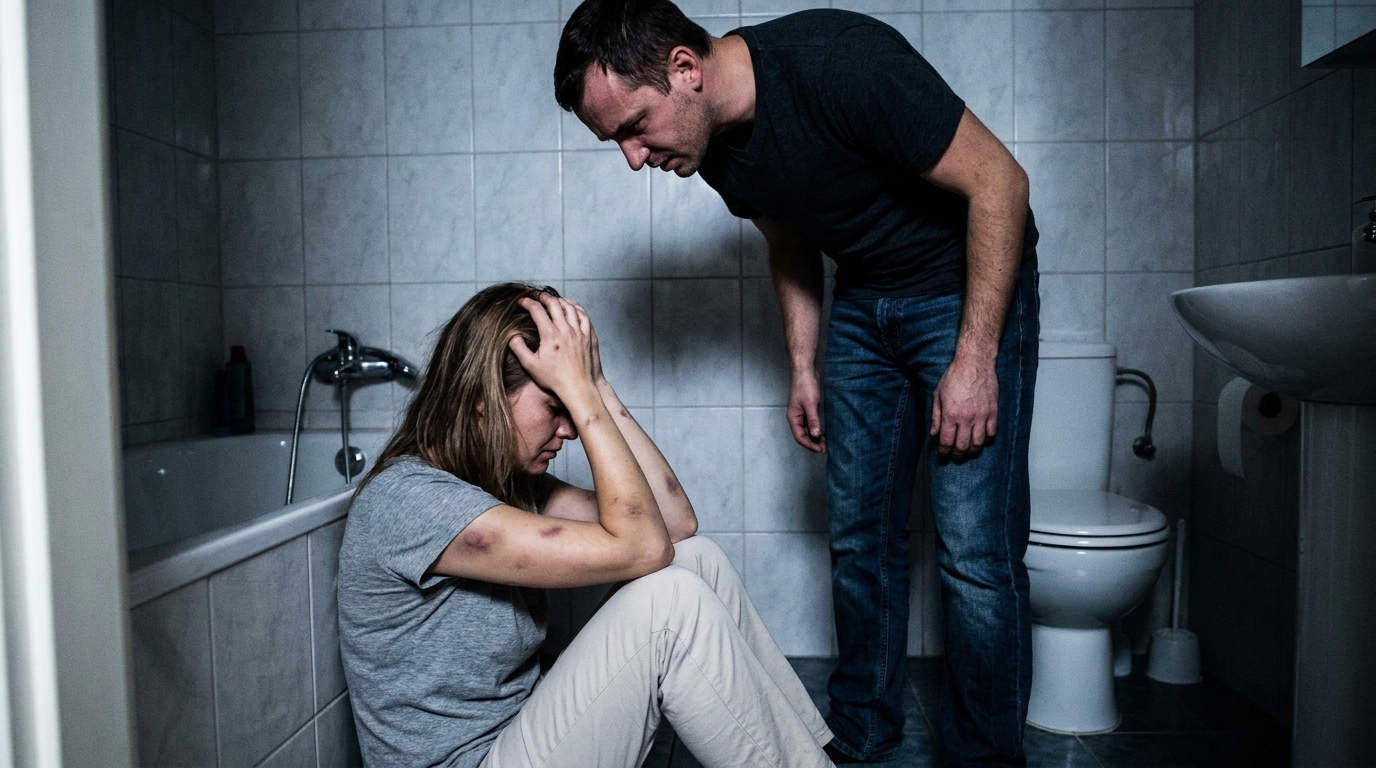
Years later, I would still remember that bathroom.
I would remember the wet floor.
The ache in my shoulder.
My son's frightened cries.
The key turning in the lock.
Most of all, I would remember the monitor.
It had not been a heroic object.
It had not been designed to save anyone.
It had simply been there.
Listening.
Recording what people said when they believed nobody was listening.
But the monitor had not saved me by itself.
I had saved myself when I chose to believe what I heard.
I had saved my son when I refused to hand him over.
I had saved our future when I stopped worrying about whether my decision would make someone angry.
That was the part I understood only later.
The hardest door to close had not been the bathroom door.
It had been the door inside my own mind—the one that kept opening whenever someone told me I was overreacting, misunderstanding, exaggerating, or causing trouble.
That door was closed now.
My son rested his head against my shoulder.
I carried him back toward the bedroom.
The baby monitor sat quietly on the dresser.
I looked at it once.
Then I turned away.
There was no recording playing.
No voice coming through the speaker.
No footsteps outside the room.
Only my son's breathing.
Only the ordinary sounds of morning.
And for the first time, I did not need to listen for danger.
I knew what safety sounded like.
The End
Read more original stories on Feel Every Story.
The Door Was Locked, but the Recording Had Already Told Me Why They Wanted It Open
Part 8 of 8


One Comment on “PART 8 – The Recording Was Only the Beginning, and Months Later I Finally Understood What I Had Saved by Refusing to Open That Door”