
PART 6 — THE DAY OUR DAUGHTER ARRIVED
Part Note: The birth provides the emotional counterpoint to the dining-table abuse. Emma regains control over who enters her space, while Daniel finally understands that protecting his new family means respecting Emma’s choices, not making decisions for her.
Hospital security had the list before we arrived.
My mother’s name was on it.
So was Caleb’s.
No exceptions.
No “but I’m the grandmother.”
No family emergencies.
No surprise visitors.
Emma signed the restriction herself.
That mattered to her.
Labor was long.
Messy.
Nothing like the peaceful scenes people post online.
Emma swore at me twice.
At one point she told the anesthesiologist she loved him more than me.
I said I understood.
She did not laugh.
Later she apologized.
I told her there was nothing to apologize for.
Our daughter’s heartbeat dipped once.
Only briefly.
But for thirty seconds, the room filled with people.
Emma looked at me.
I saw terror.
Not just about labor.
Everything came back at once.
The dresser.
The table.
The blood.
Hands controlling her body.
I leaned close.
“Look at me.”
She did.
“No one here is doing anything without telling you.”
The nurse heard me.
She reinforced it immediately.
“Emma, I’m going to reposition you. Is that okay?”
Emma nodded.
“I’m touching your leg now.”
Every step explained.
Every movement with permission.
It should have been ordinary.
For Emma, it was healing.
At 2:47 that afternoon, our daughter was born.
Seven pounds, one ounce.
A furious cry.
Dark hair.
Emma burst into tears.
I did too.
They placed the baby against her chest.
Emma stared down as if the entire world had narrowed to one face.
“Hi,” she whispered.
Then again.
“Hi.”
I stood beside them with one hand over my mouth.
Our daughter stopped crying.
Emma looked at me.
“What do we call her?”
We had debated names for months.
Suddenly neither of us could remember any.
Finally Emma laughed.
“Maya.”
I smiled.
“Maya.”
Maya Carter.
Our daughter.
Hours later, while Emma slept, I held Maya beside the window.
My phone buzzed.
A message from an unfamiliar number.
I almost ignored it.
Then I read the preview.
Please tell me she’s safe.
My mother.
New number.
I stared at it.
For one second I felt the old pull.
Habit.
Duty.
The reflex to reassure her.
Then I looked at Emma.
Sleeping.
Exhausted.
Our daughter against my chest.
I blocked the number.
No reply.
No photograph.
No announcement.
My mother learned Maya had been born through someone else.
That caused another family argument.
I wasn’t involved.
The world did not end.
That was an important discovery.
A family can be angry at you and the sun still comes up.
The baby still needs feeding.
Laundry still piles up.
Life continues.
We brought Maya home two days later.
The locks were secure.
The alarm was on.
Emma stood in the entryway holding the car seat.
She stopped.
“You okay?”
“Yeah.”
“You sure?”
She nodded.
Then looked around.
“I’m waiting to feel scared.”
“And?”
“I don’t.”
That night, Maya slept ninety minutes at a time.
Which felt like a personal attack.
By morning, Emma looked exhausted.
So did I.
For the first week, we accepted help from exactly three people.
Emma’s sister.
Her best friend.
And a postpartum nurse recommended by Dr. Patel.
No one else had a key.
No one arrived uninvited.
No one took the baby from Emma’s arms without asking.
The difference was enormous.
Three weeks after Maya’s birth, the court process involving my mother and Caleb reached a settlement stage.
Again, there was nothing dramatic.
No judge pounding a gavel and delivering a speech about justice.
There were lawyers.
Documents.
Negotiations.
Restrictions.
Mandatory counseling.
Probationary conditions.
Orders barring contact.
Financial penalties.
The case outcome was imperfect.
Emma knew that.
So did I.
But the most important protection remained.
My mother could not contact Emma.
Could not come to the house.
Could not approach Maya.
Caleb faced separate consequences and had to comply with the same no-contact boundary.
He sent no more messages.
Months passed.
Maya grew.
Emma improved.
Not in a straight line.
Some days she was fine.
Some nights the sound of a chair scraping across the kitchen floor made her freeze.
We switched to felt pads beneath the chairs.
Not forever.
Just for now.
She returned to the dining room eventually.
At first she ate standing.
Then on the sofa.
Then one evening, she looked at our table and said, “I’m tired of that room belonging to them.”
We sat down.
Just us.
Maya in a bassinet.
Pasta.
Garlic bread.
No fish.
Halfway through dinner, Emma laughed.
“What?”
“You keep watching me chew.”
I looked away.
“Sorry.”
“You’re terrible at acting normal.”
“I’m learning.”
“Learn faster.”
I smiled.
She reached across the table.
Held my hand.
That dinner mattered more than any holiday gathering we had ever attended.
Later, when Maya was six months old, Emma suggested something I didn’t expect.
“I want a new table.”
“We can buy one.”
“No.”
She looked at me.
“I want to build one.”
So we did.
Badly.
Neither of us knew woodworking.
The first tabletop warped.
The second had a corner that never quite matched.
We kept it.
Emma said perfection was overrated.
The old dining table was donated.
I watched the truck carry it away.
The sight should have felt symbolic.
Mostly I felt relieved to have space in the garage.
Healing is irritatingly ordinary sometimes.
Then, when Maya was eight months old, exactly one year after the dinner, a letter arrived.
From my mother.
Not to me.
To Emma.
Sent through attorneys.
No contact violation.
Proper channel.
Emma left it unopened for two days.
Then sat at our uneven dining table and opened it.
I stayed nearby.
She read silently.
Once.
Twice.
Then handed it to me.
My mother had finally stopped explaining.
No mention of stress.
No mention of “losing her son.”
No mention of tradition.
She wrote:
I frightened you in your own home and then humiliated and hurt you in front of people who should have protected you. I used family loyalty as permission to control you. There is no defense for that.
I read further.
She said she did not expect access to Maya.
Did not expect forgiveness.
Did not expect a relationship.
She was writing because counseling had forced her to confront how often she treated obedience as love.
I put the letter down.
“What do you think?” I asked.
Emma stared at it.
“I think she finally understands the sentence.”
“What sentence?”
“That she hurt me.”
“And?”
“I don’t know if that means she understands everything.”
Fair.
“Do you want to answer?”
“No.”
“Okay.”
She folded the letter.
“But I’m keeping it.”
“Why?”
“Because one day I might forget how hard I fought to believe myself.”
I looked at her.
She touched the page.
“This proves she finally had to say it too.”
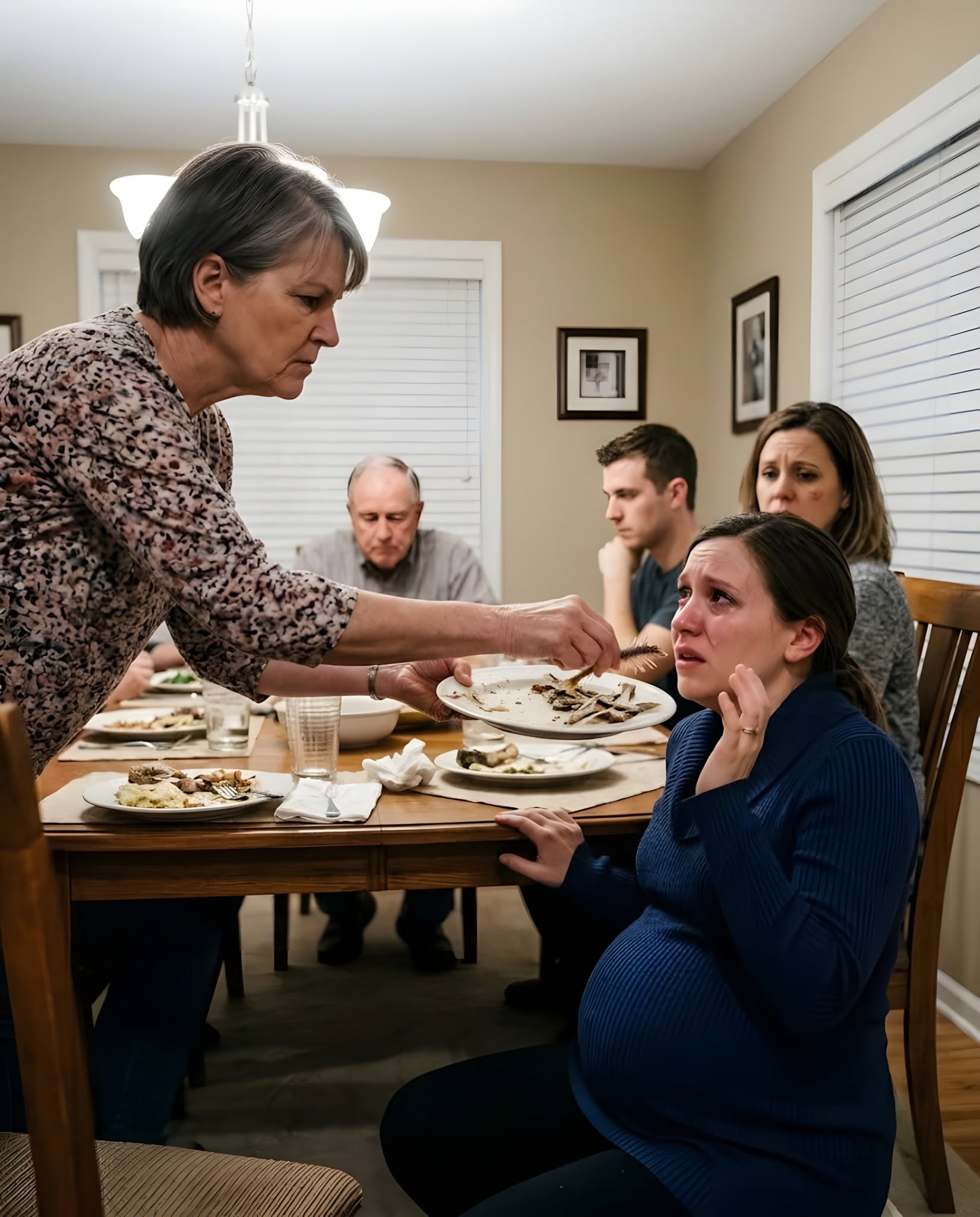
Click Here to continuous Read Full Ending Story FINAL PART: 👉I came back for a folder and found my eight-month-pregnant wife crouched under our dining table while my mother shoved fish b0nes toward her mouth.
Six relatives watched.
“She needs to learn what happens when she embarrasses this family,” my mother said, right before my wife coughed and a thin line of bl00d hit her dress.
I carried her out and photographed every plate before anyone could clear them.
Three hours later, the doctor showed me an older injury my wife had never told me about—and asked whether my mother still had access to our house.
“Yes,” I said. “She has an emergency key.”
The doctor looked at my wife instead of me. “Is she using that key with your permission?”
Emma’s fingers tightened around the edge of the hospital blanket. She shook her head once, so slightly I almost missed it.
That answer frightened me more than anything my mother had said at the table.
I pulled up the photographs while the doctor stepped outside. Six plates held neatly cut pieces of fish. Emma’s plate was different. The meat had been pushed aside, and a pile of sharp bones had been arranged directly in front of her chair. Her water glass was overturned. One dining chair had been wedged behind hers.
The pictures could not show who had moved each object, but they destroyed the story my family would eventually tell—that Emma had panicked during an ordinary dinner.
I sat beside her and placed my phone facedown.
“I’m not calling anyone yet,” I said. “Tell me what you need.”
“Change the locks,” she whispered. “Save every picture. And don’t let your mother know where they’re discharging me.”
I wanted to demand names, dates, and explanations. Instead, I asked the only question that mattered.
“Was the older injury from her?”
Emma stared at the hospital wristband around her arm. Six weeks earlier, while I was working late, my mother had let herself into our house and criticized how Emma was preparing the nursery. The argument moved into the hallway. My mother shoved her against the corner of a dresser, then told her the pain was proof she was too emotional to become a good mother.
Emma had nearly called me.
Then my mother reminded her that the entire family already thought pregnancy had made her unstable.
“She said they would all back her up,” Emma told me. “She said you’d have to choose between your wife and everyone who raised you.”
I reached for her hand, but she pulled it beneath the blanket—not because she was angry with me, but because she was ashamed of trembling.
“You never had to protect me from the truth,” I said.
“I wasn’t protecting you.” Her voice cracked. “I was trying to make it to the delivery without losing our home, our family, or you.”
I promised her the locks would be changed before we returned. I promised nobody would enter the hospital room without her permission. Then I asked why tonight had been different—why six people had simply stood there while my mother forced her beneath our table.
Emma closed her eyes.
“Because they weren’t all just watching,” she said. “Your brother Caleb took my phone and stood between me and the back door.”
I felt the room tilt.
Emma looked directly at me.


One Comment on “Six Relatives Watched My Mother Torment My Pregnant Wife—But the Doctor Uncovered Something Even Worse”