
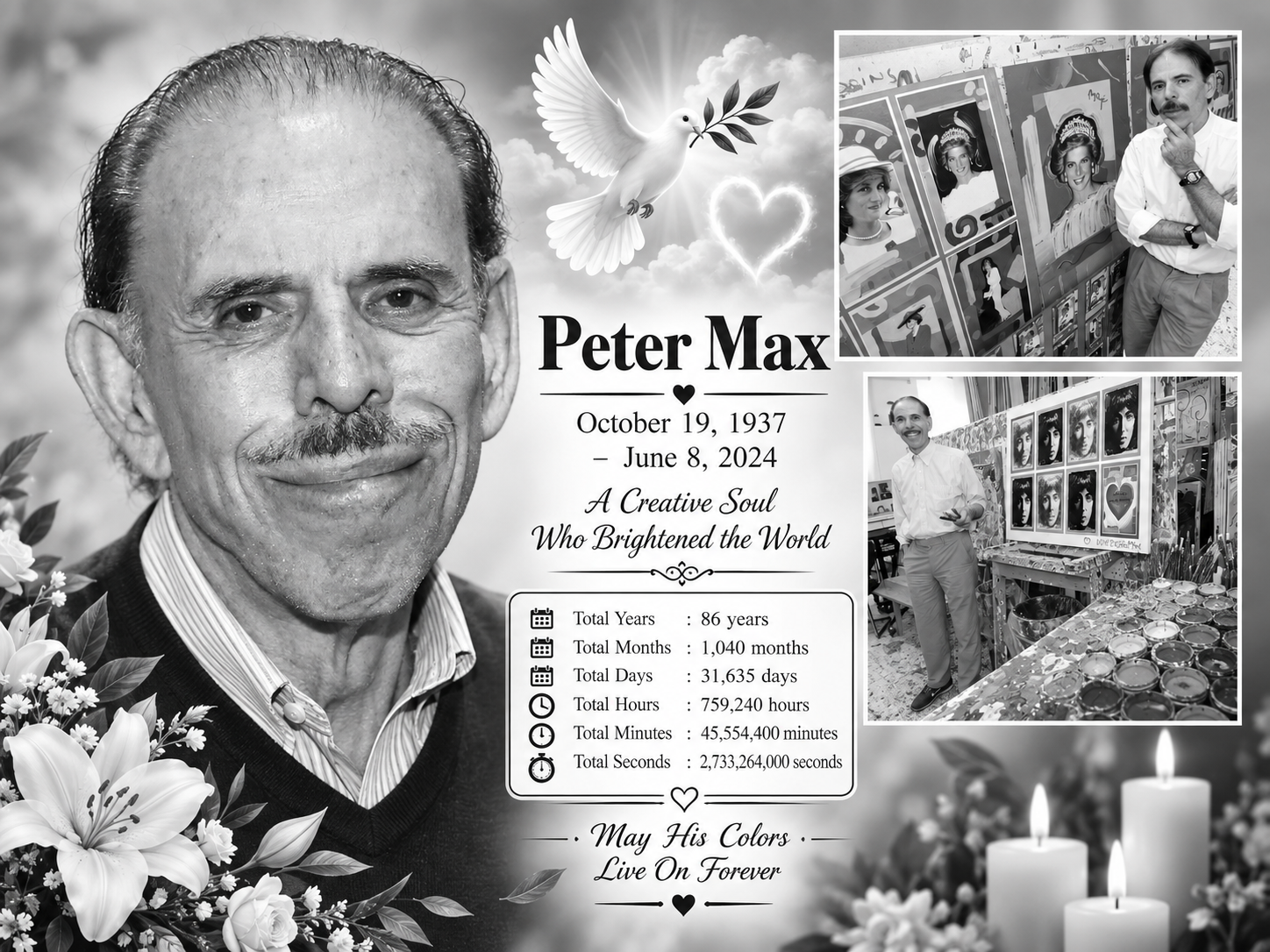
Peter Max's final chapter did not contain another great commission that could neatly close the biography.
There was no final painting that explained everything.
There was no single statement capable of summarizing nearly ninety years.
There was only the accumulated record: the paintings, the photographs, the commissions, the controversies, the family history, the public appearances, and the memories of people who had encountered his work.
That record began in Berlin in 1937.
It passed through Shanghai.
It continued through Israel.
It arrived in New York.
It expanded into the world of graphic design.
It exploded into public consciousness during the 1960s.
It retreated from commercial production.
It returned to painting.
It moved into public commissions.
It became attached to national monuments and international events.
And eventually it reached a point where the artist could no longer continue.
The date of his birth was October 19, 1937.
The date of his death was September 14, 2026.
He was 88.
He died in Manhattan.
Reliable reports available immediately after his death did not establish a specific public cause of death. The Associated Press reported that Max had advanced dementia, but that condition should not automatically be described as the official cause of death when the family had not publicly provided one. ([apnews.com](https://apnews.com/article/1fa0d98b5f1e446d903242355b689062?utm_source=chatgpt.com))
That uncertainty is worth preserving.
There is a temptation in biographies to make every ending precise.
Birth date.
Death date.
Cause.
Final words.
Final painting.
Final meaning.
Real lives are often less tidy.
Max's death provides an example.
The public knows when he died and where.
The public knows that his later years were affected by advanced dementia.
But the available reporting did not establish a specific medical cause.
The honest ending is therefore not a dramatic revelation.
It is the recognition that some details remain unknown.
What can be known with much greater certainty is the scale of what came before.
Max's work helped define the visual language of the late 1960s.
His imagery became associated with the counterculture, psychedelic design, and the expansion of popular visual art.
His name became familiar beyond traditional art audiences.
That familiarity was reinforced by television.
He appeared on programs watched by enormous audiences and demonstrated his ability to draw live.
The act of making art became part of the performance.
That was important because Max's career was never only about finished objects.
It was also about the idea of the artist as a visible creator.
He showed audiences that drawing could be entertaining.
He made the movement of a hand across a surface part of the spectacle.
At the same time, his formal training remained underneath that public image.
The young artist had studied anatomy and figure drawing.
The commercial designer had learned how to communicate through simplified shapes.
The painter had learned how color could dominate space.
The public figure learned how imagery could operate on a mass scale.
Those skills eventually merged.
The result was a style that could be recognized almost immediately.
His suns became recognizable.
His cosmic backgrounds became recognizable.
His portraits became recognizable.
His Liberty images became recognizable.
The signature reinforced what the image had already announced.
That combination of style and name was one of the reasons Max became such a powerful commercial figure.
But it also explains why he eventually needed distance from the business.
When a style becomes a commodity, the artist can become trapped inside the expectations of the market.
Max's decision to step away allowed him to recover painting as an activity rather than simply as a source of products.
His later use of large brushes and acrylics gave the work greater physicality.
The brush could move broadly.
Paint could overlap.
Colors could collide.
The canvas could remain visibly handmade.
That was a different experience from seeing his imagery reproduced on a manufactured object.
The distinction mattered to Max.
It also matters to understanding his legacy.
If he had simply continued licensing the same images without returning to painting, the story would have been different.
Instead, he repeatedly moved between commerce and personal creation.
That movement became one of the defining tensions of his career.
The public wanted the familiar Peter Max.
The artist continued exploring what Peter Max could be.
Sometimes those two interests matched.
Sometimes they did not.
His recurring symbols helped bridge the gap.
Liberty was familiar enough to satisfy recognition but flexible enough to support new interpretations.
The cosmos provided another endless source.
Faces offered an opportunity to transform recognizable people through color.
Flowers and hearts supplied simple forms that could become elaborate compositions.
Peace imagery allowed him to connect visual beauty with public messages.
These subjects gave Max a vocabulary that could survive changing decades.
That survival was tested repeatedly.
The cultural world of the 1960s became the political and social world of the 1970s.
The 1970s became the Reagan era.
The Berlin Wall fell.
The Soviet Union disappeared.
The United States entered a new technological age.
The visual environment moved from print toward digital media.
Yet Max's imagery remained recognizable.
It had been designed in an age of printing presses and television, but it remained legible in a culture increasingly dominated by screens.
That durability was partly because his images were fundamentally graphic.
They did not depend on subtle photographic realism.
They depended on shape, color, symbol, and contrast.
Those elements could survive technological change.
The medium could change.
The vocabulary remained.
His career therefore became a bridge between eras.
He belonged to the world of mid-century illustration and to the later world of mass visual culture.
He belonged to the gallery and the merchandise counter.
He belonged to the museum and the television studio.
He belonged to New York and to the international audience that encountered his work elsewhere.
The breadth was unusual.
But breadth alone does not explain why the work remained memorable.
Recognition requires repetition.
Max had it.
For decades, people repeatedly encountered his images.
The same visual principles returned often enough to become part of cultural memory.
That memory now exists independently of the artist.
This is where the story reaches its true ending.
Not with the death certificate.
Not with the hospital.
Not with the final illness.
But with the moment when the work becomes separated from the person who made it.
The separation is unavoidable.
Every artist eventually reaches it.
For Max, the separation is particularly visible because his work had always been so public.
The images were made to be seen.
They were designed to travel.
They were reproduced.
They were printed.
They were installed.
They were carried on ships and aircraft.
They appeared in public spaces.
They entered private homes.
They became part of people's visual memories.
Now they continue traveling without him.
A viewer standing before a Peter Max painting does not need to know what Max remembered that morning.
The image exists independently.
A person looking at a Liberty painting does not need to know the entire story of Max's migration.
But knowing that story changes the way the image can be understood.
The same is true of the Berlin Wall.
The same is true of the cosmic imagery.
The same is true of the public commissions.
Biography does not dictate interpretation.
It supplies context.
And context matters.
It tells us that the bright colors were created by a man whose own life had crossed borders.
It tells us that the artist associated with American popular culture was himself an immigrant.
It tells us that the painter of Liberty knew what arrival meant.
It tells us that the cosmic imagery belonged to an artist fascinated by astronomy from childhood.
It tells us that the spiritual dimension of his work was connected to his interest in yoga and consciousness.
It tells us that the commercial success eventually became burdensome enough that he stepped away from the business surrounding his images.
It tells us that the final years were marked by dementia.
It tells us that the death date is known while the precise medical cause remains undisclosed in the reliable reports available immediately afterward.
Those facts are enough.
There is no need to invent a final conversation.
There is no need to imagine his last thoughts.
There is no need to claim that he knew exactly what his legacy would become.
Those would be stories rather than evidence.
The documented story is already remarkable.
A child born in Berlin became a teenager in New York.
A student became a designer.
A designer became a cultural phenomenon.
A famous commercial artist became a painter seeking distance from his own commercial success.
A painter became an artist of public symbols.
A public artist became an international cultural figure.
An elderly artist living with dementia eventually died at 88.
And after the death, the images remained.
That final fact is perhaps the most fitting conclusion.
Max spent his career creating things that could be seen.
He filled surfaces with color.
He placed familiar symbols into unfamiliar combinations.
He turned faces into patterns.
He transformed Liberty into a field of brilliant color.
He turned fragments of history into visual objects.
He painted the world as something larger, brighter, and more interconnected than the immediate surface might suggest.
Whether every viewer accepts that vision is a separate question.
The historical fact is that millions of people encountered it.
The work became part of American visual culture.
It became part of the memory of the 1960s.
It became part of the history of commercial illustration and Pop Art.
It became part of public celebrations.
It became part of museums and private collections.
And it became part of the visual memory of people who may never have known the details of Peter Max's life.
Now those people can encounter the work again without the artist standing behind it.
That is the strange permanence of an image.
The person who made it disappears.
The image waits.
Someone opens a book.
Someone enters a gallery.
Someone sees a Liberty painting.
Someone notices a cosmic sun.
Someone recognizes a face rendered in impossible colors.
And perhaps they ask the same question that began the biography in another form:
Who made this?
The answer leads backward through the colors, through the studio, through New York, through Shanghai, through Israel, and finally to Berlin in 1937, where the story began with a child who could not possibly have known where his life would lead.
Peter Max died in Manhattan on September 14, 2026, at 88. His specific cause of death was not publicly established in the reliable reporting available at the time, while his advanced dementia was documented during his final years. His children survived him, and his work remained behind. ([apnews.com](https://apnews.com/article/1fa0d98b5f1e446d903242355b689062?utm_source=chatgpt.com))
The colors remain.
The symbols remain.
The paintings remain.
The questions remain.
And so does the record of the artist who spent nearly ninety years turning a life shaped by movement, memory, America, and imagination into images that could travel long after he could no longer travel with them.
Click Here to continue read next: PART13: The Paintings Had Outlived the Painter, but the Story Behind Them Was Only Beginning to Be Seen as Something Larger Than a Famous Style
Before the Colors Became Famous, a Child Escaped a Dangerous Europe and Carried a Memory of the World Into His Art
Part 12 of 16

