
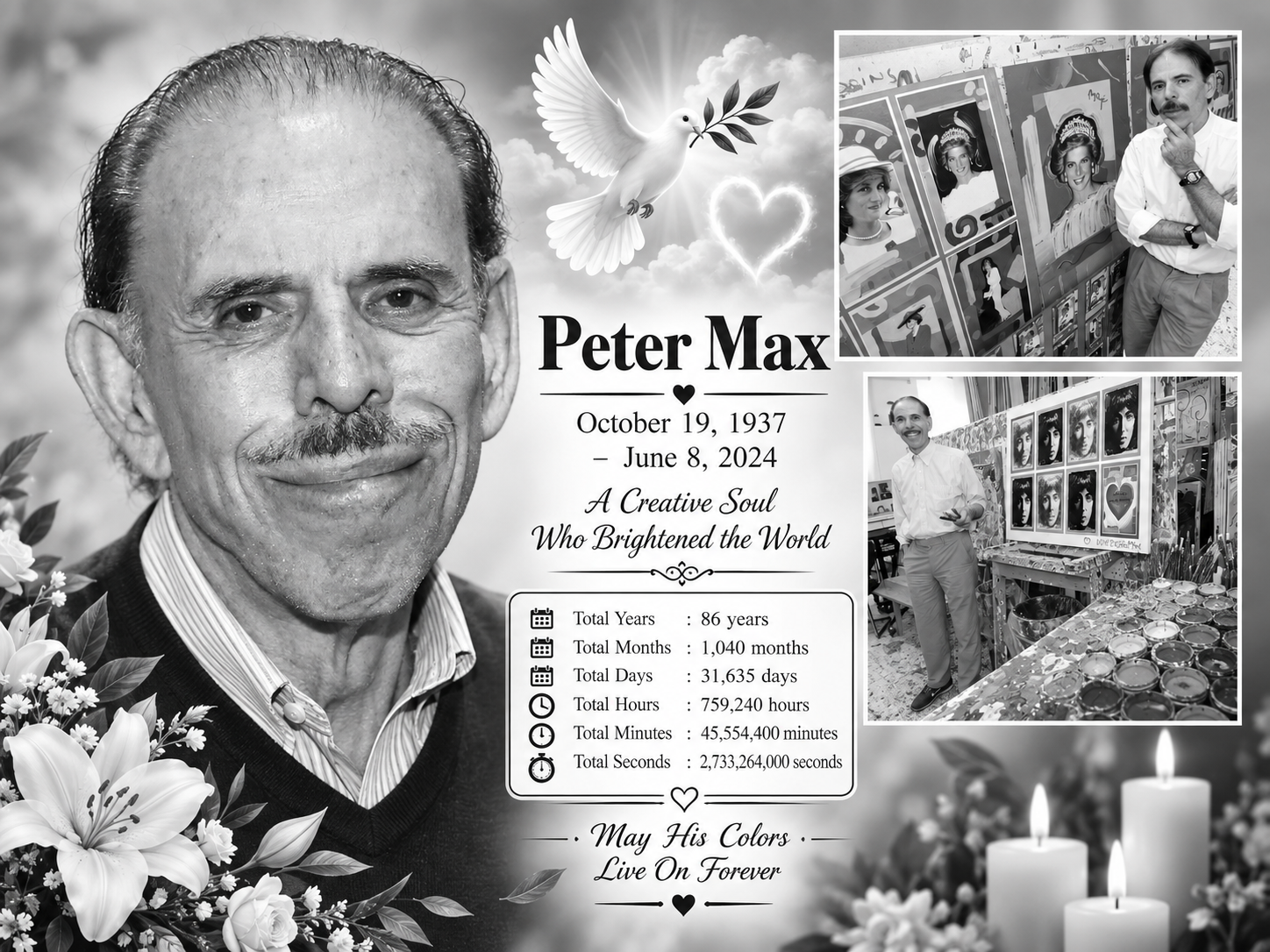
Peter Max was born Peter Max Finkelstein on October 19, 1937, in Berlin, Germany. He entered the world at a moment when his family could not have known how violently Europe would soon change. Within a year, his parents would make a decision that altered the course of his childhood forever: they would leave Germany and take their infant son to Shanghai. Decades later, the man who became famous for brilliant suns, planets, faces, flowers, rainbows, and figures in motion would look back on those early years as part of the visual vocabulary that shaped him. ([Peter Max Studio][1])
The boy who left Berlin was not yet an artist with a recognizable style. He was simply a child being carried from one country to another by parents trying to find safety. His family, Jewish and living under the growing threat of Nazi Germany, reached Shanghai in 1938. That move placed Max in a city whose colors, streets, religious life, architecture, and mixture of cultures would become part of his earliest visual memory. ([Peter Max Studio][1])
Shanghai became the longest home of his early childhood. According to the Peter Max Studio biography, the family remained there for roughly ten years. Max later remembered the city as an intense mixture of images and sounds: Buddhist traditions, Asian calligraphy, imported American popular culture, and the constant movement of a huge city. Those impressions mattered because Max would eventually make a career from transforming ordinary visual experience into something unmistakably his own. ([Peter Max Studio][1])
There was another fascination developing alongside his interest in art. Astronomy captured his imagination. The sky offered something entirely different from the crowded human world around him: enormous distances, planets, stars, darkness, light, and a sense that the universe continued far beyond whatever could be seen from a city street. The two interests—art and astronomy—would remain linked throughout his life. ([Peter Max Studio][1])
His family later moved again. In 1948 they settled in Israel, where Max continued growing up between cultures rather than inside a single national tradition. His childhood had already contained several worlds before he reached adulthood. Europe had been the place of his birth, Shanghai the place of much of his childhood, and Israel another important stage before the family eventually made its way toward the United States. ([Astrotheme][2])
In 1953, Max arrived in New York City at sixteen. The scale of the city struck him immediately. Cars, Broadway signs, enormous buildings, the Statue of Liberty, the Brooklyn Bridge, and the visual noise of American commercial life presented an entirely different landscape from the one he had known overseas. He was already interested in drawing, but New York offered him a new subject: modern America itself. ([Peter Max Studio][1])
The teenager entering New York was also entering a country whose popular culture fascinated him. He had encountered American comics, movies, and jazz before reaching the United States, but now those things surrounded him physically. They were no longer distant pieces of imported culture. They were part of the streets, shops, theaters, magazines, records, and advertisements around him. That collision between fine art and mass culture would eventually become central to his career. ([The Washington Post][3])
Max did not begin as the psychedelic artist that later generations would recognize. His formal training included serious study of realism. At the Art Students League of New York, he studied anatomy, figure drawing, and composition, including instruction under Frank Reilly. He later attended the School of Visual Arts and explored more experimental approaches. The training gave him a foundation that would become easy to overlook once his work became associated with explosive color. ([Peter Max Studio][1])
The young artist learned to observe carefully before learning to distort deliberately. That distinction would become important. Max's later paintings could appear spontaneous, but his background included disciplined study of the human figure and traditional composition. The bright forms did not emerge from an absence of technique. They grew from a decision to push technique in another direction.
By the early 1960s, Max was working in Manhattan with his friend Tom Daly. Together they established a small design studio. At first, the work was commercial: book covers, graphic design, illustrations, and commissioned imagery. It was not yet the cultural phenomenon that would make Max's name familiar across the United States. ([Peter Max Studio][1])
One important commission came from Riverside Records. Max created artwork for a recording by blues pianist Meade Lux Lewis, combining elements of his realistic training with abstraction. The work received a gold medal at the Society of Illustrators annual exhibition. It was an early indication that Max could move comfortably between traditional representation and a more experimental visual language. ([Peter Max Studio][1])
The distinction between designer and artist would soon become increasingly difficult to maintain in his career. Max was producing images for clients, but he was also developing a personal vocabulary of shapes, faces, colors, stars, planets, flowers, and figures. Commercial assignments gave him opportunities to put that vocabulary in front of enormous audiences.
Then came a significant personal influence. In 1966, while traveling in Paris, Max met Swami Satchidananda, a teacher of yoga. The encounter affected his understanding of creativity. Max later credited yoga and the Swami with changing the way he approached drawing, connecting artistic expression with a sense of inner and cosmic consciousness. ([Peter Max Studio][1])
That spiritual influence did not replace his technical training. Instead, it became another layer in his work. The stars and cosmic imagery that had fascinated him through astronomy could now coexist with a more philosophical interest in consciousness, meditation, and interconnectedness. His pictures increasingly looked less like illustrations of a single physical object and more like visual environments.
In 1967, that emerging style collided with the cultural upheaval of the era. Max created his “Be In” poster, associated with the gatherings in New York's Central Park and the counterculture of the late 1960s. His images began appearing in college dormitories, recording studios, corporate spaces, magazines, and popular media. The artist who had once worked quietly on commercial assignments was becoming a public cultural figure. ([Peter Max Studio][1])
Television accelerated that transformation. Max appeared on major programs, including The Tonight Show with Johnny Carson and The Ed Sullivan Show. On Sullivan's program, he demonstrated his ability to draw live, sometimes working with both hands simultaneously to create mirrored images. The television audience did not merely see finished artwork; viewers saw the act of drawing itself become entertainment. ([Peter Max Studio][1])
His images became inseparable from the visual atmosphere of the period. Critics and commentators compared his cultural impact in the visual arts with the influence of the Beatles in music. The comparison was not simply about fame. It reflected the way his imagery seemed to give visual form to an era already saturated with music, youth culture, experimentation, peace imagery, and psychedelic design. ([Art in Embassies][4])
By 1969, Max's name had reached another level. He appeared on the cover of Life magazine, a publication whose covers were closely associated with major figures and events in American life. Max later recalled being astonished by seeing his own face where he had once expected to see generals, athletes, movie stars, and other famous people. ([Peter Max Studio][1])
That same period demonstrated another side of his success. General Electric commissioned Max to create a line of art clocks, and his imagery spread across dozens of product lines. Posters were no longer the only place where people encountered his work. His designs appeared on consumer objects, turning the visual language of a contemporary artist into part of everyday American life. ([Peter Max Studio][1])
Space, meanwhile, remained close to his imagination. The 1969 Apollo 11 moon landing became an obvious subject for Max. He produced commemorative posters connected to the event, combining his fascination with astronomy with the extraordinary cultural significance of humans reaching the moon. The universe that had fascinated him as a child had become part of the imagery through which millions of people encountered his art. ([Peter Max Studio][1])
But success carried an unexpected problem. The more recognizable Max became, the more his art was reproduced and commercialized. His images could be found on products far removed from the quiet act of painting. The commercial reach was enormous, but it raised a question that would follow him for years: if an artist's work becomes nearly impossible to escape, what happens to the artist's need to create something private and personal?
That question was about to change the direction of Peter Max's career.
Click Here to continue read next: PART2: Fame Turned His Paintings Into Everyday Objects, Yet the Artist Eventually Stepped Away From the Crowd to Search for Another Language
Before the Colors Became Famous, a Child Escaped a Dangerous Europe and Carried a Memory of the World Into His Art
Part 1 of 16

