
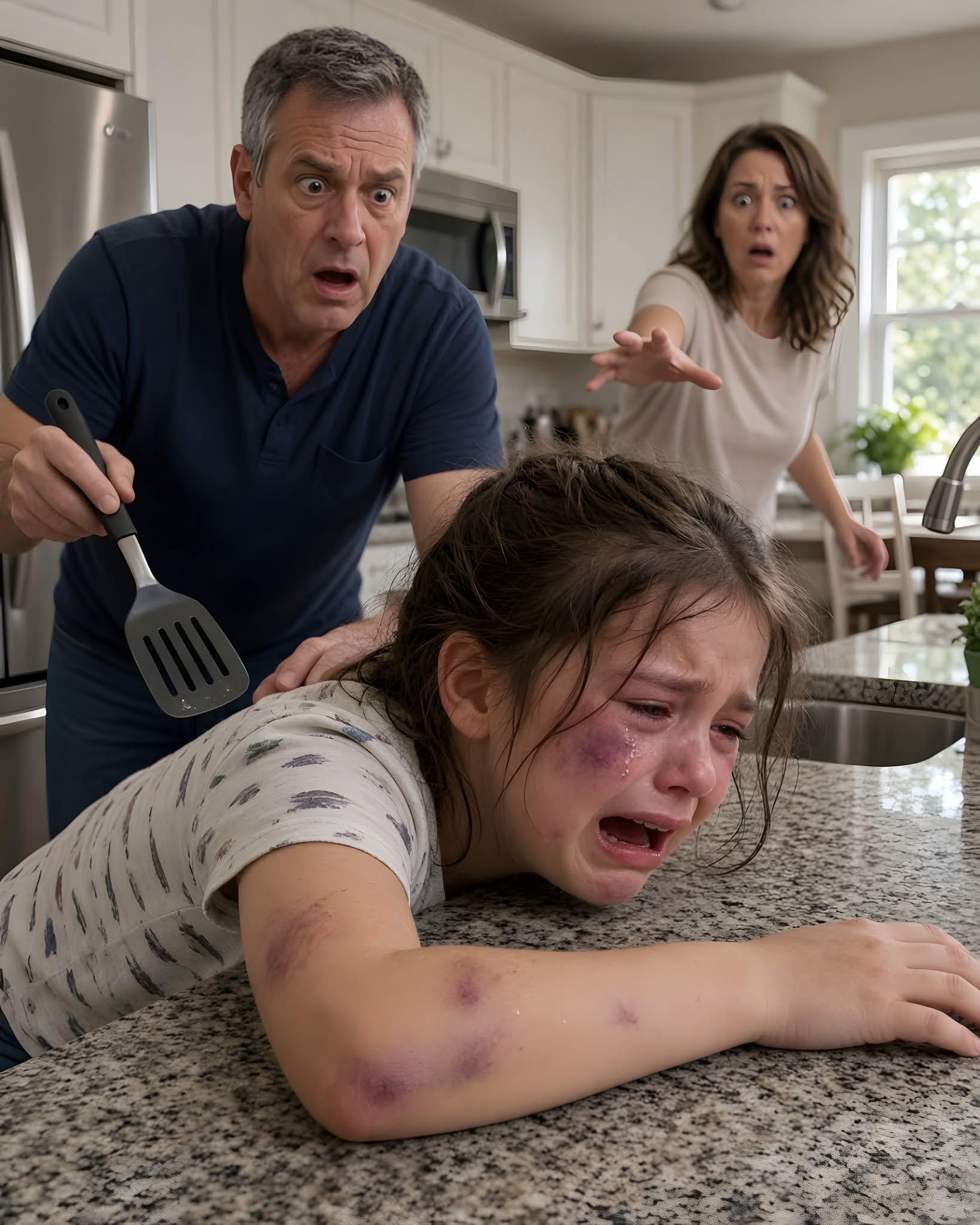
Mia did not expect the old house to feel smaller.
She had been away for several years, building a life that belonged entirely to her. Her apartment was modest but comfortable. She had a job she enjoyed, friends who knew her as an adult rather than as the frightened girl from the kitchen, and a growing collection of drawings she kept framed along the walls.
Yet when she pulled into her parents' driveway that Saturday morning, she felt the familiar mixture of comfort and unease that always came with returning.
The house looked almost exactly as she remembered it.
The porch had been repainted. The garden had grown wild around the edges. Ethan's old bicycle was nowhere to be seen because he had long since stopped riding it. Through the kitchen window, Mia could see her mother moving between the counter and the stove.
Daniel opened the front door before she reached it.
“You're early.”
Mia smiled.
“You told me breakfast was at nine.”
“It is nine.”
“Then I'm exactly on time.”
Daniel laughed and stepped aside.
Mia hugged him.
The embrace was brief, natural, and entirely different from the first years after he had returned home. There had once been careful calculations around every physical gesture. Now neither of them had to think about it.
“Mom!” Mia called.
Sarah came from the kitchen.
“There you are.”
She hugged her daughter tightly.
“You look tired.”
“I drove three hours.”
“You could have stayed last night.”
“I know.”
“You should have.”
“I know.”
Sarah smiled.
“Good. At least you're still listening.”
Mia laughed.
Ethan arrived twenty minutes later carrying a box of pastries.
“Emergency supplies.”
Sarah looked inside.
“We already have breakfast.”
“These are important.”
Daniel took the box.
“You bought six?”
“There are four of us.”
“You're assuming Mia won't eat two.”
Mia looked offended.
“I absolutely might.”
The morning became noisy almost immediately.
Someone turned on music.
Someone burned toast.
Sarah complained about the coffee.
Ethan defended the pastries.
Daniel insisted the pancakes were better than anything from a bakery.
Mia stood at the counter watching them.
She realized she had missed this.
Not the house itself.
The sound.
The ease.
The feeling that she could arrive carrying an ordinary problem and nobody would demand that she make it into something dramatic.
After breakfast, Mia helped Sarah clear the table.
Her mother watched her for a moment.
“What?”
“Nothing.”
“You're staring.”
“I was remembering when you used to sit there doing homework.”
Mia glanced at the chair.
“I remember.”
“You hated fractions.”
“I still hate fractions.”
Sarah laughed.
“Some things never change.”
Mia carried the plates to the sink.
Her eyes moved toward the stove.
The spatula was still there.
She touched the handle.
Sarah noticed.
“Do you want me to put it away?”
Mia shook her head.
“No.”
She looked at it again.
“It's just a spatula.”
Sarah smiled.
“Yes.”
Mia put it down.
That afternoon, Ethan suggested they look through old family photographs.
They carried boxes from the closet into the living room.
Photographs spilled across the carpet.
Birthdays.
School plays.
Beach trips.
Christmas mornings.
Mia picked up one picture of herself at eight years old.
She looked at it for a long time.
Daniel noticed.
“You don't have to keep it.”
“I want to.”
She turned it over.
Nothing was written on the back.
“Sometimes I wonder what she would think of me.”
Sarah sat beside her.
“She'd be proud.”
Mia smiled.
“Maybe.”
Ethan picked up another photograph.
“Look at Dad's hair.”
Daniel groaned.
“That photograph should have been destroyed.”
“No way.”
Mia laughed.
For several minutes, the painful years disappeared beneath ridiculous family stories.
Then Daniel's expression changed.
He had found the old photograph of his own father.
The room became quieter.
He put it back into the box.
Mia noticed.
“Dad?”
“I'm fine.”
She waited.
“I don't like seeing it.”
“You don't have to.”
Daniel nodded.
Sarah did not intervene.
She had learned that not every difficult moment needed to become a family discussion.
Later, Mia and Daniel sat on the back porch.
The evening breeze carried the smell of rain.
Mia asked, “Do you still have the notebook?”
Daniel smiled.
“The one I started after counseling?”
“Yes.”
“In my desk.”
“Can I see it?”
He looked surprised.
“Why?”
“I've always wondered what you wrote.”
Daniel went inside.
When he returned, the notebook was worn at the corners.
Mia opened it.
The first pages were filled with short sentences.
Stop before reacting.
Listen.
Do not demand obedience.
Respect no.
Walk away when anger rises.
Take responsibility without asking others to comfort you.
Mia read silently.
“These are good.”
“I still use them.”
“You wrote all this yourself?”
“Yes.”
She turned another page.
There were notes about mistakes.
Times Daniel had become impatient.
Times he had recognized his temper early.
Times he had left a conversation before saying something harmful.
There were no descriptions of himself as heroic.
Only reminders of what he needed to do.
Mia closed the notebook.
“I think this helped.”
“It did.”
She looked at him.
“Did you ever hate having to do it?”
“Yes.”
“Why?”
“Because every reminder meant remembering why I needed the reminder.”
Mia nodded.
“That makes sense.”
Daniel looked toward the yard.
“I almost threw it away once.”
“Why?”
“I thought I should be past all of this.”
Mia frowned.
“But you weren't.”
“No.”
“So you kept it?”
“Yes.”
She smiled.
“Good.”
That evening, Sarah called Mia into the kitchen.
“There is something I want to ask you.”
“What?”
“Would you like to take the old letter?”
Mia immediately knew which one.
She shook her head.
“No.”
“Are you sure?”
“Yes.”
“Why?”
“Because I don't need to own it to remember what it taught us.”
Sarah nodded.
“I understand.”
Mia looked at her.
“Do you still read it?”
“Sometimes.”
“Why?”
Sarah hesitated.
“To remind myself that ignoring warning signs never makes them disappear.”
Mia looked down.
“That letter helped you too.”
“Yes.”
“I used to think it was only about Dad.”
“It was never only about him.”
“What else?”
Sarah looked at her daughter.
“It was about all of us deciding what kind of family we wanted to be.”
Mia nodded.
The next morning, Daniel asked whether Mia wanted to take a walk.
They walked toward the small park nearby.
Children played soccer.
A dog chased a ball.
Someone was mowing a lawn.
Mia kicked a stone along the path.
“Dad?”
“Yes?”
“Do you ever worry that you'll become like Grandpa again?”
Daniel answered honestly.
“I think about it.”
“Even now?”
“Yes.”
“Why?”
“Because I never want confidence to become carelessness.”
Mia nodded.
“So you still have to work at it.”
“Every day.”
She looked at him.
“I think that's okay.”
“What is?”
“That people have to keep choosing who they are.”
Daniel smiled.
“You've learned a lot.”
“So have you.”
They continued walking.
At the park entrance, Mia stopped.
“I used to think you changed because everyone gave you another chance.”
Daniel looked at her.
“What do you think now?”
“I think people gave you opportunities, but you had to decide what to do with them.”
Daniel nodded.
“That is probably the most accurate thing you've ever said about it.”
Mia laughed.
“Don't make me feel too proud.”
They walked home.
When they reached the kitchen, Ethan was attempting to cook eggs.
Smoke filled the room.
Sarah stood beside the stove with her arms crossed.
“What happened?”
Ethan coughed.
“The pan betrayed me.”
Daniel opened the window.
Mia laughed so hard she had to sit down.
The moment was absurd.
It was also important.
Years earlier, smoke and sudden movement in the kitchen would have carried a completely different meaning.
Now everyone was simply dealing with burnt eggs.
Mia watched her family.
She realized that safety had become ordinary.
That was the greatest evidence that things had changed.
Not that nobody remembered.
Not that nobody felt regret.
Not that Daniel had become perfect.
But that the family could encounter a problem without fear deciding what happened next.
That evening, Mia packed her suitcase.
Sarah stood in the doorway.
“You'll come again?”
“Of course.”
“When?”
“Soon.”
“You always say soon.”
“Then I'll prove it.”
Sarah smiled.
Downstairs, Daniel was washing dishes.
Mia stopped beside him.
“I'll call when I get home.”
“Drive carefully.”
“I will.”
She hesitated.
Then she hugged him.
“Goodnight, Dad.”
“Goodnight.”
She walked toward the front door.
For a moment, she looked back at the kitchen.
The window.
The counter.
The stove.
The spatula.
Everything ordinary.
Everything changed.
Mia stepped outside.
She did not feel trapped by the memory.
She simply carried it with her as part of a larger story.
A story that included pain.
A story that included accountability.
A story that included change.
And, finally, a story that belonged to her.
Click Here to continue read next: PART14: A Message From the Past Arrived Without Warning, and Mia Had to Decide Whether Knowing More Would Heal an Old Wound or Reopen It
She Heard the Spatula Hit the Counter and Knew Something Had Changed Before Anyone Spoke
Part 13 of 16

