
Corbin sat beneath warm studio lights wearing a dark suit without a tie. The interviewer introduced him as a former producer and described his career in careful language that avoided words such as scandal, lawsuit, or collapse.
Selena watched without sound for several seconds.
Then she increased the volume.
Corbin spoke about ambition.
About how quickly success could become complicated.
About people changing once money entered a relationship.
He never said Selena's name at first.
That made the implication more obvious.
“I trusted people who didn't deserve that trust,” he said.
The interviewer asked whether he regretted the collapse of The Glass Monarch.
Corbin looked down.
“I regret believing certain people were loyal.”
Selena leaned back.
The old Corbin would have spoken faster.
This version had learned how to pause.
He had learned how to make bitterness sound like reflection.
The interviewer asked directly about the divorce.
Corbin sighed.
“My marriage was complicated.”
Selena almost smiled.
It was the safest possible word.
Complicated.
A word that could hide twelve years.
A word that required no responsibility.
The interviewer asked whether his former wife had influenced his professional downfall.
Corbin looked into the camera.
“She had enormous influence.”
Selena muted the television.
Tamara was in the doorway.
“You saw it.”
“Yes.”
“How bad?”
Selena turned the sound back on.
Corbin continued.
“I think when someone has that much power, they sometimes forget what it feels like to be on the other side.”
Tamara shook her head.
“He still doesn't get it.”
“No.”
The interviewer asked the question Corbin had clearly been waiting for.
“Do you believe Selena used Vellum Crown to punish you?”
Corbin looked solemn.
“I believe she made decisions that benefited her.”
Selena stared at the screen.
That sentence was almost clever.
It avoided a direct accusation.
It suggested motive without proving anything.
Tamara crossed her arms.
“Answer him.”
“He can't hear me.”
“I know.”
Selena muted the television again.
“I used to think I needed him to admit the truth.”
Tamara sat beside her.
“And now?”
“I don't.”
That was the difference.
The interview continued without them.
Corbin described the years before the divorce.
He claimed he had felt trapped by Selena's family.
He claimed he had wanted independence.
He described Vellum Crown as an environment where his ideas were constantly constrained.
He said the company had become “a family business pretending to be a creative institution.”
Tamara looked at Selena.
“That part might actually be true.”
Selena nodded.
“But not the way he means it.”
Corbin was asked whether he knew Selena controlled the company before the divorce.
He smiled.
“No.”
The interviewer seemed surprised.
“I knew her family had money. I didn't know the extent of their ownership.”
Selena turned off the television.
That was the first completely honest thing he had said.
She stood.
“That's enough.”
The interview went viral anyway.
By noon, every entertainment publication had clipped the cemetery story into a three-minute segment.
By afternoon, reporters were outside Vellum Crown.
The company's communications team asked Selena whether she wanted a statement.
“No.”
Blythe called.
“Absolutely certain?”
“Yes.”
“What if the story keeps growing?”
“It will.”
“What if they say you destroyed his career?”
“Then they say it.”
Blythe was silent.
“You're not even angry?”
Selena looked at the window.
“No.”
It surprised her too.
The anger had not vanished overnight.
It had simply become unnecessary.
That evening, Selena received a message from Vivian.
I saw the interview.
A second message followed.
I don't know if I should say anything.
Selena waited before replying.
You don't have to.
Vivian answered almost immediately.
I know.
Then:
I just wanted you to know I don't believe him anymore.
Selena looked at the words.
She typed:
You don't owe me proof.
There was no response for several minutes.
Then:
I know. That's why I wanted to tell you.
Selena put the phone down.
The next day, the story changed.
A former Vellum Crown executive released documents showing that Corbin had privately described the company as vulnerable months before the divorce.
Another former associate confirmed that he had discussed acquisition structures.
The interview that had been intended to restore his reputation instead revived questions about his financial dealings.
Corbin's publicist issued a statement claiming he had been misunderstood.
The statement lasted less than three hours.
Then the old recording became relevant again.
Not publicly.
Legally.
The investors involved in the attempted acquisition reopened discussions with their attorneys.
The companies that had once quietly supported Corbin began distancing themselves.
He had not been arrested.
He had not been publicly disgraced beyond repair.
But trust had become expensive.
And few people were willing to spend it on him.
Selena refused every request for comment.
Her silence frustrated journalists.
It also protected her.
One reporter wrote that Selena's refusal to answer was “the most powerful statement she could make.”
She disliked the phrase.
Power was not silence.
Power was choice.
She chose not to participate.
A week later, Malcolm called.
“There's something you should see.”
Selena opened the secure file.
It was an old corporate communication recovered from Corbin's deleted laptop.
The message had been sent months before the funeral.
It was addressed to one of the investors.
Corbin had written that once the divorce was completed, Selena would have “no practical role” in Vellum Crown.
Malcolm pointed out the date.
It was two months before Corbin served the papers.
“He had already planned for you to disappear,” Malcolm said.
Selena read the message again.
She felt something she had not expected.
Not anger.
Pity.
He had spent months planning for a future in which she was irrelevant.
And she had spent those same months believing she was trying to save a marriage.
The difference was devastating.
“What do we do with this?” she asked.
“Nothing unless necessary.”
“Then nothing.”
Malcolm paused.
“You're sure?”
“Yes.”
She closed the file.
There were truths she needed for legal protection.
There were truths she needed for closure.
And there were truths that did not need to become public simply because they existed.
She had learned the difference.
That evening, Selena walked through the studio floor.
A group of young producers were debating a script near the editing rooms.
Nobody noticed her at first.
One of them finally did.
“Ms. Renner.”
She smiled.
“Selena is fine.”
They immediately became nervous.
She laughed.
“I promise I won't ask for your quarterly projections.”
The tension broke.
They showed her the project they were working on.
It was small.
No famous actors.
No enormous budget.
No international financing.
Just a good story.
Selena listened.
Then asked two questions.
The young producer answered both.
“Keep going,” she said.
He blinked.
“Really?”
“Yes.”
She walked away.
Behind her, Tamara smiled.
“What?”
“You looked happy.”
Selena thought about it.
“I was.”
Three years earlier, she had believed saving Vellum Crown required saving every major project.
Now she understood that the company was not its biggest film.
It was the people who kept making things after the biggest film was finished.
That night, she returned home and found a package.
No return address.
Inside was the wedding ring.
The same ring Corbin had offered outside the courthouse.
Selena stared at it.
There was no note.
She placed the box on the table.
For a long time, she did nothing.
Then she opened a drawer.
Inside were old photographs, letters, and a few objects from the marriage she had never needed to throw away.
She placed the ring there.
Not because she wanted it.
Not because she forgave him.
Because it no longer had enough power to frighten her.
She closed the drawer.
Her phone buzzed.
Blythe.
Board materials for Monday.
Selena smiled.
Another decision.
Another future.
She went to bed.
The next morning, she woke before sunrise.
The city was quiet.
She made coffee and stood by the kitchen window.
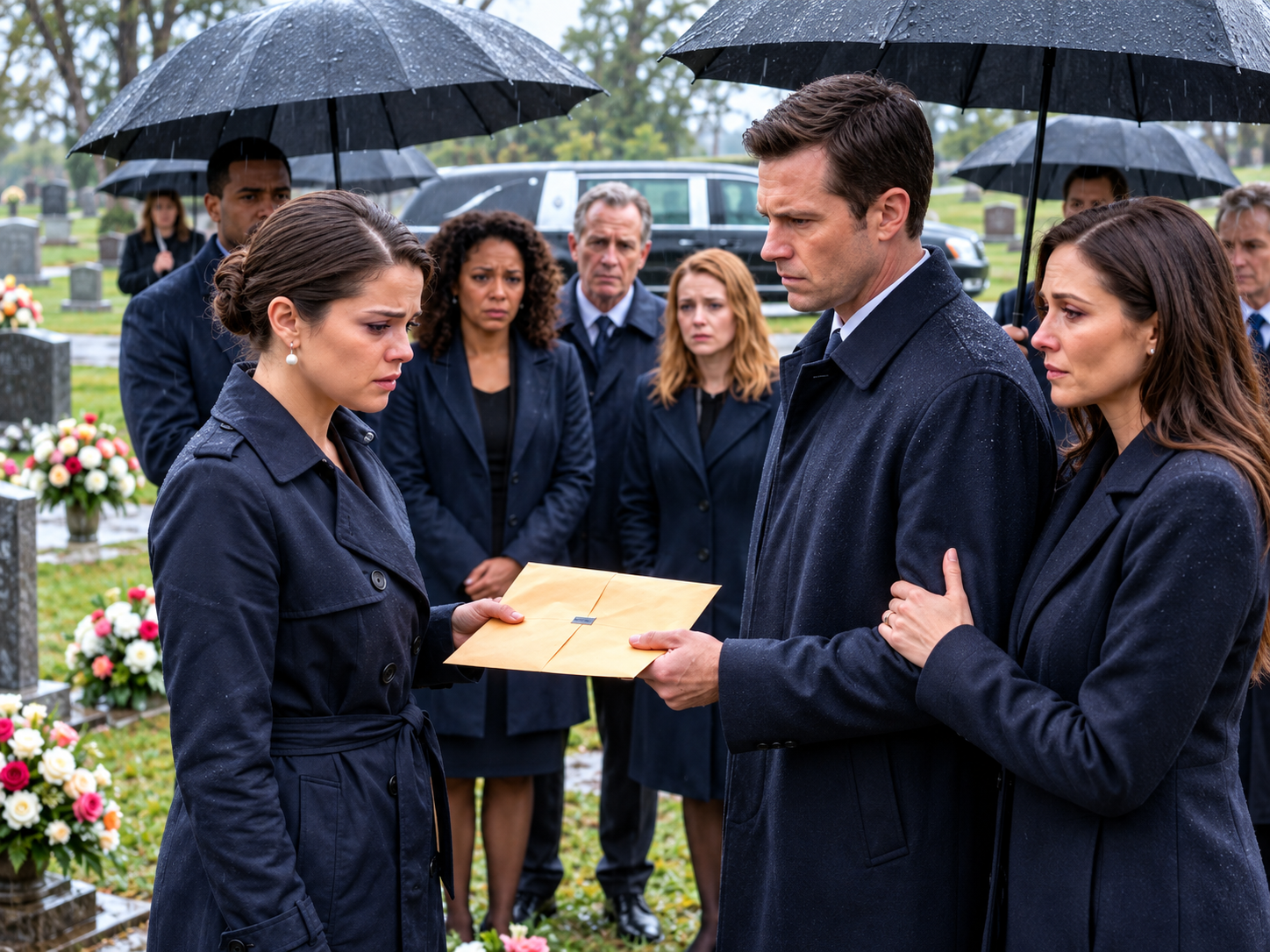
For the first time, she realized she could remember Corbin without replaying the cemetery.
That was new.
The memory had finally become one memory among many.
Not the center.
Not the beginning.
Not the end.
Just a day.
A terrible day.
A day that had changed everything.
But not because Corbin had won.
Because he had shown her what she could survive.
Click Here to continue read next: PART7: The Last Thing Corbin Returned Was Not the Ring but the Version of Selena He Had Spent Years Trying to Control
The Envelope in His Hand Was Only the Beginning of What Selena Had Been Keeping Quiet
Part 6 of 8

