
Corbin did not answer immediately.
Selena could hear traffic behind him, tires hissing over wet pavement.
“You always needed to win,” he said.
She looked at the rain sliding down the study window.
“I don't.”
“You're lying.”
“No. I'm refusing to fight the way you fight.”
“You've always been afraid to fight.”
Selena almost smiled.
“You still think silence means fear.”
“You'll regret what you're doing.”
“Good night, Corbin.”
She ended the call.
Tamara was standing in the doorway.
“You heard?”
“Enough.”
“He's going to make himself the victim.”
“He already has.”
“What are you going to do?”
Selena looked at the folders covering her father’s desk.
“Nothing publicly.”
Tamara frowned.
“That sounds dangerous.”
“It isn't.”
“He's going to talk.”
“Let him.”
“And if he lies?”
Selena closed the folder.
“Then we'll answer with records.”
The next morning, the first headlines appeared.
THE GLASS MONARCH DELAYED HOURS BEFORE GLOBAL PREMIERE.
VELLUM CROWN FACES INTERNAL DISPUTE.
DIVORCE WAR BEHIND STUDIO CRISIS?
Corbin had not named Selena publicly.
He did not need to.
The story practically wrote itself.
A powerful wife.
A successful husband.
A troubled marriage.
A major film suddenly suspended.
The public loved a simple explanation.
Selena refused to give them one.
Tamara paced around the office.
“He's making you look unstable.”
“Let him.”
“He humiliated you at the cemetery.”
“I know.”
“And now he's pretending you're sabotaging him.”
Selena turned off the television.
“If I answer emotionally, I give him exactly what he wants.”
“What do you give him instead?”
“Documents.”
The audit committee issued a statement that morning.
It contained no mention of the divorce.
No cemetery.
No affair.
No names beyond those necessary for the corporate review.
The release of The Glass Monarch had been postponed pending examination of undisclosed financial interests connected to project acquisition and third-party compensation.
That was all.
The reaction was immediate.
Within hours, reporters began asking about Arclight Meridian.
By evening, North Arbor Literary Holdings announced that it would cooperate with the review.
Corbin's public narrative began to weaken.
Then the investigators found something in Vivian's phone.
It was a voice message.
Six weeks old.
Vivian had forgotten it existed.
She sat across from Selena, Malcolm, and two outside attorneys as the recording loaded.
Her thumb hovered over the screen.
“Are you sure?”
Vivian nodded.
“I need to know.”
She pressed play.
Corbin's voice filled the conference room.
He sounded tired, but not drunk in the careless sense.
He sounded confident.
As though he were speaking to someone he trusted completely.
“I just need the opening to be big enough,” he said. “Once everyone thinks I'm indispensable, the rest gets easier.”
Selena sat perfectly still.
The recording continued.
“When the debt schedule tightens, the board will panic. Half of them will fold. Then we make the offer.”
Vivian's hand rose slowly toward her mouth.
Corbin laughed softly on the recording.
“Selena won't matter. She doesn't even understand how the company really works.”
Selena stared at the table.
The recording went on.
“Her father is dying. Once he's gone, she'll be too broken to fight anyone.”
Nobody moved.
Then came the sentence that made the room colder.
“And after the divorce, she won't even be in the room.”
The message ended.
Vivian began crying.
Tamara turned away.
Selena did not.
Malcolm waited.
Finally Selena asked, “Is that enough?”
Malcolm looked at her.
“For what?”
“To remove him from the project without using the divorce.”
“Yes.”
“Then do that.”
There was no celebration.
No satisfaction.
Selena refused to leak the recording.
She refused to give the press the cemetery photographs.
She refused to expose Vivian’s private messages.
She did not want Corbin destroyed in public.
She wanted the company protected.
At four o’clock that afternoon, the independent committee voted.
Corbin Ashford’s producer agreement was terminated.
The reasons were corporate, not personal.
Undisclosed conflicts.
Breach of fiduciary obligations under consulting arrangements.
Unauthorized use of confidential strategic information.
Conduct materially adverse to Vellum Crown.
The vote was eleven to zero.
Selena abstained.
That detail mattered.
Corbin filed suit almost immediately.
He alleged retaliation.
He alleged marital revenge.
He alleged defamation.
He alleged wrongful termination.
His attorneys argued that Selena had manipulated the process because she wanted to punish him for leaving the marriage.
Malcolm produced the committee minutes.
Selena had not voted.
The independent committee had.
The audit firm was external.
The recommendation had been unanimous.
The legal argument began collapsing before the first hearing.
Corbin still had one weapon.
The Glass Monarch.
Two days after his termination, he filed an emergency motion claiming personal ownership of parts of the film’s concept development.
If the court granted the injunction, the studio could be prevented from releasing the film.
The premiere could disappear.
The project could sit untouched for months.
Possibly years.
The press called it scorched earth.
Selena called it predictable.
That night, Malcolm arrived at her parents’ house carrying the leather folder her father had left behind.
He looked exhausted.
But there was something almost pleased in his expression.
“I found something.”
Selena put down her tea.
“What?”
“Your father anticipated a rights dispute.”
He opened the folder.
Then reached behind a hidden sleeve sewn into the lining.
A document emerged.
Selena recognized the signature immediately.
Corbin.
Three years earlier.
Before The Glass Monarch had become valuable.
Before Corbin had become a public figure.
Before he had enough leverage to demand special terms.
The document was an early development participation agreement.
Malcolm pointed to a paragraph.
“Everything created during Vellum Crown-funded development belongs to the company.”
Selena read the language.
Concepts.
Revisions.
Characters.
Treatments.
Pitch materials.
Development contributions.
All assigned to Vellum Crown.
Corbin had signed it.
Then apparently forgotten it existed.
Selena touched his signature.
“He knew.”
Malcolm shook his head.
“Your father knew.”
She looked up.
“What do you mean?”
“Your father understood that people remember the contract they sign when they're powerless. They forget it after they become successful.”
Selena closed her eyes.
Her father had always been patient.
Sometimes infuriatingly patient.
The emergency injunction was denied forty-eight hours later.
Corbin walked out of the courthouse without speaking.
The legal fight continued.
But his claim to the film had collapsed.
Three weeks after the funeral, Vellum Crown announced a new premiere date.
Selena did not attend.
Blythe called from Los Angeles.
“You should be here.”
“No.”
“You saved the project.”
“No. The team did.”
“You own the company.”
“That doesn't mean I need to stand on a carpet.”
Blythe laughed softly.
“People are asking where you are.”
“Let them ask.”
Selena was at St. Mark’s Cemetery.
She had returned alone.
There was no umbrella this time.
The rain had finally stopped.
She sat between her parents’ graves and looked at the wet grass.
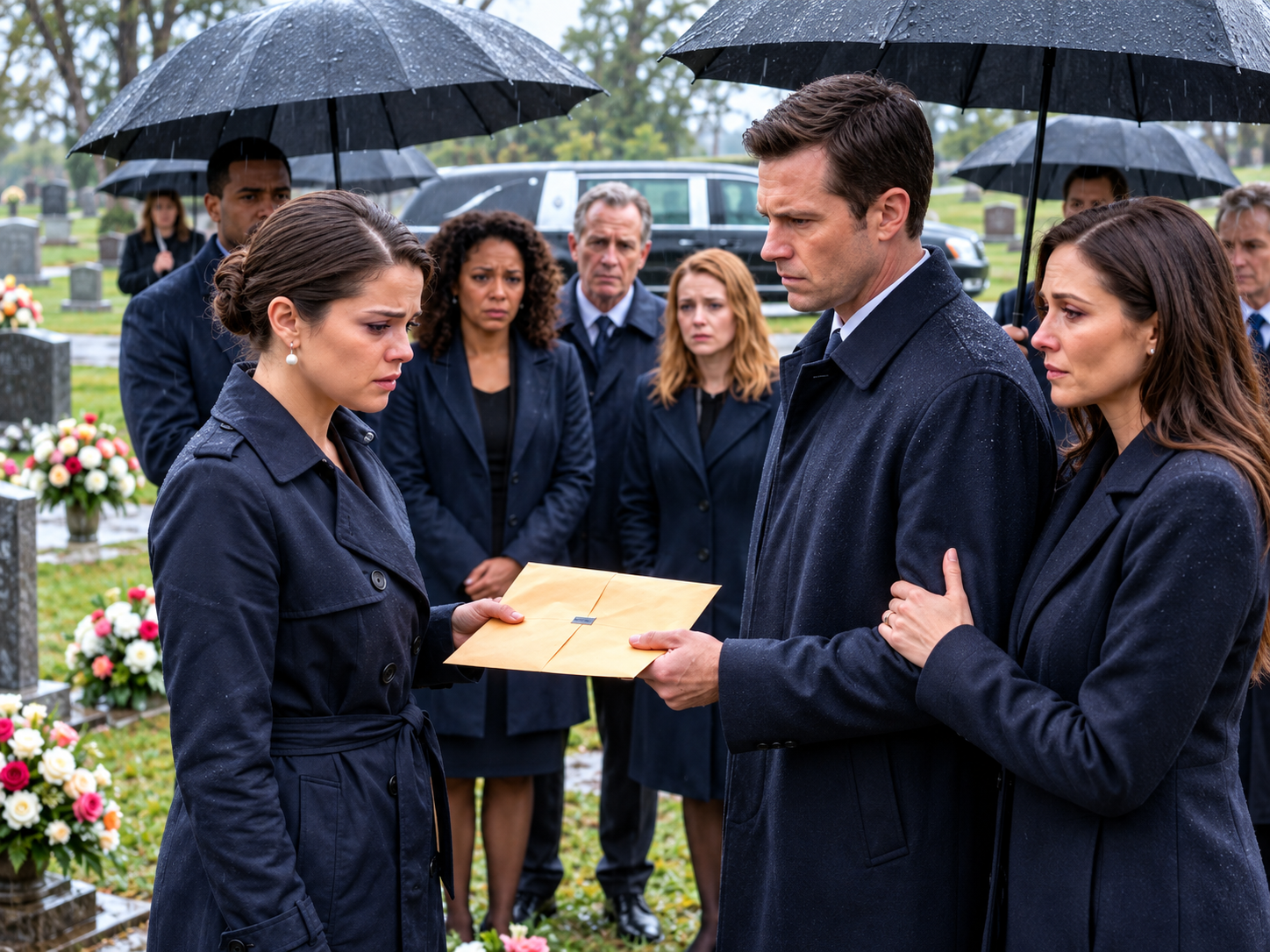
Three weeks earlier, Corbin had stood here with an envelope and believed he was ending something.
He had.
But not what he thought.
Selena had spent years believing that losing her marriage would mean losing part of herself.
Now she understood that grief and release could exist at the same time.
The film premiered without Corbin.
It also premiered without Selena.
The cast walked the carpet.
The director spoke.
Crew members who had spent years working behind the scenes finally received their moment.
The audience applauded.
The film opened strongly.
Not spectacularly.
Not disastrously.
Simply well.
Selena found something strangely satisfying about that.
Corbin had spent years trying to make The Glass Monarch proof of his importance.
The project survived without him.
That was the result he had never planned for.
Vivian did not attend either.
She moved out of the apartment Corbin had placed in her name after investigators traced its purchase through one of his entities.
She cooperated fully.
Her reputation suffered.
Some people called her manipulated.
Others called her opportunistic.
Vivian eventually stopped trying to control which version strangers preferred.
Months later, Selena received a handwritten letter.
It was from Vivian.
Selena read it alone.
Vivian wrote that she did not expect forgiveness.
She admitted that being chosen had felt intoxicating.
She admitted that she had suspected Corbin lied to her more than once.
And she admitted something harder.
There had been moments when the truth would have cost her comfort, so she had chosen not to ask.
At the bottom of the letter, Vivian wrote that she had once believed she had won because Corbin had left his wife for her.
Now she understood that a man who humiliates one woman for another can eventually humiliate the second woman for someone else.
Selena folded the letter.
She did not answer.
But she kept it.
Not because she wanted evidence against Vivian.
Because it reminded her that people could finally tell the truth after they had lost the ability to benefit from lying.
Corbin's collapse was slower than the newspapers expected.
There was no arrest.
No dramatic courtroom spectacle.
No single day when his life vanished.
Instead, consequences accumulated.
His investor group dissolved.
Two partners sued over undisclosed arrangements.
A talent agency dropped him.
North Arbor demanded repayment under a settlement.
His wrongful termination case was dismissed.
He sold the Manhattan apartment.
Then the Hamptons house.
Then the car he had once described as essential to maintaining his professional image.
The cameras that once followed him into restaurants now appeared mainly outside courthouses.
Nearly eleven months after the funeral, Tamara sent Selena a message.
You need to see this.
A photograph followed.
Corbin was leaving a mediation center.
Alone.
No stylist.
No assistant.
No Vivian.
No entourage.
He looked older.
Selena studied the photograph for five seconds.
Then deleted it.
Tamara called immediately.
“You deleted it?”
“Yes.”
“You didn't save it?”
“No.”
“Not even a little satisfaction?”
Selena smiled.
“Some.”
Tamara laughed.
“There you are.”
Selena returned to work.
She had stopped measuring her progress by Corbin.
That was the real change.
For years, even when she was angry with him, her thoughts had circled around his reactions.
Would he approve?
Would he understand?
Would he regret something?
Would he finally see her?
Now she no longer needed the answer.
The final divorce hearing was scheduled for twelve months and four days after the cemetery.
Corbin arrived early.
Selena arrived shortly afterward.
They sat on opposite sides of a quiet courthouse hallway.
There were no cameras.
No board members.
No parents.
No mistress.
No audience.
Just the two people who had once promised to grow old together.
Corbin looked at her.
“You changed.”
Selena considered the statement.
“No.”
“You did.”
“I stopped explaining myself to you.”
He looked down.
His hands were clasped between his knees.
Selena noticed something.
The watch she had given him on their tenth anniversary was gone.
For the first time in years, she wondered whether there was still anything left between them that could be called grief rather than history.
Corbin spoke quietly.
“Did you ever love me?”
She almost answered immediately.
Instead she waited.
“Yes.”
He nodded.
“I loved you too.”
Selena looked at him.
“No.”
His face tightened.
“You don't get to tell me what I felt.”
“You loved how I made your life feel.”
“That isn't fair.”
“You loved being admired.”
He looked away.
“You loved being needed.”
Silence.
“You loved being the person everyone noticed.”
He swallowed.
“And you?”
Selena looked toward the courtroom doors.
“I loved who I thought you were when no one else was watching.”
That silenced him.
A clerk passed through the hallway.
Neither moved.
Then Corbin said something that made Selena look at him again.
“Your father hated me.”
She shook her head.
“No.”
“He never trusted me.”
“That is different.”
“He thought I wasn't good enough for you.”
Selena looked at him.
“No.”
“What did he think?”
She took a breath.
“He thought you wanted to be important more than you wanted to be good.”
Corbin's expression hardened.
Then softened.
Because somewhere inside him, he knew.
The courtroom doors opened.
Their attorneys stepped into the hallway.
The hearing was about to begin.
Click Here to continue read next: PART4: The Marriage Ended Quietly, But Selena’s Final Choice Revealed How Completely Corbin Had Misunderstood Her
The Envelope in His Hand Was Only the Beginning of What Selena Had Been Keeping Quiet
Part 3 of 8

