
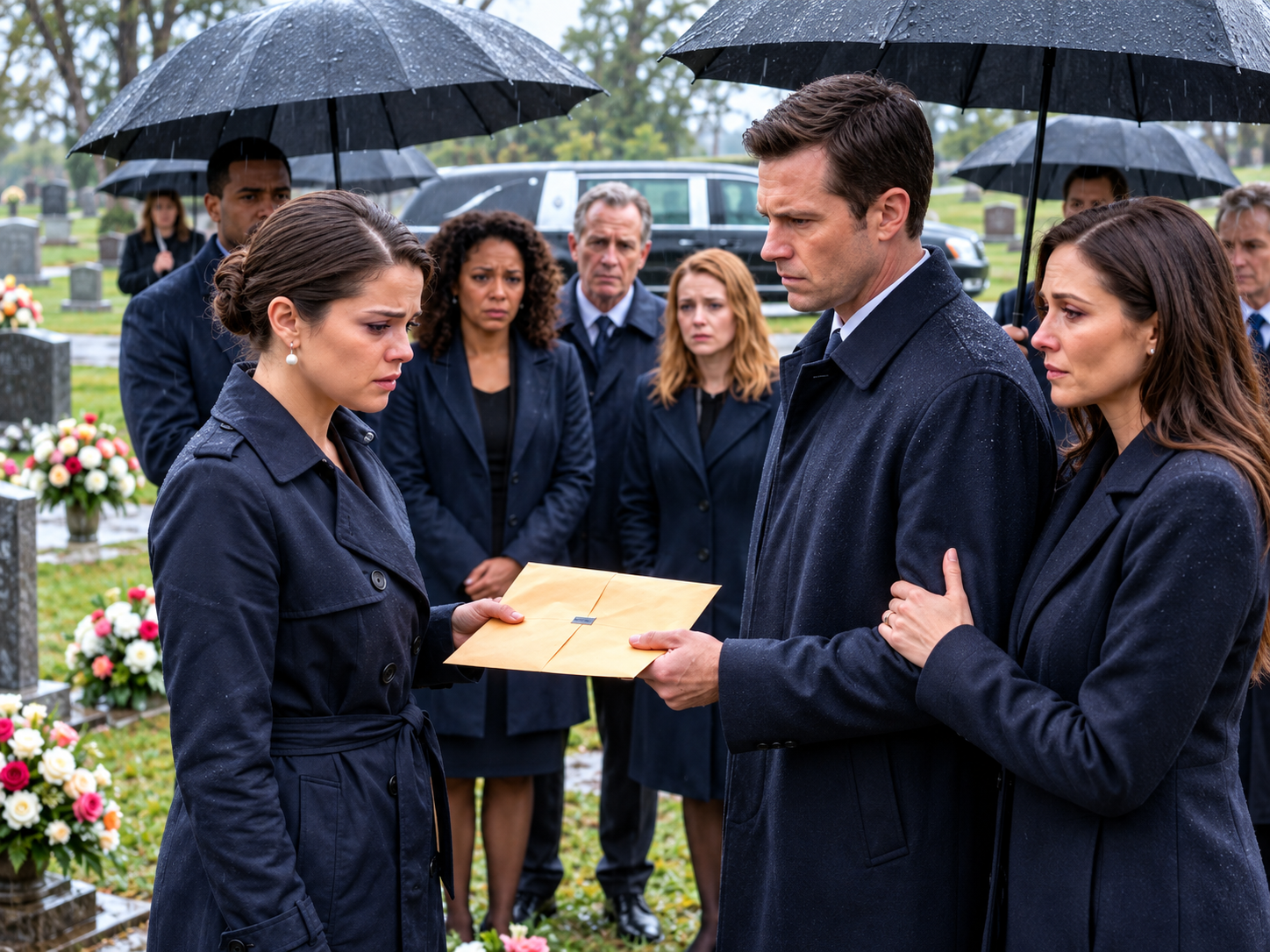
The following spring, Selena received another letter.
This one was handwritten on plain paper.
There was no company stationery.
No lawyer's name.
No request for a meeting.
She recognized the handwriting immediately.
Corbin.
She left the envelope unopened on her desk for two days.
Tamara noticed it.
“You don't have to read it.”
“I know.”
“You don't owe him anything.”
“I know.”
“Then why is it still there?”
Selena looked at the envelope.
“Because I haven't decided whether reading it would cost me anything.”
Tamara nodded.
That was fair.
On the third evening, Selena opened it.
Corbin did not apologize.
Not directly.
He wrote about the years they had shared.
Their first apartment.
The restaurant where they had celebrated their first major contract.
The night they had driven six hours because Selena wanted to see the ocean.
He remembered things she had forgotten.
For several pages, the letter almost felt like a marriage being reconstructed from fragments.
Then came the sentence she had expected.
I thought success would make me safe.
Selena stopped reading.
She continued.
I thought if I became important enough, no one could leave me.
That sentence stayed with her.
Not because it excused anything.
Because it explained something.
Corbin had spent his life running from insignificance.
Every achievement had become armor.
Every relationship had become evidence.
Every room had to confirm that he mattered.
He had mistaken being admired for being loved.
He had mistaken control for security.
And when he discovered Selena had never needed his protection, he had experienced it as humiliation.
The letter ended with no request.
No forgiveness.
No meeting.
Only one sentence.
I don't expect you to answer.
Selena folded the pages.
She did not.
Months passed.
Vellum Crown's new partnership strengthened.
The company expanded into three additional markets.
Blythe became president of studio operations, exactly as she had hoped.
Malcolm formally retired from daily legal practice.
Tamara's title changed twice because she kept insisting her responsibilities had outgrown it.
She continued calling Selena “the terrifyingly reasonable billionaire.”
Selena continued pretending to hate it.
The company also changed internally.
Executives were required to disclose outside compensation.
Conflicts were reviewed independently.
Development teams received transparent credit.
Junior employees had confidential channels to report coercion.
No single executive could control a major production from acquisition through financing and release.
Selena insisted on those changes not because Corbin was still present.
Because he wasn't.
That was precisely why the changes mattered.
A company should not depend on one bad person behaving well.
It should be designed so that power could be questioned before harm became irreversible.
One afternoon, Selena walked into the archive.
She had not been there in years.
Rows of shelves contained old scripts, contracts, production photographs, posters, and boxes labeled with project names.
A young archivist approached her.
“Can I help you find something?”
“The Glass Monarch.”
The archivist checked the database.
“It’s in storage.”
“Can I see it?”
“Of course.”
The box was smaller than Selena expected.
Inside were early concept documents, production notes, photographs, and the original development agreement.
Corbin's signature appeared at the bottom.
She touched the page.
Three years earlier, that signature had saved the company from his attempt to claim ownership.
Now it looked ordinary.
Ink on paper.
Nothing more.
The archivist pointed to a photograph.
“Is that you?”
Selena looked.
It was an early development meeting.
Corbin stood near the center.
Selena was seated at the far end of the table.
She had forgotten the photograph existed.
“You were involved from the beginning?”
“Yes.”
“You don't appear in the credits.”
“I wasn't looking for credit.”
The archivist studied her.
“Why not?”
Selena thought about the question.
“Because I was more interested in whether the work was good.”
The young woman smiled.
“That seems rare.”
Selena looked at the photograph.
“Maybe it shouldn't be.”
She left the archive with nothing.
That was intentional.
She did not need to own the past in order to have survived it.
That evening, a journalist asked for an interview.
The subject was women in entertainment leadership.
Selena almost declined.
Then she agreed.
The journalist asked about Vellum Crown.
About the reforms.
About the acquisition.
Eventually, she asked about Corbin.
Selena paused.
“I don't discuss private relationships as business strategy.”
“But his actions affected the company.”
“They did.”
“Do you regret marrying him?”
Selena considered it.
“No.”
The journalist looked surprised.
“Why?”
“Because regret makes the past sound optional.”
She folded her hands.
“I loved him. I was wrong about him. Both can be true.”
The journalist wrote that down.
Selena continued.
“I don't think the lesson is that people should never trust anyone. The lesson is that trust should not require blindness.”
The interview was published the following week.
It received more attention than expected.
Selena did not read the comments.
She had learned not to measure truth by applause.
One morning, Tamara entered her office carrying a newspaper.
“There's another Corbin story.”
Selena looked up.
“Do I need to know?”
“No.”
“Then I don't.”
Tamara smiled.
“I like that answer.”
She placed the paper down anyway.
The headline concerned Corbin's new life.
He had begun teaching occasional production workshops at a small arts program.
No major studio.
No red carpets.
No investors.
Just young filmmakers.
Tamara pointed at the article.
“He's apparently good with them.”
Selena read the paragraph.
Corbin had spoken about contracts.
About financial ethics.
About the danger of confusing visibility with value.
She looked at the photograph.
He seemed quieter.
Not transformed.
Not redeemed.
Just older.
“Do you believe he's changed?” Tamara asked.
Selena folded the paper.
“I don't know.”
“Does it matter?”
“No.”
That answer was not cruel.
It was simply true.
People could change without becoming part of your life again.
Forgiveness did not require access.
Understanding did not require reconciliation.
Selena had finally learned that too.
On the anniversary of the divorce, she did not mark the date.
She worked.
There was a production meeting at nine.
A financing call at eleven.
Lunch with Blythe.
A review of three scripts in the afternoon.
At six, she went home.
The day passed without ceremony.
She realized that was another kind of healing.
The date no longer owned her.
The cemetery did not own her.
The divorce did not own her.
Corbin did not own her.
Not emotionally.
Not financially.
Not professionally.
Nothing about her future required his permission.
The following year, Vellum Crown's valuation crossed seven hundred million dollars.
The figure appeared in financial publications.
Analysts discussed the company's growth.
Investors praised Selena's governance model.
A journalist described her as “one of the most disciplined owners in the industry.”
Selena disliked the phrase.
It made her sound like someone who had planned everything.
She hadn't.
She had simply learned to make the next honest decision.
That was enough.
One evening, Blythe called.
“I have something for you.”
“What?”
“An acquisition inquiry.”
Selena laughed.
“Another?”
“This one is serious.”
“Everything is serious when lawyers are involved.”
Blythe laughed.
Then her voice changed.
“They want to buy the company outright.”
Selena sat back.
“How much?”
Blythe gave her the number.
Selena was silent.
It was more than enough to change everything again.
“Who are they?”
Blythe named the international media group.
Selena recognized it.
“They've been studying us for months.”
“They have.”
“What do they want?”
“Most of the library. Distribution rights. Production infrastructure. They specifically asked for a list of legacy titles.”
Selena looked toward the city.
“What did they say about The Glass Monarch?”
Blythe hesitated.
“They don't want it.”
Selena smiled.
“Still?”
“Still.”
That made her laugh.
Three years earlier, Corbin had believed that film was the key to his future.
Now a company worth billions had examined the same library and decided it was not worth acquiring.
Not because it was worthless.
Because it was simply one title among hundreds.
That was perhaps the most fitting outcome of all.
The thing Corbin had built into a monument had become what it always should have been.
A project.
A story.
A piece of work.
Nothing more.
Nothing less.
The board meeting was scheduled for Monday.
Selena agreed to review the offer.
Then she went to the cemetery.
Click Here to continue read next: PART8: At the Graves Where Everything Had Once Broken, Selena Finally Understood What Corbin Had Lost Without Ever Knowing
The Envelope in His Hand Was Only the Beginning of What Selena Had Been Keeping Quiet
Part 7 of 8

