
Richard read the emergency rate twice, as if the second reading might turn the number into something more comfortable.
It didn't.
“Six hundred thousand dollars for an hour.”
“Minimum.”
“You made eighty-seven thousand a year.”
“Yesterday’s arrangement.”
His face tightened.
Claire looked down at the table, carefully neutral.
Richard stepped closer. “You cannot seriously expect Horizon to approve this.”
“I’m not expecting anything.”
“You designed the recovery procedure.”
“While I worked here.”
“Then the procedure belongs to Horizon.”
“The documentation belongs to Horizon. My judgment doesn't.”
Richard's eyes narrowed.
“The knowledge used to create that procedure was developed here.”
“Some of it.”
He waited.
I didn't elaborate.
Parker Precision Services had legally existed for three weeks. Until that moment, it had been mostly paperwork and contingency planning.
Now it had a customer.
And that customer had just discovered what an hour of failure could cost.
Mason checked his phone.
“Meridian is eighteen minutes out.”
The alarms suddenly stopped.
The silence was worse.
I looked toward the production doors.
“Why did they stop?”
Mason checked the message.
“Tyler reset the controller.”
I closed my eyes for a moment.
“You don't reset a cascade before preserving the alarm history.”
Richard frowned. “He knows what he's doing.”
“Then you don't need me.”
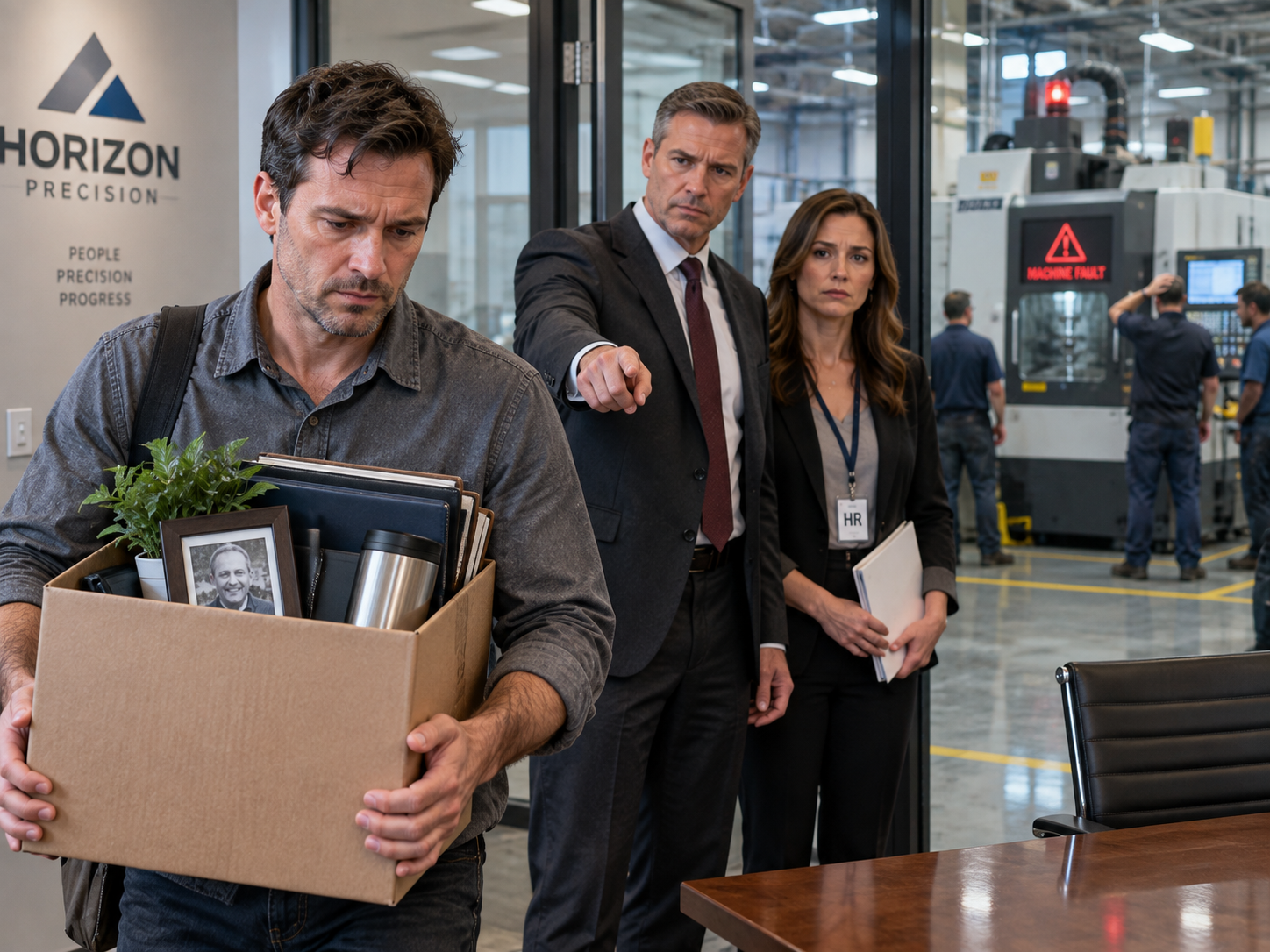
I picked up my box.
Richard stopped me before I reached the door.
“Wait.”
I did.
“What happens if we don't recover the machine?”
“You're asking me as a consultant?”
“I’m asking a question.”
“Then qualification is probably lost.”
“Probably?”
“If Meridian witnesses a machine failure immediately before an aerospace validation, they're not going to accept a promise that it was harmless.”
Mason added, “Their quality director specifically asked for Bay Three's process-capability records.”
Richard's eyes closed briefly.
Meridian wasn't buying a batch of ordinary parts. They were deciding whether Horizon could become a supplier for flight-critical assemblies.
Reliability was part of the product.
That made the timing of my termination even stranger.
Richard had removed the one engineer who knew the cell best less than an hour before the most important customer evaluation Horizon had scheduled in years.
I kept that thought to myself.
“Could Tyler fix it?” Richard asked.
“Maybe.”
“How long?”
“I haven't seen the machine.”
“Estimate.”
“No.”
He stared at me.
“You're charging six hundred thousand dollars an hour and you won't estimate the repair?”
“I’m charging that because you want me to accept responsibility for an emergency on a system I haven't inspected.”
Walter called.
I answered.
“Tell me.”
“Tyler reset it twice. Same cascade during homing.”
“Mechanical noise?”
“No.”
“Servo temperatures?”
“Normal.”
“Spindle temperature?”
“Normal.”
“Physical vibration?”
Walter paused.
“That's the strange part.”
“How strange?”
“The sensor says we're shaking ourselves apart. I can put my hand on the housing and barely feel anything.”
I looked toward Bay Three.
Now I wanted to see it.
Not because Richard had ordered me to.
Because the failure made no sense.
“Don't let anybody touch anything else,” I said.
“Already told them.”
“Especially parameters.”
Walter went quiet.
Then his voice changed.
“Ethan.”
“What?”
“Someone was inside the controller this morning.”
My eyes moved to Richard.
“Who?”
“Don't know yet.”
“Find out.”
I ended the call.
Richard was watching me.
“What did Walter say?”
“That you should decide quickly.”
That wasn't what Walter had said.
It was simply the answer Richard needed.
Claire's phone rang.
She listened, then handed it to Richard.
“Finance.”
He walked away with the phone.
I watched his shoulders tighten during the conversation.
“Emergency contractor,” he said quietly. “No, there isn't another qualified technician available in the timeframe.”
His eyes found mine.
That sentence probably cost him more than the invoice.
Mason leaned toward me.
“Are you really charging that?”
“Yes.”
“Six hundred thousand?”
“Yes.”
“For one hour?”
“Yes.”
He stared at me.
“How much is Meridian worth?”
“Thirty-eight million first-year forecast.”
“And if qualification fails?”
Mason stopped arguing.
The lobby clock read 11:19.
Richard returned.
“Finance won't authorize it without executive approval.”
“Okay.”
“You don't seem concerned.”
“I'm not the one buying anything.”
He stared at me for a moment, then reached for his phone again.
This time he called Eleanor Grant.
Eleanor had founded Horizon more than forty years earlier. She had started with a handful of employees and several manual mills in a rented building. By the time I joined the company, Horizon had become a major supplier across aerospace, medical, and defense manufacturing.
At seventy, she no longer managed the factory floor.
But everyone knew her approval could settle questions that occupied entire meetings for weeks.
Richard walked farther away.
I couldn't hear the conversation.
Then I heard the number.
Silence followed.
Then Richard said, “Yes, I terminated him this morning.”
Another pause.
Longer.
When he returned, his expression had changed.
“She approved it.”
“Written authorization.”
“You have my word.”
“You had my badge six minutes ago.”
Mason looked down to hide a reaction.
Richard typed rapidly.
My email chimed.
Emergency contractor engagement.
Horizon Precision.
Authorized by Richard Cole under executive approval.
Rate: $600,000 per hour.
Minimum: one hour.
I forwarded it to the business email account I had created when I registered Parker Precision.
Then I sent the invoice.
“Payment authorization,” I said.
“You have the engagement.”
“The invoice still requires approval.”
“This is absurd.”
“No. This is paperwork.”
Claire almost smiled.
Richard signed.
I placed my cardboard box beside Dennis's security station.
“Visitor badge.”
Richard stared.
“What?”
“You took my employee badge.”
He looked offended by the inconvenience.
Dennis understood immediately.
He printed a contractor badge.
VISITOR — ESCORT REQUIRED.
I clipped it to my shirt.
At 11:24, twelve minutes after Bay Three failed and seventeen minutes after my termination, I walked back through the security gate.
The factory looked exactly as it had when I left.
But my relationship with it had changed completely.
Walter waited beside Bay Three.
“That was fast.”
“I’m expensive now.”
He glanced at the contractor badge.
“About time.”
Tyler stood at the controller with a laptop connected.
Richard approached him.
“Step away.”
Tyler turned.
“What?”
“Mr. Parker is handling recovery.”
Mr. Parker.
Twenty minutes earlier, I had been Ethan.
Tyler disconnected his laptop.
“I already isolated the spindle alarm.”
“Did you?”
His expression hardened.
“Yes.”
I put my diagnostic case on the workbench.
“What caused it?”
“Probably a sensor problem.”
“Probably?”
He folded his arms.
Walter gave me a look.
I ignored both of them and approached the controller.
Bay Three was a large five-axis machining center enclosed behind steel and polycarbonate panels. We had bought it used and rebuilt its control architecture around Meridian's requirements.
I knew its oddities.
I knew which noises mattered.
I knew which numbers looked harmless until they appeared together.
Three alarms were active.
Third-axis following error.
Servo overload.
Spindle vibration limit exceeded.
Individually, any one could stop production.
Together, they pointed somewhere else.
I checked the drive temperatures.
Normal.
Power quality.
Normal.
Encoder feedback.
Stable.
Walter stood behind me.
“See it?”
“Not yet.”
Tyler said, “I told you. Sensor.”
I opened the alarm history.
The first recorded fault appeared at 10:43.
I stopped.
“Why didn't production stop at 10:43?”
Walter leaned closer.
“It didn't alarm then.”
“The controller says it did.”
Richard approached.
“What difference does that make?”
I pointed at the timestamp.
A fault had been generated, acknowledged, and cleared twenty-nine minutes before the machine finally locked itself down.
Somebody had known Bay Three was becoming unstable before I was fired.
I turned.
“Who was working on this at 10:43?”
Tyler answered immediately.
“Nobody.”
I looked at him.
“You sure?”
“Yes.”
Walter scratched his jaw.
“Mason said he saw someone near here earlier.”
Tyler's expression barely changed.
Barely.
I returned to the controller.
The protected-parameter menu had been accessed that morning.
That changed the problem.
“Richard.”
“What?”
“Who authorized control changes today?”
“No one.”
“Tyler?”
Tyler shook his head.
“I didn't change anything.”
I opened the servo configuration.
The third-axis gain was wrong.
The acceleration limit was wrong.
The vibration threshold was wrong.
Three protected settings had been altered.
Not random values.
Specific ones.
Values capable of producing the exact chain of faults we were seeing.
Walter leaned over the screen.
“That’s wrong.”
“I know.”
Tyler stepped closer.
“Maybe the commissioning values weren't saved correctly.”
I turned toward him.
“I saved them.”
He stopped speaking.
Richard asked, “Can you fix it?”
“Probably.”
“Then fix it.”
“I’m not finished diagnosing.”
“We’re paying you ten thousand dollars a minute.”
“Then don't interrupt me.”
Walter coughed into his hand.
Employees had begun gathering behind the safety line. Factories have their own nervous system. News about a dead machine spreads faster than an official announcement.
Mason hurried toward us.
“Meridian is at the front gate.”
Richard looked at me.
“How long?”
I didn't answer.
Instead, I opened the controller's change-history menu.
It requested administrative credentials.
Someone had accessed the protected settings that morning.
Someone had changed them.
And unless the audit log had been tampered with, the controller could tell me which account had done it.
I connected my diagnostic laptop.
Richard leaned over my shoulder.
“What are you looking for?”
I watched the audit history begin exporting.
“The reason you should be worried about something much bigger than Meridian.”
Click Here to continue read next: PART3: The Machine Named the Account Behind the Changes, but a Small Mistake in a Young Engineer’s Answer Made the Story Far More Dangerous
The Badge Went Dead Before Anyone Explained Why, and Then the Machine Behind the Glass Began Failing in Ways That Made No Sense
Part 2 of 8

