
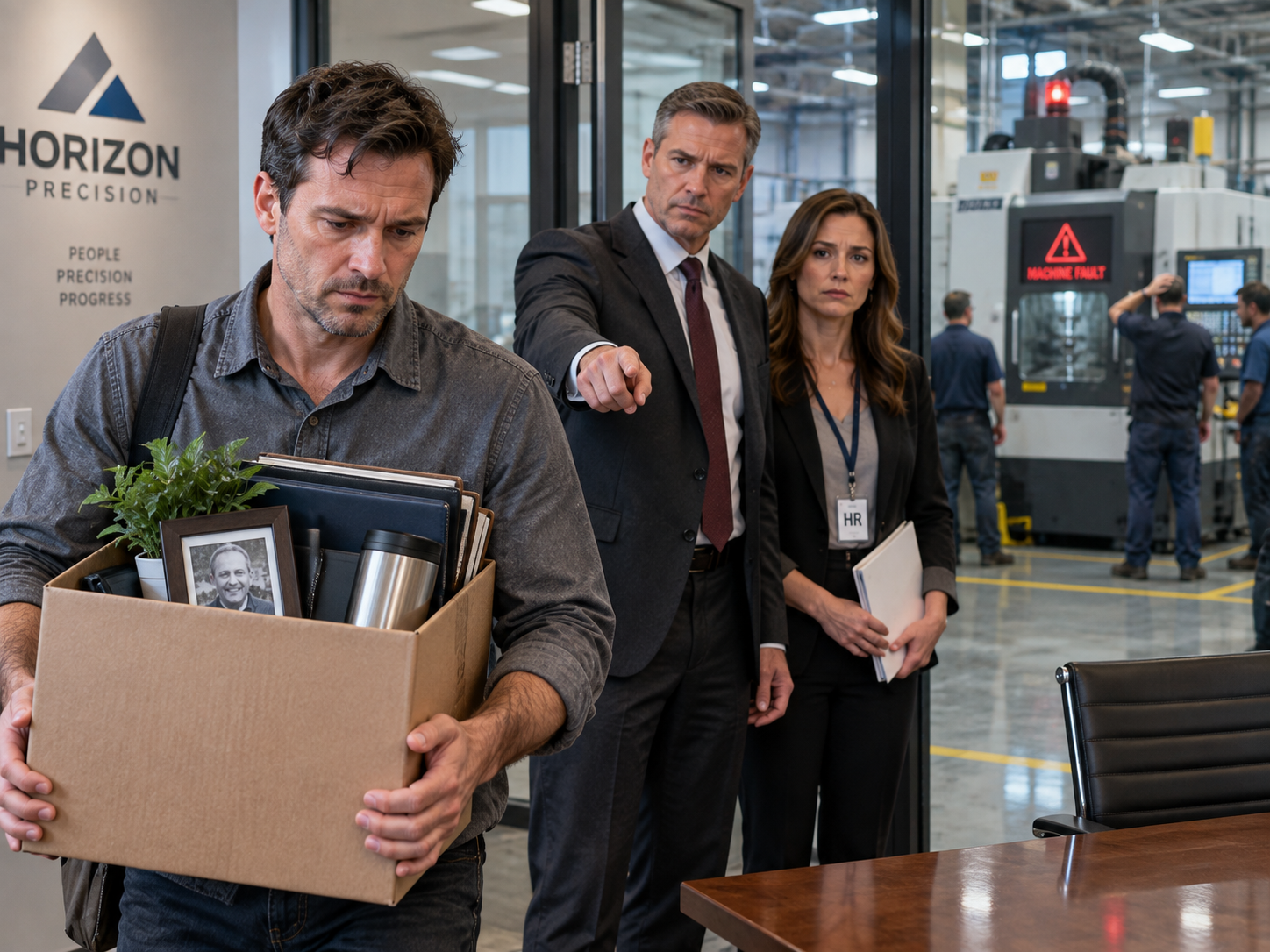
Walter said nothing for the first several miles back to Horizon.
That alone told me how seriously he was taking the situation.
Normally, silence made him uncomfortable. He filled empty space with complaints about traffic, management, modern coffee, or machine designers who left no room for human hands.
Now he watched the road.
Finally he asked, “How many companies?”
“Eleanor didn't say.”
“Calder was on it.”
“Yes.”
“And Northstar had access.”
“Yes.”
“And Richard had Calder written down.”
“Yes.”
Walter rubbed his jaw.
“This is bigger.”
“Probably.”
“Say it.”
“No.”
He glanced at me.
“You already know.”
“I know pieces.”
“You know Richard sabotaged Bay Three.”
“With Tyler's help.”
“You know Northstar touched Calder.”
“Yes.”
“And Richard had Calder on a private list.”
“Yes.”
“So what are you waiting for?”
“Something that connects the technical failures to intent.”
Walter shook his head.
“You'd make a terrible detective.”
When we reached Horizon, the atmosphere had changed.
Security no longer treated me like an employee who had been dismissed.
Dennis waved us through.
The contractor badge still said VISITOR, but the receptionist on the executive floor sent us directly to Eleanor's office.
Her attorney was there.
So was a woman I had never met.
“Ethan,” Eleanor said, “this is Naomi Patel, our cybersecurity director.”
That explained why the meeting had moved beyond ordinary corporate misconduct.
Naomi had a laptop open on the table.
“We recovered several files from Richard Cole's executive drive.”
“Deleted?”
“Yes.”
“Recoverable?”
“Some.”
Eleanor slid a printed spreadsheet toward me.
Twelve company names filled the first column.
Horizon Precision.
Calder Aerostructures.
Benton Medical Systems.
Fargo Dynamics.
Trellis Defense Manufacturing.
Seven others.
I recognized most of them.
Mid-sized manufacturers.
Large enough to depend on automated equipment.
Small enough that one specialized machine could create a serious production crisis.
Beside each name were columns for employee count, engineering payroll, downtime exposure, decision-maker, vendor relationships, and something labeled Trigger.
Horizon:
MERIDIAN QUAL.
Calder:
SPINDLE VIB.
I stared at the page.
Walter leaned over my shoulder.
“There it is.”
“Not yet.”
He looked at me.
“You're impossible.”
Naomi rotated her laptop.
“The metadata shows Richard created the spreadsheet six months ago.”
“Shared users?”
“Two external accounts.”
She opened the permissions history.
One belonged to Richard's private consulting address.
The other belonged to Adrian Kells.
Northstar.
I felt cold beneath my ribs.
“Can you prove Adrian opened it?”
“Yes.”
“When?”
She displayed the timestamps.
He had accessed the file repeatedly.
The latest access was Monday night.
The night before Horizon's machine failure.
Then she filtered Calder.
Adrian had accessed the spreadsheet Tuesday morning.
Hours before the spindle alarm.
Walter stopped smiling.
Eleanor opened another recovered version.
The second version contained more columns.
One was labeled STATUS.
Several companies were marked COMPLETE.
Several PENDING.
Horizon:
ACTIVE.
Calder:
COMPLETE.
Benton Medical:
PENDING.
Beside Benton was a date.
Friday.
Two days away.
I looked at Naomi.
“Do they use Northstar?”
“We haven't contacted them.”
“Contact them.”
The attorney raised a hand.
“Before we contact another company, we need to determine what Horizon can legally disclose.”
Eleanor looked at him.
“If somebody is preparing to interfere with their equipment—”
“If,” he interrupted.
She stopped.
He continued calmly.
“We have strong evidence of misconduct involving Horizon. We have suspicious records involving other companies. We don't yet know what every entry means.”
He was right.
I hated that.
Naomi said, “We can contact law enforcement.”
“Already done,” Eleanor said.
Walter looked at her.
“Federal?”
The attorney answered.
“Potential unauthorized computer access across state lines.”
The room changed.
Until then, I had still been thinking about Richard as a dishonest executive who had created an elaborate corporate fraud.
Now the technical evidence suggested something larger.
A network.
Remote access.
Industrial sabotage.
Potential fraud across multiple states.
Eleanor tapped the Friday date.
“What do we do about Benton?”
The attorney folded his hands.
“Preserve evidence and follow law-enforcement guidance.”
“That doesn't protect their machines.”
“No.”
I looked at the spreadsheet.
“If Friday is a planned trigger and we wait for proof, the proof may be a failed production line.”
Naomi nodded.
“We can advise them to review remote-access logs without accusing anyone.”
The attorney considered that.
“That may be appropriate.”
Eleanor called Benton.
Twenty minutes later, we were on a conference call with Rachel Lin, Benton's CEO, and their engineering director.
Eleanor carefully explained that Horizon had found evidence of unauthorized parameter changes associated with a third-party industrial-services ecosystem.
She did not mention Richard's spreadsheet.
She did not accuse anyone.
Rachel understood immediately.
“We had Northstar perform a systems assessment last month.”
Walter looked at me.
I wrote the name on my pad.
The engineering director continued.
“They were supposed to have temporary VPN access revoked after the assessment.”
Naomi asked, “Are those credentials still active?”
There was a pause.
Keyboard sounds.
“Yes.”
The room went still.
“When were they last used?”
More typing.
“This morning.”
My arms prickled.
“What system?” I asked.
“Cell Two.”
“What does Cell Two do?”
“Final polishing and dimensional verification.”
A system where tiny calibration changes could produce expensive quality problems without immediately stopping production.
“Disable external access,” Naomi said.
Rachel didn't hesitate.
“Do it.”
The engineering director began.
I asked, “Can you inspect the change logs?”
“Yes.”
“Look for protected parameter changes today.”
Keyboard clicks filled the call.
Then the engineering director inhaled.
“I have three.”
“Three what?” Rachel asked.
“Parameter changes.”
“What parameters?”
“Robot path compensation. Force limit. Metrology offset.”
I closed my eyes.
Three small changes.
Different factory.
Same method.
“Who changed them?” Rachel asked.
“We have a Northstar service account.”
Silence.
Naomi instructed them to preserve the logs and restore the last validated configuration.
They did.
The machine had not yet produced defective work.
They had caught it.
Then I looked back at Richard's spreadsheet.
The Friday date remained.
“What happens Friday?” I asked.
Rachel paused.
“Our quarterly business review with MedAxis.”
Walter pointed at the sheet.
QBR.
The pattern finally became clear.
The trigger column did not describe machine problems.
It described business events.
Meridian qualification.
Calder production pressure.
Benton's customer review.
The failures were timed for moments when management would be most frightened by them.
“They're manufacturing the need for their own service,” I said.
Nobody spoke.
“They wait until a customer audit, qualification, delivery deadline, or executive review. Then they create a technical failure.”
Walter finished it.
“And arrive afterward with the cure.”
Naomi began checking the remaining entries.
Two companies had customer audits.
One had a regulatory inspection.
Another had a major production launch.
Every trigger corresponded to a moment when equipment failure would hurt more than usual.
Then Naomi stopped.
“What?”
She rotated the screen.
A second Horizon entry appeared.
Not ACTIVE.
Not COMPLETE.
TEST.
The date was six months earlier.
I stared.
“What happened six months ago?”
Walter answered.
“Line Four.”
The memory returned immediately.
A grinding machine had suffered unexplained calibration drift.
We lost three days.
Richard had used the incident repeatedly to argue that our internal engineering team was too slow.
Then Walter's face changed.
“Frank.”
I knew what he meant.
Frank Dorsey.
One of Horizon's senior maintenance technicians.
He had injured his hand during the Line Four failure.
The official investigation had blamed him for an improper lockout.
Frank had always disagreed.
He said the machine moved when it should not have.
At the time, we had believed the official report.
Now Naomi searched the archived control logs.
The old records were still there because I had created the archive myself.
She opened them in read-only mode.
At 6:14 the evening before Frank's accident, an external service account had entered the controller.
Several parameters had changed.
One controlled probe compensation.
Another affected maintenance jog behavior.
Walter stared at the screen.
“That parameter controls whether the axis can respond during manual service mode.”
“Yes.”
“Frank was right.”
“Yes.”
He pushed his chair backward.
“They blamed him.”
His voice rose.
“They made him sit through hearings and tell everyone he forgot a lockout.”
Eleanor looked stricken.
Naomi preserved the records.
Then she recovered an email from Richard.
Subject:
Baseline.
The message from Adrian was brief.
“Test confirms controlled disruption creates desired management response.”
Walter read it again.
“Controlled disruption.”
Another email appeared.
Richard to Adrian.
“Need cleaner separation next time. Technical staff were too close to cause.”
I understood.
Six months earlier, our engineering group had nearly discovered the manipulation.
This time Richard had removed the person most capable of recognizing the pattern immediately before the visible failure.
My termination had not merely been part of the outsourcing plan.
It had been containment.
Eleanor stared at the records.
“For six months I believed engineering failed us.”
Nobody answered.
“I approved reductions because of Line Four.”
She looked at me.
“I approved your termination.”
That surprised me.
Richard had made the termination sound entirely like his decision.
Eleanor continued.
“He presented your department as the source of repeated technical risk.”
The budget meetings suddenly looked different.
Every failure had become evidence.
Every unexplained breakdown had strengthened Richard's argument.
Every job eliminated had made the next failure easier to explain.
“How many people lost their jobs?” I asked.
Claire answered.
“Six positions over four months.”
Six families.
Six livelihoods.
All attached to a business case built on manipulated evidence.
Walter looked at the spreadsheet.
“This wasn't only sabotage.”
Everyone looked at him.
He tapped the list.
“They were creating unemployment as inventory.”
No one spoke.
Naomi kept searching.
Payments appeared.
Consulting fees.
Operational strategy.
Vendor evaluation.
Money flowed through Cole Industrial Consulting.
The structure was becoming visible.
Richard identified vulnerable companies.
Adrian assessed access.
Failures were created around consequential business events.
Management became receptive to outsourcing.
Northstar or related vendors appeared with solutions.
Richard's company collected advisory fees.
The system could feed itself.
Then Daniel from Calder called.
“We found something else.”
I put him on speaker.
“Our IT team pulled remote sessions.”
“How many?”
“Three other machines.”
“Parameter changes?”
“One confirmed.”
“What happened?”
“We rejected a production batch.”
“How much?”
“About nine hundred thousand dollars.”
Nobody moved.
“We blamed tool wear,” Daniel continued.
“Was it?”
“No.”
“What changed?”
“Dimensional compensation.”
Exactly the kind of alteration that created bad parts while looking like ordinary process drift.
Daniel said he had contacted two companies that had attended the same Northstar presentation.
One had suffered an unexplained calibration incident.
I told him to preserve everything and not confront anyone.
He said he had already contacted his attorney.
Good.
After the call ended, Walter returned to the Line Four record.
His finger stopped on a timestamp.
“Frank's accident was 6:42.”
“Yes.”
“Remote access ended at 6:39.”
Three minutes before the axis moved.
I looked at the screen.
Someone had been connected almost until the moment Frank was injured.
Eleanor picked up the phone.
“Call Frank.”
She did.
When he answered, his voice sounded older than I remembered.
“Hello?”
Eleanor swallowed.
“Frank. It's Eleanor Grant.”
A pause.
“Well. That's unexpected.”
She looked at the control log.
“So is what I'm about to tell you.”
Click Here to continue read next: PART7: Frank Remembered a Detail the Investigation Had Erased, and the Missing Evidence Finally Explained Why Horizon’s Most Trusted Failure Report Was Never What It Seemed
The Badge Went Dead Before Anyone Explained Why, and Then the Machine Behind the Glass Began Failing in Ways That Made No Sense
Part 6 of 8

