
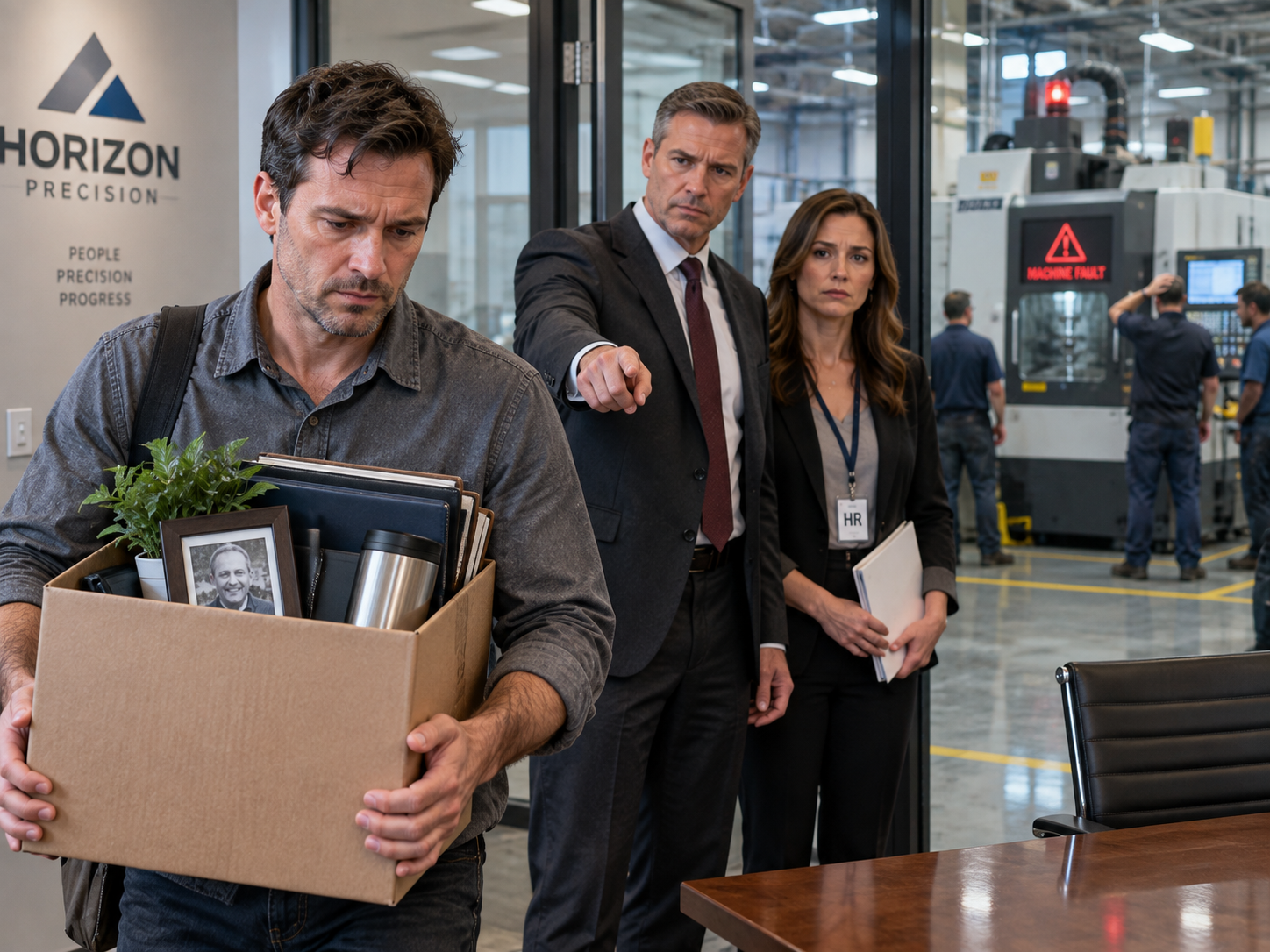
The audit export finished while Meridian’s representatives were being escorted from the front lobby toward Conference Two.
I saved two copies before opening either.
Richard noticed.
“Why two?”
“One stays untouched.”
“For what?”
“Evidence.”
The word settled over Bay Three.
Tyler shifted his weight.
Richard's expression hardened.
“You're repairing a production machine.”
“I’m determining why protected parameters were altered without authorization.”
“Nobody said they were altered deliberately.”
“Protected values don't change themselves.”
Walter folded his arms.
“And machines don't normally reach into their own menus and click buttons.”
I opened the audit file.
Every administrative event carried a timestamp and a user identification number. The controller didn't understand office politics. It didn't know who was popular, who had been promoted, who was about to be fired, or who had influence with management.
It simply recorded actions.
I scrolled to 10:41.
There it was.
User 14.
Protected editing enabled.
Third-axis gain modified.
Acceleration limit modified.
Vibration configuration accessed.
Richard leaned closer.
“Who is User 14?”
“I already know.”
He waited.
“Tyler.”
No one spoke.
Tyler's face changed.
It wasn't dramatic. His lips parted slightly, and the hand holding his tablet stopped moving.
Richard recovered first.
“That proves his account was used. It doesn't prove Tyler made the changes.”
I looked at him.
He was right.
It was an important distinction.
“I agree.”
Tyler blinked.
I printed the audit record and signed it with the current time.
Richard reached for the paper.
I moved it into my case.
“That's Horizon property.”
“The original electronic record is. This copy documents an independent contractor inspection.”
His jaw tightened.
“You're making this unnecessarily difficult.”
“You ended the easy arrangement.”
Walter turned away.
His shoulders moved once.
I suspected he was laughing.
Tyler spoke.
“I logged into the machine earlier.”
Everyone looked at him.
“I was checking the work offsets.”
“At 10:41?”
“Around then.”
“Did you change the servo gain?”
“No.”
“Acceleration?”
“No.”
“Vibration threshold?”
“No.”
“Who else had your credentials?”
“No one.”
“Did you leave your session open?”
Tyler hesitated.
“Maybe.”
Richard stepped between us.
“This isn't an interrogation.”
I closed the laptop.
“Fine.”
Tyler's shoulders loosened.
Then I asked, “What's the validated third-axis gain?”
His relief vanished.
“One twenty-four.”
Walter spoke quietly.
“No.”
The correct value was 122.
Tyler looked toward Richard.
It lasted less than a second.
Most people would have missed it.
I didn't.
Walter didn't.
Richard noticed that we had noticed.
Before anyone could speak, footsteps approached from the aisle.
Employees moved aside.
Eleanor Grant entered Bay Three.
I had seen her on the production floor only a handful of times during my eleven years. She knew many machinists by name, but she no longer wandered through the factory without a reason.
A founder standing beside a failed machine during a major customer qualification meant the situation had moved beyond ordinary operations.
She looked at the flashing beacon.
Then the gathered employees.
Then me.
Her eyes dropped to the contractor badge.
“Mr. Parker.”
“Ms. Grant.”
Richard immediately began speaking.
“We've isolated the controls problem. Ethan is restoring the validated configuration, and we should have production—”
Eleanor raised one hand.
He stopped.
She looked at me.
“Are you here as a Horizon employee?”
“No.”
“Independent contractor?”
“Yes.”
“Then give me your independent assessment.”
Richard's shoulders stiffened.
I explained what we knew.
The first fault.
The later cascade.
The protected values.
The audit history.
User 14.
I did not accuse Tyler of sabotage.
The evidence did not justify that conclusion yet.
Eleanor listened without interrupting.
When I finished, she asked, “Can those values change accidentally?”
“No.”
“Can an automatic software process alter them?”
“Not those parameters.”
“How are they changed?”
“Administrative access. Protected editing. Individual confirmation.”
“So several deliberate actions?”
“Yes.”
She turned toward Tyler.
“Did you authorize those changes?”
“No.”
“Did you make them?”
His throat moved.
“No.”
Eleanor nodded once.
“Your laptop and access credentials will be preserved by IT.”
Tyler looked at Richard.
Richard looked back.
This time Eleanor noticed the exchange.
I saw her notice.
Richard tried to redirect the discussion.
“Meridian is already in Conference Two. We need Bay Three operational before they reach the floor.”
Eleanor looked at me.
“Can you recover the machine?”
“If the failure is limited to configuration and the sensor system.”
“How long?”
“Forty-five minutes at most.”
Richard's mouth tightened.
“We've already authorized an hour.”
“Correct.”
Eleanor looked between us.
“At six hundred thousand?”
“Yes.”
“If you finish in forty-five minutes?”
“The one-hour minimum still applies.”
She considered that.
“Understood.”
Richard seemed more offended by her acceptance than by my rate.
I connected the encrypted commissioning backup I had created after the final validation sequence.
The file contained the known-good configuration for every protected subsystem.
I compared each value before restoring it.
Third-axis gain: 122.
The controller showed 137.
Acceleration: 98.
The controller showed 121.
Several other settings were subtly wrong.
None was catastrophic alone.
Together, they could make the machine look unreliable without destroying it.
That distinction bothered me.
Whoever had altered the machine had not simply tried to break it.
The changes seemed designed to make it fail in a controlled way.
I restored the validated configuration.
One alarm cleared.
Then another.
The third-axis error disappeared.
Servo overload disappeared.
The spindle vibration alarm remained.
Walter looked at the screen.
“That one's trouble.”
“Maybe.”
Tyler spoke from behind us.
“Bad sensor.”
I watched the live vibration signal.
The pattern was too clean.
Mechanical damage had a recognizable signature. Loose bearings, misalignment, imbalance, and worn components produced irregular patterns.
This looked different.
The sensor was reporting something artificial.
I shut the spindle down and locked out the machine.
Walter helped remove the access panel.
Inside the spindle housing, the air smelled of warm oil and metal.
I checked the cable.
Secure.
Connector.
Secure.
Sensor mount.
I stopped.
Beside the vibration sensor was a thin piece of aluminum.
It was almost invisible against the housing.
I reached for tweezers.
Walter bent closer.
“What is that?”
I removed it carefully.
A small machining shim.
Barely larger than a fingernail.
Large enough to distort the sensor.
Walter's face hardened.
“That didn't fall in there.”
“No.”
Richard stepped closer.
“What is it?”
“A spacer.”
“So?”
“It was wedged beside the vibration sensor.”
Tyler said nothing.
Eleanor asked the question everyone else was avoiding.
“Would someone have to put it there?”
“Yes.”
“Deliberately?”
“Yes.”
Silence spread through the bay.
The problem had changed categories.
This was no longer a bad configuration.
Someone had physically interfered with the machine.
Walter looked at Tyler.
Tyler looked at the floor.
Richard looked at me.
“Can we prove who put it there?”
“Not from the shim.”
“Then let's avoid accusations.”
Again, Richard was unusually concerned with evidentiary precision.
I placed the shim in a small evidence bag.
Richard stared.
“Seriously?”
“Very.”
I reinstalled the sensor correctly, closed the housing, removed the lockout, and started the spindle warm-up.
Two thousand RPM.
Smooth.
Five thousand.
Stable.
Eight thousand.
The vibration trace stayed flat.
Walter exhaled.
“Come on, sweetheart.”
Bay Three completed homing.
No alarms.
I loaded the qualification setup.
The machine moved through its axes with the controlled, familiar rhythm I remembered from commissioning.
Then the beacon changed.
Red disappeared.
Green came on.
The employees behind the safety line began clapping.
Walter hit my shoulder hard enough to move me half a step.
“Knew you'd bring her back.”
“I fixed a machine.”
“Same thing around here.”
Meridian's quality team entered the aisle moments later.
They saw a functioning production cell.
They didn't see the twenty minutes when everything had nearly collapsed.
Richard moved toward the Meridian delegation.
Eleanor stayed beside me.
“You protected us from an expensive afternoon.”
“I haven't finished the inspection.”
She looked at the evidence bag.
“I suspected you might say that.”
Richard returned.
“We're operational. That's what matters.”
“No,” Eleanor said.
He stopped.
She looked at the audit record in my case.
“Now I want to know why we weren't.”
Tyler's face tightened.
Eleanor turned to me.
“Tomorrow. Nine o'clock. My office.”
Richard stepped forward.
“Ms. Grant, Ethan's position was eliminated because—”
“No.”
Her voice remained quiet.
Richard stopped.
“We eliminated his salary,” she said. “Apparently we did not eliminate our need for his expertise.”
She handed me her card.
“I want to discuss a longer arrangement.”
“Machine support?”
“Something larger.”
I packed my laptop.
For the second time that day, I carried the same cardboard box toward security.
The contractor badge clipped to my shirt.
The six-hundred-thousand-dollar invoice already sitting in my email.
Mason caught me before I reached the lobby.
“Ethan.”
I stopped.
He looked nervous.
Not excited.
Afraid.
“What?”
He glanced behind him.
“There's something you need to know before tomorrow.”
I waited.
“I was near Bay Three before the first alarm.”
“At 10:41?”
“Just before.”
My hand tightened around the box.
“Did you see Tyler?”
“Yes.”
That didn't surprise me anymore.
Mason swallowed.
“But he wasn't alone.”
I said nothing.
“Richard was there first.”
The factory noise seemed to fade.
“You're certain?”
“I saw his badge. I saw him at the controller.”
“Doing what?”
“I couldn't see.”
Mason looked toward the executive corridor.
“But I heard enough to know Tyler wasn't acting by himself.”
Click Here to continue read next: PART4: The Young Engineer Finally Spoke, and What He Carried Into Eleanor’s Office Connected the Sabotage to a Plan Hidden Inside Horizon’s Own Leadership
The Badge Went Dead Before Anyone Explained Why, and Then the Machine Behind the Glass Began Failing in Ways That Made No Sense
Part 3 of 8

