
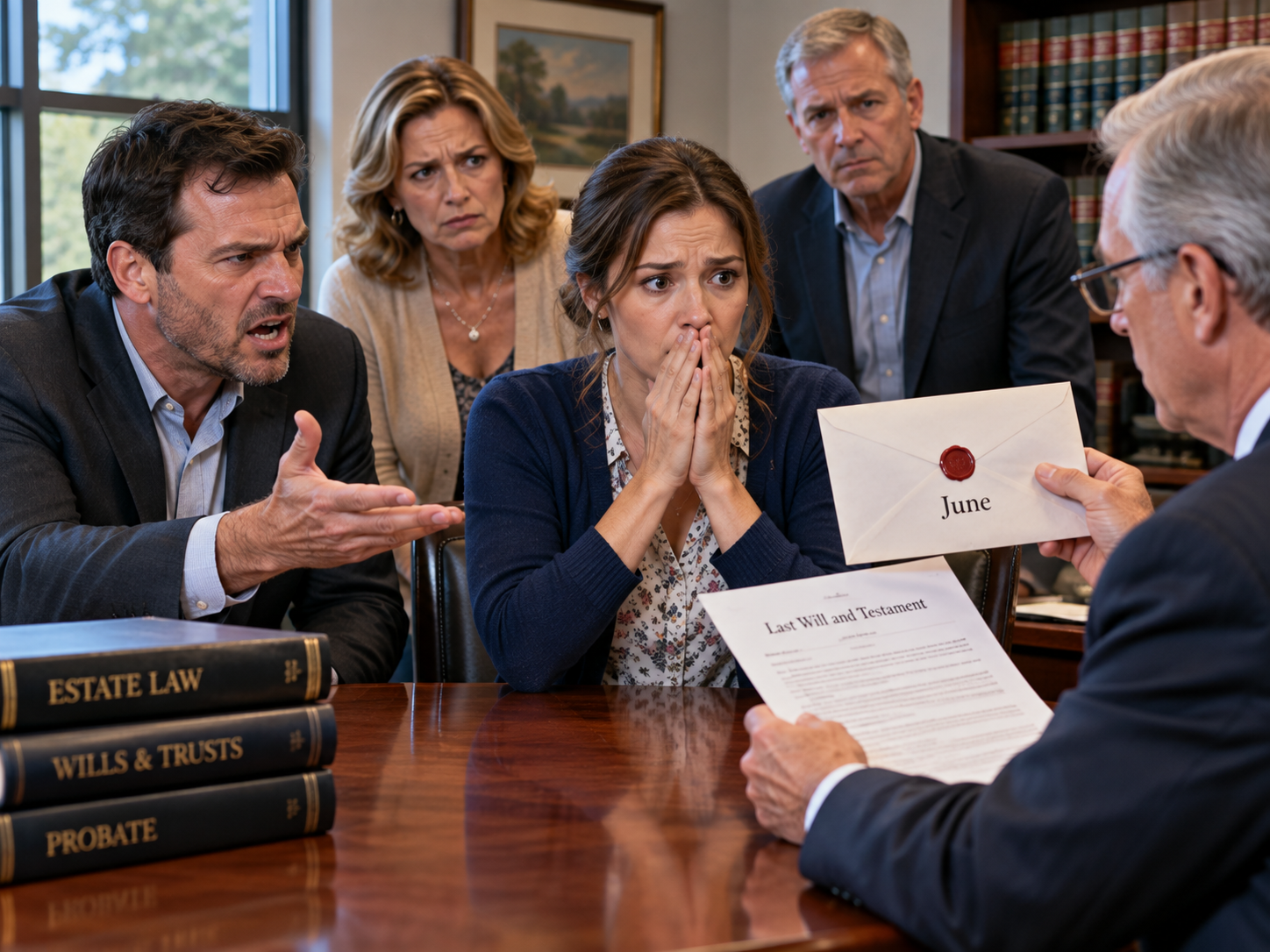
The missing page arrived the next morning.
Mercer had recovered it from Robert's truck.
It was folded inside the owner's manual.
June read it at Vernon's office while rain tapped steadily against the windows.
The handwriting was Harold's.
The language was legal.
But the final paragraph was personal.
If June ever became trustee, she was not required to preserve the family from consequences.
She was required to preserve the truth.
That distinction mattered.
June read the paragraph twice.
Then she looked at Vernon.
“What does this mean for Robert?”
“It means you cannot use trust assets to erase his debts.”
“I wasn't planning to.”
“But you may be asked.”
“By whom?”
“Everyone.”
She almost smiled.
“That sounds right.”
The investigators had connected Dale to the forged documents.
His company had been created specifically to acquire the water rights.
Bank records showed payments from an intermediary account.
Dale denied knowing who controlled it.
But the evidence was strong.
Thomas agreed to testify.
Robert agreed to cooperate.
Carol finally admitted that she had known Robert was searching for old family records.
Mark admitted that he had suspected the farm was worth more than Harold ever admitted.
Everyone had a version of the truth.
Harold's ledger had them all.
Page after page recorded transactions.
Loans.
Promises.
Arguments.
Forgiveness.
Refusals.
June found her own name repeatedly.
Not beside amounts.
Beside dates.
Wednesday.
Wednesday.
Wednesday.
Each entry was followed by a brief note.
Groceries.
Doctor.
Sheets.
Coffee.
She stopped reading.
“He wrote all this down?”
Vernon smiled.
“He remembered.”
“That isn't the same thing.”
“No.”
June touched the page.
“I thought he was keeping accounts.”
“He was.”
“Of me?”
“Of what mattered.”
She turned another page.
A final note had been written two days before Harold died.
June will think she owes me.
She doesn't.
That sentence broke her.
She lowered her head.
Vernon waited.
After several minutes she asked:
“Why did he leave me the trust?”
“Because you were the only person he believed would be willing to walk away from it.”
June looked up.
“What?”
“He wanted the trustee to have enough character to refuse money.”
“And if I did?”
“Then the assets would go to the scholarship foundation.”
“So he wasn't testing whether I loved him.”
“No.”
“What was he testing?”
“Whether you could choose what was right even when it hurt.”
June closed the ledger.
“That sounds unfair.”
“Yes.”
She laughed quietly through tears.
“That also sounds like Grandpa.”
The following afternoon, Dale's attorney requested a settlement.
The offer was enormous.
If June authorized the transfer of the water rights, Dale would pay the trust enough money to make everyone wealthy.
Mark urged her to consider it.
Carol argued that Harold would have wanted the family secure.
Even Thomas admitted the offer would end the legal fight.
June refused.
Not immediately.
She read the contract.
She asked questions.
She reviewed the maps.
She asked whether the water rights could be sold without violating the trust.
The answer was yes.
Then she asked the only question that mattered.
“Would Harold have wanted this?”
Vernon said nothing.
June understood.
“No.”
She rejected the offer.
Dale's attorney left furious.
That evening, Robert called from detention.
“Did they offer you money?”
“Yes.”
“How much?”
“Enough.”
“Did you take it?”
“No.”
Robert was silent.
“You should have.”
“Why?”
“Because I know what that kind of money means.”
June's voice hardened.
“It means Grandpa's plan worked.”
Robert sighed.
“I deserved that.”
“Yes.”
“June?”
“What?”
“Do you still hate me?”
She looked out the window.
“No.”
He breathed out.
“But I don't trust you.”
“I know.”
“That has to change on your side, not mine.”
“I know.”
For the first time, he did not argue.
Weeks passed.
The legal case moved forward.
Dale was charged.
Thomas provided documents proving the old dispute.
The forged 1984 agreement was formally examined.
It became clear that Harold had been telling the truth.
Thomas had not surrendered his property voluntarily.
Someone else had forged his signature.
That discovery changed the old family story.
Harold had not betrayed his brother.
He had spent decades protecting him from the consequences of someone else's fraud.
Thomas broke down when he learned.
“I blamed him.”
June sat beside him.
“You didn't know.”
“He tried to tell me.”
“You were angry.”
“I was young.”
“So was he.”
Thomas looked at her.
“You sound like Harold.”
“I hope that's a compliment.”
“It is.”
The final hearing came six months later.
The judge confirmed the trust.
The water rights remained protected.
Dale's company was dissolved.
Robert entered a plea agreement that included restitution.
He would not receive trust money.
But June agreed to one thing.
She would not abandon him.
She arranged for him to receive counseling and legal assistance through a program unrelated to the trust.
It was not forgiveness.
It was accountability without cruelty.
The family changed after that.
Mark stopped asking about the farm.
Carol began visiting the scholarship foundation meetings.
Dale disappeared from family conversations.
Thomas moved to a small apartment near the county line.
He visited the cemetery once.
June went with him.
They stood before Harold's grave in silence.
Thomas placed an old photograph beneath a stone.
“I should have come sooner,” he said.
June looked at the photograph.
“So should everyone.”
Thomas smiled.
Then he asked:
“Do you know what Harold told me the last time I spoke to him?”
“No.”
“He said the family didn't need another heir.”
“What did he say they needed?”
Thomas looked at her.
“Someone who could stop inheriting the same mistakes.”
June stared at the grave.
She finally understood.
The money had never been the center of the story.
The land had not been the center.
Even the water rights were not the center.
The inheritance was a test of whether the family would repeat itself.
Harold had spent his life rescuing people from consequences.
At the end, he stopped.
Not because he stopped loving them.
Because he finally understood that love without boundaries could become another form of destruction.
June placed her hand on the headstone.
“I got your message.”
The wind moved through the grass.
For once, there was no phone call waiting afterward.
Click Here to continue read next: PART8: The Final Accounting Changed What June Thought Her Grandfather Had Left Behind, and the Family Finally Learned What the Inheritance Was Really For
The Will Made Everyone Angry, but the Envelope With June’s Name on It Suggested Grandpa Had Prepared for Something Much Worse
Part 7 of 8

