
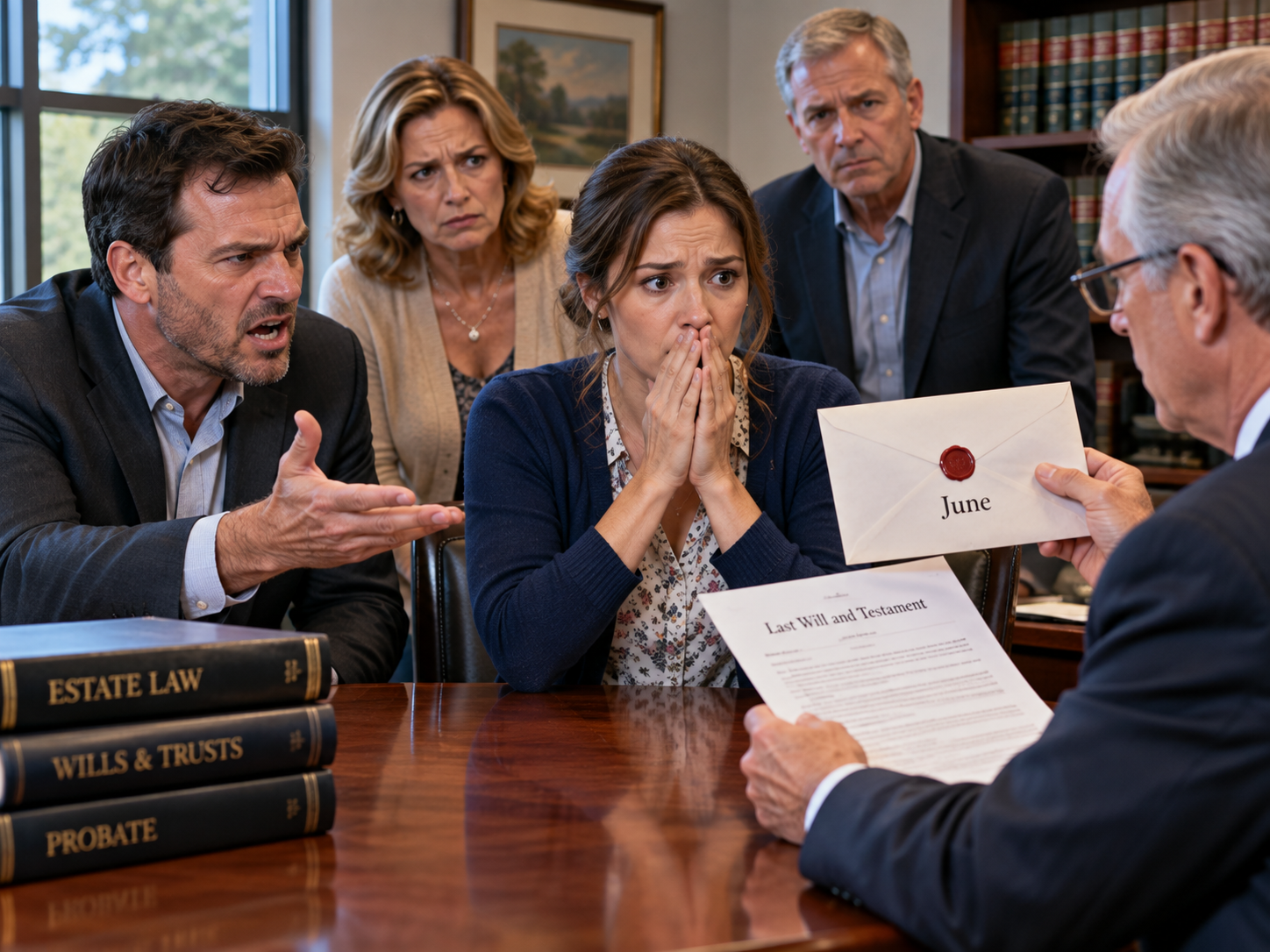
Mark was out of the Silverado before the dust had settled.
“What did you find?”
June held the envelope against her chest.
“Something Grandpa didn't leave for you.”
Dale came around the truck. Carol followed more carefully, her formal shoes sinking into the loose gravel.
“We came because we're concerned,” Carol said.
June looked at the three vehicles behind her.
“You followed me thirty miles.”
“We're family.”
“That doesn't answer my question.”
Mark pointed at the envelope.
“If this concerns the property, we have a right to know.”
“According to whom?”
“Common sense.”
June looked toward the farmhouse.
“Common sense would have suggested visiting Grandpa before he died.”
Mark's face hardened.
“You act like you were the only person who cared about him.”
“I never said that.”
“You don't have to.”
June's grip tightened around the envelope.
“I came every Wednesday.”
“So?”
“I came when there wasn't anything to gain.”
Carol stepped closer.
“Some of us had responsibilities.”
June turned toward her.
“I had responsibilities too.”
“You don't have children.”
The words landed with a dull finality.
June went completely still.
I remembered an afternoon when she had found Harold on the bathroom floor after a fall. She had called the ambulance, gathered his medication, found his insurance papers, cleaned the blood from his arm, and only afterward sat on the porch shaking.
Now she looked at Carol with the same quiet expression.
“No,” June said. “I didn't have children. I had an old man whose refrigerator needed checking.”
Carol flinched.
“You're being cruel.”
“You once told me I was wasting my Wednesdays playing nurse.”
Carol looked away.
June finally opened the envelope.
Three things fell into her hand.
A letter.
A small brass key.
A Prairie State Bank business card.
A name had been written across the back.
Richard Vernon.
Mark saw the bank logo.
“What account is that?”
June ignored him.
She unfolded the letter.
Her eyes moved over the first paragraph.
Then she smiled.
I looked at her.
“What?”
“He says dying has at least spared him from my meatloaf.”
I laughed.
June laughed too.
For two seconds, she looked younger.
Then the smile faded.
Harold had spent years insulting her meatloaf while taking second helpings.
She continued reading.
The next pages were different.
Harold wrote about the Wednesdays.
He wrote about the groceries, the medicine, the appointments, the dirty laundry, and the endless arguments over whether he should call the plumber or fix something himself.
He wrote that June kept coming when there was no birthday, holiday, favor, or inheritance attached.
Other relatives came when they needed something.
June came because Wednesday had arrived.
She lowered the letter.
“The dollar amounts were deliberate.”
Mark crossed his arms.
“We already know that.”
“No. Grandpa expected people to question whether he knew what he was doing.”
“We heard the lawyer.”
“He says he made sure nobody could claim that.”
Dale looked away.
June noticed.
Then she read the next paragraph.
Her expression changed.
“What?”
She stared toward the farmhouse.
“The farm isn't mine.”
Mark frowned.
“What?”
“It isn't yours either.”
Carol shook her head.
“Your grandfather owned this property.”
“He did.”
“Then who inherited it?”
June swallowed.
“Nobody.”
Mark took a step forward.
“What are you talking about?”
“He sold it.”
The silence was so complete that the cicadas sounded deafening.
Carol gave a short laugh.
“No.”
“Fourteen months ago.”
“That isn't possible.”
“He sold the farm under an agreement that let him stay here for the rest of his life.”
Mark stared across the fields.
“For how much?”
June folded the letter.
“I don't know yet.”
Carol stepped forward.
“We deserve to know.”
June looked at her.
“Why?”
“Because Harold was my father.”
“Yes.”
The answer was quiet.
“You lived eleven minutes away.”
Carol's lips pressed together.
“I had obligations.”
“So did I.”
June's voice remained steady.
“Mine included him.”
Nobody replied.
Dale pointed at the brass key.
“What does that open?”
June returned to the final section of the letter.
Then she checked her phone.
4:07.
Her face tightened.
“What?”
“I have to take this to Prairie State Bank.”
“When?”
“Before five.”
Mark stared.
“Today?”
“Yes.”
“What happens if you miss it?”
“I don't know.”
“You don't know?”
“Grandpa doesn't say.”
The key rested in her palm.
“If I miss the appointment, the instructions go back to Albright.”
Mark and Dale exchanged a glance.
Suddenly the argument had changed.
Nobody knew what the key opened.
But everyone knew there was less than an hour to find out.
“We'll go with you,” Mark said.
“No.”
“June.”
“No.”
“We can follow.”
She looked at him for a long moment.
Then she nodded.
“All right.”
Mark seemed surprised.
“All right?”
“Follow me.”
She walked toward the Tacoma.
I followed.
Once we were inside, I looked across the cab.
“You're actually letting them follow us?”
“Absolutely.”
“You look almost pleased.”
She started the engine.
“Grandpa taught me another route to Solomon.”
“Another road?”
“Technically.”
That word made me nervous.
June backed through the gate.
Then she drove straight into the pasture.
“There is no road there.”
“There used to be.”
“When?”
“Before the bridge was rebuilt.”
“When was that?”
“Nineteen ninety-six.”
She accelerated.
The truck dropped into two shallow ruts almost completely hidden by grass.
Behind us, Mark stopped at the gate.
For one second I thought he might decide the pursuit was not worth destroying his truck over.
Then his Silverado bounced into the pasture.
Dale followed.
Carol hesitated longest.
Her Buick eventually came through too.
June drove around the pond, crossed a shallow drainage ditch, and passed behind a line of cottonwoods.
She knew the trail because Harold had shown it to her.
We were children again for a moment, racing along farm tracks in Grandpa's old truck while he shouted that nobody should tell Grandma.
Carol's Buick struck something.
A plastic piece bounced across the grass.
I covered my mouth.
June glanced sideways.
“Don't laugh.”
“I'm not.”
“You are.”
“I'm breathing strangely.”
She laughed.
It was the first genuine laugh I had heard from her all afternoon.
Then it stopped.
“I miss him.”
“I know.”
Her hands tightened on the steering wheel.
“I thought there would be another Wednesday.”
I waited.
“Last week he asked me to stay after dinner.”
“For what?”
“Coffee.”
“And?”
“I told him I had laundry at home.”
She stared at the road.
“I left.”
“You didn't know.”
“I should have stayed.”
“You spent two years showing up.”
“I know.”
“He knew.”
She wiped beneath one eye.
“I hope so.”
We reached pavement at 4:18.
Mark emerged behind us less than a minute later.
Dale followed.
Carol did not.
June kept driving.
At 4:46, she turned into Prairie State Bank.
The building was nearly empty.
A teller looked up.
“We're closing soon.”
June placed the business card on the counter.
“I need Richard Vernon.”
The teller looked at the card.
Then at June.
“June Parker?”
“Yes.”
“I'll get him.”
Mark and Dale entered behind us.
“They aren't with me,” June said.
Mark snorted.
“We are absolutely with her.”
An older man came through a side corridor.
He was tall, silver-haired, and wore nearly rimless glasses.
He studied June's face.
“You have Harold's eyes.”
June swallowed.
“You knew my grandfather?”
“Forty-one years.”
He introduced himself as Richard Vernon.
Mark immediately explained who he was.
Dale did the same.
Vernon listened politely.
Then he looked at June.
“Have you authorized either man to participate?”
“No.”
“They remain outside.”
Mark objected.
“This concerns family money.”
Vernon adjusted his glasses.
“No, sir.”
He led June through a locked door.
She caught my sleeve.
“She comes with me.”
Vernon looked at her.
“You authorize your cousin?”
“Yes.”
He opened the door.
The room was disappointingly ordinary.
Three chairs.
A table.
A blue binder.
No vault.
No dramatic stacks of cash.
Vernon sat down.
“Your grandfather established a trust.”
June stared at him.
“What kind?”
“A substantial one.”
She almost laughed.
“Grandpa washed aluminum foil.”
“I know.”
“He cut coupons.”
“I know.”
“He unplugged appliances because he thought standby power was robbery.”
Vernon smiled.
“Your grandfather was frugal. That did not mean he was financially unsophisticated.”
He opened the binder.
The numbers made June stop breathing.
Harold had acquired agricultural interests over decades. He had bought commercial property. He had invested quietly. He held mineral rights. He had accumulated assets nobody in the family knew existed.
“How much?”
Vernon turned a statement toward her.
Liquid assets alone exceeded three-point-eight million dollars.
June covered her mouth.
“There is more?”
He unfolded a map.
Seven agricultural holdings.
Two commercial properties.
Mineral interests.
And the proceeds from the farm sale.
June stared at the documents.
“Why did he hide all this?”
Vernon's expression softened.
“Because your grandfather wanted an answer.”
“To what?”
“Who would continue treating him like Harold Parker if they believed there was nothing to gain?”
June lowered her eyes.
Vernon continued.
“You kept coming on Wednesdays.”
A tear landed on the map.
Then Vernon closed the binder halfway.
“There are conditions.”
June gave a weak laugh.
“Of course there are.”
For twelve months, she could not give trust assets to relatives. No loans. No debt payments. No houses. No indirect transfers.
“What if I break the conditions?”
“You lose control of the trust.”
“To another relative?”
“No.”
That answer made her look up.
Outside the glass wall, Mark was pacing.
Then he struck the locked door.
“June!”
Dale joined him.
Carol's voice rose from the lobby.
“My father promised me that farm!”
Vernon lowered the blind.
June watched him.
“What?”
His expression had changed.
“Harold anticipated anger.”
“That much is obvious.”
“That is not what concerned him.”
“What did?”
Vernon returned to the table.
“Someone learned about the trust before Harold died.”
June froze.
“When?”
“Three weeks ago.”
“What happened?”
“Harold came here unexpectedly.”
“And?”
“He was frightened.”
The word seemed impossible.
Harold Parker could be angry. Stubborn. Exhausted. Suspicious.
But frightened?
Never.
“Of whom?”
“Someone entered the farmhouse while Harold was away.”
June's face drained.
“When?”
“During a medical appointment.”
She looked at me.
She had driven Harold to that appointment.
Vernon explained that the study had been disturbed. Files were moved. Nothing obvious seemed stolen.
Harold installed a hidden camera.
Someone returned.
The camera captured images before its transmission stopped.
Vernon removed a photograph and placed it facedown.
June turned it over.
A man was kneeling beside Harold's filing cabinet.
The image was grainy.
The face was not.
June recognized the watch first.
She had bought it for him.
Then the shoulders.
The hair.
The profile.
Her father.
Robert Parker.
He had told everyone he had not been in Kansas for months.
The timestamp showed him inside Harold's study nine days before Harold died.
Click Here to continue read next: PART3: June Accepted the Trust, but Grandpa’s Final Recording Turned Family Suspicion Into Evidence That Someone Had Been Stealing More Than Money
The Will Made Everyone Angry, but the Envelope With June’s Name on It Suggested Grandpa Had Prepared for Something Much Worse
Part 2 of 8

