
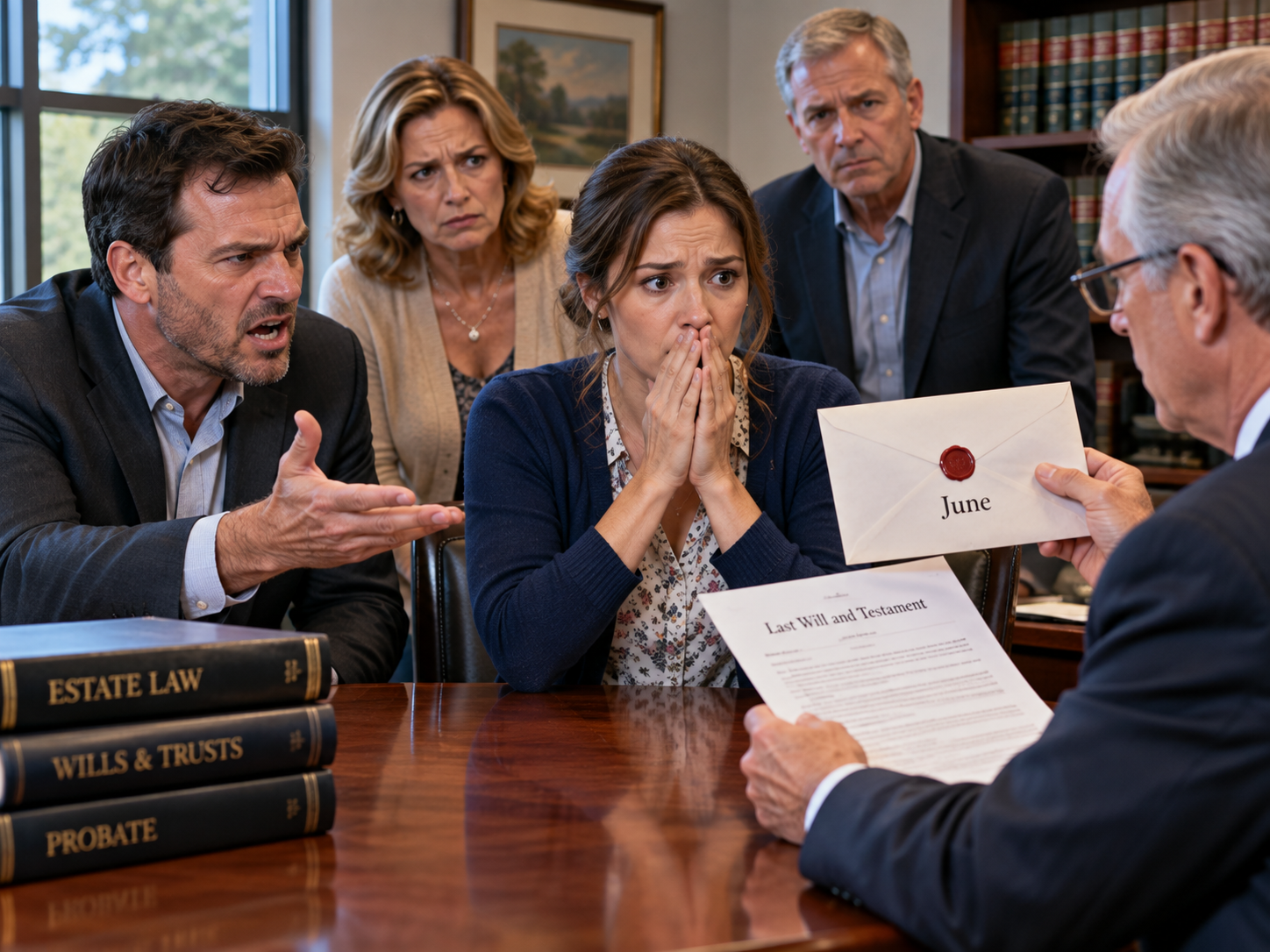
Mark laughed when the lawyer said “one dollar.” It was not a happy sound. It came out sharp and startled, bounced off the conference-room walls, and died beneath the hum of the air conditioner.
“You’re telling me Harold left us a dollar each?”
Mr. Albright did not look embarrassed. He had arranged the papers in front of him with the precision of someone who knew that the next few minutes would become unpleasant. He straightened one page, adjusted his glasses, and answered without raising his voice.
“That is exactly what the document says.”
Nobody moved.
June sat beside me with her hands folded in her lap. She was wearing the navy cardigan she had worn to Grandpa’s funeral, and a pale bleach stain showed on one sleeve. She had made the stain herself while scrubbing his bathroom a few weeks earlier. At the time she had been annoyed with herself for ruining the sweater. Grandpa had laughed and told her that if anyone in the family noticed the mark, they should volunteer to clean something themselves.
Now the sleeve was perfectly still.
Mark leaned over the table. “What about the farm?”
“We will reach the property provisions shortly.”
“That land is worth something.”
“I am aware.”
“How much?”
Albright looked over the top of his glasses. “I suggest you allow me to finish.”
Mark sank back into his chair, but his jaw remained tight.
The reading continued.
One dollar to Mark.
One dollar to Dale.
One dollar to me.
One dollar to each of the cousins who lived several states away.
The repetition made the amounts sound almost insulting.
Nobody needed to say why. Harold Parker had owned hundreds of acres in Kansas. He had spent his entire life acquiring equipment, land interests, mineral rights, and commercial property while behaving as though spending five dollars unnecessarily was a personal moral failure. Even the relatives who rarely visited knew the farm had value.
Aunt Carol was the first to speak.
“Dad told me the house would stay in the family.”
June lifted her eyes.
“When did he tell you that?”
Carol turned toward her.
“What?”
“When did Grandpa tell you?”
“He said it many times.”
“Can you give me one example?”
Carol’s mouth tightened.
“This is not the time to interrogate me.”
“It seems like exactly the time.”
The room became quiet enough that I could hear the faint clicking of the wall clock.
Carol folded her hands. “You should be careful, June.”
“Why?”
“Because you spent a great deal of time alone with him.”
June stopped breathing for a second.
“What is that supposed to mean?”
“I didn't say it meant anything.”
“You said it in front of everyone.”
Dale shifted in his chair. Mark looked from one woman to the other.
“No one is accusing anybody,” Dale said.
Mark gave a humorless smile.
“Not yet.”
I turned toward him.
“What are you implying?”
He shrugged.
“Grandpa was eighty-six. He was sick. He was taking heart medication. And now everyone gets a dollar.”
June looked directly at him.
“I didn't write his will.”
“No. You were just at his house all the time.”
“Because nobody else was.”
That ended the argument more effectively than shouting could have.
Carol looked down.
Dale studied his hands.
Mark's expression changed, though only briefly.
June had spent nearly two years driving twenty-nine miles every Wednesday after work to Grandpa’s farm. She brought groceries. She sorted his medication. She changed his sheets. She cleaned his kitchen when he complained that his refrigerator was making strange noises. She drove him to appointments after he stopped trusting himself on longer trips.
And every Thursday morning, without fail, Harold called her.
“You coming next week?”
“Yes.”
“Bring better coffee.”
“You say that every week.”
“Because every week you bring bad coffee.”
Then he would hang up.
June always went.
Albright closed the will folder.
“Mr. Parker anticipated that some of you might question his competence or suggest another person influenced his decisions.”
Carol looked up.
“Why would Dad expect that?”
“Because he prepared accordingly.”
Albright explained that Harold had undergone independent medical evaluations. Witnesses had documented his condition. Important documents had been signed under controlled circumstances. There were recordings, handwritten notes, medical records, and other evidence establishing that Harold knew what he owned and understood exactly what he wanted done with it.
June’s shoulders dropped slightly.
Carol whispered, “He expected us to fight.”
“No,” June said quietly. “He expected us to try.”
That sounded like Harold.
He had labeled everything. Keys. Toolboxes. Spare parts. Extension cords. Once, when Mark borrowed a post-hole auger, Harold had made him sign a handwritten note confirming that he had possession of it.
If Harold believed something might cause trouble later, he prepared for the trouble while he was still alive.
Albright reached into a second folder.
He removed an ordinary cream-colored envelope.
It was slightly worn. One corner had bent. Blue handwriting crossed the front.
JUNE.
June stared at her name.
“What's that?”
“Something your grandfather left under separate instructions.”
Mark leaned forward.
“What kind of instructions?”
Albright placed the envelope directly in front of June.
“Those instructions apply only to her.”
Carol immediately objected.
“If it concerns the farm, the whole family should hear it.”
“It does concern the farm.”
“Then read it.”
“I cannot.”
“Why?”
“Because Harold specifically instructed me not to allow it to be opened here.”
June touched the envelope with two fingers.
“What am I supposed to do with it?”
“Take it to the north gate of the farm.”
“Why?”
“I was not told to explain.”
“What happens there?”
“You will discover that yourself.”
Mark pushed his chair backward.
“This is absurd.”
Albright remained calm.
“It is your grandfather's estate. He was entitled to make private instructions.”
Mark looked at June.
“What if she doesn't go?”
“The envelope returns unopened. An alternate provision then becomes effective.”
June looked at the clock.
“What time?”
“As soon as reasonably possible.”
“That isn't a time.”
For the first time, the lawyer's expression softened.
“Before four o'clock.”
June followed his gaze to the clock.
3:21.
She stood.
Mark stood too.
“I’m coming.”
“No.”
“You have no idea what you're walking into.”
“Neither do you.”
“That’s exactly why I'm coming.”
June tucked the envelope against her side.
Then she looked at me.
“Will you drive?”
I understood.
She did not want an audience. She wanted someone she trusted.
“Of course.”
Mark stepped in front of the doorway.
“You cannot leave with instructions concerning family property while everyone else stays here.”
June looked at him.
“Grandpa gave you a dollar.”
Mark blinked.
“He gave all of us a dollar.”
“Exactly. Whatever he wanted done next, he didn't ask you.”
For a moment, Mark looked as if he might argue.
Then he moved.
Outside, the Kansas heat hit us immediately. The parking lot shimmered beneath the afternoon sun. June unlocked her Tacoma but did not get in.
She turned the envelope over.
The flap had been reinforced with clear tape.
I smiled despite myself.
“He even taped the envelope.”
“Grandpa didn't trust glue.”
She ran her thumb over his handwriting.
“I keep thinking he's going to call.”
I said nothing.
“He always called after appointments. Sometimes twenty minutes after I got home. He'd remember something he'd forgotten to complain about.”
“You hated those calls.”
“I'd give anything for one now.”
Her voice cracked.
She looked away, wiped her eyes, and took two steady breaths.
That was June. She gave herself a few seconds for grief, then returned to whatever needed doing.
We climbed into the truck.
She had barely reached the end of the parking lot when she checked the rearview mirror.
“Mark's leaving.”
I looked back.
His Silverado pulled onto the road behind us.
Then Dale's Jeep.
Then Carol's Buick.
“All three?”
June nodded.
“Maybe they're going somewhere else.”
She gave me a look.
“Fine. That was a terrible theory.”
Her phone began vibrating.
MARK.
She ignored it.
A second call appeared.
DALE.
Then CAROL.
“They're talking to each other,” I said.
“I know.”
“What do you want to do?”
“Get to the farm before four.”
We drove west.
The town disappeared behind us. The church where Harold had been buried three days earlier passed on our right. Beyond it came feed stores, grain elevators, fields browned by late summer heat, and long stretches of road where the horizon seemed to pull away whenever you thought you were getting close.
The north gate was not the entrance most people used.
It stood along County Road 18, half-hidden by weeds. An old chain hung between two weathered cedar posts. Beyond it lay the farmhouse, the barn, the pond, and the windmill that had not turned properly in years.
June stopped.
3:47.
We climbed out.
Grasshoppers sprang from the weeds.
“Albright said nothing else?” I asked.
“No.”
We examined the latch.
Nothing.
The posts.
Nothing.
An old metal tube had been fixed to one brace. June pulled it loose.
Empty.
She crouched.
“Wait.”
She brushed dirt away from the lower hinge.
A strip of silver duct tape was wrapped beneath the post.
June peeled it back.
A small magnet was attached underneath.
A plastic sleeve hung from it.
Inside was another envelope.
Two names were written across the front.
JUNE — AND THE COUSIN SHE TRUSTS ENOUGH TO BRING.
I stared at it.
“That is very specific.”
A small smile appeared on June's face.
Then disappeared.
She handed it to me.
“You open it.”
“Why me?”
“If Grandpa left me another complaint about my cooking, I want a witness.”
I slipped my thumb under the flap.
Then gravel cracked behind us.
June caught my wrist.
“Wait.”
We turned.
Mark's Silverado came through the dust first, braking hard beside the road.
Dale followed.
Carol's Buick appeared a moment later.
All three vehicles stopped behind June's truck.
Nobody pretended anymore.
They had followed us.
June looked at the unopened envelope in my hand.
Whatever Harold had hidden beneath that fence post, his family clearly believed it belonged to them too.
And as the dust settled around the three vehicles, I realized something else.
Harold had known they would follow.
Click Here to continue read next: PART2: The Farm Was Already Gone, Yet the Brass Key and a Bank Appointment Revealed That Harold Had Hidden Far More Than Land
The Will Made Everyone Angry, but the Envelope With June’s Name on It Suggested Grandpa Had Prepared for Something Much Worse
Part 1 of 8

