
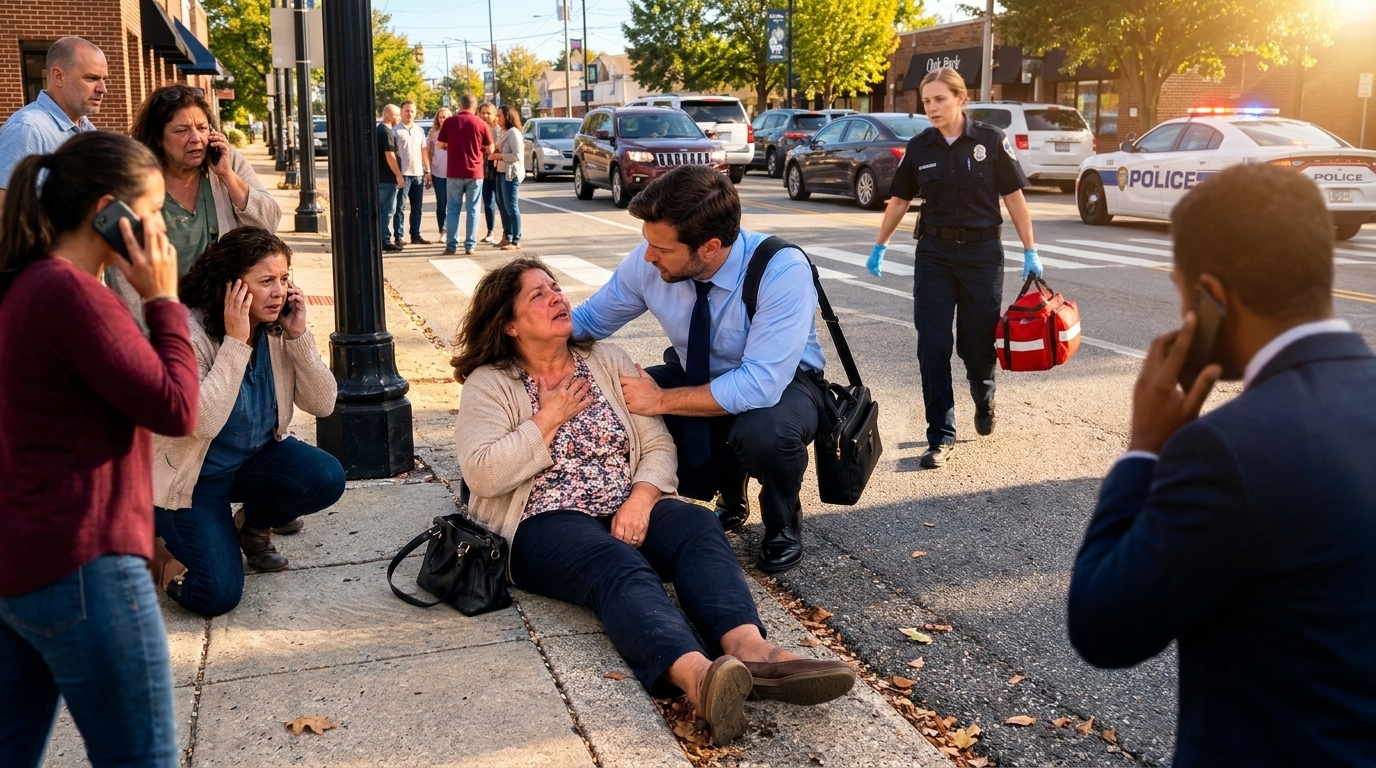
A year after the morning that changed my life, Eleanor called me on a Sunday afternoon.
Her voice sounded cheerful.
“I have a favor.”
“That sounds dangerous.”
She laughed.
“I want you to drive me somewhere.”
“Where?”
“You'll know when we get there.”
“That isn't reassuring.”
“You survived one trip with me already.”
“I wasn't driving you then.”
“Exactly.”
I laughed.
Claire was sitting nearby and watched me with an amused expression.
“When?” I asked.
“Tomorrow.”
“All right.”
Eleanor gave me the location.
I recognized it immediately.
The highway.
I didn't tell Claire.
She knew from my face.
“You're going back.”
“Yes.”
“With Eleanor?”
“Yes.”
She smiled.
“Then go.”
The next afternoon, I met Eleanor outside her house.
She was wearing a light jacket and carrying a small paper bag.
Thomas helped her into the passenger seat.
“Take care of her.”
“I will.”
Eleanor looked at him.
“I'm perfectly capable.”
Thomas smiled.
“I know.”
She closed the door.
We drove.
For the first several minutes, neither of us said much.
Traffic moved steadily.
The city faded behind us.
Then Eleanor opened the paper bag.
“What did you bring?”
“Tomatoes.”
I laughed.
“You brought tomatoes?”
“They're from my garden.”
“Claire will like them.”
“I know.”
“You remembered?”
“I remember everything.”
We continued driving.
When we reached the stretch of highway, Eleanor asked me to pull over.
I did.
We got out.
She stood beside the road and looked around.
“This is it.”
“Yes.”
She breathed slowly.
“I don't remember the exact spot.”
“Neither do I.”
“That doesn't matter.”
She opened the paper bag.
Inside were four tomatoes.
She held one out.
“What am I supposed to do with that?”
“Take it.”
I did.
She smiled.
“My students used to think I gave them homework.”
“You're giving me a tomato.”
“Consider it an assignment.”
I laughed.
Then she became serious.
“I wanted to come here because I needed to see it again.”
“Why?”
“Because for a long time, I thought this was where I almost died.”
I waited.
“But it isn't.”
She looked toward the road.
“This is where I learned I wasn't invisible.”
I didn't know what to say.
She continued.
“When I was lying there, I thought all those cars were people who didn't see me.”
She touched the paper bag.
“But you did.”
“I almost didn't.”
“You did.”
She looked at me.
“That is the fact.”
I nodded.
We stood together while traffic passed.
Then Eleanor said something I had never expected.
“I need you to forgive yourself.”
“For what?”
“For being late.”
I looked at her.
“I lost my job because of it.”
“You lost your job because someone valued a schedule more than a person.”
“That wasn't entirely his fault.”
“No.”
She shook her head.
“You chose to stop.”
“Yes.”
“He chose to fire you.”
“Yes.”
“Those are separate decisions.”
I had never thought of it that way.
She continued.
“You have spent a year making your decision sound like the cause of everything that happened afterward.”
I looked down at the tomato in my hand.
“Maybe.”
“You didn't cause your old company's failure.”
“No.”
“You didn't cause those patient complaints.”
“No.”
“You didn't create the broken system.”
“No.”
“You simply refused to participate in one small part of it.”
I looked at her.
“That's a powerful way to describe it.”
“I'm a teacher.”
I laughed.
“Fair enough.”
She smiled.
Then she looked down the highway.
“Do you know what I remember most?”
“What?”
“Your voice.”
“My voice?”
“You kept talking.”
“I was trying to keep you awake.”
“I know.”
She smiled.
“You told me about your daughters.”
I thought back.
“I did?”
“Yes.”
“I don't remember.”
“I do.”
She told me that I had described Lily as serious and Cora as stubborn.
I laughed.
“That sounds accurate.”
“You told me Cora had been sick.”
“She had.”
“You were worried about her.”
“Yes.”
“And you were worried about being late.”
“Yes.”
“And yet you stayed.”
I looked at her.
“I couldn't leave.”
“That is what I wanted you to understand.”
She touched my arm.
“You didn't stop being a father when you stopped for me.”
I felt something tighten in my chest.
“You were still thinking about them.”
“Yes.”
“You were still afraid.”
“Yes.”
“You were still late.”
“Yes.”
“You were still responsible for your family.”
“Yes.”
“And you still helped.”
I nodded.
“That is what courage looks like.”
I looked away.
The highway blurred for a moment.
Eleanor didn't comment.
She simply stood beside me.
Eventually, she said, “Let's go home.”
We returned to the car.
Before she got in, she looked at me.
“Your father was right.”
I smiled.
“About the foundation?”
“Yes.”
“You remember that?”
“Thomas told me.”
“Of course he did.”
She laughed.
We drove back.
At her house, Thomas was waiting.
Eleanor handed him the empty paper bag.
“Mission accomplished.”
Thomas looked at me.
“What mission?”
“She'll tell you.”
I smiled.
“Probably.”
Before I left, Eleanor called me back.
“Sebastian.”
“Yes?”
“Thank you.”
“You're welcome.”
She shook her head.
“No.”
She looked at me carefully.
“Thank you for turning around.”
I smiled.
“Thank you for calling out.”
She nodded.
Then she went inside.
I drove home.
Claire was waiting.
“How was it?”
I sat beside her.
“Good.”
“That's all?”
I smiled.
“She brought tomatoes.”
Claire laughed.
“Of course she did.”
I handed them to her.
She took them into the kitchen.
I watched her put them on the counter.
Then I looked around our house.
Lily's shoes were by the door.
Cora's dinosaur drawings covered part of the refrigerator.
A framed family photograph stood on the shelf.
The mortgage was still there.
Bills still arrived.
Life still contained difficult days.
Nothing had become magically perfect.
That was important.
The morning on the highway had not transformed me into someone who never struggled.
It had simply shown me something I had forgotten.
A life can change because of one decision.
Not because the decision guarantees a reward.
Because it reveals what you are willing to protect when protecting it costs you something.
I returned to Ellery Health the next morning.
The patient communication program had expanded to every major department.
Rachel led it.
Naomi had become one of her closest collaborators.
The old complaints were now part of a training archive.
New employees read them.
They learned why the reforms existed.
They learned what happened when people stopped listening.
They learned that technical accuracy was not enough if the person receiving the information couldn't understand it.
Harold eventually left the company.
The investigation found that he had knowingly altered budget information and suppressed concerns.
Others received disciplinary action.
Some remained.
That was uncomfortable too.
Real institutions don't become pure because one bad person leaves.
They become better when people change how decisions are made.
Martin stayed.
So did I.
A few months later, the board asked me to speak at an internal leadership conference.
They wanted me to tell the story of the highway.
I almost refused.
Then I agreed.
But I didn't tell it the way people expected.
I didn't make myself the hero.
I told them I had passed Eleanor first.
I told them I had been worried about my presentation.
I told them I had almost kept driving.
That was the part I wanted people to hear.
Because most choices aren't made between obvious good and obvious evil.
They're made when you're tired.
Late.
Busy.
Worried.
Convinced someone else can handle it.
You tell yourself you'll help next time.
You tell yourself it isn't your responsibility.
You tell yourself the consequences of stopping are too expensive.
And sometimes those arguments sound reasonable.
Until you look back.
After the speech, a young employee approached me.
“I needed to hear that.”
“Why?”
“My father is sick.”
I didn't know what to say.
She continued.
“I've been working constantly because I thought that's what I had to do.”
I nodded.
“Work matters.”
“Yes.”
“But?”
She smiled.
“But so does knowing when to stop.”
I smiled back.
“Exactly.”
That evening, I drove home.
Traffic was heavy.
The sun was low.
For a moment, I saw a car stopped ahead on the shoulder.
My heart tightened.
I slowed.
A man was standing beside his vehicle, looking beneath the hood.
Another driver had already stopped behind him.
Someone was helping.
I continued.
Not because I had stopped caring.
Because someone else had already stopped.
I smiled.
The lesson was never that I had to become the person who stopped every time.
It was that I should never allow convenience to become an excuse for refusing to see.
When I reached home, Claire was waiting at the door.
She kissed me.
“How was your day?”
“Long.”
“Bad?”
“No.”
“Good?”
I thought about it.
“Meaningful.”
She smiled.
“That sounds like you.”
I looked past her.
Lily was reading on the couch.
Cora was asleep with one sock missing.
The house smelled like dinner.
I stepped inside.
For a moment, I thought about that cardboard box.
Three years of work packed into a container beside me.
I had thought my life was ending.
It wasn't.
It was changing.
The job I lost had taught me what kind of workplace I didn't want.
The job I gained taught me what kind of work I wanted to do.
Eleanor taught me that being seen can matter as much as being helped.
Rachel taught me that persistence can survive years of being ignored.
Claire taught me that doing the right thing does not require a promise that everything will work out.
And my daughters taught me that the person I wanted to be was watching me even when they weren't.
I went into the kitchen.
Claire handed me a plate.
“You look thoughtful.”
“I was thinking about Eleanor.”
“She still sends tomatoes?”
“Apparently.”
Claire laughed.
I sat down.
Outside, cars moved along the road.
Somewhere out there, people were hurrying toward appointments, meetings, homes, families, obligations.
Everyone had somewhere to be.
So had I.
That morning, I had been late.
I had been afraid.
I had been focused on everything I could lose.
Then I looked back.
And I turned around.
I lost a job.
I gained a direction.
A woman survived.
A company changed.
A family learned that one bad morning did not have to define the rest of our lives.
And years later, when I think about the decision, I no longer remember the time on the clock.
I don't remember the presentation slides.
I don't remember what excuse I might have used if I had kept driving.
I remember Eleanor's hand in mine.
I remember her frightened eyes.
And I remember the moment I realized I had a choice.
That is what stayed with me.
Not the firing.
Not the new title.
Not the money.
Not the praise.
The choice.
Because sometimes the most important turn you ever make is the one nobody else sees.
The End
Read more original stories on Feel Every Story.
I Left Home Before Sunrise for the Most Important Presentation of My Career, Then One Glimpse on the Highway Forced Me to Choose
Part 8 of 8

