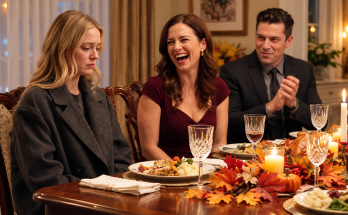
The first invitation to a family gathering arrived almost a year after Leo was found. It came from my aunt, who wanted to host a small lunch for the relatives who had helped during the search. She said she hoped we could spend time together without discussing the case. The message was kind, but I hesitated when I read that Elena's name had been included in the original guest list.
I called my aunt and asked whether she expected Elena to attend. She said she had not invited her directly, but another relative had suggested that the family should eventually find a way to come together. My aunt admitted she didn't know what to do. She wanted the children to have a relationship with their relatives, but she did not want to pressure us.
I appreciated her honesty. I told her that I wasn't ready to attend a gathering where Elena might appear unexpectedly. I also said I didn't want to make her choose sides. We agreed that she could hold the lunch without us, and we would arrange a separate visit another time. She sounded disappointed, but she did not argue.
Sarah asked whether I had felt guilty afterward. I said I had, a little. We had spent years attending family events without thinking twice about who would be there. Now every invitation required questions about safety, boundaries, and the children's comfort. I missed the ease we had once taken for granted. But I also knew that pretending nothing had happened would not restore that ease. It would only ask us to hide the truth again.
A few weeks later, my aunt proposed a smaller gathering at our home. She would come with two relatives who had supported the search and had respected our privacy since Leo's rescue. Elena would not be invited, and no one would ask the children about the investigation. I agreed. It felt important to show the children that family contact could be safe and ordinary without requiring every relationship to be restored.
On the morning of the gathering, Leo helped Sarah set the table. He chose the plates and arranged the forks, then asked whether he could sit near the hallway. I told him he could choose his seat wherever he felt comfortable. He picked a chair with a clear view of the front door. I noticed but did not comment. He had the right to decide what made him feel secure without being asked to justify it.
The relatives arrived on time. They hugged the children only after asking whether they wanted a hug, and they did not bring up the court proceedings. One aunt asked Leo about school, while another asked Maya about a drawing she had made. The conversation stayed on ordinary things: a garden project, a new teacher, a neighbor's dog that kept stealing shoes. It was not a perfect afternoon, but it was the first family gathering in a long time where I did not feel compelled to monitor every sentence for hidden pressure.
At one point, my aunt took me aside. She apologized for the earlier invitation and said she had underestimated how much it might ask of us. I thanked her for listening. She did not tell me that family should forgive family or that time would heal everything. She simply said she wanted the children to feel safe around the relatives who remained in their lives. That was a conversation I could have.
After lunch, Leo and Maya built a tower from wooden blocks while the adults drank tea. My aunt watched them from the sofa and began to cry quietly. She said she was grateful to see Leo playing again. I sat beside her and let her cry. She had helped search for him and had carried her own fear during those months. I did not tell her to stop feeling sad. We had all been changed by what happened, and there was no need to pretend otherwise.
The gathering ended without a dramatic announcement. The relatives thanked us for having them, and the children waved from the doorway. After they left, Sarah and I cleaned the kitchen while Leo finished his tower. I realized that the afternoon had not required us to forgive Elena, reconcile with my father, or agree on a single family story. It had required only that the people present respect the boundaries we had set.
That was the kind of family life I wanted to build. Not one where everyone agreed, but one where safety and dignity were not negotiable. People could remain connected without demanding access to every part of our lives. They could express sorrow without making us responsible for easing it. They could care about the children without using them to repair adult relationships.
The next challenge came when one of the relatives asked whether Elena might someday be allowed to send Leo a birthday card. I told her I wasn't ready to make that decision. She said she understood, then added that Elena had been asking about the children. I felt the old pressure return, the familiar suggestion that because someone missed the family, we should make room for them.
I answered carefully. “Her feelings matter, but Leo's safety and readiness matter more. We will decide what contact is appropriate when we're ready.”
My relative nodded, though I could tell she had hoped for a different answer. I did not explain further. I had learned that boundaries became weaker when I treated every disappointed reaction as a request for another argument. A clear answer was enough.
Elena's lawyer had previously asked whether she could send letters to the children. We had declined while Leo's recovery was fragile. Now that he was more stable, his therapist advised us to consider his wishes rather than make a permanent decision based only on our anger. We discussed the possibility with Leo in simple terms, explaining that his aunt had asked to send a letter but that he did not have to receive one.
He thought for several days before answering. Finally, he said he didn't want a letter now. He was worried that it might make him feel responsible for her sadness. I told him that was a reasonable concern and that he did not have to accept contact just because she wanted it. We would revisit the question only if he chose to.
Maya had a different reaction. She said she wanted to know whether Elena was sorry, but she did not want to see her. I explained that those wishes could coexist. She could be curious about someone's feelings without agreeing to a visit. We would not arrange a meeting merely to satisfy curiosity or to give an adult a chance to explain herself.
I wrote to Elena's lawyer, stating that no direct contact would be arranged at that time. I did not accuse Elena in the message or discuss the details of the case. I simply made the boundary clear. The lawyer acknowledged the response and did not press us further.
My father was careful not to use the family gathering as an opportunity to ask for more contact. He heard about the lunch from my aunt and sent a brief message saying he was glad the children had enjoyed themselves. I thanked him. When he later asked whether he could attend Maya's school performance, I discussed it with her. She wanted him there, so we arranged for him to sit with the relatives she felt comfortable seeing. Leo chose not to attend that particular event, and we respected his decision.
At the performance, my father sat quietly near the back. He applauded when Maya finished, then congratulated her without turning the moment into a discussion about the past. Maya was happy to see him, and I was glad she could have that experience. It did not mean I had forgiven him or that the relationship had returned to what it was. It meant that the boundaries we had established could allow different relationships to develop at different speeds.
Afterward, my father thanked me for making the arrangement possible. I told him that I had done it because Maya wanted him there, not because everything between us had been resolved. He nodded. “I understand,” he said.
I hoped he did. I also knew that I could not control whether he fully understood. My responsibility was to make decisions based on the children's needs and my own boundaries, not to manage his interpretation of them.
A few months later, my aunt hosted another gathering, this time for a family birthday. The guest list was clear in advance, and no one tried to add Elena at the last moment. I decided to attend with Sarah and the children. It felt easier because we knew what to expect. Leo chose to stay home with a trusted caregiver, while Maya came with us. Neither child was criticized for making a different choice.
At the party, I spoke with relatives I had not seen for months. Some asked about Leo, and I gave brief updates. Others talked about work, travel, and ordinary family news. I felt the familiar warmth of being among people who shared my history, but I no longer assumed that shared history meant unlimited trust. I could enjoy the afternoon while remaining aware of my own limits.
Near the end of the gathering, an older cousin said she hoped the family would eventually be whole again. I understood what she meant, but I answered honestly. “It may not look the way it did before. We're trying to build something safe and honest now.”
She seemed uncertain how to respond. I did not press her to agree. The word whole had once meant everyone gathered around the same table, with no open disagreement and no visible fracture. Now I understood that a family could look complete from the outside while hiding serious harm. I would rather have fewer people at a table where the truth was allowed than a full room where someone had to stay silent.
On the drive home, Maya asked why some relatives wanted everyone to get along so badly. I told her that people often disliked conflict and wished it would disappear. Sometimes they believed a reunion would make everyone feel better. But a reunion could only be healthy if the people involved felt safe and were willing to respect each other.
“Can people still be family if they don't see each other?” she asked.
“Yes,” I said. “Being related doesn't mean you have to spend time together all the time. What matters is how people treat one another.”
She looked out the window, thinking. Then she asked whether she could have ice cream when we got home. I laughed and said we could see what was in the freezer. It was an ordinary ending to a complicated conversation, and I was grateful for it.
That evening, Leo asked how the party had gone. I told him it had been calm and that Maya had enjoyed herself. I did not tell him he should have come or suggest that he had missed something important. He seemed satisfied, then returned to the game he had been playing. His decision to stay home had been respected, and he did not need to defend it.
I began to see that the family we were building would not be defined by who was invited to every gathering. It would be defined by whether each person could make a choice without being punished for it. Some relationships might grow again. Others might remain distant. The children would learn that love did not require them to ignore discomfort, and that an invitation was not an obligation.
My father continued to work on his relationship with us through small, consistent actions. He asked before visiting, accepted no without argument, and stopped referring to the day he saw Leo at the well as a mistake made under pressure. He called it what it was: a decision to conceal the truth. I noticed the change, but I did not rush to reward it with greater access. Trust would have to be built over time.
Elena remained outside our daily lives. I did not know whether she would ever fully understand the harm she had caused or whether her regret would remain mixed with excuses. I no longer needed to investigate her feelings. The legal process had established the consequences of her actions, and our family had established the boundaries needed to move forward. That was enough for now.
As the year drew to a close, we held a small celebration at home. Leo chose the food, Maya decorated the table, and Sarah played music while I prepared dinner. My father joined us for a short visit after the children agreed they wanted him there. He stayed for dessert and left when the evening ended. No one made a speech about forgiveness or family unity. We ate, laughed, and cleaned up together.
Later, I found Maya arranging her drawings on the refrigerator. The picture of our house with the red door was still there, its corners curled from months of handling. She placed a new drawing beside it: four people standing beneath a yellow sun, each with a different color shirt. There was no dark rectangle beneath the house this time.
I asked her what the new picture meant.
“It means we're here,” she said.
I kissed the top of her head and let her finish arranging the drawings. The family we had now was not the one I had imagined before Leo disappeared. It was smaller in some ways, more careful in others, and honest about things we had once tried to hide. We had learned that togetherness without safety was not the kind of unity we wanted.
The gathering everyone had hoped would bring us back to the old family had not happened in the way they expected. Instead, we learned how to gather without pretending, how to decline invitations without guilt, and how to leave space for relationships that might change without forcing them to change now. That was a more difficult kind of family life, but it was one we could live in without sacrificing the truth.
Click here to continue reading: PART 12: When Leo Finally Asked Whether He Could Ever Forgive His Aunt, I Told Him His Future Did Not Belong to Her
My Daughter Put Her Ear Against My Sister’s Perfect Floor and Whispered That Her Missing Brother Was Still Alive
Part 11 of 16