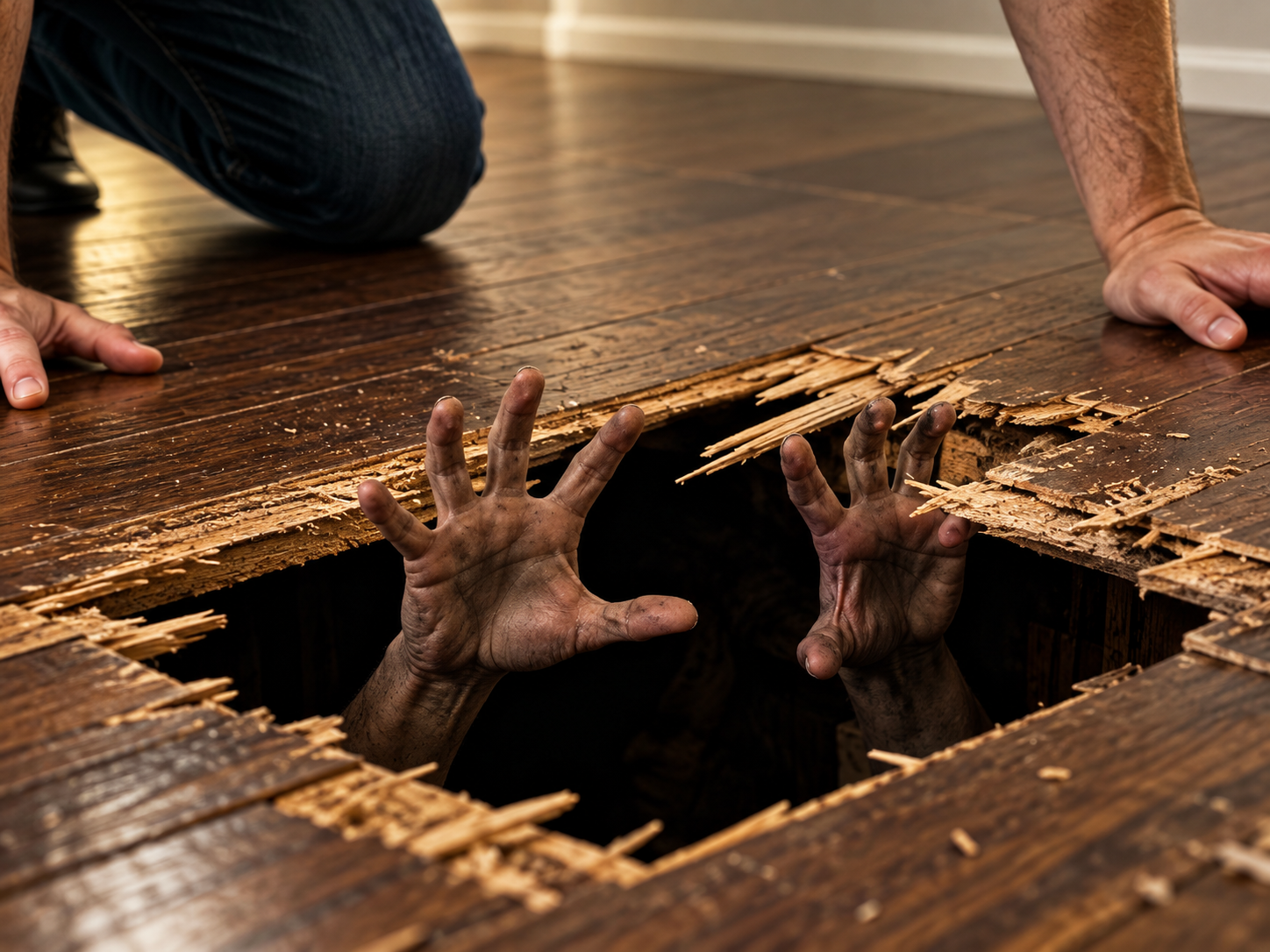
I kept one hand wrapped around Leo's wrist while my other hand reached for my phone. The opening was too narrow to pull him through without risking an injury, and I could feel how little strength he had left. His fingers trembled against my skin. I spoke to him continuously, telling him to hold on, that I was there, and that he would not be left alone in the dark again. I was afraid that if I stopped talking, the silence below would swallow him.
“Maya, go to the front door,” I said. “Stay where you can see the driveway. Don't go outside, and don't let anyone in.”
She wiped her cheeks with the back of her hand. “What about Leo?”
“I'm staying with him. You can hear me from here.”
She hesitated, looking at her aunt. Elena lowered her eyes. That was enough to send Maya hurrying toward the hallway.
I dialed emergency services and gave the address, my name, and the most important fact I could manage to say clearly: my missing eight-year-old son was alive inside a concealed space beneath the living-room floor. I told the dispatcher that the child appeared weak and that I needed paramedics and police. I also explained that the house's owner might be involved in his confinement. The dispatcher asked whether I could safely reach him. I said I could reach his hand, but the opening was too small.
“Stay with him,” she instructed. “Do not try to force him through the opening. The responders are coming.”
I put the phone on speaker beside me. Elena remained several feet away, her hands clasped so tightly that her knuckles had turned white. I wanted to cross the room and shake answers out of her, but every second Leo held my wrist seemed more important than the questions. I lowered my face toward the opening.
“Buddy, can you tell me if anything hurts?”
“My legs.”
“Both legs?”
He hesitated. “They feel funny.”
“That's all right. Don't try to stand yet. Help is coming.”
“Are you going to leave?”
The question broke something in me. “No. I'm not going anywhere.”
He seemed to believe me, but his grip did not loosen.
I asked whether he could tell me how long he had been down there. He struggled to answer. He knew it had been a long time, but he had lost track of the days. At first, he had counted meals and slept whenever the light changed. Then the light stopped changing regularly, and he began counting the times the door opened instead. I asked what door he meant, but he began breathing too quickly, and I stopped questioning him.
Elena made a small sound behind me.
“Don't talk to him,” I said without looking up.
“David, he needs to know—”
“He needs a doctor. He needs to get out of there. And he needs you to stay away from him.”
She stepped back.
I could hear sirens in the distance. The sound seemed impossibly far away. I watched the phone's timer move forward while the dispatcher kept me talking, asking whether Leo was conscious and whether his breathing had changed. I answered each question as best I could. I had never felt so helpless in my life. My son was close enough for me to hold his hand, yet the floor separated us as completely as fourteen months of unanswered questions had done.
When the first responders entered the house, I heard them identify themselves from the hallway. I shouted that they should come to the living room and warned them about the opening. Two paramedics approached with equipment while police officers moved toward Elena. One officer asked her to step away from the broken floor. She obeyed without resistance, staring at the place where Leo's hand emerged.
The paramedics assessed the opening and called for additional equipment. They spoke to Leo in calm, simple sentences, explaining that they were going to help him. I refused to release his hand until one of them assured me they had a secure way to reach him. Even then, I stayed beside the opening, telling my son exactly what was happening before each movement. I would not let him wake from a moment of darkness and believe that someone had taken him away again.
The rescue took longer than I could bear. The boards had been fixed over a concealed access point, and the space below was not designed for a person to enter or leave easily. The responders worked carefully, widening the opening and supporting the surrounding structure. When they finally brought Leo up, he looked so small that my mind struggled to connect him to the laughing boy who had once raced through our backyard with muddy knees.
His hair was longer than I remembered, tangled and dull. His cheeks were hollow. His clothes hung loosely from his body, and a dirty blanket had been wrapped around his shoulders. He blinked against the living-room lights, flinching when one of the paramedics moved too quickly. I reached toward him, then stopped when the medic explained that they needed to assess him first.
“Leo,” I said, keeping my voice steady. “It's Dad. You're safe with the doctors.”
He looked at me for a long time. His eyes moved over my face as though he were checking whether I was real.
“Dad?”
“I'm here.”
His mouth trembled. “You came.”
I took his hand again. “I should have found you sooner.”
He shook his head, then winced as if even that small movement hurt. “She said you weren't coming.”
I felt my stomach turn, but I did not ask who he meant. I already knew.
The paramedics placed Leo on a stretcher and covered him with a clean blanket. One of them told me he needed urgent medical evaluation for dehydration, malnutrition, and the effects of prolonged confinement. They could not tell me the full extent of his condition at the house. They needed to take him to hospital immediately.
I followed them toward the front door. As we passed Elena, she reached out a hand.
“Leo, sweetheart—”
He recoiled so violently that the stretcher shifted.
“Don't let her touch me!” he cried.
The room went still.
The police officer beside Elena moved between her and the stretcher. I climbed into the ambulance with my son, leaving the house behind me with its broken floor, its spilled tea, and the sister I no longer recognized. Through the rear doors, I saw another officer escort Elena toward a separate vehicle. She looked at me once, but I turned away.
At the hospital, the hours blurred into examinations, blood tests, scans, and questions from medical staff. Sarah arrived before the first major assessment was finished. I had called her from the ambulance, and I heard her voice break when I told her Leo was alive. She drove straight to the hospital, abandoning whatever she had been doing. When she entered the room and saw him lying beneath a warm blanket, she covered her mouth with both hands.
Leo stared at her.
“Mom?”
Sarah fell beside the bed, but she did not grab him. She waited until he reached toward her, then held him with a gentleness that seemed to contain all the fear she had carried for fourteen months. She whispered his name over and over, kissing his forehead and brushing his hair away from his eyes. He began to cry, and she cried with him.
I stood near the door, one hand pressed against my mouth. I had imagined this reunion thousands of times. In my dreams, Leo ran toward us, healthy and laughing, and Sarah and I held him until the fear disappeared. Reality was slower and more painful. He was alive, but he was injured by what had happened. His body needed care, and his mind had learned to expect danger from the people who should have protected him.
A child specialist asked us to let Leo rest and avoid pressing him for details. The police would arrange a formal interview when he was medically stable, using trained professionals who could speak with him without leading his answers. I wanted to ask everything at once—who had taken him, why no one had found him, what Elena had meant about Mark—but I understood that my need for answers could not come before his need to recover.
Later, when Sarah had stepped into the corridor to speak with the doctor, Leo caught my sleeve.
“Dad, is Mark coming?”
The question chilled me.
“No,” I said. “Why would you think that?”
Leo stared at the blanket. His fingers rubbed a loose thread over and over. “Aunt Elena said he would come if I told.”
“Tell me what, buddy?”
He shook his head and began to tremble. I stopped. I called the nurse and told her he was frightened, and she helped me settle him with a cup of water and the promise that no one would speak to him about the past until he was ready.
But the name had already changed everything.
Mark Heller had been part of our family for as long as I could remember. He had worked for my father for decades, first overseeing private security at our properties and later coordinating protection for family members and business executives. He knew the back roads around our Texas estate, the service gates, the camera systems, and the people who would answer his calls. When Leo disappeared, Mark led search teams and spoke to reporters about how committed we all were to bringing him home.
He had stood beside me outside the police command post, one hand on my shoulder, promising that he would not stop looking. He had helped coordinate volunteers. He had called me after midnight with updates, even when there was nothing new to report. I had trusted him with information I had not shared with everyone else because I believed he was trying to bring my son home.
If Leo was afraid of Mark, I needed to know why.
I called my father, Richard Vance, and told him Leo had been found alive. For several seconds, he said nothing. Then I heard him draw a sharp breath, followed by a broken, disbelieving sound I had never heard from him before.
“Where is he?” he asked.
“Hospital. Sarah's with him. He's being treated.”
“Who found him?”
“Maya heard him under Elena's floor.”
My father fell silent again. I told him the police had taken Elena for questioning and that Leo had asked whether Mark was coming. I heard a chair scrape across the floor at his end of the call.
“Do not confront Mark,” he said. His voice had changed. The grief was still there, but something colder had settled over it. “Do not warn him. Tell the police exactly what Leo said, and let them decide how to approach him.”
“I know.”
“David, listen to me. Mark had access to the property, the search plans, and our security records. If he is involved, we cannot assume this stops with Elena.”
I looked through the glass panel in the hospital door. Leo had fallen asleep, one hand curled around Sarah's fingers.
“What did he do?” I asked.
“I don't know yet,” my father answered. “But I will find out what records he accessed, who he spoke to, and what happened on the night Leo disappeared. I won't interfere with the investigation. I'll preserve what we have and give it to the authorities.”
That was the first time I understood how much our family might have mistaken familiarity for trust. Mark had been allowed into every part of our lives. He knew our routines and our weaknesses. He knew where we kept spare keys and which roads the children liked to ride their bicycles on. If he had used that knowledge against us, the danger had been hiding in plain sight while we searched the fields.
A police detective arrived before dawn. He told us Elena was being questioned and that the officers were treating the concealed room as a potential crime scene. The property would be secured, and the floor, access point, and items found below it would be documented. He asked whether we knew of any reason someone might want to keep Leo hidden. I could only tell him what I had heard: Elena's admission that she had kept Leo alive, her warning about Mark, and Leo's fear of both of them.
The detective listened without promising a quick answer. “We need to separate what we can prove from what we suspect,” he said. “Your son has been through something terrible. We will make sure his account is handled carefully, and we'll follow the evidence wherever it leads.”
I nodded, though the words felt painfully slow beside the urgency inside me. I wanted Mark arrested immediately. I wanted Elena to explain every minute of the fourteen months. I wanted someone to tell Sarah that the nightmare was over. But Leo was still under medical care, and the investigation had barely begun. Rage could not replace evidence, and certainty could not be forced into existence because I needed it.
That morning, my father arrived at the hospital with his face drawn and his jacket thrown over an open-collared shirt. He went first to Leo's room, where he stood beside the bed for a long time before touching his grandson's hand. Leo stirred, opened his eyes, and watched him.
“Grandpa?”
“I'm here, son,” my father whispered.
Leo looked toward the door. “Is Mark with you?”
My father froze.
“No,” he said gently. “He isn't coming in here.”
Leo's fingers tightened around the blanket. He looked at my father as though deciding whether he could believe him.
Then he whispered, “Grandpa, you saw her too.”
My father did not move.
“Who did I see?” he asked.
Leo's eyes filled with tears. “The lady by the old well.”
I turned toward my father. The color had drained from his face.
Click here to continue reading: PART 3: My Father Recognized the Woman Leo Described, and the Search for My Son Became an Investigation Into Our Own Family
My Daughter Put Her Ear Against My Sister’s Perfect Floor and Whispered That Her Missing Brother Was Still Alive
Part 2 of 16