
Winter arrived gradually, bringing colder mornings, bare branches, and the soft gray light that settled over the town before the sun had fully risen. Emma found herself enjoying the quieter season. She and Daniel developed small rituals that belonged only to them: Saturday breakfasts at the kitchen table, evening walks when the weather allowed, and reading together on the sofa after dinner. None of those moments was extraordinary, but their ordinary nature was precisely what made them precious.
For a long time, Emma had imagined that rebuilding her life would require one dramatic moment in which she finally felt free of everything that had happened. She had expected a day when the memory of the chapel would lose its power, when she could hear Victoria’s name without feeling her stomach tighten, and when the story of her disappearance and return would become something distant enough to discuss without effort.
Instead, recovery had arrived in small, unremarkable increments. She could go several days without thinking about the wedding. She could look at the photographs from the café without feeling compelled to analyze every face. She could speak about the accident without having to explain why her memories were incomplete or why certain details still made her uncomfortable. The past had not disappeared. It had simply stopped occupying every available space.
One evening, while Daniel was preparing dinner, Emma stood near the window and watched the first snow begin to fall. The flakes drifted slowly beneath the streetlights, settling on the pavement and the roofs of parked cars.
“Do you remember our first winter together?” she asked.
Daniel glanced over his shoulder. “You mean when you insisted that my apartment was too cold and brought three blankets?”
“Your apartment was freezing.”
“You turned the heating up so high that I had to open a window.”
“And yet you still married me.”
“I've always had questionable judgment,” he replied.
Emma laughed, and he reached across the counter to squeeze her hand. She felt the familiar warmth of his fingers around hers and thought about the man who had once stood at an altar believing that she had chosen to leave him. Their relationship had survived not because they had avoided pain, but because they had eventually learned to speak about it without allowing fear to make decisions for them.
There were still moments when Emma worried about what might happen if another crisis arose. She knew that trust could be damaged again, even between people who loved each other deeply. Daniel could not promise that life would never surprise them, and she no longer expected him to. What mattered was that they had agreed not to treat silence as proof, distance as rejection, or someone else’s confident explanation as a substitute for asking each other the truth.
That evening, they ate dinner by the window while the snow thickened outside. Daniel asked whether Emma wanted to visit her parents during the holidays. She said yes, provided the gathering remained small and nobody expected her to spend the entire day managing other people’s feelings. He agreed without hesitation.
“And Victoria?” he asked carefully.
Emma rested her fork beside her plate. “I don't know yet. I'll decide when we know the plan.”
Daniel nodded. “All right.”
The answer reassured her because it contained no pressure. He did not need her to forgive Victoria to prove that their marriage was secure. He did not need her to reject Victoria to demonstrate loyalty to him. The choice was hers, and he trusted her to make it.
A few days later, Emma received a message from Victoria. It was brief and respectful, mentioning that their mother had begun decorating the house for the holidays and asking whether Emma wanted a particular box of childhood ornaments that had been stored in the attic. Victoria added that their mother could bring the box to Emma if she preferred not to meet.
Emma read the message while waiting for a work call to begin. She appreciated that Victoria had offered an alternative rather than assuming they should meet. She also noticed that the message did not contain a hidden request to discuss the past, and she was grateful for that.
She replied that she would like the ornaments and that their mother could bring them. Victoria answered, Of course. I hope you and Daniel are doing well.
Emma wrote back, We're doing well. I hope you are, too.
That was all. There was no emotional breakthrough, no dramatic declaration, and no promise of a future visit. Yet Emma felt comfortable with the exchange. She was learning that a relationship did not have to become intimate to become less hostile, and it did not have to be completely repaired to become more honest.
When the box arrived, Emma and Daniel opened it together on the living room floor. Inside were small ornaments wrapped in tissue paper: a wooden star with a chipped point, a painted glass bird, and a tiny red house with a crooked chimney. Each object carried a memory. Emma remembered making the star at school and insisting that it be placed at the top of the tree. She remembered Victoria carefully painting the red house and becoming furious when Emma accidentally touched the wet roof.
They laughed at the memory, and then Emma became quiet.
“What is it?” Daniel asked.
“I keep thinking about how young we were. We didn't know what would happen to us.”
“No one does.”
“I know. I just wish that knowing someone for so long meant they couldn't hurt you like that.”
Daniel set an ornament down and turned toward her. “I wish that, too. But the years you shared don't make what she did less serious. And what she did doesn't mean you were foolish for loving her.”
Emma looked at him, feeling the words settle into a place she had not known was still unsettled. For months, she had examined her own memories as though affection itself were evidence against her judgment. Had she ignored signs? Had she mistaken closeness for trust? Had she been naïve to believe her sister would never deliberately use her suffering against her?
Perhaps there were things she might understand differently now. But loving someone was not the same as approving of every choice they might make. Emma had not caused Victoria’s betrayal by trusting her. Victoria had been responsible for deciding what to do with that trust.
They placed the ornaments on the tree that evening. Emma chose the wooden star for the top, and Daniel hung the little red house near a branch where its crooked chimney would be visible. The tree looked imperfect when they finished, with several ornaments crowded together and a bare patch near the bottom. Emma thought it was beautiful.
On the morning of the family holiday gathering, her mother called to confirm the arrangements. Victoria would attend for part of the afternoon, but their mother emphasized that nobody expected Emma to remain if she became uncomfortable. Emma thanked her for making the plan clear and decided she would go. She wanted to see her parents, share a meal, and continue making choices that reflected her own wishes rather than her fear of what Victoria might do.
The gathering was peaceful. Their father told a story about a disastrous holiday meal from years earlier, and Aunt Margaret argued that his memory had improved the story with every passing year. Daniel helped clear the table. Their mother brought out the ornaments that Emma had left behind, and everyone spent several minutes trying to identify which childhood crafts belonged to which daughter.
Victoria did not attempt to draw Emma aside. She greeted her when she arrived, asked whether she wanted tea, and left the choice of seating entirely to her. When Emma mentioned that she had been thinking about taking a short trip in the spring, Victoria asked where she might go and listened to the answer without suggesting that they travel together.
It was a small afternoon, full of ordinary conversation. Emma noticed that she did not spend the entire time monitoring Victoria’s expression. She still paid attention to her own discomfort, but she no longer felt obligated to interpret every pause or glance as a possible threat.
Before Emma and Daniel left, Victoria approached them near the front door.
“I wanted to thank you for coming,” she said to Emma. “And I wanted to say that I know a peaceful afternoon doesn't change what happened. I don't want you to think I'm treating it as if it does.”
Emma studied her sister for a moment. Victoria looked nervous, but she was not crying or asking for reassurance. She seemed to understand that the words would not automatically produce a comforting response.
“Thank you for saying that,” Emma replied. “I enjoyed seeing everyone.”
Victoria nodded. “I'm glad.”
Emma could have added more. She could have told Victoria that she appreciated the way she had respected the boundaries that afternoon. She could have said that the photographs still meant something to her, or that she was beginning to feel less anxious about occasional contact. All of those things were true. But she did not feel the need to turn them into a larger conversation.
She said goodbye, stepped outside with Daniel, and walked toward the car.
The cold air touched her cheeks, and she drew her coat closer around herself. Daniel unlocked the doors and waited while she settled into the passenger seat.
“How are you feeling?” he asked.
Emma looked back at the warmly lit windows of her parents’ house. She could see movement inside as her family returned to the kitchen. Somewhere in that house were the people who had known her as a child, the people who had misunderstood her absence, and the people who were slowly learning that loving someone did not excuse them from listening to the truth.
“I'm glad I went,” she said. “And I'm glad we're leaving now.”
Daniel smiled. “Both can be true.”
She reached for his hand before he started the car. “I'm beginning to think that's the lesson I keep having to learn.”
“What lesson?”
“That two things can be true at the same time. I can love my family and still need boundaries. I can remember Victoria as the sister who once protected me and still acknowledge that she later betrayed me. I can be glad she's trying to change without deciding that I have to trust her again.”
Daniel squeezed her hand. “That sounds like a good lesson.”
“It doesn't always feel good.”
“Most important lessons don't.”
They drove home through streets lined with holiday lights. Emma watched the colors move across the windows and thought about how much her life had changed since the day she had entered the chapel. At that time, she had believed she needed to convince everyone that she had not abandoned Daniel, that she had not chosen to disappear, and that the woman standing at the altar had taken advantage of her absence.
She had needed to tell the truth because the truth had been taken from her. But she had eventually discovered that reclaiming her life required more than correcting other people’s beliefs. It required deciding what she wanted after the truth was known.
She had chosen to rebuild her relationship with Daniel because they both wanted to build something honest. She had chosen to see her parents because she loved them, while also making it clear that their desire for peace could not determine her boundaries. She had chosen to exchange occasional messages with Victoria because she was willing to leave a small door open, not because she had forgotten what lay behind it.
Those choices could change. If Victoria began pressuring her, Emma could step back. If a family gathering became painful, she could leave. If the occasional messages stopped feeling comfortable, she could stop answering. None of those possibilities would mean she had failed to heal.
The freedom to choose again was part of what she had reclaimed.
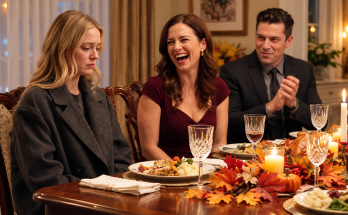
Several weeks later, Emma and Daniel hosted a small dinner at their home. They invited her parents, Aunt Margaret, and Daniel’s mother. The gathering was deliberately simple, with a meal they could prepare together and enough time afterward to sit around the table without rushing. Victoria was not invited. Emma had decided that she wanted this particular evening to remain small, and she did not offer an elaborate explanation.
Her mother accepted the decision without questioning it. Aunt Margaret brought a dessert and helped arrange the plates. Daniel’s mother arrived with flowers, joking that she had brought them because she was forbidden to bring another embarrassing childhood photograph of her son.
The evening unfolded with laughter and easy conversation. Emma noticed how different it felt to welcome people into her home when she was not afraid that every gathering would become a discussion about the past. She could be a host, a wife, a daughter, and a person with her own interests. Her life was not simply a response to what Victoria had done.
After dinner, her father helped Daniel carry the dishes to the kitchen while the others remained at the table. Emma gathered the empty glasses and looked around the room. The photographs on the wall included pictures from her small wedding, a recent walk with Daniel, and a family snapshot from her father’s birthday. She had chosen each image because it represented a moment she wanted to remember, not because it told a perfect story.
Her mother followed her gaze. “You seem more settled,” she said softly.
“I feel more settled,” Emma replied. “Not because everything is fixed. I think I've stopped waiting for everything to be fixed before I allow myself to enjoy my life.”
Her mother’s eyes filled with emotion. “I wish we had understood sooner.”
“So do I.”
“Do you think things will ever be different with Victoria?”
Emma took a moment before answering. She knew her mother was not asking her to make a promise, but the question carried years of hope.
“Maybe,” she said. “We might find a way to have a relationship that works for both of us. Or we might always keep some distance. I don't know. I don't want to decide the rest of my life today.”
Her mother nodded. “That's fair.”
Emma reached across the table and touched her mother’s hand. “I love you. I want you in my life. But I need you to remember that I can't be responsible for making everyone comfortable with the choices I make.”
“I will remember,” her mother said. “And if I forget, you can remind me.”
Emma smiled. “I probably will.”
Later, after the guests had left and the dishes were clean, Emma and Daniel sat together beneath the warm light of the living room lamp. The house was quiet, the holiday decorations glowed softly, and the last of the evening’s tea had grown cold on the coffee table.
Daniel rested his arm along the back of the sofa. “Do you ever think about the wedding now?”
“Yes,” Emma said. “Sometimes.”
“Does it still hurt?”
“Sometimes.”
He waited, allowing her to continue if she wanted.
“But it isn't the only thing I think about anymore,” she said. “I think about our wedding, too. The small one. I think about the way you looked at me when we promised to be honest with each other. I think about the life we've built since then. The first time I cooked dinner without worrying about whether I had enough energy. The day we bought the table. The ridiculous argument about the blankets.”
“You were wrong about the blankets.”
“I was absolutely right.”
He laughed, and she leaned against his shoulder.
“I used to think the chapel was the moment that defined everything,” she continued. “Victoria stood there in my place, and I walked in carrying proof that she had lied. It was the day everyone finally heard the truth. But I don't want that day to define every day that came after it.”
“It doesn't have to.”
“I know. I think I'm finally beginning to believe it.”
Daniel kissed the top of her head. They remained on the sofa for a while, listening to the quiet house. Emma felt no need to declare that she had forgiven Victoria, and she felt no need to declare that she never would. The question had become less urgent because her future no longer depended on finding the perfect answer.
She understood now that forgiveness, if it ever came, would not require her to restore the relationship to its former closeness. It would not require her to forget the lies, dismiss the months of confusion, or accept explanations in place of changed behavior. And if forgiveness never arrived in the form she once imagined, she could still build a meaningful life.
Victoria remained her sister. Their history still contained childhood laughter, shared secrets, and moments of tenderness. It also contained jealousy, deception, and a betrayal that had changed the way Emma understood trust. Neither side of that history had to be erased for Emma to move forward.
She could wish Victoria well without inviting her into every part of her life. She could respond to a respectful message without promising another meeting. She could keep a childhood photograph without pretending that the relationship in it still existed in the same form.
Most importantly, she could stop waiting for someone else to decide when she was allowed to be happy.
The next morning, Emma woke before Daniel and walked into the living room. Pale sunlight filtered through the curtains, falling across the photographs on the wall. She stopped in front of the picture from their small wedding. Her dress had been simple, the gathering intimate, and the moment itself free of the grand spectacle she had once imagined. She remembered the quiet certainty she had felt when Daniel took her hands and promised to build a life with her based on truth.
She had not chosen that wedding to prove that Victoria had lost. She had chosen it because she wanted to marry Daniel, and because both of them had decided that their relationship deserved a future shaped by honesty rather than fear.
Emma touched the edge of the frame, then lowered her hand.
The woman who had entered the chapel carrying hospital papers had been determined to make the world understand what had happened to her. She had needed that moment. Without it, the lie might have continued to define her life.
But the woman standing in the quiet living room now wanted something more than recognition. She wanted a future in which she did not have to keep presenting evidence to justify her boundaries, her feelings, or her decisions. She wanted to love people without surrendering her judgment, to remember the past without living inside it, and to make choices that belonged to her.
Daniel appeared in the doorway, still sleepy, his hair untidy. “What are you doing up so early?”
“Thinking.”
“Dangerous habit.”
She turned and smiled. “I've been told.”
He came to stand beside her, following her gaze toward the photographs. He did not ask whether she was thinking about Victoria or the wedding. He simply slipped his hand into hers.
Outside, the morning continued, indifferent to the old conflict. Cars passed along the street, a neighbor opened a gate, and the world carried on with the quiet insistence of ordinary life.
Emma squeezed Daniel’s hand.
She could not change the past. She could not return the months she had spent recovering, undo the lies that had divided her family, or force the people who had misunderstood her to become wiser overnight. She could not make Victoria into the sister she had once believed she would always have.
But she could decide what happened next.
She could keep the memories that mattered, maintain the boundaries that protected her, and remain open to whatever honest changes the future might bring. She could love without pretending, forgive if and when she was ready, and refuse to confuse peace with silence.
The truth had stopped the wedding that was never supposed to happen. What followed had taught Emma something the wedding itself could not: that reclaiming her life was not a single dramatic act, but a series of decisions made quietly, repeatedly, and on her own terms.
And as she stood beside the man she had chosen, in the home they had built together, Emma finally understood that her sister’s betrayal would always be part of her history—but it no longer had the power to decide the shape of her life.
Click here to continue reading: PART 17: An Ordinary Invitation From Victoria Tests the New Boundaries Between the Sisters and Reveals Whether Respect Can Survive Disappointment
The Bride Was Waiting Behind the Church Doors When She Heard Her Own Sister Promise to Love the Man She Had Left Behind
Part 16 of 20

One Comment on “PART 16 – Emma Finally Understands That Her Sister’s Betrayal Will Always Be Part of Their History, but It No Longer Has to Decide the Shape of Her Life”