STORY TITLE: My Mother-in-Law Cut Off My Wedding Braid in Front of 200 Guests—Then My Husband Invited the One Woman She Feared Most
PART 1 TITLE: Our First Dance Had Barely Begun When My Mother-in-Law Made a Choice That Stopped Two Hundred Guests Cold
The first sign that something was wrong was Nick’s hand tightening around mine.
We had barely begun our first dance when his smile disappeared. One moment, he was looking down at me with the same tenderness that had carried us through seven years together. The next, his attention shifted over my shoulder toward the edge of the dance floor, and his whole body became still.
“Don’t turn around yet,” he murmured.
I almost laughed, thinking he had spotted someone making an embarrassing attempt to join us. Then I felt a light tug at the back of my hair.
It was small enough to mistake for a snag in the fabric of my dress. My braid had been carefully arranged that morning, woven with delicate ivory ribbon and secured beneath a scattering of tiny pearl pins. It rested against my back, reaching almost to my waist. My mother had helped me braid it when I was a child, and even after I grew older, I had kept the tradition for important occasions.
I turned my head.
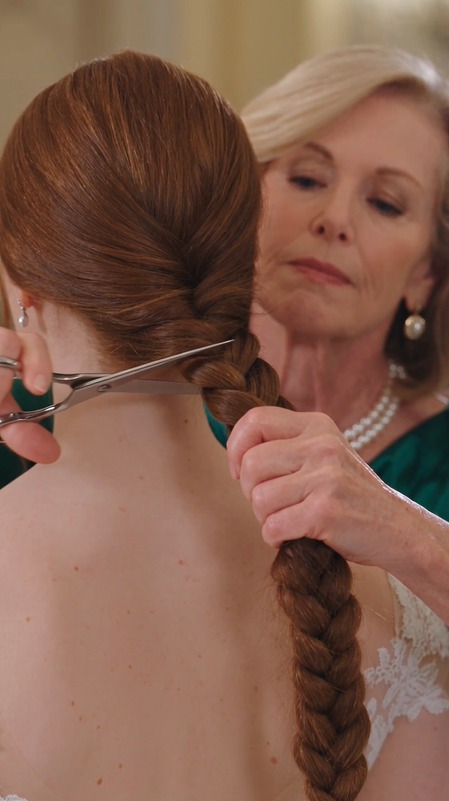
Martha Weston stood behind me, holding a pair of silver sewing scissors.
For a fraction of a second, my mind refused to understand what I was seeing. My mother-in-law wore the pale champagne gown she had chosen weeks earlier, a dress that caught the chandelier light whenever she moved. Her expression was not wild or confused. She looked perfectly composed, as though she had simply stepped forward to correct an imperfection in the decorations.
The scissors were open.
A thick section of my braid lay between their blades.
“Martha?” I said.
She pulled.
The sharp metal closed with a small, unmistakable snip.
I felt the sudden loss of weight before I heard the collective gasp. My braid fell against my shoulder, then slipped through Martha’s fingers and dropped onto the polished floor. Ivory ribbon trailed across the marble beside it.
The orchestra stumbled into silence.
Nick released me so quickly that my hand fell between us. I stared at the severed hair lying near the hem of my wedding dress, unable to make my eyes move anywhere else. Seven years of growing it, caring for it, and imagining how it would look on this day had been reduced to something discarded beneath a pair of expensive shoes.
Then Martha spoke.
“Perhaps now you’ll understand that not everything you bring into this family belongs here.”
Her voice carried farther than she seemed to expect. The nearest tables heard every word. Beyond them, guests turned in their seats, their conversations dying one by one until the entire ballroom became painfully quiet.
I looked at Nick.
His face had changed. The warmth I had seen during our vows was gone, replaced by an expression so controlled that it frightened me more than shouting would have. He looked at the scissors, then at the hair on the floor, and finally at his mother.
“Mum,” he said quietly, “put those down.”
Martha lifted her chin. “Don’t tell me what to do in my own family.”
“Our family?” Nick repeated.
She glanced around the room, apparently noticing for the first time how many people were watching. Her fingers tightened around the scissors. Instead of looking ashamed, she seemed offended that anyone had witnessed what she considered a private correction.
I could hear someone whispering near the nearest table. A chair scraped against the floor. Somewhere behind us, a glass was set down with a trembling clink.
My cheeks burned, but I refused to cry in front of her.
The dress I had spent months choosing suddenly felt too tight around my ribs. I wanted to cover the back of my head with both hands. I wanted to disappear into the quiet corridor beyond the ballroom doors. Most of all, I wanted to know why the woman who had spent our engagement trying to control every detail of our wedding had decided that this was the moment to humiliate me beyond repair.
Martha answered before I could ask.
“You have made a mockery of every tradition this family holds dear,” she announced. “You ignored my advice about the ceremony, the guest list, the flowers, even the seating arrangements. You insisted on doing everything your way. I thought marriage meant joining a family, not forcing everyone to accommodate one person’s stubbornness.”
Her eyes settled on my hair.
“And I will not sit quietly while you turn our name into a joke.”
A strange calm began to spread through me. It was the kind that arrived after shock, when the mind stopped searching for an explanation and started counting the damage.
She had not accidentally caught my braid. She had not mistaken me for someone else. She had walked behind me during my first dance, carrying scissors, and cut my hair in front of two hundred guests because she believed she had the right to punish me.
Nick stepped between us.
“You brought scissors to our wedding?”
Martha’s lips tightened. “I had them in my bag. Don’t be ridiculous.”
“Then why were you standing behind my wife with them?”
“Because somebody needed to make her understand.”
He looked at the severed braid again. “Understand what?”
“That she cannot behave however she likes and expect no consequences.”
I had heard versions of this argument for years. Martha had never needed to raise her voice to make her preferences known. A disapproving pause over dinner, a carefully chosen comparison with Cassandra, a remark about my family being unfamiliar with the Weston way of doing things—she had always found a method of reminding me that I was an outsider.
Cassandra, her best friend’s daughter, had been her preferred choice for Nick since before I met him. Martha spoke of Cassandra’s upbringing as though it were a qualification for marriage and described her connections as if they were family heirlooms. She had never openly said that Nick should leave me for Cassandra. She had not needed to. Every invitation, every pointed question, every little performance of disappointment had carried the same message.
I was not the woman she had chosen.
For seven years, I had tried to be gracious about it. I had told myself that Martha needed time. I had encouraged Nick to maintain his relationship with her, even when it meant swallowing my own hurt. I had attended dinners where Cassandra was praised for accomplishments that would have earned me a lecture about ambition. I had smiled through comments about my mother’s modest home and my father’s ordinary job.
I had believed that love did not require everyone to approve of me.
Standing beneath the ballroom chandeliers, with my hair on the floor, I understood that Martha had mistaken my patience for permission.
Nick crouched and picked up the severed braid. He held it carefully, keeping the ribbon from dragging across the marble. When he stood, he did not look at me with pity. He looked at me as though he was waiting for me to decide what happened next.
That small act nearly broke me.
“I am so sorry,” he whispered.
I shook my head, although I could not have explained whether I meant that he should not apologize or that I could not bear to hear it.
Martha gave a short, disbelieving laugh. “Oh, for heaven’s sake. It’s hair. It grows back.”
Nick turned toward her.
“That’s what you think this is about?”
“What else could it be?”
“It’s about you deciding that you can hurt my wife whenever she refuses to obey you.”
“Your wife,” Martha repeated, emphasizing the words as if they were an accusation. “You have known her for seven years. You still don’t understand what she is doing to you.”
I felt the old instinct rise in me—to explain, to defend myself, to prove that I had not trapped her son or manipulated him into choosing a life she disliked. I had spent too much of our relationship answering accusations that had never been made directly.
This time, I said nothing.
Nick noticed.
He turned toward the guests. Some looked horrified. Others were frozen in the uncomfortable position of people who had witnessed something unforgivable and were waiting for someone else to decide how to react. A few had their phones in their hands, though most lowered them when Nick’s eyes passed over the room.
“I’m sorry you’ve all had to witness this,” he said. His voice was steady, but it carried to the farthest tables. “This was supposed to be a celebration of our marriage. What just happened has nothing to do with tradition, and it will not be excused as a family disagreement.”
Martha’s face tightened.
“Nick, don’t make a scene.”
He looked at her for a long moment.
“You made the scene, Mum.”
A murmur passed through the ballroom.
She took one step toward him. “You will regret speaking to me like that.”
“Maybe,” he replied. “But not as much as I would regret pretending this was acceptable.”
The certainty in his voice startled me. Nick had always been gentle with his mother, even when he disagreed with her. He would challenge her privately, then spend the next day trying to smooth over whatever had gone wrong. I had sometimes worried that his desire to avoid conflict would eventually leave me standing alone in front of it.
Now he stood beside me with two hundred witnesses watching, and he did not move away.
Martha noticed the difference too.
She glanced toward the front tables, searching for a sympathetic face. Her gaze landed on Cassandra, who sat rigidly beside her parents. Cassandra’s mouth was slightly open. She looked neither pleased nor triumphant. If anything, she appeared embarrassed to be associated with the woman who had just cut a bride’s hair in the middle of her wedding reception.
“Martha,” Cassandra said uncertainly, “perhaps you should sit down.”
Martha stared at her as if she had been betrayed.
“Don’t involve yourself.”
Cassandra lowered her eyes.
That was when I understood how much of Martha’s authority depended on everyone around her remaining quiet. She expected loyalty to flow in one direction. People could stand beside her as long as they agreed with her, but the moment they questioned her, they became disobedient too.
Nick placed the severed braid in my hand.
I closed my fingers around it. The hair was heavier than I expected, warm where his palm had held it, and I felt a fresh sting behind my eyes.
“Do you want to leave?” he asked softly.
I looked toward the ballroom doors. My mother stood near the edge of the crowd, one hand pressed against her chest. She had watched me walk down the aisle that afternoon with tears of happiness in her eyes. Now she was staring at the floor as though she might cross the room and pick up every strand herself.
Part of me wanted to run to her and let the evening end. I could imagine the car ride home, the pins scattered across my dressing table, and the silence that would follow when the shock finally wore off.
But I looked at the guests who had come to celebrate us. I thought of our vows, the promises we had made without knowing how thoroughly they would be tested before the cake was cut.
“No,” I said. “I don’t want to leave because she decided I don’t belong here.”
Nick nodded once.
“Then we stay.”
He turned to the nearest member of the venue staff and asked for the scissors to be removed. The young man approached cautiously, but Martha thrust them toward him with an irritated flick of her wrist.
“Take them,” she snapped. “Apparently, everyone has decided I’m the villain.”
The staff member accepted the scissors without answering.
Martha adjusted the bracelet at her wrist and smoothed the front of her gown. The gesture was so ordinary that it made the entire incident feel even more grotesque. She seemed to believe that if she composed herself, everyone else would eventually be forced to follow.
Nick reached into the inside pocket of his jacket and took out his phone.
“What are you doing?” Martha demanded.
“Making a call.”
“To whom?”
He did not answer immediately. His eyes moved toward the far end of the ballroom, where a quiet corridor led to the estate’s private entrance. Then he looked back at his mother.
“There’s someone who should be here for this.”
Martha’s expression changed.
It was not the familiar irritation she wore when a waiter brought the wrong wine or someone questioned her seating plan. The color seemed to drain from her face, and for the first time that evening, she looked genuinely uncertain.
“Who?” she asked.
Nick unlocked his phone.
“The one person you should have hoped would never hear about this.”
PART 2 TITLE: My Husband Made One Call, and the Woman Who Had Terrified Martha for Years Was Finally on Her Way
Martha took a step toward Nick before he could finish dialing.
“Put that phone away.”
He did not even look up.
“Nick, I’m speaking to you.”
“I heard you.”
“Then answer me. Who are you calling?”
He raised the phone to his ear. The silence that followed was brief, but it seemed to stretch across the ballroom. Guests who had been preparing to return to their seats remained standing. The musicians on the balcony had set their instruments down, and the chandeliers hummed faintly above us.
When someone answered, Nick’s voice softened.
“It’s me. I need you at the estate tonight. Now, if you can.”
He listened.
“Yes, it’s happened. And no, I’m not exaggerating.”
Another pause.
“She’s here. You need to see what she’s done for yourself.”
Martha’s hand closed around his forearm.
“End the call.”
Nick gently removed her hand. “I’ll explain when you arrive.”
He listened again, then said, “Thank you. I’ll meet you at the entrance.”
When he lowered the phone, Martha was staring at him with an expression I had never seen before. Her anger remained, but something had opened beneath it—a fear she could not conceal quickly enough.
“You have no right to involve her,” she said.
“Interesting,” Nick replied. “You didn’t seem concerned about rights when you cut my wife’s hair.”
“You don’t know what you’re doing.”
“Then explain it to me.”
She looked around the ballroom. Two hundred people had become an audience she could no longer control, and every second of silence seemed to make her more uncomfortable.
“This is a family matter,” she said at last.
“It’s my marriage.”
“You’re my son.”
“And she’s my wife.”
The words were simple. They did not sound like a threat or a speech prepared for an audience. Nick spoke as though he had finally stopped treating those two relationships as competing obligations.
Martha looked toward Cassandra again, but Cassandra had risen from her chair. She was standing beside her mother now, holding her small evening bag against her waist.
“Perhaps I should go,” Cassandra said quietly.
Martha’s head snapped around. “You will do nothing of the sort.”
Cassandra flinched. Then, after a moment, she straightened.
“I don’t think I should be here for this.”
“You have been invited to my son’s wedding.”
“I was invited to celebrate Nick’s marriage,” Cassandra answered. “Not to watch you punish his wife.”
Martha stared at her, speechless for a moment.
It was the first time Cassandra had openly challenged her in my presence. I had spent years imagining her as a willing participant in Martha’s plans, partly because Martha talked about her so often and partly because I had rarely seen Cassandra disagree. But the young woman standing near the table did not look like someone who had enjoyed being chosen over me. She looked tired, embarrassed, and determined not to make the situation worse.
“You’ve changed,” Martha said.
“No,” Cassandra replied. “I just don’t want to pretend this is normal.”
Her mother took her arm, and the two of them moved away from the table. Martha watched them go, her lips pressed together. For a few seconds, she seemed to consider following them, but she turned back to Nick instead.
“You’re letting strangers think the worst of me.”
“You did that yourself.”
“You have no idea how much I’ve sacrificed for you.”
“I know you raised me. I know you paid for things when I was young. I know you’ve worked hard to make this estate and your name mean something.” Nick’s voice remained even. “None of that gives you ownership of my life.”
Martha’s face reddened.
“You sound just like her.”
Nick’s eyes narrowed slightly. “Like whom?”
She did not answer.
I noticed the hesitation. It was not the first time I had heard Martha refer to another woman as if the name itself were something dangerous. During the months leading up to the wedding, she had occasionally mentioned an old family friend who had supposedly abandoned the Weston family during a difficult period. She had never explained what happened. Whenever Nick asked, Martha changed the subject or accused him of digging up old grievances.
Once, while we were having lunch at the estate, I had noticed an empty place on a shelf in the drawing room. A pale rectangle marked the wall where a framed photograph had once stood. When I asked whether a picture had been moved, Martha had said the room was being redecorated.
I had not thought much about it at the time.
Now, looking at her, I wondered whether the woman Nick had called was the person Martha had spent years trying to keep out of sight.
Nick glanced at me.
“Are you all right?”
I wanted to tell him I was fine. It was the automatic answer I had given for years whenever Martha said something cruel and I did not want to make him choose between confronting her and preserving the peace. But my scalp still ached where the braid had been cut, and my hand was clenched around the severed hair.
“No,” I admitted. “I’m not.”
His expression softened.
“You don’t have to be.”
He lifted a hand toward my head, then stopped before touching me. “Would you like me to find someone who can help with your hair?”
I nodded.
My mother reached us before he could call the stylist. She took my free hand and looked at the back of my head with an expression of grief so naked that I nearly began crying again.
“Oh, sweetheart.”
“I know,” I whispered.
She gently touched the remaining braid. The cut was uneven, leaving a blunt section near my shoulder where the scissors had passed through. Some loose strands had caught in the pearl pins, and one ivory ribbon hung crookedly against my dress.
“Does it hurt?”
“Not really.”
She gave me a look that told me she understood I was answering a different question.
“I should have stopped her,” she said.
“You couldn’t have known she would do that.”
“I knew she could be cruel.”
My mother had never liked Martha. She had been polite at every dinner and careful not to interfere in my relationship, but she had never been fooled by the polished manners or the expensive gifts. She had warned me that a person who made affection feel like a reward could eventually make you afraid of losing it.
I had defended Martha more than once, insisting that she was simply protective of Nick. My mother had accepted my explanation without believing it.
Now she pressed my hand between both of hers.
“You don’t need to make excuses for her anymore.”
I swallowed hard.
Across the room, Nick was speaking to the venue manager. He asked that the ballroom doors remain open and that no one remove the security recordings from the evening. The manager looked surprised by the request, then nodded.
Martha overheard him.
“Security recordings?” she demanded. “What on earth for?”
“Because I want an accurate record of what happened.”
“You’re treating me like a criminal.”
“I’m treating what happened seriously.”
She gave a brittle laugh. “You would rather believe a camera than your own mother?”
“I would rather know the truth than hear another explanation about how everyone else misunderstood you.”
For a moment, I thought she might slap him. Her hand rose slightly, then fell to her side. The guests were watching too closely now, and she knew it.
She turned toward me instead.
“You must be very pleased with yourself.”
I looked at her without answering.
“Seven years,” she continued. “Seven years of slowly turning him against me, and now you’ve finally got the scene you wanted.”
The accusation struck an old, familiar nerve. I could feel the words lining up in my mind: I never asked him to choose. I have always encouraged him to see you. I have tried to make this work.
But none of those explanations mattered. Martha could transform any boundary into an attack and any act of cruelty into a reaction she had been forced to provoke. If I defended myself, she would say I was manipulative. If I stayed silent, she would say I had nothing to deny.
So I asked one question.
“Why did you bring scissors onto the dance floor?”
Her mouth opened, but no answer came.
“Why did you wait until we were dancing?” I continued. “Why didn’t you tell me what was bothering you before the wedding? Why did you decide that cutting my hair in front of everyone was an acceptable way to handle it?”
Martha’s eyes flashed.
“You have no understanding of what that braid represents.”
“Then you could have explained it.”
“You wouldn’t have listened.”
“You never tried.”
She looked at Nick, expecting him to interrupt. He did not.
The silence became unbearable for her.
“You think you’re so innocent,” she said. “You walk into this family and expect everyone to rearrange themselves around you. You want the name, the estate, the privileges—”
“I wanted to marry your son.”
“And now you have.”
“Yes,” I said. “I have.”
For the first time, I saw how little she knew what to do when I refused to argue on her terms.
My mother guided me toward a quiet area beside the ballroom, where the stylist had set up a small station earlier in the evening. The woman hurried over with a brush, pins, and a compact mirror. She examined my hair carefully, asking permission before touching anything.
“We can make it look intentional,” she said gently. “A shorter style, perhaps. Something soft around the face.”
“Can you do that without cutting any more?”
“Of course.”
I sat while she worked. In the mirror, I could see the ballroom behind me, the guests gradually settling into clusters, and Martha standing alone near the center of the dance floor. Her champagne gown still glittered under the lights, but she no longer looked like the hostess of a grand celebration. She looked like a woman waiting for a verdict.
The stylist removed the damaged pins and gathered the uneven strands into a low arrangement. She left the remaining hair loose around my shoulders, using a few pearl clips to hold it in place. It was not the hairstyle I had planned, but it was gentle and elegant. When she turned the mirror toward me, I recognized my face again.
My mother kissed my forehead.
“You’re beautiful.”
I smiled, although my eyes were wet.
“I don’t feel beautiful.”
“You don’t have to feel anything in particular right now.”
That was the first kindness anyone had offered me that evening without asking me to be brave in return.
A few minutes later, the ballroom doors opened.
The room changed before I even saw who had entered. Martha, who had been speaking in a low voice to one of the venue staff, went completely still. Her fingers tightened around the stem of an untouched champagne glass. The glass trembled, and a thin line of liquid slipped over the rim onto her hand.
At the entrance stood an older woman in a dark blue evening suit, her silver hair swept back neatly from her face. She carried no handbag that I could see, and she did not pause to admire the ballroom or acknowledge the guests who had turned toward her.
She looked directly at Nick.
Then her gaze moved to me, to my altered hair, and finally to the severed braid resting on a small linen-covered table near the dance floor.
Her expression grew cold.
“Oh, Martha,” she said. “You have done something very foolish.”
Martha’s champagne glass slipped from her hand and shattered against the marble.
PART 3 TITLE: The Woman Martha Had Tried to Erase Walked Into the Ballroom and Asked for the One Thing No One Expected
Nobody moved to clean up the broken glass.
The older woman crossed the ballroom with measured steps, her shoes making a quiet, regular sound against the marble. She did not hurry, and she did not appear impressed by the number of people watching her. The guests made space without being asked, their curiosity giving way to something closer to respect.
Nick met her halfway.
“Grandmother.”
She touched his cheek, then looked at him with a concern that seemed to make the rest of the room disappear.
“Are you hurt?”
“No.”
“Is your wife?”
Nick glanced toward me. “Not physically.”
The woman followed his gaze. When she reached me, she offered her hand.
“My dear, I’m Eleanor Weston. I’m Nick’s grandmother.”
I had heard her name before, though never in a way that made her sound like someone I might meet. Martha had referred to her as a difficult woman who had become estranged from the family years ago. Nick had once said that he remembered visiting her as a small child, but that his mother had gradually stopped taking him there.
I had assumed the distance was the result of an old disagreement.
Now I wondered what sort of disagreement could make Martha look frightened at the sight of her own son’s grandmother.
Eleanor held my hand for a moment, studying my face with clear, steady eyes.
“I’m sorry we’ve met under these circumstances.”
“Thank you for coming,” I said.
She looked at the shortened hair around my shoulders. “May I ask what happened?”
Before I could answer, Martha stepped forward.
“This is a private family matter, Eleanor.”
Eleanor turned slowly.
“You seem to have forgotten that you made it public.”
A few guests looked down, hiding their reactions. Martha’s cheeks flushed.
“You were not invited to this wedding.”
“Nick invited me just now.”
“You know perfectly well what I mean.”
“I know that you have spent years making sure I was not welcome anywhere you could influence.” Eleanor’s voice remained calm. “But I am here now, and I would like to hear what happened from the people who were involved.”
Martha gave a sharp, dismissive laugh.
“Ask your precious grandson. He’s apparently decided to turn a minor incident into a public trial.”
Eleanor glanced at Nick.
“Was it minor?”
“No.”
“Then let’s not call it that.”
She asked the venue manager to bring a chair and a glass of water for me. When the manager hurried away, she looked around the room and addressed the guests without raising her voice.
“I realize this is an uncomfortable situation. I will not ask anyone to leave, and I will not ask anyone to take sides. But if you witnessed what happened, please don’t allow anyone to persuade you later that you imagined it.”
Martha’s expression hardened.
“You have no authority here.”
Eleanor turned to her. “I have no desire to control this wedding. It belongs to Nick and his wife. But I will not stand by while you humiliate her and then demand that everyone pretend it was nothing.”
The words were not loud, yet they carried through the ballroom with remarkable clarity. Eleanor seemed to understand that she did not need to dominate a room to command attention. She simply refused to be pushed away from the truth.
Nick explained what had happened, starting with the first dance and ending with the severed braid on the table. He did not embellish the details or raise his voice. When he finished, Eleanor looked at Martha.
“Is any part of that account untrue?”
Martha folded her arms.
“She was disrespectful.”
“That wasn’t my question.”
“She has been disrespectful for years.”
“Still not my question.”
Martha looked toward the guests, searching for someone willing to rescue her from the question she had been asked. Nobody stepped forward.
Finally, she said, “I cut her hair. I did it because she needed to understand that she cannot ignore every tradition in this family and expect me to accept it.”
Eleanor closed her eyes briefly.
When she opened them, her expression was more sorrowful than angry.
“You really haven’t learned anything.”
Martha stiffened. “Don’t start.”
“I have spent a long time hoping you would grow beyond this.”
“You abandoned this family.”
“I left because I could no longer live inside a household where every disagreement became a test of loyalty.”
“You walked away from your son.”
“I walked away from you,” Eleanor replied. “I wrote to Nick’s father. I asked to see my grandson. I sent birthday cards and letters. You returned some of them unopened.”
Martha’s face changed, but she recovered quickly.
“That is your version.”
“Then we can discuss the letters another day. Tonight is about what you did to this bride.”
I sat very still. Eleanor had mentioned something I had never heard from Nick. He looked as surprised as I felt.
“Mother told me you stopped writing,” he said.
Eleanor turned toward him.
“I was told you didn’t want to see me. I didn’t believe it, but I had no way to reach you without turning every visit into another fight. I should have tried harder.”
Nick looked down at the floor. For a moment, the anger left his face, replaced by the hurt of a child who had grown up believing someone he loved had chosen to disappear.
Martha seized the opening.
“Don’t let her rewrite history. She has always wanted to make me look cruel.”
Eleanor nodded once.
“You are right about one thing. We have a history, and it is complicated. But that doesn’t change what you did tonight.”
She walked toward the small table where the braid lay. She did not touch it immediately. Instead, she looked at me.
“May I?”
I nodded.
Eleanor lifted the braid carefully, gathering the ivory ribbon in her palm. She examined the cut end, where the strands had been severed unevenly, then turned the ribbon between her fingers.
“Did you choose this ribbon?” she asked.
“My mother and I chose it together.”
“Was there a reason you wanted your hair braided?”
I took a breath. “My mother used to braid it for special occasions when I was little. I wanted something familiar with me today. Something that reminded me of home.”
Eleanor’s face softened.
“Then it was never just hair.”
“No.”
She placed the braid back on the linen.
Martha scoffed. “This is becoming absurd. People wear flowers in their hair. People cut their hair. It’s not a sacred relic.”
Eleanor turned toward her.
“You are still talking about the hair as though the hair is the problem.”
“Because it is hair!”
“No, Martha. The problem is that you believed you could take something from another person to prove that you had power over her.”
For once, Martha had no immediate answer.
Eleanor asked the manager whether anyone had recorded the first dance. Several guests raised their hands. One woman near the dance floor said she had taken a short video when the music began. Another guest admitted that her phone had captured the moment Martha stepped behind me.
Martha looked around in disbelief.
“You were all filming?”
“Not all of us,” the woman answered. “But some of us were.”
“I expect those recordings to be deleted.”
Eleanor’s eyebrows rose. “You expect a great many things.”
Nick stepped forward. “Nobody is being asked to post anything. But no one is going to be pressured into destroying what they saw.”
Martha turned on him.
“You’re letting strangers collect evidence against your own mother.”
“No one needs to collect evidence against you. We all watched you do it.”
The truth of that statement seemed to settle over the room. There was no mysterious accusation to investigate, no misunderstanding that could be cleared up with a carefully chosen explanation. Martha had acted in front of two hundred people. The question was whether everyone would now be expected to pretend that the act meant nothing.
Eleanor looked toward the musicians’ balcony.
“Would you mind giving us a moment before you resume?”
The orchestra leader nodded.
Eleanor then turned back to Martha.
“Why did you do it?”
Martha’s eyes flashed with anger. “I have already explained.”
“You gave us an excuse. I’m asking for the reason.”
“I wanted her to understand what it means to join this family.”
“By cutting her hair?”
“By making her understand that she cannot do whatever she wants.”
Eleanor looked at Nick, then at me.
“And what did you want her to do?”
Martha seemed offended by the question. “Show some respect.”
“What would respect have looked like to you?”
“She should have listened to me about the wedding.”
“Which decision?”
Martha hesitated.
Eleanor continued, gently but firmly. “The flowers? The music? The seating? The dress? The guest list? Tell us what she did that justified this.”
Martha’s jaw worked. She looked as though she wanted to list every slight she had collected over seven years, but the smallness of those grievances seemed to trouble her when she had to choose one in front of everyone.
“She refused to consider Cassandra,” she said at last.
Cassandra, who had remained near the tables with her parents, lifted her head.
Eleanor did not look away from Martha. “Consider her for what?”
“As Nick’s wife.”
The words landed with a new kind of silence.
Nick let out a slow breath.
“Cassandra is my friend. I never wanted to marry her.”
“You barely gave her a chance.”
“I gave her friendship. I gave her honesty. I never promised her anything else.”
“You would have been happier with someone who understood this family.”
“I am happy with my wife.”
Martha looked at me with naked contempt.
“She has no idea what she’s getting into.”
“Then perhaps you should have spent more time welcoming her and less time trying to frighten her away,” Eleanor said.
I looked at Cassandra. She seemed mortified by the direction the conversation had taken. When Martha said her name again, she finally stepped forward.
“Please don’t use me as an excuse,” Cassandra said. “I never asked Nick to marry me. I never wanted him to leave her.”
Martha stared at her.
“You know how much I wanted this.”
“I know how much you wanted to decide it for him.”
Cassandra’s voice shook, but she continued. “You’ve compared us for years. Every time Nick spoke about her, you asked what I would have done differently. It made me feel as though I was being used to punish someone I barely knew.”
Martha looked wounded, as though Cassandra’s honesty were a more terrible betrayal than the act that had brought Eleanor to the ballroom.
“You were supposed to be on my side.”
“I was supposed to be myself.”
Nick reached for my hand again. I took it, feeling the warmth of his fingers around mine. My anger had not disappeared, but it had changed. For the first time, the story Martha had told about our relationship was being challenged by people who had no reason to protect her version.
Eleanor returned to the center of the room.
“I didn’t come here to punish you, Martha,” she said. “Nick called because he needed someone who would not tell him to ignore what happened. I am here because he asked me to be here, and because this young woman deserves to have her wedding treated with dignity.”
Martha’s eyes narrowed.
“You always did enjoy making yourself look virtuous.”
“No,” Eleanor replied. “I learned that being quiet to preserve appearances can be another way of helping the person doing harm.”
The words seemed to reach beyond the ballroom, into years of old arguments and unspoken resentment.
Then Eleanor looked at Nick.
“There is something else you should know about why I stayed away.”
Martha went pale.
“Don’t,” she whispered.
Eleanor’s gaze remained on her grandson.
“Your mother told you I left because I disapproved of your father. That was not the whole truth.”
Nick’s fingers tightened around mine.
“What did she leave out?”
Eleanor drew a slow breath.
“That I tried to tell your father what was happening in this family, and I was told to stay silent for the sake of its reputation. When I refused, I was shut out. And when I tried to reach you, I was told that you did not want me in your life.”
Nick stared at her.
“Who told you that?”
Eleanor looked directly at Martha.
“Your mother.”
PART 4 TITLE: By the End of the Night, Martha Had Lost the One Thing She Valued More Than Her Reputation
For several seconds, Nick said nothing.
The ballroom seemed to have become too large for the three of us. Guests stood in scattered groups beneath the chandeliers, while the broken glass near the dance floor caught the light. Martha had gone very still, her face drained of the practiced confidence she had worn throughout the evening.
Nick finally turned toward her.
“Did you tell Grandmother I didn’t want to see her?”
Martha’s lips parted. She looked at Eleanor, then at the guests, and finally at her son.
“You were a child. You wouldn’t have understood.”
“That isn’t an answer.”
“I was trying to protect you.”
“From what?”
“From being dragged into a dispute between adults.”
Nick’s voice remained quiet. “You told me she had stopped caring about me.”
“I never said that.”
“You said she had chosen to leave us.”
Eleanor lowered her eyes. She did not interrupt or rush to defend herself. The restraint made the moment more painful than an argument would have been.
Martha drew herself upright.
“I was under tremendous pressure at the time. Your father and I were having difficulties. The estate was in trouble. Everyone had an opinion about how I should raise you. I made decisions I believed were necessary.”
“And you never reconsidered them?”
She looked away.
Nick released my hand, not to approach his mother but to create a little space between them.
“You made me believe my grandmother had abandoned me. You kept her away because you didn’t want her challenging you. And tonight, when my wife refused to let you control our wedding, you cut off her hair in front of everyone.”
Martha’s eyes filled, though whether with regret or humiliation, I could not tell.
“You’re making me sound monstrous.”
“No,” Nick said. “I’m describing what happened.”
The distinction seemed to hurt her more than any insult could have. She had spent years arguing about intentions, feelings, and the unfairness of being misunderstood. Nick was no longer debating what she meant to do. He was looking at what she had actually done.
Eleanor stepped closer to him.
“You don’t have to settle every old question tonight,” she said. “There will be time to look at the letters, talk about the past, and decide what relationship you want with me. You are allowed to feel angry. You are allowed to need time.”
Nick swallowed.
“I would have visited you.”
“I know.”
“I thought you didn’t want me there.”
Eleanor’s eyes glistened. “I thought the same thing about you.”
They stood facing each other, separated by years of misunderstandings that had never been given the chance to become conversations. Then Nick reached for her hand. Eleanor held it tightly, and for a moment, the ballroom witnessed a reunion that had nothing to do with wealth, status, or the grand estate surrounding us.
Martha watched them as if she had become a stranger at her own family’s table.
I felt a sudden ache for the years they had lost. I also felt angry that the truth had emerged only after another person had been humiliated in public. It would have been easy to let Eleanor’s arrival turn the evening into a story about Martha’s past, but I did not want my own injury to disappear beneath it.
I touched Nick’s arm.
“I need to say something.”
He turned toward me immediately.
“Of course.”
I looked at Martha. My voice trembled at first, so I paused and tried again.
“I know you didn’t want me to marry Nick. You’ve made that clear for years. I tried to believe that if I was patient and respectful, we might eventually find a way to be family.”
Martha pressed her lips together.
“I never expected you to agree with every decision I made. I didn’t expect you to love every part of me. I only wanted to be treated like a person who deserved basic respect.”
I glanced at the braid on the table.
“My hair mattered to me because it was connected to my mother and to memories I wanted to carry into my marriage. You didn’t ask what it meant. You didn’t ask why I chose it. You decided that hurting me would teach me a lesson.”
Martha shook her head. “I didn’t think you would take it so dramatically.”
“That is part of the problem,” I replied. “You keep deciding how much something should hurt me, and then you use your own judgment to tell me whether I am allowed to feel it.”
She looked away.
“I cannot change what happened tonight. I cannot make you regret it. But I will not spend the rest of my marriage trying to earn permission to belong in it.”
Nick moved beside me, his shoulder touching mine.
Martha looked at him. “So this is it? You’re choosing her over your mother?”
Nick’s expression tightened.
“I am choosing to protect my marriage. That isn’t the same as abandoning you.”
“It certainly looks that way.”
“You can be part of our lives if you respect our boundaries. You cannot use your place as my mother to control my wife, humiliate her, or punish her when she disagrees with you.”
“And if I don’t accept that?”
“Then we’ll have distance between us.”
The words were not spoken in anger. Nick sounded heartbroken, and that made them more convincing. He was not trying to win the argument or make his mother suffer. He was telling her what he would no longer allow.
Martha glanced toward the tables, where guests were quietly gathering their belongings. Some approached us to offer their support. Others simply nodded before leaving, unwilling to turn the evening into a spectacle. A few stayed back, perhaps hoping to see whether Martha would apologize.
She did not.
Instead, she lifted her chin and said, “I hope you both understand what you’re doing.”
“I do,” Nick replied.
For the first time since the scissors had closed, I believed him.
Eleanor asked the venue manager to make arrangements for anyone who wished to leave safely and quietly. She did not order Martha out or demand that the guests condemn her. She refused to transform the room into a court where she would serve as judge. The facts were already visible, and each person would decide what they could live with afterward.
When the manager approached to ask whether the reception should continue, Nick looked at me.
“Do you want to go home?”
I thought about the wedding dress I had imagined wearing, the photographs we had planned to take, and the first dance we had barely begun. I thought about the way my mother had looked at me when my hair fell to the floor. For a moment, I wanted to end the evening before anything else could be taken from us.
Then I looked at the musicians, still waiting on the balcony, and the tables set for a celebration that had not yet had the chance to become ours.
“I don’t want to pretend tonight was fine,” I said. “But I don’t want her to be the reason we leave either.”
Nick nodded.
“Then we decide what happens next.”
We agreed to give the guests the option of staying for dinner, without speeches or formalities. The venue staff cleared the broken glass and replaced the damaged table setting. The musicians resumed with a gentle instrumental piece, not the song we had chosen for our first dance but something quiet enough to let people talk without raising their voices.
My mother sat beside me while the stylist made one final adjustment to my hair. When I looked in the mirror, I could still see the unevenness where the braid had been cut, but the style was neat. It looked like a choice rather than an injury, even though I knew the difference.
“You don’t have to keep smiling,” my mother whispered.
“I know.”
“And you don’t have to forgive anyone tonight.”
“I know that too.”
She kissed my cheek. “Good.”
Eleanor came to sit with us. She asked whether I wanted the braid returned to me, and I said yes. She had placed it in a clean box lined with tissue, keeping the ribbon carefully arranged beside it.
“I don’t know what you’ll want to do with it,” she said. “You don’t need to decide now.”
I rested the box beside my chair.
“Thank you for coming.”
“I wish Nick had never needed to call me for this reason.”
“So do I.”
She looked toward the far end of the room, where Nick was speaking to his grandmother about the letters she had mentioned. His posture had relaxed slightly, but his face still carried the shock of learning that a part of his childhood had been shaped by a story that was not entirely true.
“He has a good heart,” Eleanor said.
“He does.”
“And you have been patient with this family.”
I did not know how to answer. I had spent so long treating patience as proof that I deserved to stay that I was no longer sure whether it had helped me or harmed me.
Eleanor seemed to understand.
“Patience is a virtue,” she said, “but it should never be the price of being treated decently.”
Across the room, Cassandra approached us. She stopped a respectful distance from the table, her hands clasped in front of her.
“I owe you an apology,” she said.
I looked at her, surprised.
“For what?”
“For not speaking sooner. I knew Martha was comparing us, and I knew she hoped Nick would change his mind. I told myself it wasn’t my responsibility because I hadn’t asked for any of it. But I could have made it clearer that I didn’t want to be part of the comparison.”
“You didn’t cut my hair,” I said.
“No. But I let her talk as though I was waiting for you to fail.”
Cassandra’s eyes were tired. She did not ask me to absolve her or insist that I understand how difficult her own position had been.
“I don’t want to be used against you,” she said. “And I don’t want to be used against Nick either.”
“Then don’t let anyone make that decision for you.”
She nodded, visibly relieved that I had not turned the moment into another confrontation. After a brief pause, she offered her congratulations.
“I hope your marriage is a happy one.”
“Thank you,” I replied. “I hope you find a life that belongs to you, too.”
Cassandra returned to her parents, and I watched her go with a strange sense of relief. The competition Martha had tried to create between us had never needed to exist. It had been useful to her because it kept everyone looking sideways at one another instead of questioning why she believed she should decide who was worthy of belonging.
Later that evening, Nick and I stood together in the emptying ballroom. The candles had burned lower, and the white peonies on the tables were beginning to droop. The estate no longer looked like the perfect setting for a fairy tale. It looked like a real place where real people had hurt one another, made difficult choices, and discovered truths they could no longer ignore.
Nick held out his hand.
“May I have the dance we didn’t finish?”
I looked at him, then at the space where the first dance had begun.
“Yes.”
He drew me close, careful not to touch the back of my head until I rested against him. The musicians played softly, and we moved slowly across the marble floor. My shortened hair brushed his sleeve. The place where the braid had been felt unfamiliar, but his hand was steady against mine.
“I’m sorry,” he whispered again.
“I know.”
“I should have challenged her sooner.”
“You challenged her tonight.”
“After she hurt you.”
I lifted my head enough to meet his eyes.
“Then don’t let tonight become another memory we explain away. Don’t tell yourself it was a bad moment and everything can return to normal tomorrow.”
“I won’t.”
“I don’t need you to hate your mother. I need you to understand that loving her doesn’t mean allowing her to hurt me.”
He held my gaze.
“I understand.”
I believed he wanted to understand. Whether he could sustain that choice over the years ahead would be proven by what he did, not by what he promised beneath the chandeliers. But for the first time, I did not feel responsible for making that choice easy for him.
When the music ended, Nick kissed my forehead.
We did not return to the dance floor for another performance. We did not ask the guests to applaud us or pretend that the evening had unfolded as planned. We simply stood together until the last notes faded, then walked toward the entrance with my mother and Eleanor beside us.
Martha was still in the ballroom when we passed the doors. She stood alone near the table where the braid had been displayed, her champagne gown immaculate, her expression unreadable.
She did not apologize.
I did not ask her to.
For years, I had believed that if I could find the right words, show enough patience, and prove that I loved Nick sincerely, Martha might eventually welcome me. That night, I finally understood that her approval was not the missing piece of my marriage. It was something she had used to keep me reaching for her permission.
I was done reaching.
The following morning, Nick and I would begin the practical work of deciding what contact with Martha would look like, how we would protect our home from interference, and what kind of relationship we might eventually build with Eleanor. There would be difficult conversations and consequences that could not be settled in one night. The past would not disappear simply because the truth had been spoken aloud.
But one thing had changed beyond repair.
Martha could no longer tell us that nothing had happened. Two hundred guests had seen her act. Her own granddaughter-in-spirit had refused to defend her. Her son had chosen to protect his wife without pretending that the choice required him to erase his mother from his life. And the woman Martha had tried to keep away had returned, not to seize control of the family, but to stand beside the people who needed someone willing to tell the truth.
As we stepped outside, the night air touched my face. I held the small box containing my braid close to my chest. I did not know whether I would keep it forever or eventually let it go. For now, it was a reminder of what had been taken and of what remained mine to decide.
Nick opened the car door for me, then paused.
“Are you ready to go home?”
I looked back once at the illuminated estate. The ballroom windows glowed behind the ivy, and the last guests were making their way toward the waiting cars. The wedding had not ended the way I had imagined. Some memories would always carry pain, and the sight of scissors might make my stomach tighten for a long time.
But I had married the man I loved. I had spoken honestly without begging to be believed. And when someone tried to make me feel powerless, I had discovered that I did not have to accept the role she had chosen for me.
“Yes,” I said. “Let’s go home.”
Nick took my hand, and we left together.
END PART 4
Continue the SAME rewrite in this SAME conversation with Parts 5–8 only. Maintain exact continuity from Part 4, including the same original story title, characters, relationships, timeline, established details, clues, and planned ending. Write 1,800–2,500 words and 22–40 substantial paragraphs per part. Use PART 5 TITLE: through END PART 8 markers. Do not repeat STORY TITLE. Do not restart, summarize, change the story, or add explanations.