
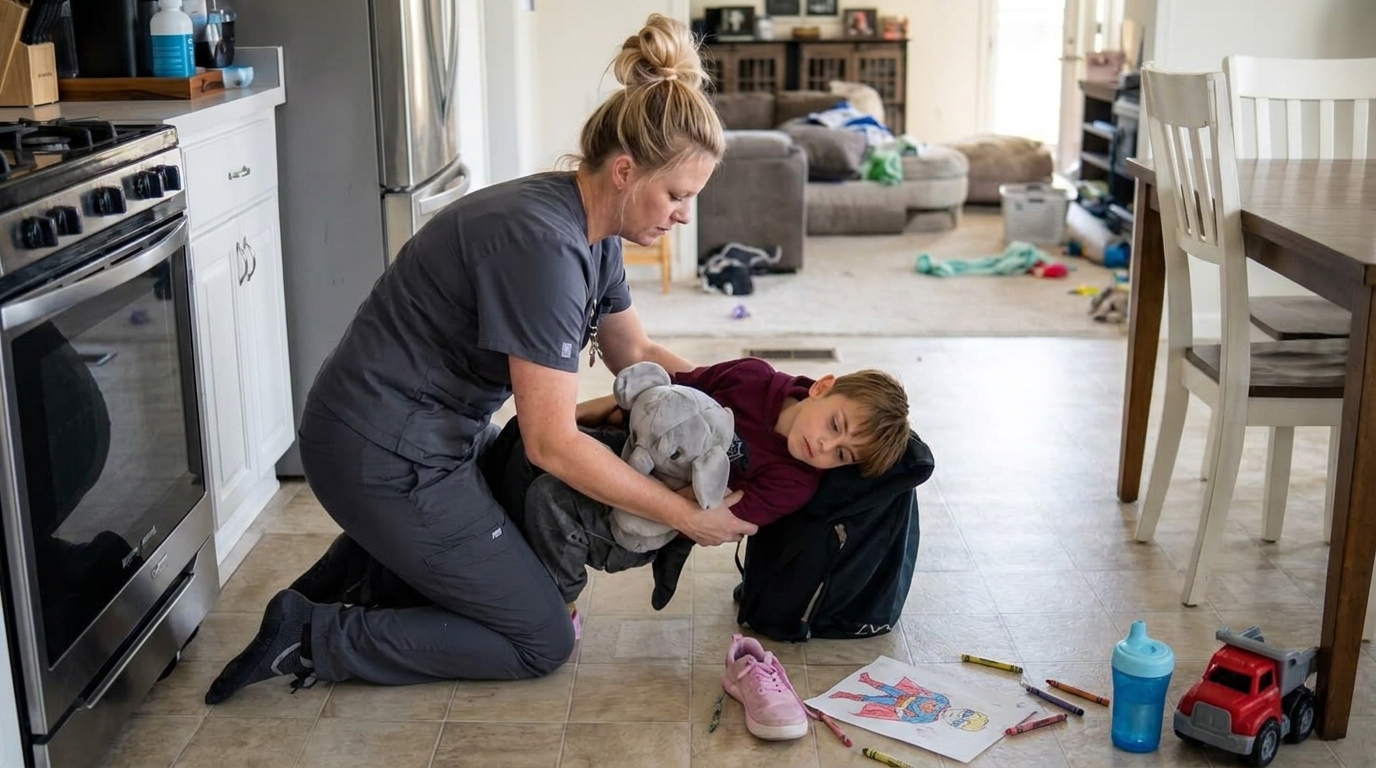
After Celina told me about the altered schedule, I barely slept. I kept replaying the morning in my mind, but this time I wasn't imagining what I had seen upstairs. I was reconstructing what had happened downstairs.
Gideon had expected another forty-six minutes.
He had planned around my absence.
That meant Roger hadn't been accidentally forgotten.
He had been part of the timing.
I called my attorney first thing in the morning.
“There is additional information,” I said.
I explained what Celina had told me.
My attorney listened carefully.
“Can she confirm it in writing?”
“Yes.”
“Have her do that.”
Celina provided a statement that afternoon.
She explained that Gideon had repeatedly told her when I was expected home. He had instructed her not to arrive before certain times. He had told her that Roger would be asleep or downstairs and that there would be no problem because I worked until morning.
Then she described the night I found them.
Gideon had told her I would not return until seven.
At some point after five, Roger had woken.
Gideon told him to stay downstairs.
He promised he would come back.
He didn't.
Instead, he went upstairs with Celina.
That was the part I couldn't stop thinking about.
Roger had trusted him.
He had waited because his father told him to.
And Gideon had known exactly where he was.
My attorney added Celina's statement to the case file.
The next hearing was scheduled quickly.
This time, Gideon's attorney attempted to argue that Celina was unreliable because she had participated in the affair.
My attorney didn't deny that.
She simply pointed out that unreliability did not automatically make every statement false, especially where independent records supported the timeline.
The hospital system had my shift schedule.
The time I clocked out.
The route home.
The messages between Gideon and Celina.
The phone records.
The photographs I had taken that morning.
The evidence connected.
The story no longer depended on Celina alone.
Gideon had created a trail without realizing how much of it he was leaving behind.
Then something unexpected happened.
My attorney discovered that Gideon had contacted the hospital several months earlier.
He had asked general questions about my schedule.
Not directly through my department.
Through an administrative channel.
He had wanted to know whether my shifts were predictable.
The hospital couldn't disclose confidential information beyond what policy allowed, but the inquiry itself had been recorded.
My attorney looked at me.
“This is significant.”
I felt sick.
“He was tracking my schedule.”
“It appears so.”
I remembered all the nights Gideon had casually asked when I would be home.
At the time, I thought he was making dinner plans.
Now I heard the questions differently.
“What time do you leave tomorrow?”
“Are you working Friday?”
“Are you sure you're not coming home early?”
They had sounded ordinary.
They weren't.
The court reviewed the information.
Gideon's attorney argued that the inquiry could have been innocent.
Perhaps.
But the inquiry appeared alongside the messages.
Alongside the affair.
Alongside the custody discussions.
Alongside the financial transfers.
Together, the pieces formed a pattern too coherent to dismiss.
During the next hearing, the judge asked Gideon whether he had ever instructed Roger to remain downstairs while he was upstairs with Celina.
Gideon initially said no.
Then the messages were shown.
His answer changed.
“I may have said something like that.”
“Did you know the child was alone?”
“I believed he was safe.”
“Did you check on him?”
“No.”
“Why not?”
Gideon looked toward his attorney.
The judge waited.
Finally, Gideon said, “I made a bad decision.”
The words were quiet.
But they were the closest he had come to admitting what happened.
I didn't feel relieved.
A bad decision sounded too small.
A bad decision was forgetting an appointment.
A bad decision was taking the wrong turn.
What Gideon had done involved choices repeated over months.
Still, the admission mattered.
The court ordered that Roger's primary residence remain with me.
Gideon would have structured visitation.
The financial division would proceed separately.
The house could not be sold without agreement or court authorization.
The custody battle that Gideon had prepared for had effectively collapsed.
But there was still one thing I needed to understand.
Why had he been so certain that I would never discover the affair?
Celina had the answer.
“He thought you trusted him completely.”
She told me this during a meeting arranged through our attorneys.
We sat across from each other in a quiet office.
“He said you were too tired to question anything.”
I looked at her.
“He said that?”
“Yes.”
“What else?”
“He said you were always exhausted after work.”
I closed my eyes.
“He used my exhaustion as protection.”
Celina nodded.
“He said you'd come home, take care of Roger, sleep, and go back to work.”
I stared at the floor.
It was painfully accurate.
He had understood my routine.
He had counted on it.
Then Celina said something that changed my understanding again.
“He also thought you wouldn't look at the guest room.”
“Why?”
“Because he kept the door closed.”
I almost laughed.
Not because it was funny.
Because the smallest details had protected him for months.
The closed door.
The predictable schedule.
The late-night shifts.
The financial transfers made in small amounts.
The custody research done quietly.
Every piece had been designed to avoid attracting attention.
And then one morning, I came home forty-six minutes earlier than expected.
That was all it took.
Not a detective.
Not a confession.
Not a dramatic confrontation.
Just one ordinary change in a work schedule.
After the hearing, I went home for the first time in weeks.
The house felt unfamiliar.
The kitchen was exactly as I remembered it.
The floor where I had found Roger had been cleaned, but I could still picture him there.
I stood in the doorway for a long time.
Then I walked upstairs.
The guest room was empty.
Gideon's boxes were gone.
There was a small indentation in the carpet where the bed frame had been.
I sat on the edge of the mattress.
The room no longer felt like evidence.
It felt like a place where something irreversible had happened.
My phone buzzed.
A message from Gideon.
I want to see Roger.
I replied:
Your scheduled visitation is Saturday.
He answered:
I miss him.
I stared at those words.
For months, I had wanted Gideon to understand what he had done.
Now I realized understanding wasn't something I could force.
He would have to live with it.
I put the phone down.
That evening, Roger and I returned to the house together.
He stood in the kitchen and looked around.
“Are we staying here?”
“For now.”
“Is Daddy coming back?”
“No.”
He nodded.
Then he pointed at the floor.
“That's where I slept.”
I crouched beside him.
“Yes.”
He looked at me.
“Can we put a rug there?”
I smiled despite myself.
“Yes.”
“What color?”
“You choose.”
He thought seriously.
“Blue.”
“Blue it is.”
We went to the store the next day.
It was such a small thing.
A rug.
A child's choice.
A patch of floor that needed to become ordinary again.
But when we placed it in the kitchen, Roger stood on it and smiled.
The house still held painful memories.
But it was beginning to hold something else too.
Our life after the truth.
Click Here to continue read next: PART7: The Final Court Decision Took Away Gideon’s Leverage, but It Was Roger’s Small Question That Forced Me to Face What Healing Would Really Require
The Cold Floor Told Me Something Was Wrong Long Before My Husband Ever Had the Chance to Explain Himself
Part 6 of 8

