
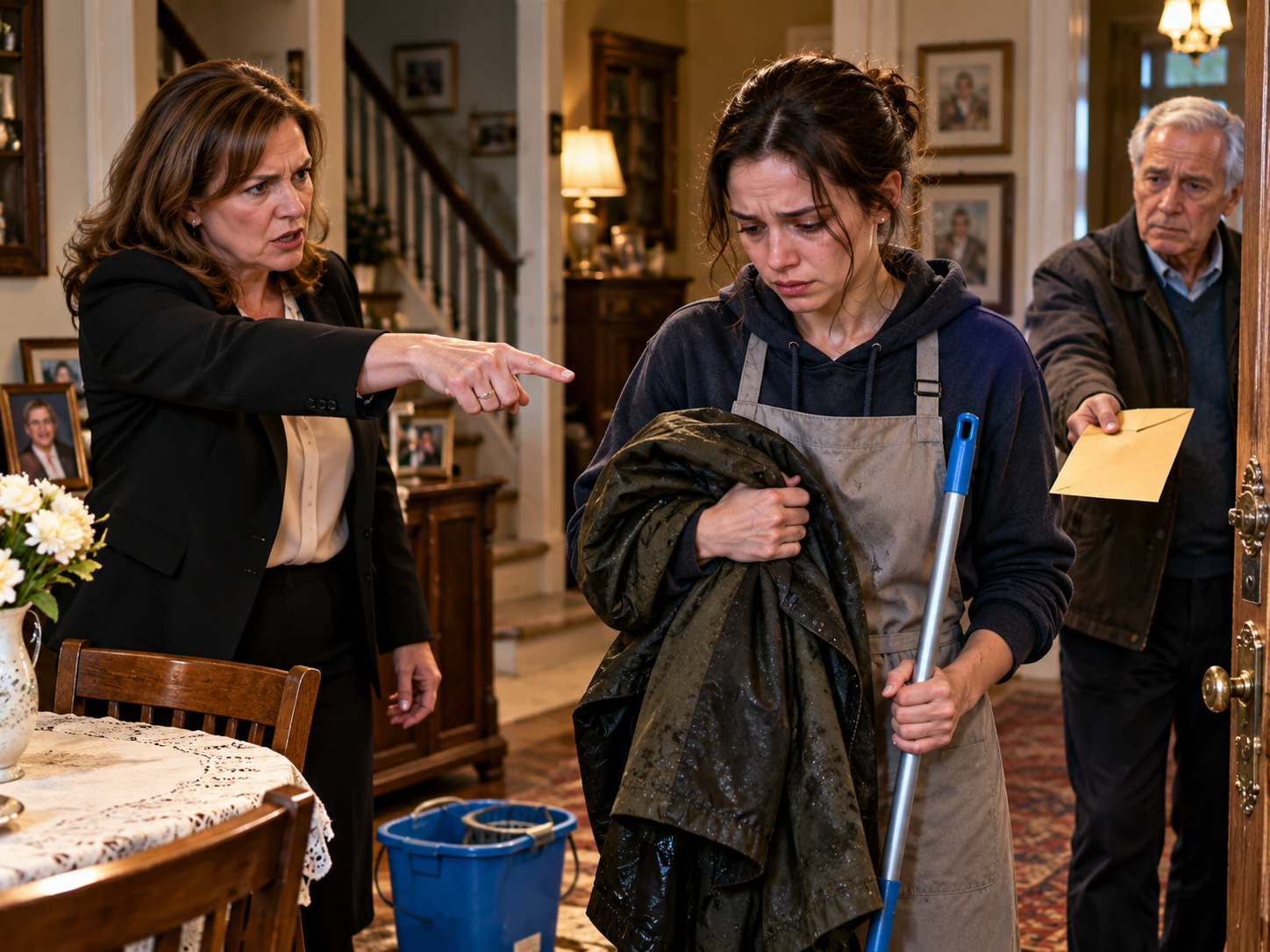
The next morning, Mrs. Voss asked me not to come back.
Not because she was angry.
Because she was frightened.
“You should stay away from this house,” she said.
I stood on the porch with my backpack over one shoulder.
“You hired me for seven months.”
“I didn't.”
“I know.”
She looked at me.
“I am sorry.”
“You don't have to apologize for someone else's decision.”
“I should have told you sooner.”
“Yes.”
She nodded.
That simple agreement hurt more than an excuse would have.
I returned to my apartment and spent the day looking through everything I had been given.
The photograph.
The letters.
The notebook.
The copy of the ledger.
My mother's handwriting appeared repeatedly.
She had not been hiding from me.
She had been trying to protect me.
That distinction became clearer when I found a letter addressed to my mother.
It had been written by Lucan.
He said he had discovered that people were using names without permission.
He described payments that did not belong to the people receiving them.
He said his father knew more than he admitted.
And then came the sentence that changed everything.
“I don't think the house is safe anymore.”
I read it three times.
Then I called Helen.
She answered immediately.
“I wondered when you'd call.”
“What happened to Lucan?”
“He disappeared.”
“Did he die?”
“No one knows.”
“What about my mother?”
“She helped him.”
“With what?”
“Records.”
Helen told me that Lucan had discovered a financial scheme involving false identities, forged signatures, and payments routed through accounts that appeared legitimate from the outside.
My mother had helped him copy documents.
When the people involved realized what was happening, Lucan vanished.
My mother was frightened.
She took me to Mrs. Voss's house because she believed the family would protect us.
Instead, Mrs. Voss's husband told everyone that Lucan had betrayed the family and left.
Years later, my mother died.
But she had never stopped believing the truth would eventually surface.
The cleaning advertisement had been posted by Helen.
She had found my name through an old contact and recognized the connection.
She had needed a reason to bring me into the house without alerting the people who had been watching it.
The twenty dollars was real.
The job was real.
But the reason behind it was not.
Mrs. Voss had been waiting for me.
And Lucan had left evidence for me.
The evidence eventually reached investigators.
The old ledgers matched financial records that had never been explained.
The names in the notebooks matched people who had spent years trying to recover money taken from them.
The documents did not prove every rumor.
They did prove enough.
Several accounts had been manipulated.
Property records had been altered.
Payments had been concealed.
And Mrs. Voss's children had known the house contained documents that could expose the history.
That explained the property offer.
They did not simply want the house.
They wanted control of everything inside it.
Calder was the first to be questioned.
He denied knowing anything.
Sabine claimed her mother was confused.
Bram insisted the papers were meaningless.
Then investigators found the correspondence between their father and Lucan.
The story changed.
The family admitted Lucan had confronted his father years earlier.
They admitted he had discovered the financial scheme.
They admitted they had tried to persuade him to stay quiet.
But they still denied knowing where he had gone.
No body was ever found.
No grave was located.
No final answer came.
That uncertainty remained the one wound no document could close.
Mrs. Voss struggled with it.
“I spent thirty years believing I had lost my son because he made a terrible choice,” she told me.
“You don't know that.”
“No.”
“You don't have to believe the worst thing simply because someone told you to.”
She looked toward the blue door.
“I should have opened it years ago.”
“You were afraid.”
“Yes.”
“So was everyone else.”
The investigation also established something else.
The family had not been the only people who knew about the records.
Someone had kept track of Mrs. Voss's house.
Someone had watched who came and went.
That person was never identified with certainty.
But after the documents became public, the surveillance stopped.
For the first time in years, Mrs. Voss could sit beside her front window without checking every passing car.
She decided not to sell the house.
Instead, she placed it into a protected legal arrangement so none of her children could pressure her into transferring it.
The blue door remained.
But it was no longer locked.
One Saturday morning, I helped her clean the room.
We opened every box.
Some contained old photographs.
Others held letters.
There were photographs of Lucan as a child, Lucan at seventeen, Lucan beside his mother, Lucan standing in the printing shop.
Mrs. Voss touched each picture carefully.
“I kept thinking I needed to know exactly what happened before I could love him without guilt.”
I looked at her.
“You never stopped loving him.”
She smiled sadly.
“No.”
“You just stopped trusting your own memories.”
She considered that.
“Yes.”
The last thing we found was a small envelope hidden beneath the lining of the suitcase.
My name was written across it.
Merrick.
Inside was a note from my mother.
She had written it shortly before she died.
She said she was sorry that I had grown up believing she had been unable to protect me.
She said she had tried.
She also wrote that if I ever reached the Voss house, I should not look for revenge.
“Look for the truth,” she had written.
That was all.
I folded the note and held it against my chest.
Mrs. Voss sat beside me.
“She knew you would come.”
“I don't know how.”
“Neither do I.”
Outside, someone was mowing a lawn.
A dog barked.
A bus passed at the end of the street.
Ordinary sounds.
The kind of sounds I had once believed belonged to other people's lives.
Mrs. Voss reached for my hand.
“You never got your twenty dollars.”
I laughed.
“No.”
“I owe you more than that.”
“You don't owe me anything.”
She shook her head.
“I owe you the truth.”
She eventually paid every dollar she owed me.
Then she added the grocery money I had spent during those first weeks.
I tried to refuse.
She wouldn't let me.
“Your kindness should not have to make you poor,” she said.
I kept the first twenty-dollar bill in a drawer.
Not because of its value.
Because seven months earlier, I had believed I was walking into that house to clean floors for twenty dollars.
I had actually walked into a story that began before I was born.
I never learned exactly what happened to Lucan.
There were theories.
There were records.
There were people who claimed to know.
But no one could give Mrs. Voss the one thing she wanted most: certainty.
So we stopped pretending certainty was necessary before grief could begin.
Mrs. Voss continued living in the house.
She kept the photographs.
She kept the blue door open.
She planted new flowers along the porch.
Her children eventually stopped visiting.
Sabine sent one letter.
Calder sent none.
Bram never apologized.
Mrs. Voss read Sabine's letter once and placed it in a drawer.
She did not answer.
As for me, I stayed in school.
I found another part-time job.
I repaired my apartment's broken faucet myself because I had learned not to wait forever for someone else to keep a promise.
Sometimes, on Thursdays, I still visited Mrs. Voss.
I cleaned because she needed help.
She paid me because she could.
But neither of us called it a cleaning job anymore.
One afternoon, I found her standing in front of Lucan's photograph.
She was holding a fresh rose.
“I used to think this house was where everything went wrong,” she said.
“And now?”
She looked around.
“Now I think it is where we finally stopped lying.”
She placed the rose beneath the photograph.
I stood beside her.
For a long moment, neither of us spoke.
The house was quiet.
Not the frightened quiet it had once carried.
A different kind.
A room no longer had to be locked simply because the truth inside it was painful.
And I finally understood why the old woman had stared at my face when she first opened the door.
She had not been seeing a stranger.
She had been seeing the child my mother had once carried into that house, the child everyone had tried to protect through silence, and the young woman who had unknowingly returned to finish what they had started.
The twenty dollars had brought me through the front door.
The truth was what had kept me there.
The End
Read more original stories on Feel Every Story.
Twenty dollars was supposed to keep me in school, but the old woman at the end of the street seemed to be waiting for something only she remembered
Part 4 of 4

