
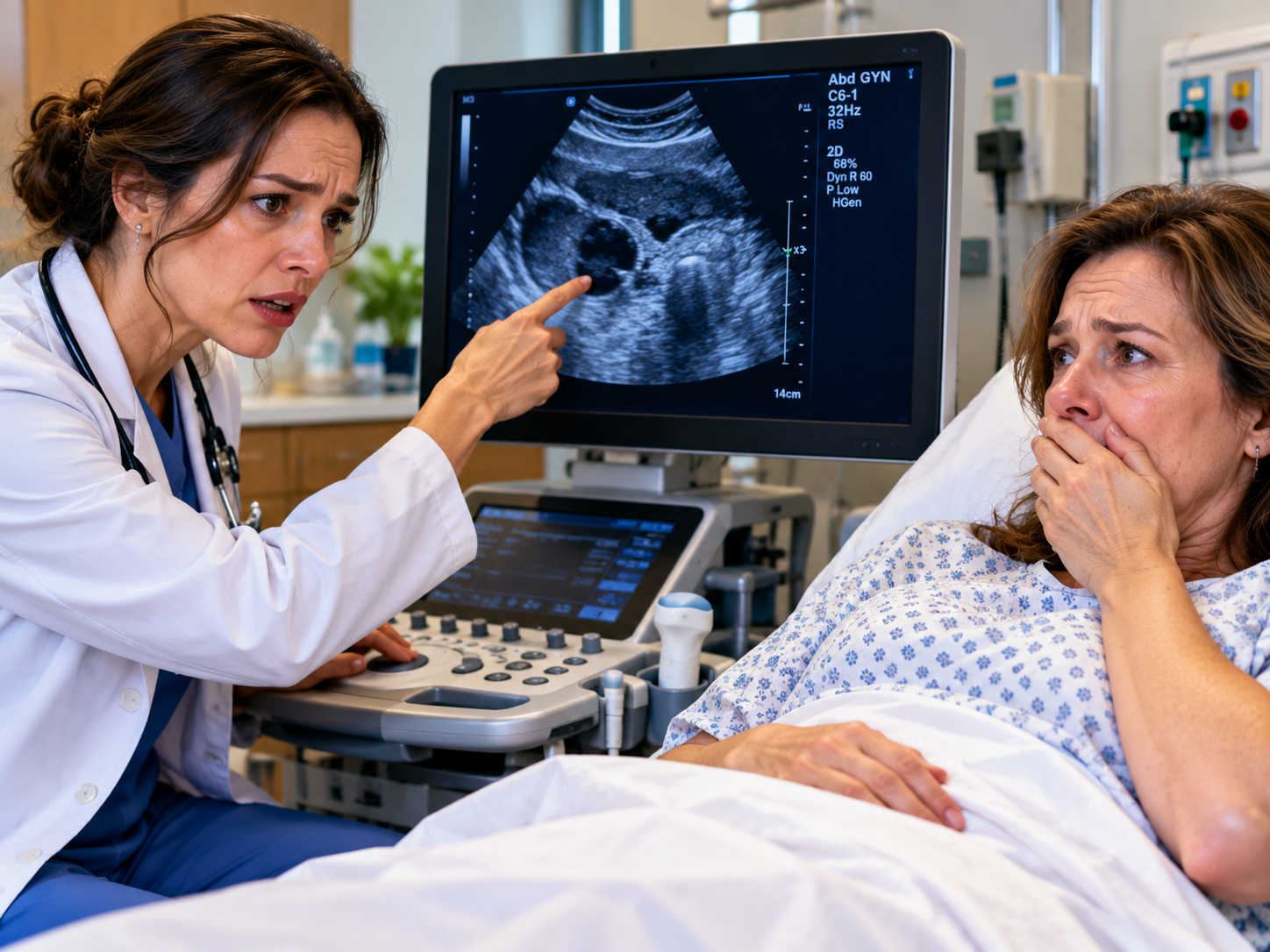
For several seconds, nobody spoke.
I read the sentence again.
Then again.
My eyes moved over the old report until the words blurred.
“Identity was uncertain.”
That was what the hospital had written.
Not that I had been confused.
Not that I had misunderstood.
My identity had been uncertain to the people treating me.
I looked at Michael.
He was staring at the table.
“Did you know?”
He shook his head.
“No.”
“You signed for surgery.”
“I was told you were dying.”
“Did anyone tell you they weren't certain which records belonged to me?”
“No.”
His voice cracked.
“They brought me a consent form. They said there was internal bleeding and they needed permission.”
“And you signed.”
“Yes.”
He looked at me.
“I thought I was saving you.”
The administrator spoke quietly.
“The review conducted at the time concluded that the surgical decision was clinically justified based on the information available to the treating team.”
I almost laughed.
“That sentence is supposed to make me feel better?”
“No.”
She lowered her eyes.
“It is supposed to distinguish the medical decision from the identification error.”
Dr. Evans leaned forward.
“The important thing now is that we have enough evidence to establish what happened.”
I looked at her.
“Tell me.”
She opened the corrected records.
“You did undergo surgery.”
I closed my eyes.
“Your uterus was removed.”
The words still hurt.
But they were no longer the whole story.
“The procedure itself was documented,” she continued. “The problem was that some of the supporting records were initially assigned incorrectly because of the identification error during the emergency.”
“What was the other patient's condition?”
“I can't discuss her medical information.”
“I understand.”
I did.
For the first time, the anger had somewhere specific to go.
Not toward another woman.
Not toward Michael.
Toward a system that had made a terrible mistake and then buried the confusion beneath corrected paperwork.
“What did Michael know?”
The administrator looked at him.
“He knew surgery had occurred. He knew the surgeon told him it was necessary. There is no evidence that he knew your identification had been uncertain.”
I looked at Michael.
He nodded slowly.
“I never knew.”
“Then why did you tell me I only had stomach pain?”
His eyes filled.
“Because I couldn't face you.”
“That isn't the same thing.”
“No.”
“Why did you think I would never remember?”
He looked at me for a long time.
“Because after the affair, I convinced myself that everything that happened to you was part of the punishment you deserved.”
I stared at him.
He continued.
“I hated what you did. I hated myself for still loving you. I didn't know how to live in the same house with you without either forgiving you or leaving.”
“So you chose neither.”
“Yes.”
“And the surgery became another secret.”
“Yes.”
His honesty did not erase the damage.
But it finally gave the damage a shape.
I looked down at my hands.
“I thought you stopped touching me because you were punishing me.”
“At first, I was.”
He did not soften the answer.
“I wanted you to feel the distance you'd created.”
I nodded slowly.
“And then?”
“Then years passed.”
His voice became quieter.
“I got used to being angry.”
That sentence hurt more than shouting would have.
“Why didn't you leave?”
“Because Jake was still young.”
“You could have divorced me.”
“I know.”
“Why didn't you?”
Michael looked at the floor.
“Because I didn't want our son growing up believing that one terrible thing his mother did destroyed his entire family.”
I felt tears rise.
“You stayed.”
“Yes.”
“But you weren't really here.”
“No.”
We sat together in the hospital conference room, eighteen years late to a conversation we should have had after the first week.
Dr. Evans placed her hand over the file.
“There is one more issue.”
I looked up.
“The ultrasound I performed suggests the surgery is consistent with the history we've now confirmed.”
“So there isn't a new disease?”
“No.”
I let out a breath.
For the first time since that appointment, my lungs seemed to work properly.
“The physical finding isn't the mystery anymore,” she said. “The mystery was why your medical history did not contain the surgery.”
The hospital administrator nodded.
“The record discrepancy explains that.”
“Then why did no one notice for eighteen years?”
“We cannot know with certainty.”
That was the honest answer.
I appreciated it.
Not knowing had caused much of this.
Pretending to know had caused the rest.
The hospital gave us copies of the corrected records and an explanation of the historical identification error. They also provided information about the review process that had followed the incident.
There would be no dramatic courtroom scene.
No secret villain.
No hidden diagnosis.
Just an old institutional mistake, a husband who had made his own mistakes, and a woman who had spent eighteen years believing punishment was something she had earned.
On the drive home, Michael stopped at a red light.
“You can divorce me.”
I looked at him.
“What?”
“You should have left years ago.”
I watched the traffic move across the intersection.
“Do you want a divorce?”
He swallowed.
“I don't know what I want.”
“That hasn't changed.”
“No.”
He turned his hands on the steering wheel.
“But I know I don't want to spend another eighteen years pretending we're strangers.”
I looked out the window.
Neither of us spoke again until we reached home.
Jake came over that evening.
He was forty now.
Old enough to remember the strange marriage he had grown up inside.
He walked into the kitchen carrying groceries and immediately noticed our faces.
“What happened?”
I looked at Michael.
Michael looked at me.
Then I told our son the truth.
Not every medical detail.
Not anything that belonged only to me.
But enough.
I told him that his mother had betrayed his father.
I told him his father had never forgiven me.
I told him I had overdosed.
I told him the hospital had performed surgery and that my medical records had later contained serious identification errors.
Jake listened without interrupting.
When I finished, he sat down.
“Why didn't either of you tell me?”
I looked at him.
“Because we thought protecting you meant keeping you outside it.”
He nodded slowly.
“You were wrong.”
“Yes.”
Michael lowered his head.
“Yes, we were.”
Jake rubbed his palms together.
“I always thought you stayed married because you were too stubborn to divorce.”
Michael gave a small, sad smile.
“That's probably part of it.”
Jake looked at me.
“And you?”
“I stayed because I believed I had forfeited the right to ask for anything better.”
He looked at both of us.
“That isn't a marriage.”
“No,” I said.
“It wasn't.”
The sentence did not feel cruel.
It felt accurate.
Weeks passed.
Dr. Evans continued my follow-up care, and eventually the medical concern became routine. The ultrasound finding had an explanation. The strange absence in my records had an explanation.
But the eighteen years between the hospital and that examination did not.
Those years could not be corrected in a chart.
Michael and I began counseling.
The first session was uncomfortable enough that I nearly walked out.
The counselor asked us why we had stayed.
Michael said, “For Jake.”
I said, “Because I was ashamed.”
The counselor looked at both of us.
“And now?”
Michael glanced at me.
“I don't want to punish her anymore.”
I looked down.
“I don't want to spend the rest of my life punishing myself.”
It was the first honest sentence we had spoken together in years.
We did not suddenly become affectionate.
There was no miraculous restoration of eighteen lost years.
Some wounds do not close because someone finally explains how they happened.
They close slowly because the people involved stop reopening them.
Months later, Michael asked if I wanted to move back into our bedroom.
I stood in the doorway.
The room looked almost exactly as it had in 2008.
Same dresser.
Same lamp.
Same faint mark on the wall.
But it no longer belonged to the same marriage.
“I don't know,” I said.
He nodded.
“That's okay.”
That answer mattered.
For eighteen years, uncertainty had always felt like something dangerous.
Now, for the first time, we allowed it to exist without forcing an answer.
Eventually, I brought one small box into the room.
Inside were the hospital records.
The original report.
The corrected report.
The explanation of the identification error.
And the note Dr. Evans had given me about my current medical history.
Michael looked at the box.
“Do you want to keep all that?”
“Yes.”
“Why?”
“Because I don't want to forget.”
He nodded.
Neither of us wanted to forget.
Not the affair.
Not the overdose.
Not the surgery.
Not the hospital's mistake.
Not Michael's cruelty.
Not my betrayal.
Not the years we wasted.
Forgetting would have been easier.
Remembering was more honest.
One evening, Jake came for dinner with his wife.
The four of us sat around the table.
Michael served the food.
I poured the wine.
At one point, Jake reached across the table and touched his father's wrist.
“I’m glad you two finally talk.”
Michael looked at him.
“So am I.”
Jake smiled.
I looked around the table.
For years, I had believed the worst thing that happened to our family was my affair.
I no longer believed that.
The affair had been the first fracture.
The silence afterward had widened it.
The hospital error had created another wound.
And our refusal to speak had allowed every wound to become permanent.
None of those things could be undone.
But they could finally be named.
Later that night, Michael and I stood together in the kitchen washing dishes.
Our hands nearly touched over the sink.
Neither of us pulled away.
He looked at me.
I looked at him.
There was no grand declaration.
No promise that eighteen years could disappear.
Just two people standing beneath the warm kitchen light, finally willing to occupy the same space without pretending nothing had happened.
“You know,” he said quietly, “I should have told you.”
“Yes.”
“I should have told you everything.”
“Yes.”
“And I should have left when I couldn't forgive you.”
I dried a plate.
“Yes.”
He gave a tired smile.
“You're not going to make this easy.”
“No.”
For the first time in years, he laughed.
I laughed too.
The sound felt unfamiliar in that house.
But it belonged there.
I never stopped regretting my affair.
Michael never stopped carrying the consequences of the choices he made afterward.
The hospital never became innocent simply because the records were eventually corrected.
And I never recovered the years I spent unaware of what had happened to my own body.
But the truth had finally done what silence never could.
It had separated the things that belonged to me from the things that did not.
My betrayal was mine.
Michael's decision to punish me was his.
The hospital's identification error belonged to the hospital.
And the years we chose to remain strangers belonged to both of us.
I kept the records.
Not as evidence against anyone.
As a reminder that a life can contain several truths at once.
I had hurt my husband.
He had hurt me.
A hospital had made a serious mistake.
And despite all of it, we were still capable of deciding what happened next.
That evening, when I turned off the kitchen light, Michael was waiting for me in the hallway.
He didn't reach for my hand.
He didn't need to.
He simply stepped aside so I could walk beside him.
For the first time since 2008, neither of us walked away.
Click here to continue reading: PART 5: After Eighteen Years of Silence, Susan and Michael Had to Learn Whether Truth Could Repair a Marriage That Had Already Become a Stranger
The Marriage That Survived My Betrayal Became Stranger Than Divorce When an Ultrasound Revealed Something My Eighteen Years of Shame Could Not Explain
Part 4 of 20

