
Six weeks after Thanksgiving, a cream-colored envelope appeared beneath my front door.
There was no return address.
My name was written across the front in handwriting I recognized immediately.
Brittany.
I stood in the hallway for nearly a minute before picking it up. The house was quiet, and late-afternoon sunlight stretched across the hardwood floor in narrow rectangles. I had become accustomed to quiet, but the sight of her handwriting disturbed it.
I carried the envelope into the kitchen and placed it beside my coffee cup.
I didn't open it immediately.
That surprised me.
A year earlier, I would have torn it open the moment I saw her name. I would have wondered what she needed, how serious it was, whether Richard had caused another problem, whether I could solve it before dinner.
Now I simply looked at it.
The difference was small.
It was also enormous.
Eventually, I opened it.
Brenda, I know I don't have the right to ask you for anything.
I stopped reading.
Then I continued.
I want to tell you what happened after you left. Not because I want you to feel guilty. I don't. I just think you deserve to know what I finally understood.
I sat down.
The rest of the letter described a conversation Brittany had overheard between Richard and one of his friends several months after the divorce. According to her, Richard had spoken about the marriage as though I had been the difficult one.
Brittany wrote that she had believed him at first.
Then she began remembering things differently.
She remembered how often I had paid.
How often I had organized.
How often I had quietly corrected mistakes.
She remembered that I had rarely complained.
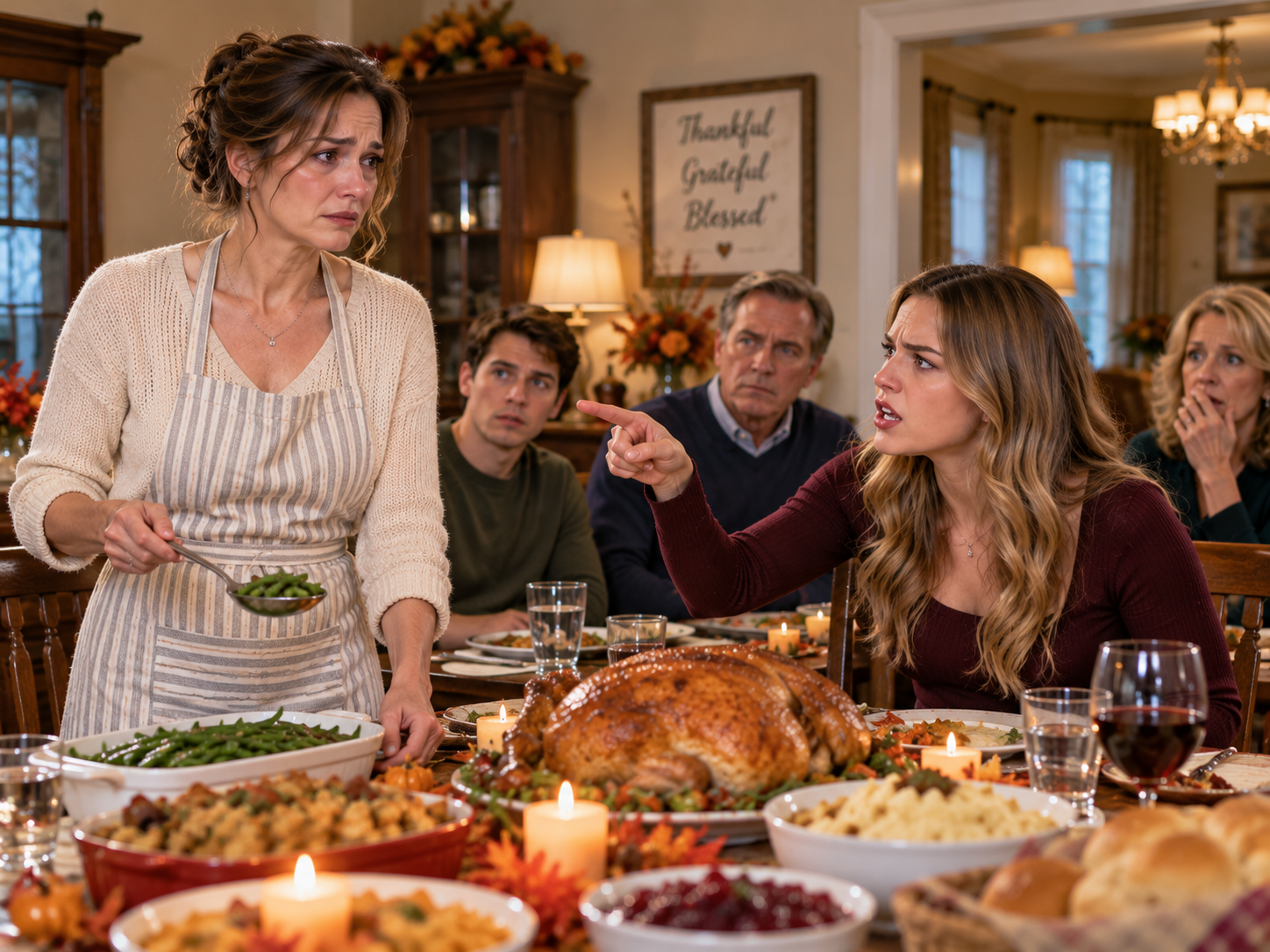
And she remembered the Thanksgiving dinner.
That was the part that made me put the letter down.
I went to the sink.
Outside, a light rain had started.
I watched water collect on the window while I tried to decide whether I wanted to finish reading.
I did.
Brittany wrote that she had recently found an old folder in Richard's office.
Inside were copies of financial documents, old emails, and notes from years earlier.
One note had my name on it.
I read the sentence she had copied into her letter.
Brenda will handle it. She always does.
I closed my eyes.
It wasn't shocking.
That was what made it painful.
The sentence reduced years of responsibility to a prediction.
I would handle it.
Of course I would.
Because I always had.
Brittany ended the letter with a request.
She wanted to meet me.
Not for money.
Not for help with school.
Not because she needed something repaired.
She wanted to apologize properly.
I folded the letter.
Then I put it in a drawer.
I didn't answer that day.
For the next three days, I carried on with my routine.
Morning coffee.
Work.
Walk.
Dinner.
Reading.
Sleep.
But the letter stayed in the drawer.
On the fourth evening, I took it out.
I called Brittany.
She answered on the second ring.
"Hello?"
"It's me."
Silence.
"Brenda?"
"Yes."
She breathed out.
"I wasn't sure you'd call."
"I wasn't sure either."
"I understand."
"I'll meet you."
"Really?"
"Coffee."
"Okay."
"Public place."
"Of course."
"And Brittany?"
"Yes?"
"If we're going to talk, we're going to tell the truth."
She was quiet.
"That's what I want."
We met Saturday morning.
She was already sitting near the window when I arrived.
She looked different.
Not dramatically.
Just older.
More deliberate.
She stood when she saw me.
"Hi."
"Hi."
I sat across from her.
For a few seconds, neither of us touched the menus.
Finally, she said, "Thank you for coming."
"I said I would."
"I know."
She looked at her hands.
"I don't know where to start."
"Start with what you wrote."
She nodded.
"My dad taught me to think that money was how you showed love."
I said nothing.
"He always said that if someone loved you, they didn't keep score."
I looked at her.
"That's not entirely wrong."
"No."
She swallowed.
"But he used it differently."
"How?"
"He made it sound like people who loved us should never say no."
I understood.
She continued.
"And when you did say no, he said you were changing."
I stared at her.
"Did he say that?"
"Yes."
"About me?"
"Yes."
I looked out the window.
The street was wet from the morning rain.
"Did you believe him?"
"For a while."
"And now?"
"I think he was afraid."
I looked back at her.
"Afraid of what?"
"Being responsible."
That answer was more honest than anything Richard had ever said to me.
Brittany reached into her bag.
She pulled out a small notebook.
"I found this in his office."
I didn't take it.
"What is it?"
"Notes."
"About what?"
"Money. You. Me."
She opened it.
Several pages contained dates and brief reminders.
Tuition.
Insurance.
Car.
Call Brenda.
Ask Brenda.
Check whether Brenda paid.
I felt something cold settle in my stomach.
Not because I hadn't known.
Because now I could see how ordinary it had become to him.
My name had been turned into an instruction.
Ask Brenda.
She'll handle it.
Brittany closed the notebook.
"I wanted to bring it because I thought you deserved to see it."
I shook my head.
"I believe you."
"You're not angry?"
"I am."
"At me?"
"Not only you."
She nodded.
"I thought so."
We sat quietly.
Then Brittany said something I hadn't expected.
"I've started paying my own bills."
"I know."
"How?"
"Carol told me."
She smiled faintly.
"She watches everything."
"She does."
"I thought it would feel terrible."
"What does it feel like?"
"Different."
"Different how?"
"Like my life belongs to me."
That sentence stayed between us.
I smiled.
"Then maybe you're learning."
She looked relieved.
We finished our coffee.
Before leaving, she asked whether she could come to my house sometime.
I hesitated.
"Not yet."
She nodded.
"I understand."
There was no argument.
No guilt.
No pressure.
That mattered.
I walked to my car alone.
Halfway there, my phone rang.
Richard.
I almost didn't answer.
Then I did.
"What?"
He sounded tired.
"I heard you met Brittany."
"Yes."
"You shouldn't be discussing our private matters with her."
"I didn't."
"She came to me afterward."
"What did she say?"
"She said things I don't appreciate."
"That isn't my responsibility."
"Brenda."
"What?"
"You don't know everything."
"Then tell me."
Silence.
I waited.
Finally he said, "I made mistakes."
I closed my eyes.
It was the closest thing to an admission I had heard from him.
"What kind?"
"Too many."
"That's not an answer."
"I don't know how to fix it."
"You can't fix a marriage after it's over."
"I wasn't talking about the marriage."
I looked toward the parking lot.
"What are you talking about?"
He didn't answer immediately.
Then he said, "I found something."
"What?"
"Something that belongs to you."
My grip tightened around the phone.
"What?"
"I'll bring it."
"Where?"
"Your house."
"No."
"I won't stay."
"Then mail it."
He hesitated.
"I think you should see it in person."
I almost refused.
Instead, I heard myself say, "Tomorrow. Ten minutes."
"Okay."
We ended the call.
I sat in my car for a long time.
The past had a habit of arriving in envelopes, notebooks, and unexpected phone calls.
But this time I wasn't the woman waiting to be told what to do.
If Richard had something that belonged to me, I would decide what happened next.
The following morning, I cleared the kitchen table.
At ten exactly, the doorbell rang.
I opened it.
Richard stood outside holding a small wooden box.
And for the first time since our divorce, he looked genuinely afraid.
Click Here to continue read next: PART6: Richard Placed the Wooden Box Between Us, and What I Found Inside Changed the Story I Thought I Knew
The Dinner Table Went Quiet, and I Finally Heard What My Husband Had Been Saying Without Words
Part 5 of 16

