
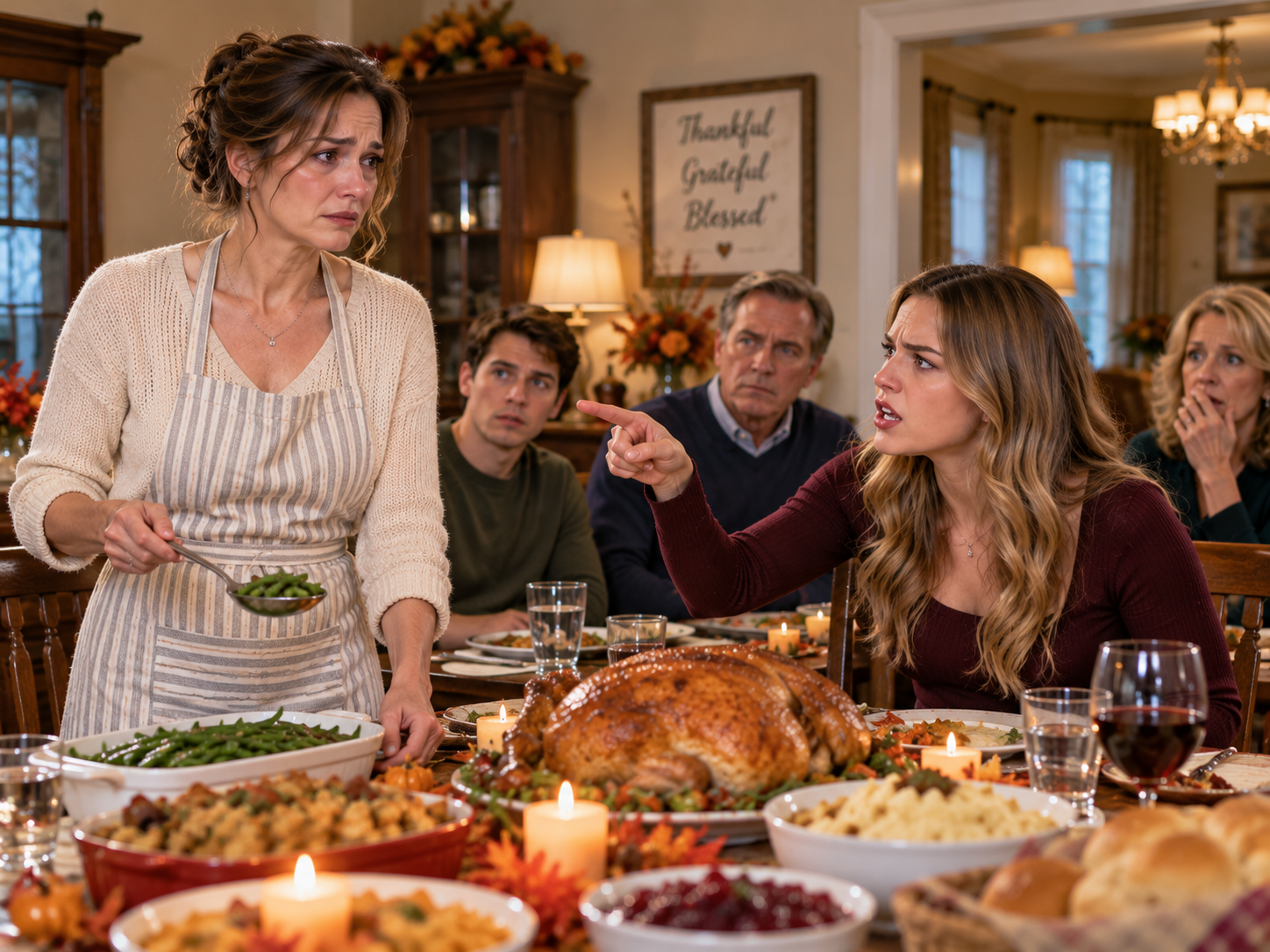
There are endings that arrive with shouting.
Mine arrived with a casserole dish.
A serving spoon.
A family dinner.
And one sentence spoken by a man who did not realize how carefully I had been listening to everything before it.
For months after I left Richard, I wondered whether I had been too harsh.
That question disappeared slowly.
Not because anyone convinced me.
Because time gave me evidence.
I saw what happened when I stopped solving problems.
Richard learned to handle his own bills.
Brittany found work.
The household continued.
Nothing collapsed permanently.
That was important.
For years, I had believed that if I stopped carrying certain responsibilities, everyone would suffer.
The truth was simpler.
They would adjust.
People usually do when the person making their lives convenient finally stops.
Brittany continued working near campus.
She became more independent.
Our relationship never became what I once imagined it might be.
There was no dramatic mother-daughter reconciliation.
No tearful holiday speech.
No sudden transformation.
There was something better.
Honesty.
She called occasionally.
Sometimes we talked for ten minutes.
Sometimes only five.
She stopped asking for money.
She stopped referring to me as someone who owed her something.
That was enough.
One winter evening, she called and told me she had received a promotion.
"That's wonderful."
"Thanks."
Then she said, "I wanted you to know."
I smiled.
"I'm glad you told me."
She hesitated.
"I've been thinking about that dinner."
"So have I."
"I was awful."
"You were young."
"I was still awful."
I did not argue.
Then she said, "My dad made it seem like you were controlling everything."
I looked down at my tea.
"I know."
"I believed him."
"I know."
"I should have asked."
"Yes."
There was no anger in my answer.
Only truth.
She sighed.
"I don't want to be like that."
"Then don't be."
She laughed softly.
"I guess it's more complicated than that."
"It usually is."
We said goodnight.
After the call, I stood by the kitchen window.
Snow was falling.
The same kind of snow I had watched during the divorce.
But I was not the same woman who had watched it then.
Back then, I had been afraid of what would happen if I stopped maintaining everything.
Now I understood that maintaining everything had prevented me from noticing what was already broken.
That was the strange gift of leaving.
It did not give me a new life.
It gave me my own life back.
I began doing small things I had postponed for years.
I repainted the downstairs bathroom.
I bought a chair I liked without asking whether anyone else thought it was practical.
I joined a weekend gardening group.
I learned to make bread.
Sometimes the loaves were terrible.
I ate them anyway.
I traveled with Carol for a few days in the spring.
We rented a small room near Lake Michigan and spent most of the trip walking, drinking coffee, and arguing about directions.
She told me I was becoming stubborn.
"I thought I already was."
"No," she said. "You used to be accommodating."
"That's a nicer word for it."
She laughed.
"Fine. You used to be accommodating."
We walked along the water.
The wind was cold.
I realized I wasn't thinking about Richard.
Not even once.
That was when I knew the marriage had finally ended inside me.
The legal ending had happened months earlier.
The emotional ending was quieter.
It happened when I stopped checking whether he was okay.
Stopped wondering whether he regretted it.
Stopped imagining what he might say if we ever talked honestly.
Some people think closure comes from the person who hurt you.
Mine came from no longer needing anything from him.
Richard called only twice after the divorce.
The first call was about paperwork.
The second concerned a utility transfer.
Both conversations were brief.
Neither contained the apology I once thought I needed.
Maybe he never understood.
Maybe he understood and didn't know how to say it.
Maybe he simply moved on.
It no longer mattered.
One afternoon, I ran into him at the hardware store.
He told me I looked good.
I told him he did too.
It was a harmless lie.
Then he said, "I didn't think it would matter that much."
Those words stayed with me.
Not because they hurt.
Because they explained everything.
The problem had never been that Richard woke up one morning and decided to destroy our marriage.
The problem was that he repeatedly made small choices without considering what they meant to me.
A sentence here.
An assumption there.
A payment shifted.
A responsibility transferred.
A disrespect ignored.
A boundary treated as unnecessary.
Individually, each thing could be dismissed.
Together, they formed a life in which I was expected to carry the weight and remain grateful for the privilege.
The dinner simply made the pattern impossible to ignore.
That was why I never hated Brittany.
I was angry with her.
I was hurt by her.
But she was not the person who had built the arrangement.
She had learned how the arrangement worked.
Richard had taught her.
And I had helped him by staying quiet.
That last part was difficult to admit.
I could not blame everyone else while pretending I had no choices.
I had choices.
I chose peace repeatedly.
I chose silence.
I chose convenience.
I chose to interpret warning signs generously.
I chose to believe that my contribution would eventually be recognized.
Those choices did not make me foolish.
They made me human.
But once I understood the pattern, I had another choice.
I could leave.
And I did.
The following Thanksgiving, I stood in my kitchen again.
Same dish towel.
Different house.
Different life.
Carol was at the stove.
Gary was arguing with the television.
Lucas was setting plates on the table.
I watched him carry a stack of dishes and thought about the first Thanksgiving.
Back then, I had been trying to prove that I could hold everything together.
This time, nobody needed me to prove anything.
Lucas came into the kitchen.
"You okay?"
"I'm fine."
He looked at me.
"Really?"
I smiled.
"Really."
He nodded.
Then he took the serving dish from the counter.
"I've got it."
Those three words stayed with me.
I've got it.
Not because I was incapable.
Not because I was helpless.
Because care can be mutual.
That was what I had been missing.
After dinner, I stepped outside.
The air was cold enough to sting.
The neighborhood was quiet.
Behind me, I could hear my family talking.
For a moment, I thought about the house I had left.
The kitchen.
The table.
The navy runner.
The chipped gravy boat.
The green bean casserole.
The sentence that had changed everything.
Then I realized something.
The sentence had not destroyed my marriage.
It had revealed it.
That distinction mattered.
Because if I had blamed one cruel remark for everything, I might have spent the rest of my life wondering whether I had overreacted.
But the remark had only opened the door.
Behind it were years of assumptions.
Years of invisible labor.
Years of financial responsibility disguised as generosity.
Years of being told I was important while being treated as useful.
The dinner had simply made the contradiction impossible to ignore.
I stood outside until my hands became cold.
Then I went inside.
The house was warm.
Carol handed me a plate.
Lucas asked whether I wanted pie.
Gary was still arguing about football.
I laughed.
It was an ordinary evening.
That was the outcome I wanted.
Not revenge.
Not punishment.
Not a dramatic victory.
Ordinary peace.
The kind that does not require another person's humiliation.
The kind that does not depend on swallowing your own dignity.
The kind that lets you wake in the morning without wondering who needs you to fix something.
I still wake before sunrise.
I still make my coffee too strong.
I still stand in the kitchen while the sky slowly changes color.
But now the quiet feels different.
Nobody is asking.
Nobody is assuming.
Nobody is moving money around inside systems they did not build.
Nobody is calling my care controlling simply because gratitude would require them to admit how much they received.
There is only the sound of the coffee maker.
The refrigerator humming.
The faint movement of the house settling around me.
And me.
Fifty-two years old.
Not beginning again.
Not rebuilding from nothing.
Continuing.
That difference matters.
I did not lose everything when I left.
I lost the illusion that keeping everything together was the same as being loved.
What remained was more valuable.
My home.
My work.
My son.
My sister.
My quiet.
My choices.
My ability to say no without explaining myself for an hour afterward.
Most of all, I kept the part of myself I had almost traded away for peace.
I used to think a strong woman was someone who could endure almost anything.
Now I think strength can look much quieter.
Sometimes strength is refusing another payment.
Sometimes it is closing a laptop.
Sometimes it is putting down a fork.
Sometimes it is saying, "Okay," when someone finally shows you exactly where they believe you belong.
And sometimes it is waking before sunrise, looking at the web you spent years holding together, and realizing that you are allowed to remove your hands.
The web may fall.
People may complain.
They may call you selfish.
They may say you changed.
They may tell everyone that you abandoned them.
Let them.
You do not have to remain inside a story written by people who benefited from your silence.
One year after that dinner, I stood in my kitchen with the same kind of dish towel in my hand.
But this time, when someone needed the serving dish carried to the table, another pair of hands reached for it.
No one had to be asked.
No one had to be reminded.
No one had to be shamed into caring.
That was the part I had wanted all along.
Not gratitude.
Not control.
Not recognition.
Reciprocity.
I went outside one last time before bed.
The cold air touched my face.
I looked up at the dark sky.
My life was smaller than it had once been.
There were fewer people at the table.
Fewer obligations.
Fewer explanations.
But it was mine.
And for the first time, that was enough.
The dinner had not ended my life.
It had ended the version of my life in which I believed I had to disappear to keep everyone else comfortable.
I finally understood what had taken me years to see:
Peace is not peace when you are the price being paid for it.
So I stopped paying.
And the life that remained was the first one that truly belonged to me.
Click Here to continue read next: PART5: The Letter on My Kitchen Table Asked for Something I Was No Longer Sure I Could Give Without Losing Myself Again
The Dinner Table Went Quiet, and I Finally Heard What My Husband Had Been Saying Without Words
Part 4 of 16

