
The name on the document was Anna.
Helen had chosen it before Elena was born.
She had written it in a notebook beside the bed at the clinic.
Anna Vale.
That was the name her father had erased.
Elena looked at Helen.
“I want to use it.”
Helen touched the paper.
“You don't have to.”
“I know.”
“Then why?”
“Because it was mine before he took it.”
Helen smiled through tears.
“Then take it back.”
The legal process took months.
Documents had to be compared.
Witnesses interviewed.
Records authenticated.
The original birth record was eventually found among the nurse's archived papers.
The name was confirmed.
Anna Vale.
Mara attended the ceremony when the correction became official.
Rose came.
Daniel came.
Helen sat in the front row.
When Anna signed the final document, she paused.
Then she smiled.
Not because the past had disappeared.
Because it no longer controlled the future.
Afterward, they went to a small restaurant near the courthouse.
Nobody made a speech.
They simply ate.
Rose ordered dessert.
Daniel laughed.
Helen complained that everyone was making too much noise.
Mara watched them.
It felt ordinary.
That was the strange part.
For so long, she had imagined the truth would arrive like a storm.
Instead, the most important changes happened quietly.
A name corrected.
A letter opened.
A photograph returned.
A mother and daughter learning how to sit beside each other without fear.
Months later, Mara returned to the bedroom where everything had begun.
The floral quilt was still there.
Helen's hair had grown out.
She no longer hid the scar near her temple.
The clippers were gone.
Mara found her mother sitting by the window.
“You kept the quilt.”
Helen smiled.
“You said I should.”
“I don't remember saying that.”
“You did.”
Mara sat beside her.
Outside, children were playing on the sidewalk.
Helen watched them.
“I used to hear children and wonder.”
“About Elena?”
“About all of them.”
Mara knew what she meant.
The children whose names had disappeared.
The families who had waited.
The people who had survived without knowing why.
Helen looked at her.
“I wish I could save them all.”
Mara took her hand.
“You saved the ones you could.”
Helen nodded.
“That has to be enough.”
“It is.”
Helen smiled.
“Your father used to tell me that forgetting was mercy.”
Mara shook her head.
“It wasn't.”
“No.”
“It was fear.”
Helen looked toward the mirror.
“Yes.”
They sat quietly.
Then Helen said, “Do you know what I remember most about that room?”
“What?”
“Rose singing.”
Mara smiled.
“Rose sang?”
“When we were children.”
“What did she sing?”
Helen laughed softly.
“I don't remember the song.”
“Then why remember it?”
“Because I remember being less afraid.”
Mara understood.
Memory did not always preserve words.
Sometimes it preserved sensations.
A voice.
A hand.
A smell.
The feeling of being safe for a few minutes in a place where safety was rare.
Later that afternoon, Rose arrived with Anna.
Anna carried the old red ribbon.
She had sewn it onto a piece of cloth and framed it.
“I thought you might want this.”
Helen looked at it.
“No.”
Anna frowned.
“Why not?”
“Because it's yours.”
Anna smiled.
“Then we'll keep it together.”
They placed the framed ribbon on the bedroom wall.
Mara looked at it.
Something about the simple red strip felt different now.
It had once been evidence.
Then it had become a clue.
Now it was simply a piece of a childhood.
That mattered.
Not every object needed to remain a wound.
Some could become memories.
Daniel arrived later.
He brought flowers.
Helen raised an eyebrow.
“What did you do?”
“Nothing.”
“Then why flowers?”
“Can't a man bring flowers without being accused?”
Rose laughed.
Mara smiled.
Anna looked between them.
For the first time, the family sat together without needing to discuss the past.
They talked about dinner.
The weather.
A broken fence.
A television program.
Ordinary things.
And the ordinary conversation was perhaps the greatest proof that something had changed.
The past no longer occupied every chair at the table.
It had a place.
But it did not own the room.
Years passed.
The investigation eventually became a historical case study.
The recovered records were donated to an archive.
Families traveled from different towns to examine them.
Some found names they had been searching for.
Some found photographs.
Some found nothing.
Mara volunteered with the archive.
She learned how to preserve fragile paper.
She learned that water damage could erase a sentence but leave a name.
She learned that ink faded differently depending on the paper.
She learned that history was often kept alive by people who refused to throw away what seemed useless.
One afternoon, she found a photograph of the boarding house.
The building stood beneath the trees.
Helen was in the doorway.
Rose was beside her.
Both were young.
Mara stared at the image.
She finally understood something.
The story had never really been about a locked room.
The room was only where the truth had been hidden.
The real prison had been fear.
Fear of being found.
Fear of being blamed.
Fear of losing someone.
Fear of telling the truth.
And fear could pass from one generation to another just as easily as a family name.
But it could also stop.
Mara placed the photograph back in its sleeve.
That evening, she visited Helen.
Anna was already there.
Rose was making tea.
Daniel was fixing a loose cabinet door.
Mara stood in the doorway.
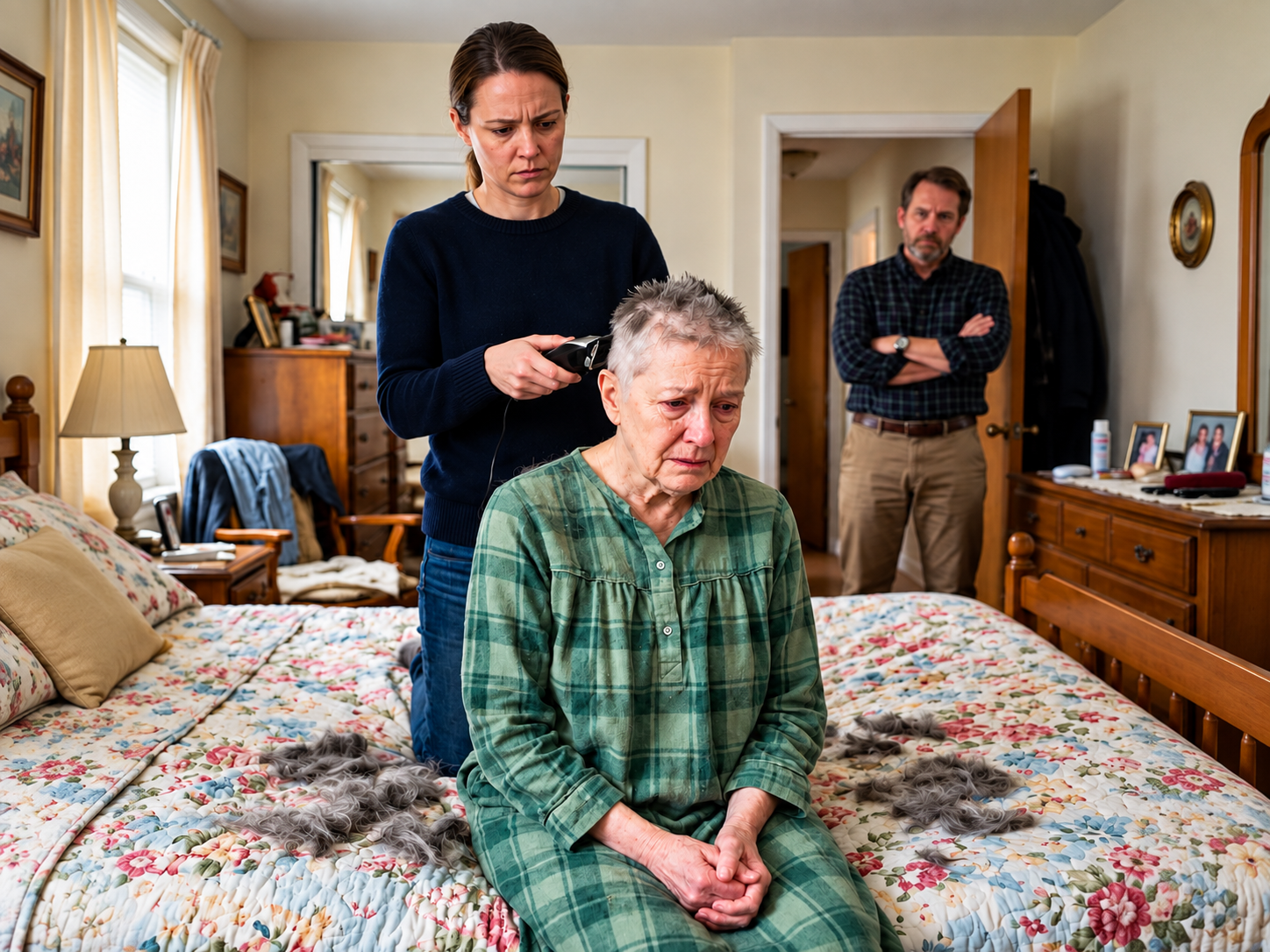
For a moment, she remembered the first morning.
Her mother sitting on the quilt.
Gray hair scattered everywhere.
Daniel watching from the doorway.
The clippers buzzing.
The photograph waiting in an envelope.
She had believed the hair was the beginning of the story.
Now she knew it had been the end of something.
The end of hiding.
Helen noticed her.
“Why are you standing there?”
Mara smiled.
“Just remembering.”
“Good memories?”
“Some.”
Helen nodded.
“That's allowed.”
Mara walked inside.
Anna looked at her.
“Dinner?”
“Of course.”
They sat together.
The same family that had once been divided by secrets now argued over what to order.
Rose wanted soup.
Daniel wanted roast chicken.
Helen wanted neither.
Anna laughed.
Mara watched her mother.
Helen caught her looking.
“What?”
“Nothing.”
“You're staring.”
“I like seeing you happy.”
Helen smiled.
“I am.”
Mara nodded.
The answer was simple.
No grand speech followed.
No miraculous erasure of the past.
Just a woman who had spent decades afraid finally admitting that happiness could exist alongside grief.
Later that night, after everyone left, Helen walked into the bedroom.
She touched the framed red ribbon.
Then she looked at the quilt.
For years, she had believed the things left behind by the past had to be hidden.
Now she kept some where she could see them.
Not because she wanted to suffer.
Because she no longer needed to.
She sat on the edge of the bed.
The room was quiet.
No crying came from behind the wall.
No footsteps moved through the hidden passage.
No voice emerged from an old cassette.
There was only the soft sound of the house settling.
Helen smiled.
She had spent thirty-seven years waiting for silence to feel safe.
At last, it did.
Across town, Mara finished writing the final archive note.
She placed the recovered family records into their protective folders.
The final line read:
The names were lost, but they were not erased.
Mara stared at the sentence.
Then she added another.
They were remembered.
She closed the file.
The next morning, she visited Helen again.
Her mother was sitting near the window.
Anna was beside her.
Rose was reading.
Daniel was asleep in a chair.
Mara walked over.
Helen looked up.
“Did you bring breakfast?”
“Yes.”
“Good.”
Mara handed her the bag.
Helen opened it.
“Coffee?”
“Of course.”
“You're a good daughter.”
Mara smiled.
“You're a good mother.”
Helen looked at her.
There was no hesitation this time.
No apology.
No qualification.
Just a quiet smile.
Anna reached across the table.
“Tell me the story again.”
Helen laughed.
“You've heard it.”
“I know.”
“Why again?”
“Because every time you tell it, I remember something different.”
Helen looked at Mara.
Mara understood.
The story could be told again.
Not because they were trapped in it.
Because they had survived it.
Helen began.
She told them about the boarding house.
About Rose.
About the hidden room.
About the baby.
About the ledger.
About the years of silence.
She told them what she had done wrong.
What she had tried to do right.
What she still regretted.
She told them the truth without protecting anyone from it.
When she finished, Anna reached across the table and took her hand.
“Thank you.”
Helen looked at her.
“For what?”
“For telling me.”
Helen squeezed her fingers.
“I should have told you sooner.”
Anna smiled.
“You told me when you were ready.”
Mara looked toward the bedroom.
The floral quilt was visible through the open doorway.
The old scar.
The framed ribbon.
The empty place where the clippers had once sat.
Everything was still there.
Nothing had been erased.
That was the point.
The family had not healed by forgetting.
They had healed by remembering without running.
And when the last light of afternoon entered the room, Helen looked at her daughters and realized that the secret she had feared would destroy them had done something else instead.
It had finally brought them home.
Click Here to continue read next: PART13: The Archive Gave Mara One More Reason to Return to Bellweather, Where an Ordinary Box Carried a Memory Nobody Had Understood
By the Time the Last Gray Hair Fell, Mara Knew Her Mother Was Hiding Something More Painful Than Fear
Part 12 of 16

