
Clara was ten when she first asked why Daniel had died.
The question came during breakfast.
She was spreading jam across toast while Mateo read an email on his phone.
"Why did Grandpa die?"
Mateo put the phone down.
He knew the question would eventually come.
He had simply hoped for more time.
"Because he was very sick."
"Was he old?"
"No."
"Was he scared?"
Mateo looked at her.
"Yes."
Clara stopped spreading jam.
"Did he know?"
"Yes."
"Did you know?"
"I was a child."
"Did Grandma know?"
"Yes."
Clara thought about it.
"Did everybody lie to each other?"
The question was sharper than she intended.
Mateo didn't answer immediately.
"No."
Then he corrected himself.
"Sometimes people kept things quiet because they thought they were protecting each other."
"Is that lying?"
"Sometimes it can become one."
Clara looked confused.
"Then why did they do it?"
"Because they were afraid."
She nodded slowly.
"Afraid of what?"
"Losing each other."
Clara looked at him.
"But they lost Grandpa anyway."
Mateo felt the truth of the sentence.
"Yes."
Elena, sitting across the table, reached for Clara's hand.
"Your grandfather loved us very much."
"Then why didn't he tell everybody?"
Elena looked at Mateo.
He nodded.
She answered.
"Because loving someone doesn't automatically make you good at making decisions."
Clara smiled faintly.
"Like when Dad says he knows how to fix things and makes them worse?"
Mateo laughed.
"Exactly like that."
Elena laughed too.
The heaviness lifted.
But the conversation continued.
Clara wanted to know about the treatment plant.
She wanted to know why Daniel had collected papers.
She wanted to know why people had threatened him.
Mateo answered carefully.
Some things were too complicated for a ten-year-old.
But he refused to invent simpler answers.
When she asked whether the company had caused Daniel's illness, he said they didn't know.
When she asked whether Daniel had been brave, he said Daniel had been frightened and acted anyway.
When she asked whether being frightened made someone weak, Elena answered.
"No."
"Then what does?"
"Refusing to admit you're frightened."
Clara thought about that for a long time.
Later that day, Mateo took her to the archive.
They stood before Daniel's photograph.
"That's him."
"Yes."
"Can I see his handwriting?"
Mateo opened the digital collection.
Clara traced one line with her finger without touching the screen.
"He writes messy."
"He did."
"Did you write like him?"
"Probably."
She looked at him.
"Do you want to?"
Mateo smiled.
"No."
"Why?"
"Because I want to write like me."
Clara smiled.
"Good."
The answer surprised him.
It was exactly the answer he had once needed.
That evening, Elena gave Clara a photograph.
It showed Daniel sitting at a kitchen table with a stack of pancakes.
One pancake was burned.
"What happened?"
"He couldn't cook."
Clara laughed.
"Grandpa was bad at cooking?"
"Terrible."
"Why didn't Grandma stop him?"
"Because she loved him."
"That's not a good reason."
Elena laughed.
"You're right."
The family began a new tradition.
Every Sunday, someone told a Daniel story.
Not about the investigation.
Not about the company.
Just Daniel.
The first story was about the pancakes.
The next was about the bicycle.
Then came the treehouse.
Then the time he accidentally locked himself outside.
Then the time he tried to teach Mateo how to fish and spent most of the afternoon untangling the line.
The stories accumulated.
Daniel became funny.
Annoying.
Kind.
Stubborn.
Impatient.
Generous.
Human.
Clara loved the stories.
One Sunday she asked, "Why didn't you tell me these before?"
Mateo thought.
"Because we were busy telling the serious story."
"What serious story?"
"The one about the treatment plant."
She frowned.
"I like the pancake story better."
Mateo smiled.
"Me too."
The family laughed.
The next year, Clara entered a school project about local history.
She chose the old treatment plant.
Mateo helped her research.
He insisted that she use primary documents.
She examined Daniel's notes.
She compared them with official reports.
She identified where the evidence was uncertain.
Her teacher praised the project for distinguishing fact from assumption.
At the final presentation, Clara stood beside a poster showing the old plant.
"People sometimes think history is about finding heroes," she told her class.
Mateo stood at the back.
Clara continued.
"My family learned that history is also about mistakes, fear, and choices."
She pointed to a copy of Daniel's notebook.
"My great-grandfather made mistakes."
Then she pointed to the environmental records.
"He also kept records that helped other people."
She looked at her classmates.
"Both things can be true."
Mateo felt his eyes sting.
Afterward, Clara ran to him.
"Was it okay?"
"It was more than okay."
"Did I say anything wrong?"
"No."
"Grandma said I sounded like you."
Mateo laughed.
"That's dangerous."
When they returned home, Elena was waiting.
Clara showed her the project.
Elena studied it.
"You forgot one thing."
"What?"
"Your grandfather wasn't a perfect man."
"I said that."
"You did."
Elena smiled.
"Then you remembered the important part."
That night, Mateo sat with Elena beneath the maple tree.
The old watch rested between them.
Clara was inside doing homework.
"She understands," Elena said.
"Some of it."
"More than we did at her age."
Mateo nodded.
"I think we spent too much time believing children needed protection from difficult truths."
Elena sighed.
"Sometimes they do."
"Yes."
"But not from reality."
Mateo looked at her.
"That's the difference."
She nodded.
The family had finally learned to distinguish privacy from secrecy.
Not every adult problem belonged to a child.
But when children asked honest questions, they deserved honest answers appropriate to their age.
It was a small principle.
It had taken decades to learn.
One evening, Clara asked Mateo whether she could have Daniel's old desk when she grew up.
He laughed.
"Why?"
"Because it has secrets."
Mateo smiled.
"No secrets."
She looked disappointed.
"Then why keep it?"
"Because it belonged to him."
She nodded.
"Okay."
Years later, she would remember that answer.
The desk was valuable because of what had happened around it, not because it contained something hidden.
The drawers stayed open.
The papers were cataloged.
The photographs were labeled.
The family stories were recorded.
Nothing needed to be buried anymore.
And Mateo finally realized that the family's greatest change was not what they had discovered.
It was what they had stopped doing.
They had stopped making silence their first response.
They had stopped confusing protection with control.
They had stopped turning Daniel into a symbol.
They had stopped asking Mateo to finish what Daniel had started.
They had learned to let each person carry only what belonged to them.
The watch continued ticking.
The maple tree continued growing.
Clara continued asking difficult questions.
And Mateo continued answering them.
Click Here to continue read next: PART16: The Family Finally Gathered Beneath the Maple Tree Without a Secret to Reveal, and Mateo Understood Why Their Longest Story Was Never Meant to End
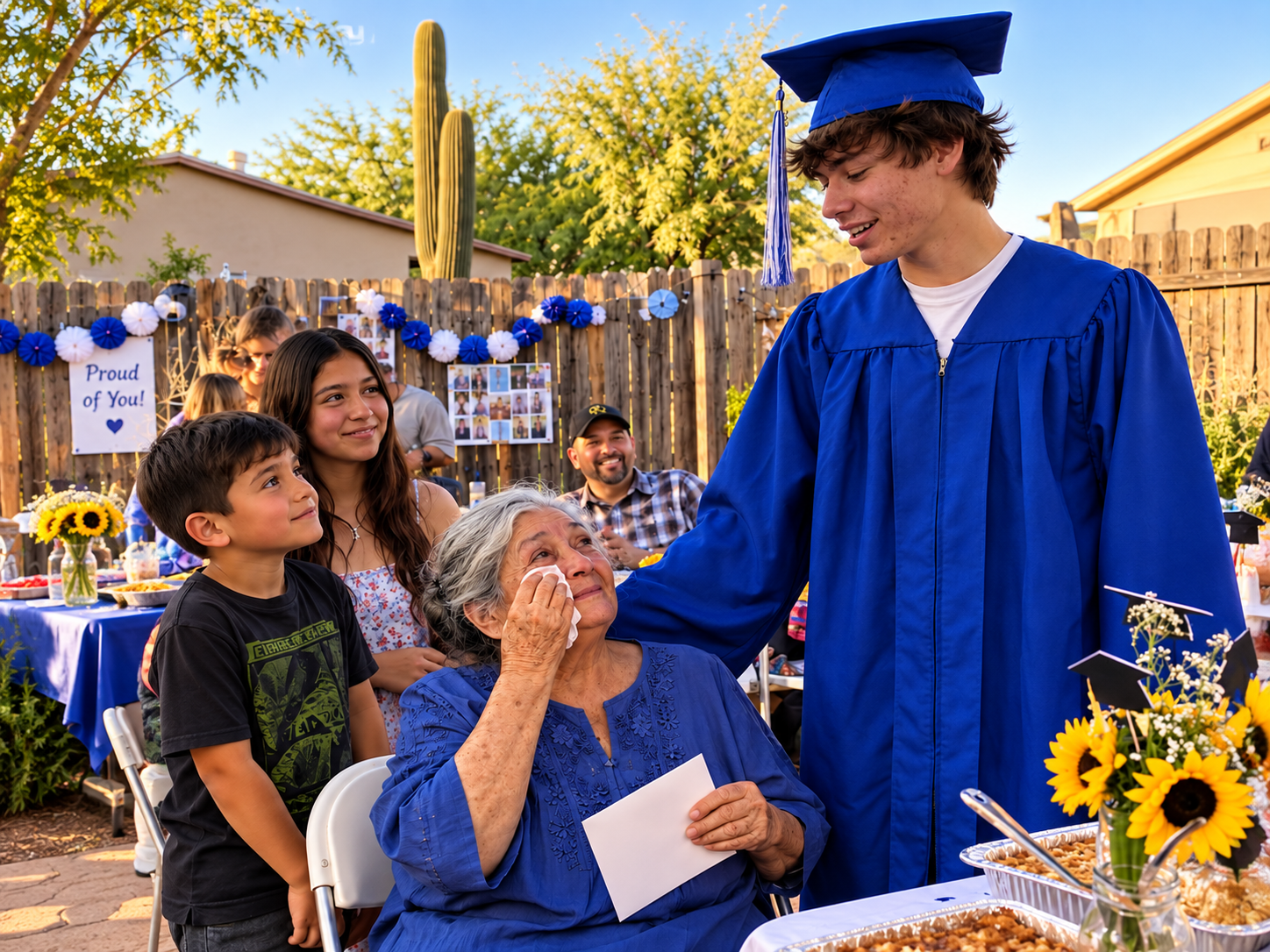
Everyone Was Smiling Until Grandma Opened the Envelope, Read the First Line, and Realized Her Grandson Had Hidden Something Much Bigger Than Graduation
Part 15 of 16

