
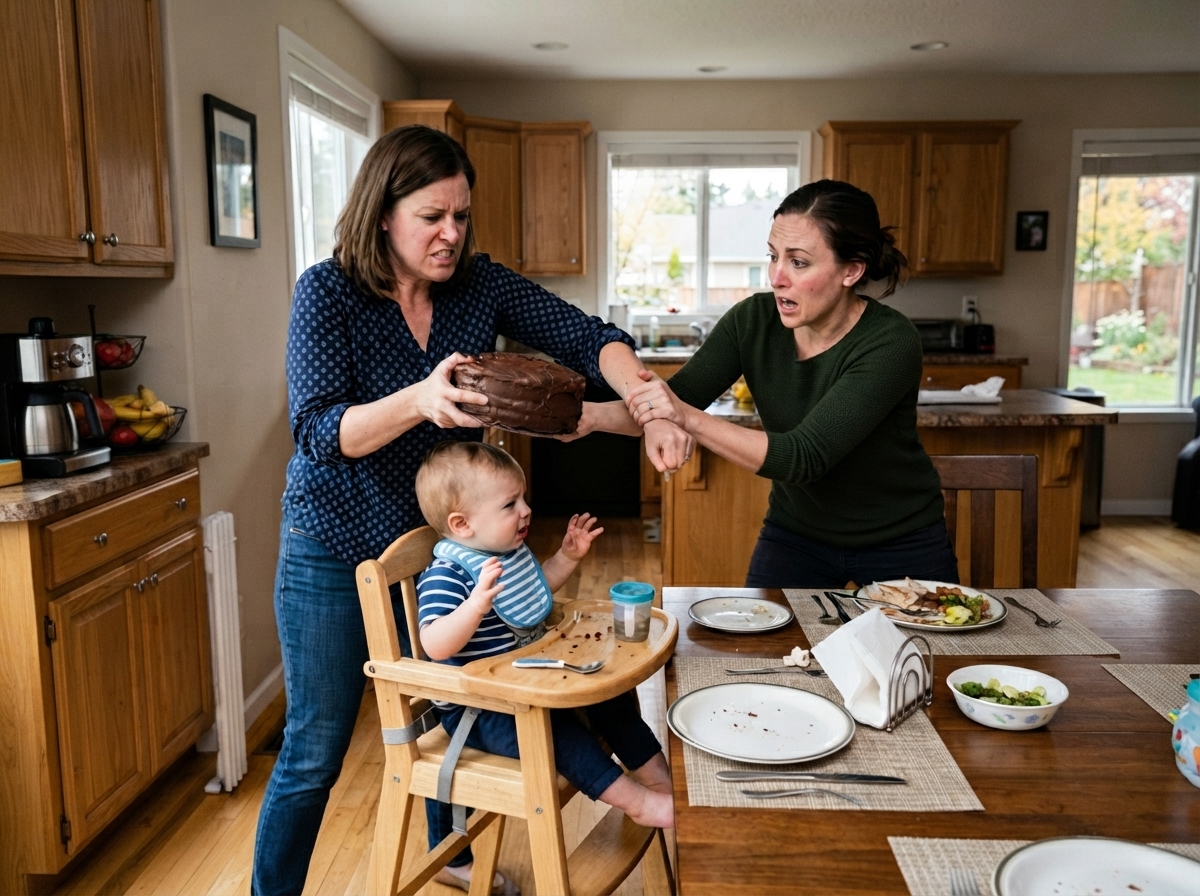
NOTE: This final part resolves the confrontation, explains Victor’s motive, clarifies Lucas’s actions, restores the missing truth, and shows how the family chooses to move forward without repeating the secrecy of the past.
The door shook again.
My son clung to my husband.
Detective Harris stood between us and the entrance.
“Everyone stay back.”
Another impact came.
Then silence.
A long, terrible silence.
Finally, police sirens approached from the street.
The pressure outside disappeared.
Officers surrounded the property.
Victor Hale was arrested less than two blocks away.
He had not entered the house.
He had been waiting for another opportunity.
The documents were secured.
The immediate danger was over.
But the questions remained.
Why had Victor pursued those papers for decades?
Why had my father hidden them?
And why had Lucas become involved?
We learned the answers over the following weeks.
Victor had been responsible for the financial fraud that destroyed the original business partnership.
My father discovered it.
Instead of reporting him immediately, my father tried to use the evidence as leverage.
That decision trapped everyone.
Lucas's father wanted the truth exposed.
Victor threatened him.
My father became afraid.
Then Lucas's father died.
My father kept the documents.
He convinced himself he was protecting everyone.
But his silence allowed Victor to continue his life untouched.
Lucas eventually discovered fragments of the story.
He began investigating.
When he found evidence that the documents might be inside our house, he tried to force us to notice.
The marked cake was his mistake.
The anonymous messages were his attempt to frighten us into looking.
He had crossed a line.
But he had not intended to poison my son.
The police confirmed that the cake contained no harmful substance.
The strange marking compound was exactly what Lucas had admitted using.
I hated that he had frightened us.
But I also understood why he had believed nobody would listen otherwise.
That did not excuse him.
It simply made him human.
Lucas's mother eventually met with us.
She was older than I had expected.
When she saw me, she cried.
“I am sorry.”
I didn't know what to say.
“For what?”
“For what your father did.”
“You didn't do it.”
“No.”
She looked at the house.
“But I should have found another way.”
“You wanted the documents.”
“I wanted my husband's name cleared.”
I looked at her.
“He wasn't guilty.”
“No.”
“And my father was?”
She shook her head.
“Your father made terrible choices.”
That answer felt familiar.
Everyone in this story had apparently been complicated.
But this time I understood what that meant.
People were not simply good or bad.
They made decisions.
Those decisions had consequences.
Sometimes the consequences lasted longer than the people who created them.
Lucas apologized too.
He admitted marking the cake.
He admitted watching the house.
He admitted sending the messages.
He said he had convinced himself that fear was the only language our family would understand.
I told him he was wrong.
“You frightened my son.”
“I know.”
“You frightened me.”
“I know.”
“You could have come to us.”
“I didn't think you'd believe me.”
“Maybe we wouldn't have.”
He looked at me.
“But you still should have tried.”
He nodded.
That became the most important lesson of the entire ordeal.
Fear could explain a choice.
It could not erase responsibility.
The legal case against Victor continued.
The original documents were submitted as evidence.
The business records were reviewed.
The property dispute was resolved.
The house remained ours.
Lucas's mother received formal recognition of her family's rightful claim to the business assets that had been stolen from them.
The money did not make everything right.
Nothing could.
But the truth finally existed in the open.
My mother changed too.
She stopped hiding my father's letters.
She gave me his old photographs.
She opened the study she had kept locked for eight years.
Inside were shelves of notebooks.
I found one with my name on it.
I opened it.
The first page said:
I don't know how to tell my daughter what I have done.
I sat on the floor.
My mother came into the room.
“You never knew about this?”
“No.”
She sat beside me.
“He loved you.”
I looked at the notebook.
“I believe that.”
“But?”
“But love didn't make his choices right.”
She nodded.
“No.”
That was the first time we spoke about my father honestly.
Not as a hero.
Not as a villain.
As a man.
A flawed man.
A frightened man.
A father who loved his daughter but made decisions that endangered the people he claimed to protect.
I could finally remember my childhood without having to defend him.
The good memories stayed.
The bad truths stayed.
Neither needed to destroy the other.
My son was too young to remember the birthday incident.
That was a blessing.
He remembered only that his birthday cake had been delayed.
Months later, he asked:
“Can I have cake now?”
I laughed.
“Yes.”
We made one together.
He stood on a chair beside me.
He poured flour everywhere.
He tasted the frosting.
He laughed when it got on his nose.
My husband took pictures.
Emma came over.
My mother came too.
For a moment, I watched everyone.
The same people.
A completely different family.
There was no fear.
No secret envelope.
No anonymous message.
No one watching through the window.
Just cake.
My son blew out the candles.
Everyone applauded.
Then he looked at me.
“Mommy.”
“Yes?”
“Big piece.”
I laughed.
“You can have a big piece.”
He smiled.
That ordinary moment felt more meaningful than any dramatic revelation.
Because the story had never really been about the cake.
The cake had only opened the door.
The real story was about what families do when the truth becomes inconvenient.
Some hide it.
Some distort it.
Some use it.
Some fear it.
And eventually, someone has to decide whether the next generation deserves to inherit the consequences.
I decided my son would not.
I kept the documents.
I kept my father's notebook.
I kept the photograph.
But I didn't keep them hidden.
We created a family archive.
Everything was labeled.
Dates.
Names.
Known facts.
Unknown facts.
Documents.
Photographs.
Letters.
No secret compartments.
No locked boxes behind walls.
When my son was old enough, I would tell him the story.
Not because he needed to carry it.
Because he deserved to know where his family came from.
That was the difference.
Knowledge was not the same as burden.
A secret becomes a burden when children are forced to protect adults from the truth.
Knowledge becomes strength when children are given the freedom to understand it.
Years passed.
My son grew.
The birthday incident became a strange family story.
Sometimes Emma would still apologize.
“I shouldn't have touched that cake.”
I would smile.
“No.”
“You're never going to let me forget.”
“Absolutely not.”
She laughed.
My mother would shake her head.
Then someone would mention Victor.
The room would become quiet.
We never celebrated what happened.
We simply remembered it.
That mattered.
Because forgetting would have been another kind of dishonesty.
Lucas eventually rebuilt his relationship with his mother.
He completed the legal process and stopped contacting us.
There was no dramatic reconciliation.
No sudden friendship.
Just boundaries.
Sometimes that is what healing looks like.
Not everyone becomes close.
Some people simply stop hurting each other.
That can be enough.
My mother eventually gave me the final letter my father had written.
I read it alone.
He apologized.
Not perfectly.
Not completely.
But honestly.
He admitted that he had spent years believing he could control consequences by controlling information.
He wrote that he had been wrong.
At the bottom was one final sentence.
If my daughter ever reads this, I hope she learns from my mistakes instead of inheriting them.
I cried.
Then I folded the letter.
I did not forgive him for everything.
But I forgave myself for loving him.
That was something I had needed to learn.
You can love someone who disappointed you.
You can remember someone's kindness while refusing to excuse their mistakes.
You can forgive without pretending.
And you can move forward without erasing what happened.
The next birthday, my son was older.
He wore another paper crown.
The cake was chocolate again.
He insisted on helping.
My husband lit the candles.
Emma stood beside me.
My mother watched from the table.
I looked around the kitchen.
For a brief moment, I remembered that other birthday.
The reaching hands.
The fear.
The messages.
The hidden history.
Then my son shouted:
“Mommy! Hurry!”
I smiled.
“What?”
“Make a wish!”
I looked at him.
I didn't need one.
Everything I had once wished for had become much simpler.
Safety.
Honesty.
A family that could speak.
A child who could grow without inheriting fear.
I blew out the last candle.
Everyone cheered.
My son laughed.
Then he reached for the cake.
This time, nobody stopped him.
I cut him a large piece.
He took one bite and grinned.
“Good?”
He nodded enthusiastically.
“Very good.”
I watched him eat.
The cake was only cake.
And that ordinary fact felt like a victory.
Not because the past had disappeared.
It hadn't.
The past would always be there.
In photographs.
In letters.
In names.
In memories.
But it no longer controlled us.
We had taken the secret out of the walls.
We had put the documents into the light.
We had stopped asking fear to make our decisions.
And when I looked at my son, I knew exactly what I wanted to give him.
Not a perfect family.
Not a perfect history.
Just the truth.
Enough truth that when his own difficult questions came someday, he would never have to wonder whether asking them meant he was betraying the people he loved.
He could ask.
We would answer.
And if we didn't know, we would say so.
Because sometimes the strongest thing a family can say is not “Everything is fine.”
Sometimes it is simply:
“I don't know yet.
But we will face the truth together.”
STORY TITLE: My Sister Reached Across the Dinner Table for My Baby’s Birthday Cake, Then She Whispered Something That Made Me Question Why She Had Come at All
Click Here to continue read next: PART5: The Birthday Was Finally Over, Yet One Forgotten Photograph Revealed Why My Sister Had Risked Destroying Our Family’s Trust That Night
The Birthday Cake Was Still Warm When My Sister Tried to Take It Away, and the Reason She Gave Me Made Everyone at the Table Go Silent
Part 4 of 8

