
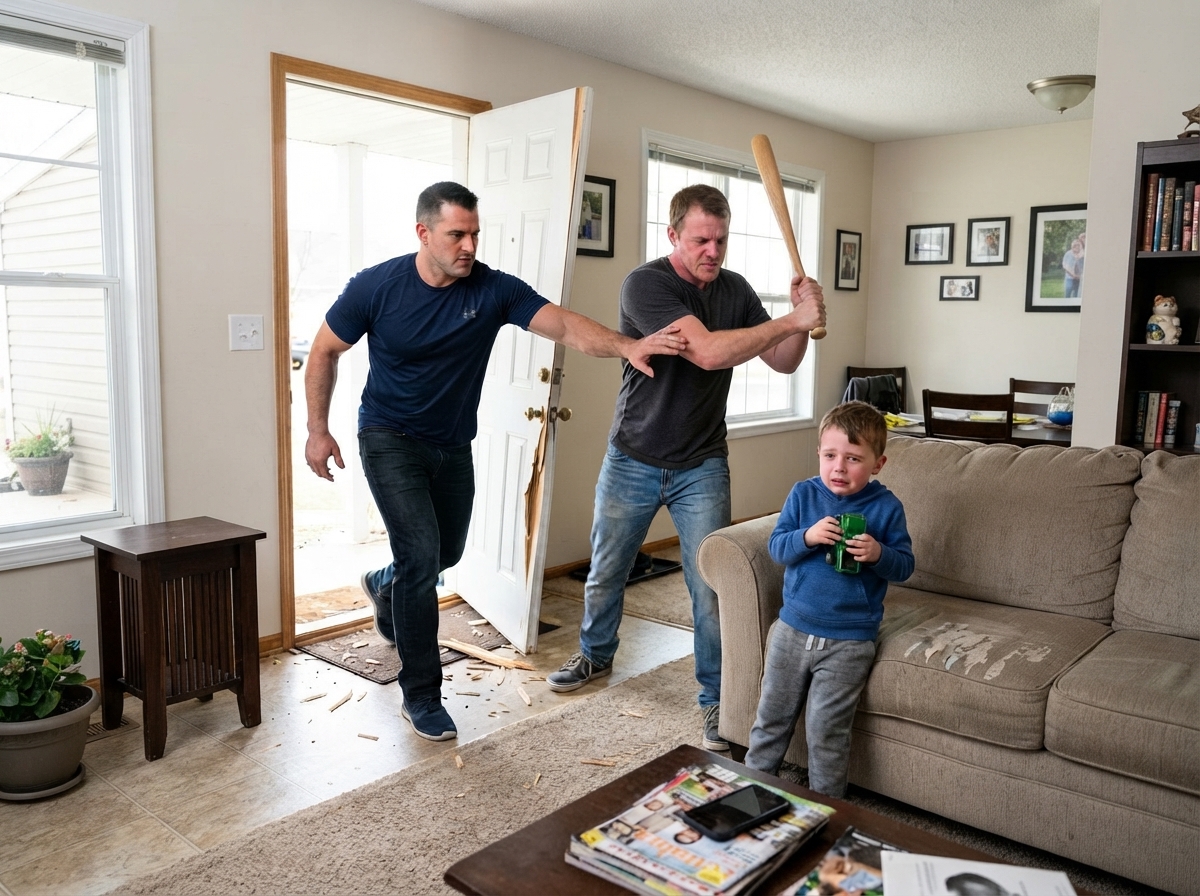
NOTE: This part focuses on the immediate aftermath of the investigation, the emotional damage caused by years of secrecy, and the discovery that solving the old case did not instantly repair everything it had broken.
For several weeks after Evan's arrest, our house was unusually quiet.
No police cars waited outside.
No unfamiliar messages appeared on my phone.
No one called asking whether we had found the missing file.
The front door had been replaced, the damaged frame repaired, and the splintered pieces of wood were gone. If someone had visited our house without knowing what happened, they would have seen nothing unusual.
But I saw everything.
I still remembered the sound of the door breaking.
I still remembered Noah crying.
I still remembered Marcus standing in the doorway with the bat.
And I still remembered the way Daniel had looked when I realized he had known Marcus before that morning.
The danger had passed, but the questions inside our marriage had not.
One evening, after Noah went to bed, Daniel and I sat at the kitchen table.
He had barely touched his coffee.
"I know you're angry," he said.
"I am."
"I should have told you about the file."
"Yes."
"I should have told you about my brother."
"Yes."
He nodded.
"I don't know how to make that right."
I looked at him.
"You can't make it right by explaining it."
"What can I do?"
"Tell me everything."
He looked frightened.
Not because he had another terrible secret.
Because he understood that this time I was asking for the truth without allowing him to decide which parts I could handle.
So he told me.
He explained how, years earlier, his brother had begged him for help.
The company investigation had been overwhelming.
Daniel had discovered that his brother was involved in concealing evidence, and he had tried to protect him.
He had convinced himself that protecting family was more important than exposing a complicated truth.
My father had warned him that secrets rarely stayed contained.
Daniel had disagreed.
He had been wrong.
When his brother disappeared, Daniel had believed the story that he was dead.
He had carried guilt for years.
"I thought if I told you, you'd see me differently," he said.
"I do see you differently."
His face tightened.
"But differently doesn't automatically mean worse."
He looked at me.
"What does it mean?"
"It means I know you're capable of making bad decisions."
He nodded slowly.
"And I know you love us."
That distinction mattered.
I did not need Daniel to be perfect.
I needed him to stop believing that love gave him permission to hide difficult truths.
We agreed that from then on, there would be no private secrets involving our safety, finances, or our son.
We would tell each other even when the truth was uncomfortable.
Especially then.
The following morning, Noah came downstairs carrying his backpack.
He looked at the repaired door.
"Is it fixed?"
"Yes."
He touched the new frame.
"Can somebody break it again?"
"No," Daniel said.
Then he corrected himself.
"Well, someone could try. But we're better prepared now."
Noah seemed satisfied.
He sat at the table.
I placed breakfast in front of him.
After a few minutes, he asked, "Is Marcus still angry?"
"No."
"Is Evan going to come back?"
"No."
"How do you know?"
I paused.
"Because the police have him."
Noah nodded.
Then he asked, "Did Daddy know him?"
Daniel looked at me.
This time, I let him answer.
"Yes," Daniel said.
Noah frowned.
"Why didn't you tell Mom?"
Daniel swallowed.
"Because I thought keeping an old problem away from you would protect you."
Noah considered that.
"Did it?"
Daniel shook his head.
"No."
That was the first time I heard my husband admit the lesson directly to our son.
Noah looked down at his cereal.
"Next time, tell Mom."
Daniel smiled sadly.
"I will."
The school also changed after the incident.
The principal apologized to us.
The teacher who had accepted the accusation against Noah admitted that the situation had been handled too quickly.
The school reviewed its procedures for outside adults speaking with students.
Noah's record was corrected.
The accusation disappeared.
But the emotional damage remained.
For several months, Noah became nervous whenever an unfamiliar adult approached him.
He asked whether they knew his father.
He asked whether they were angry.
He sometimes looked toward us before answering simple questions.
His counselor explained that he had learned to expect adults to have hidden motives.
That broke my heart.
Children should not have to think that way.
We started teaching him that he could always tell us when something frightened him.
Even if someone told him to keep it secret.
Especially then.
One afternoon, Noah came home carrying a drawing.
It showed our family standing beside the repaired front door.
The three of us were holding hands.
Above us was a bright yellow sun.
I smiled.
"Who drew this?"
"I did."
"Why?"
"Because the door is fixed."
I hugged him.
"Yes."
He looked at me.
"And because we're still together."
I couldn't answer for a moment.
Daniel came into the room.
He saw the drawing.
His eyes became wet.
He crouched beside Noah.
"That's a good drawing."
Noah smiled.
Then he added, "I made the door really strong."
Daniel laughed.
"Good."
That drawing stayed on our refrigerator for years.
Not because it was beautiful.
Because it represented what the investigation could never show in a report.
We were rebuilding.
Not returning to the family we had been before.
Building a different one.
A family where questions were allowed.
A family where children were listened to.
A family where secrets were no longer confused with protection.
But one question continued to bother me.
Why had Evan believed the old file was still in our possession?
The police had already established that he knew Daniel had copied it.
But who had told him that my father still had it?
Daniel didn't know.
Marcus didn't know.
I didn't know.
Then I remembered something.
My father had mentioned the storage unit shortly before his death.
He had told me someone had asked about it.
At the time, I thought he was talking about a storage company employee.
Now I wondered.
I called the detective.
She checked the old records.
There had been an inquiry about the unit two years earlier.
The person had used a different name.
But investigators traced the phone number.
It belonged to someone who had once worked for Evan.
The discovery did not change the main case.
But it answered another question.
Evan had been searching for the file long before he contacted Marcus.
The pressure against Noah had been part of a much longer effort.
That realization disturbed me.
It meant the danger had not appeared suddenly.
It had been approaching quietly.
We simply had not recognized it.
My husband felt responsible.
"If I'd told you about the file sooner…"
"Don't."
"But—"
"We can't change what we didn't know."
He looked at me.
"We can change what we do now."
He nodded.
That became our approach.
We stopped asking ourselves how we could have prevented the past.
We asked how we could make the future safer.
We updated our security.
We changed our routines.
We made sure Noah knew which adults were trusted.
We spoke with his teachers.
We kept copies of important documents.
None of it was dramatic.
That was the point.
Safety was usually built from ordinary habits.
Not heroic moments.
Not last-second rescues.
Ordinary preparation.
Months later, Marcus asked whether we would meet him for coffee.
I agreed.
He looked embarrassed.
"I owe you another apology."
"You already apologized."
"I know."
He stared at his hands.
"I came to your house because I believed a story without checking it."
"You were angry."
"That doesn't excuse it."
"No."
He nodded.
"I was wrong."
That mattered.
Marcus told me that his relationship with his son had changed.
He had started listening more.
His son had been frightened by what happened too.
"He asked me why adults get angry before asking questions."
I smiled sadly.
"What did you tell him?"
"I told him adults make mistakes."
"That's true."
"Then he asked whether I was going to make the same mistake again."
I looked at Marcus.
"What did you say?"
"I said I hoped not."
That was probably the best answer he could give.
Nobody could promise perfection.
We could only promise to learn.
The investigation eventually concluded.
Evan's case moved into the courts.
Daniel's brother accepted responsibility for his role in concealing evidence.
The old company dispute was finally documented properly.
Marcus's name was cleared of the accusations that had followed him.
Daniel's name was also cleared.
The file my father had preserved became part of the official record.
For the first time in decades, the story did not belong to one person.
It belonged to the evidence.
That mattered to me.
Then, just when I thought we had reached the end, another envelope arrived.
It had no return address.
Inside was a single sheet of paper.
The handwriting was unfamiliar.
There were only two sentences.
"Your father knew more than he told you.
Ask Daniel what happened the night before your father's death."
I read the note twice.
Then I looked toward my husband.
He was standing in the doorway.
One glance at my face told him something was wrong.
"What is it?"
I handed him the paper.
He read it.
The color drained from his face.
I stood.
"What happened the night before my father died?"
Daniel didn't answer.
That silence was different from all the others.
This time, it was not fear.
It was recognition.
Click Here to continue read next: PART6: The Letter About My Father Opened an Old Wound, and Daniel Finally Revealed the Conversation He Had Kept Hidden Since the Night Everything Changed
The Door Exploded Open Before Sunrise, and My Son’s Terrified Face Told Me Something Was Wrong With the Story I Had Been Given
Part 5 of 8

